
The mountain climber exercise is a fast, bodyweight movement that combines cardio and strength to help burn calories, build core stability, and improve full-body endurance. It’s popular because it requires no equipment, fits into short workouts, and can be adjusted for beginners or advanced training.
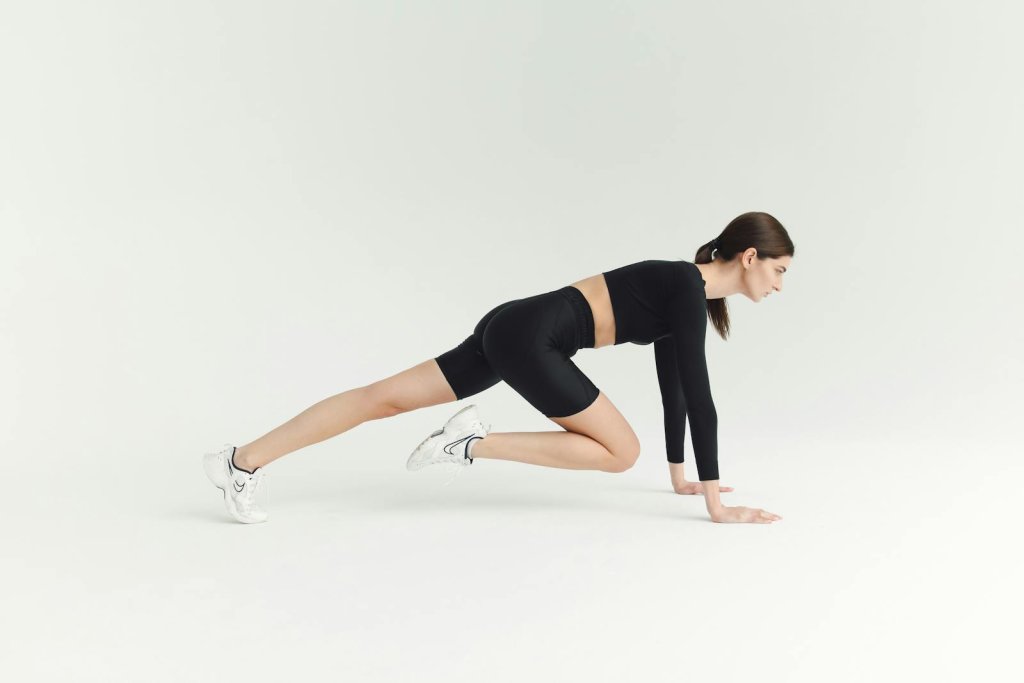
Understanding how the mountain climber exercise works—and how to do it correctly—helps you get better results while protecting your shoulders, hips, and lower back. Below, you’ll find clear guidance on benefits, muscles worked, proper form, frequency, variations, and safety, all aligned with current fitness guidelines.
What Is the Mountain Climber Exercise?
The mountain climber exercise is a dynamic, plank-based movement where you alternate driving your knees toward your chest while maintaining a strong plank position.
It combines:
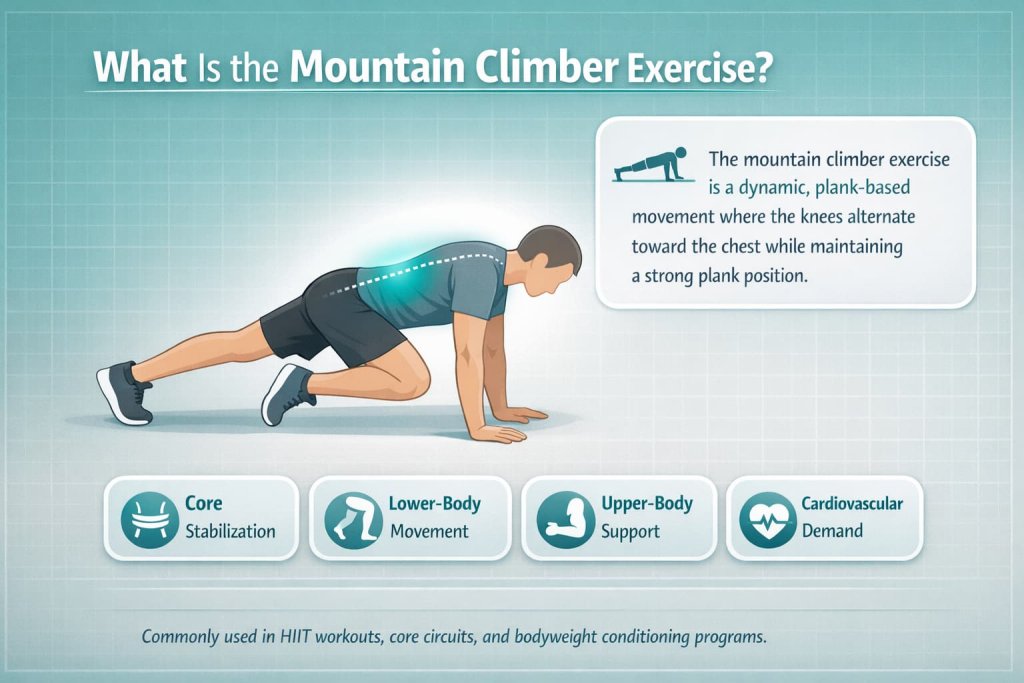
- Core stabilization
- Lower-body movement
- Upper-body support
- Cardiovascular demand
Because it uses multiple muscle groups at once, mountain climbers are commonly included in HIIT workouts, core circuits, and bodyweight conditioning programs.
How to Do the Mountain Climber Exercise Correctly
How to do it
- Start in a high plank position with hands under shoulders
- Keep your spine neutral and core braced
- Drive one knee toward your chest without lifting your hips
- Quickly switch legs, returning the first foot to the floor
- Continue alternating knees in a controlled rhythm
- Breathe steadily and keep shoulders stacked over wrists
Focus on quality first. Speed should never come at the cost of posture.
Mountain Climber Exercise Variations
Mountain climber exercise variations let you adjust intensity, joint demand, and muscular emphasis while keeping the same foundational plank pattern. Using the right variation helps you progress safely and target specific movement goals.
1. Slow Mountain Climbers (Controlled Knee Drives)
Why it works:
Slowing the movement increases time under tension, forcing the core to work harder to stabilize the spine. This variation emphasizes control over speed and is ideal for learning proper alignment.
Muscles worked:
Core stabilizers (transverse abdominis, rectus abdominis), hip flexors, shoulders, and quadriceps.
How to do it:
- Start in a high plank with shoulders stacked over wrists
- Brace your core and keep your hips level
- Slowly drive one knee toward your chest
- Pause briefly, then return the foot to the floor
- Alternate legs with smooth, controlled motion
Trainer Tip:
Move as slowly as possible without losing form. If your hips start to lift or your lower back arches, slow down further.
2. Incline Mountain Climbers (Bench or Wall)
Why it works:
Raising the hands reduces the load on the shoulders and core, making this variation more accessible for beginners or those rebuilding strength.
How to do it:
- Place your hands on a bench, box, or wall
- Step your feet back into an incline plank
- Keep your body in a straight line from head to heels
- Drive one knee in at a time toward your chest
- Maintain steady, controlled breathing
Muscles worked:
Core, shoulders, chest, hip flexors, and legs with reduced intensity compared to floor versions.
Trainer Tip:
The higher the hands, the easier the exercise. Lower the incline gradually as strength improves.
3. Cross-Body Mountain Climbers
Why it works:
Crossing the knee toward the opposite elbow increases rotational demand, challenging the obliques and improving anti-rotation control.
How to do it:
- Begin in a strong high plank position
- Drive your right knee toward your left elbow
- Return the foot to the floor with control
- Switch sides and continue alternating
- Keep hips stable and square to the floor
Muscles worked:
Obliques, deep core muscles, shoulders, hip flexors, and quads.
Trainer Tip:
Think “rotation without twisting.” The torso stays steady while the legs move.
4. Spiderman Mountain Climbers
Why it works:
This variation adds hip mobility and greater range of motion, making it more demanding for both the hips and core.
How to do it:
- Set up in a high plank
- Step one foot outside your hand, bringing the knee wide
- Pause briefly, then return to plank
- Alternate sides at a controlled pace
Muscles worked:
Core, hip flexors, glutes, inner thighs, shoulders, and upper back.
Trainer Tip:
Move deliberately rather than rushing. This variation is about control and mobility, not speed.
5. Resistance Band Mountain Climbers
Why it works:
Adding band resistance increases load on the hip flexors and core, making each knee drive more challenging.
How to do it:
- Loop a resistance band around your feet or anchor it behind you
- Get into a high plank position
- Drive one knee forward against band resistance
- Alternate legs while maintaining plank alignment
Muscles worked:
Hip flexors, core stabilizers, glutes, shoulders, and quads.
Trainer Tip:
Use a light band at first. Excessive resistance can compromise form and reduce core engagement.
6.Slider Mountain Climbers
Why it works:
Sliders increase instability and friction, requiring more core control and smooth movement throughout each repetition.
How to do it:
- Place sliders or towels under your feet
- Start in a high plank
- Slide one knee toward your chest
- Return smoothly and switch sides
- Keep movement fluid and controlled
Muscles worked:
Core, hip flexors, shoulders, glutes, and quadriceps.
Trainer Tip:
Focus on slow, continuous motion rather than speed to maximize core activation.
How Often Should You Do Mountain Climbers?
Mountain climbers can be used as cardio, conditioning, or core work.
General guidelines:
- 2–4 times per week
- 20–40 seconds per set
- 2–4 sets per workout
- Rest 20–60 seconds between sets
The Centers for Disease Control and Prevention recommends combining aerobic activity with muscle-strengthening exercises at least two days per week. Mountain climbers can contribute to both when programmed correctly.
Common Mistakes to Avoid
Even though the movement looks simple, form errors are common.
Avoid:
- Letting hips rise too high (turns it into a pike)
- Allowing the lower back to sag
- Rounding the shoulders
- Bouncing the feet without control
- Holding your breath
Correct alignment helps the mountain climber exercise target the core rather than stressing the lower back.
Muscles Worked in the Mountain Climber Exercise
The mountain climber exercise engages multiple muscle groups simultaneously.
Primary muscles:
- Rectus abdominis and transverse abdominis (core stabilization)
- Hip flexors (knee drive)
- Deltoids (shoulder support)
- Quadriceps (leg movement)
Secondary muscles:
- Glutes (pelvic control)
- Obliques (anti-rotation stability)
- Chest and triceps (plank support)
This full-body activation is why mountain climbers are often described as both a cardio and strength exercise.
Why the Mountain Climber Exercise Is So Effective
The mountain climber exercise stands out because it delivers multiple training benefits at the same time.
Regular practice may help support:
- Higher calorie expenditure compared to slower core exercises
- Improved core control during dynamic movement
- Better shoulder and hip stability
- Increased heart rate for cardiovascular conditioning
- Efficient workouts when time is limited
According to the Physical Activity Compendium, vigorous bodyweight conditioning movements such as mountain climbers can reach high MET values when performed at fast, continuous effort.
Is the Mountain Climber Exercise Safe?
For most healthy adults, mountain climbers are safe when performed with good form and gradual progression.
Safety tips:
- Warm up shoulders, hips, and core before starting
- Start slow if you’re new to plank-based exercises
- Stop if you feel sharp pain in the shoulders or lower back
- Modify the movement if wrist or shoulder discomfort occurs
If you have a history of shoulder, wrist, or spinal issues, consult a qualified professional before adding high-speed variations.
Who Should Modify or Avoid Mountain Climbers
Some people may need adjustments to stay comfortable and safe.
- Modify if you have wrist, shoulder, or lower-back discomfort
- Use incline or slow versions if plank strength is limited
- Avoid fast variations if you cannot maintain a neutral spine
Stop if pain occurs and choose a lower-impact alternative when needed.
FAQs About the Mountain Climber Exercise
Is the mountain climber exercise good for fat loss?
Mountain climbers may support fat loss by increasing calorie expenditure, especially when used in HIIT-style workouts.
How long should beginners do mountain climbers?
Beginners can start with 15–20 seconds per set at a controlled pace and build up gradually.
Do mountain climbers work abs?
Yes. The core must stay braced throughout the movement, making it an effective anti-extension core exercise.
Are mountain climbers cardio or strength?
They are both. The movement challenges cardiovascular fitness while requiring muscular endurance and stability.
Can I do mountain climbers every day?
They can be done frequently, but intensity and volume should be managed to allow recovery.
Are mountain climbers better than crunches?
They train the core differently. Mountain climbers emphasize stability and movement, while crunches focus on spinal flexion.
Conclusion
The mountain climber exercise is a time-efficient, equipment-free movement that challenges your core, legs, shoulders, and cardiovascular system at the same time. When performed with proper form and smart programming, it fits easily into fat-loss workouts, HIIT routines, or full-body conditioning plans.
If you want an exercise that delivers maximum impact in minimal time, mountain climbers are a practical and proven choice. Add them gradually, focus on alignment, and progress as your control and endurance improve.