
Yes, resistance band glute exercises can lift, shape, and strengthen your butt effectively—even without heavy equipment. Bands create constant tension, activate all three glute muscles, and train your hips through functional, joint-friendly movement patterns. If your goal is a rounder, stronger, more stable lower body, these exercises are among the simplest and most effective ways to build glute strength at home.
Understanding how to train your glutes properly is important because these muscles support your hips, spine, and knees during daily activities. This guide covers how resistance band glute exercises work, safety essentials, and the best movements for building real strength and shape.
Why Resistance Band Glute Exercises Matter
Resistance band glute exercises are important because they strengthen all three glute muscles—the gluteus maximus, gluteus medius, and gluteus minimus—using simple, accessible equipment. Bands create increasing tension as they stretch, keeping your glutes engaged through the entire movement and improving both strength and stability. This makes them especially valuable for people who want effective lower-body training at home without heavy weights.
Key reasons they matter include:
- They improve functional daily movement like climbing stairs, walking, and standing up.
- They create constant, targeted tension on the glutes for better muscle activation.
- They strengthen hip stabilizers that support proper knee and spine alignment.
- They are low-impact, joint-friendly, and suitable for all fitness levels.
- They help activate deep glute muscles that many people struggle to recruit.
- They prepare the body for heavier lifting and more advanced leg workouts.
The 12 Best Resistance Band Glute Exercises
These banded glute exercises target your glute max, glute med, and glute min through a mix of hip extension, abduction, and stability movements. Each exercise strengthens your hips, improves lower-body function, and helps shape a stronger, more lifted butt.
1. Banded Glute Bridge
Why it works: Builds foundational glute strength and improves hip extension.
Muscles worked: Gluteus maximus, hamstrings, core.
How to do it:
- Lie on your back, feet hip-width apart.
- Place a band above your knees.
- Lift hips by pressing through your heels and pushing knees outward.
- Squeeze glutes at the top, then lower slowly.
Trainer Tip: Keep ribs down to avoid over-arching your lower back.
2. Single-Leg Banded Glute Bridge
Why it works: Increases glute activation on each side individually.
Muscles worked: Glute max, glute med, hamstrings.
How to do it:
- Assume the bridge position with the band over your thighs.
- Lift one leg.
- Drive through the planted heel to lift your hips.
- Lower with control and switch sides.
Trainer Tip: If hips tilt, return to two-leg bridging until stable.
3. Banded Hip Thrust
Why it works: One of the highest glute activation exercises for shaping and strength.
Muscles worked: Glute max, hamstrings, hip stabilizers.
How to do it:
- Place upper back on a bench or couch edge.
- Band around thighs.
- Drive hips up, pushing knees out.
- Pause at the top before lowering.
Trainer Tip: Look forward to keep your neck neutral.
4. Banded Clamshell
Why it works: Strengthens glute med and combats knee valgus (knees caving in).
Muscles worked: Glute med, hip rotators.
How to do it:
- Lie on your side with knees bent.
- Band above your knees.
- Lift top knee while keeping feet together.
- Lower slowly.
Trainer Tip: Keep hips stacked to prevent rolling back.
5. Side-Lying Hip Abduction with Band
Why it works: Targets glute med for hip stability and lateral strength.
Muscles worked: Glute med, glute min.
How to do it:
- Band around ankles or lower thighs.
- Lift top leg up and slightly back.
- Lower under control.
Trainer Tip: To avoid TFL dominance, keep toes pointed slightly downward.
6. Lateral Band Walk
Why it works: Trains hip stabilizers used in walking, running, and balance.
Muscles worked: Glute med, glute max.
How to do it:
- Band around ankles or feet.
- Slight bend in knees.
- Take small steps sideways without rocking the torso.
Trainer Tip: Maintain constant band tension.
7. Monster Walk
Why it works: Strengthens glutes through diagonal patterns for functional movement.
Muscles worked: Glute med, glute max, hip stabilizers.
How to do it:
- Band around ankles or shins.
- Sit slightly into a squat.
- Step diagonally forward, then diagonally backward.
Trainer Tip: Keep chest tall and steps small.
8. Banded Squat
Why it works: Bands teach proper knee tracking and boost glute engagement at the bottom.
Muscles worked: Glutes, quads, hamstrings.
How to do it:
- Band above knees.
- Sit hips back and down.
- Press knees outward as you stand.
Trainer Tip: Use a chair behind you if your squat depth varies.
9. Banded Romanian Deadlift (Hip Hinge)
Why it works: Strengthens glutes and hamstrings through the hinge pattern.
Muscles worked: Glute max, hamstrings, core.
How to do it:
- Stand on a long band.
- Hinge hips back with soft knees.
- Return to standing by driving hips forward.
Trainer Tip: Keep back straight—movement comes from the hips.
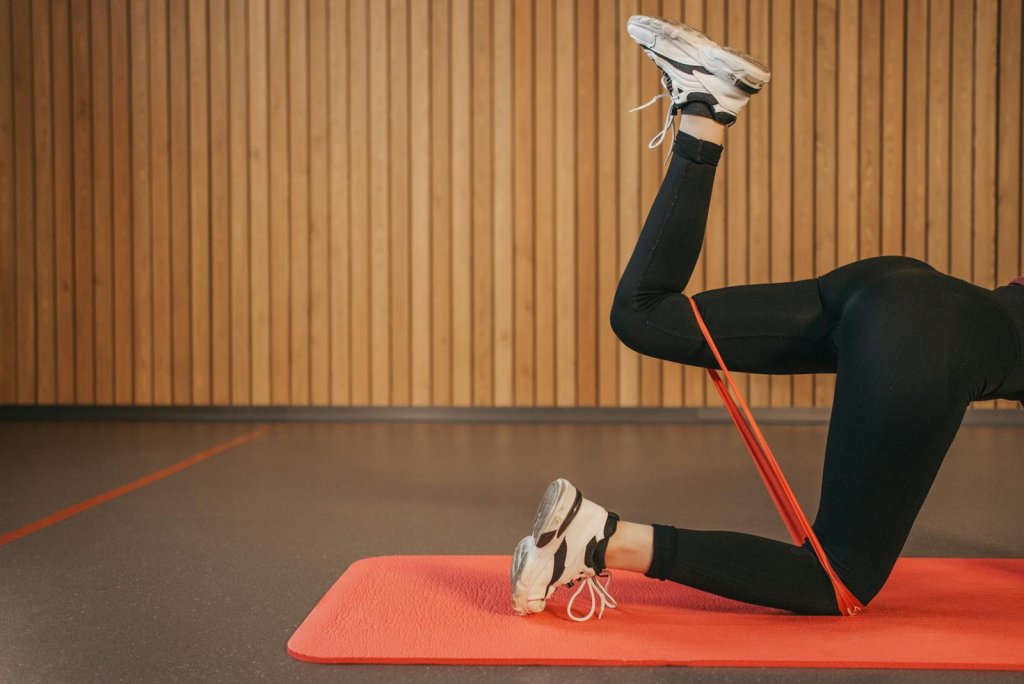
10. Quadruped Banded Kickback
Why it works: Isolates glute max without loading the spine.
Muscles worked: Glute max, core.
How to do it:
- On all fours, band around one foot.
- Kick straight back.
- Lower slowly.
Trainer Tip: Avoid arching—keep core braced.
11. Banded Fire Hydrant
Why it works: Strengthens upper glutes and improves hip stability.
Muscles worked: Glute med, glute max.
How to do it:
- On all fours, band above knees.
- Lift your knee out to the side.
- Lower with control.
Trainer Tip: Keep torso still to prevent compensating.
12. Standing Banded Hip Abduction
Why it works: Builds functional lateral strength used in daily movement.
Muscles worked: Glute med, glute min.
How to do it:
- Band around ankles.
- Hold a chair for balance.
- Move one leg out to the side.
- Switch legs.
Trainer Tip: Keep pelvis level—avoid leaning.
Sample Resistance Band Glute Workout
Beginner (2x/week):
- Glute Bridge – 2×12
- Lateral Band Walk – 2×10 each direction
- Clamshell – 2×15
- Banded Squat – 2×10
Intermediate (2–3x/week):
- Hip Thrust – 3×12
- Single-Leg Bridge – 3×8 each
- Monster Walk – 2×12 steps
- Kickback – 3×12 each
- Banded RDL – 3×10
Rest 45–75 seconds between sets.
How Often Should You Train Your Glutes?
- Minimum: 2 days per week
- Optimal: 2–3 days per week
- Advanced: 3–4 sessions when split properly
This aligns with activity guidelines from the CDC, ACSM, and WHO, which recommend full-body muscle-strengthening at least twice weekly.
Common Mistakes to Avoid
- Using bands that are too heavy
- Allowing knees to collapse inward
- Rushing reps instead of holding tension
- Over-arching the lower back during hip lifts
- Letting the band pull you out of control
- Training inconsistently
How to Do Resistance Band Glute Exercises Safely
- Check bands for cracks to avoid snapping.
- Start with light or medium resistance.
- Move slowly and control both the lifting and lowering phases.
- Keep spine neutral—avoid aggressive arching.
- Keep knees aligned with toes during squats and bridges.
- Stop if you feel sharp hip, knee, or back pain.
- Use a wall or chair for balance if needed.
Who Should Avoid or Modify These Exercises?
Modify or consult a professional if you have:
- Hip, knee, or back injuries
- Recent surgeries
- Conditions affecting balance
- Sharp or radiating pain during exercise
Safe modifications include lighter bands, reduced range of motion, or supported positions.
FAQs
1. Can resistance bands grow my glutes?
Yes. Bands can build strength and shape, especially for beginners and intermediates.
2. What band resistance should I start with?
Light or medium. Increase resistance only when you can control every rep.
3. Are bands better than weights?
Both work. Bands are excellent for activation, shaping, and stability. Weights provide higher overall loading for advanced hypertrophy.
4. How soon will I see results?
Most people notice differences in 4–8 weeks with consistent training.
5. Is band training safe for knee pain?
Often yes, but results vary. Always consult a professional if knee pain persists.
6. Can I do band glute exercises daily?
Light activation daily is fine. Full workouts: 2–4 days per week.
7. Are fabric or latex bands better?
Fabric bands are more comfortable and stable; latex bands are more affordable.
Conclusion
Resistance band glute exercises offer a simple, affordable, and highly effective way to lift, shape, and strengthen your butt at home. With consistent training, proper technique, and progressive resistance, you can build strong, functional glutes that support your hips, knees, and lower back. Start with a few exercises, master your form, and increase resistance as your strength improves.
Ready to build your strongest glutes? Start with two workouts this week and progress from there.
References
- Boren et al., 2011 – EMG of Glute Max and Glute Med
Electromyographic analysis of gluteus medius and gluteus maximus during rehabilitation exercises
https://pubmed.ncbi.nlm.nih.gov/22034614/ - Lewis et al., 2019 – Band Position in Resisted Side-Stepping
Hip-muscle activity in men and women during resisted side stepping with different band positions
https://pubmed.ncbi.nlm.nih.gov/30615490/ - Garber et al., 2011 – ACSM Exercise Quantity and Quality Position Stand
Quantity and quality of exercise for developing and maintaining fitness in apparently healthy adults
https://pubmed.ncbi.nlm.nih.gov/21694556/ - Physical Activity Guidelines for Americans, 2nd Edition
Physical Activity Guidelines for Americans, 2nd edition (U.S. Department of Health and Human Services)
https://health.gov/sites/default/files/2019-09/Physical_Activity_Guidelines_2nd_edition.pdf