
The hyperextension exercise (often called the back extension) is a hip-hinge movement that strengthens your posterior chain, especially your glutes, hamstrings, and spinal erectors—when you do it with a neutral spine and controlled range of motion. Done right, it’s a simple way to build “back-and-hips” strength you can carry over to lifting, sports, and daily life.
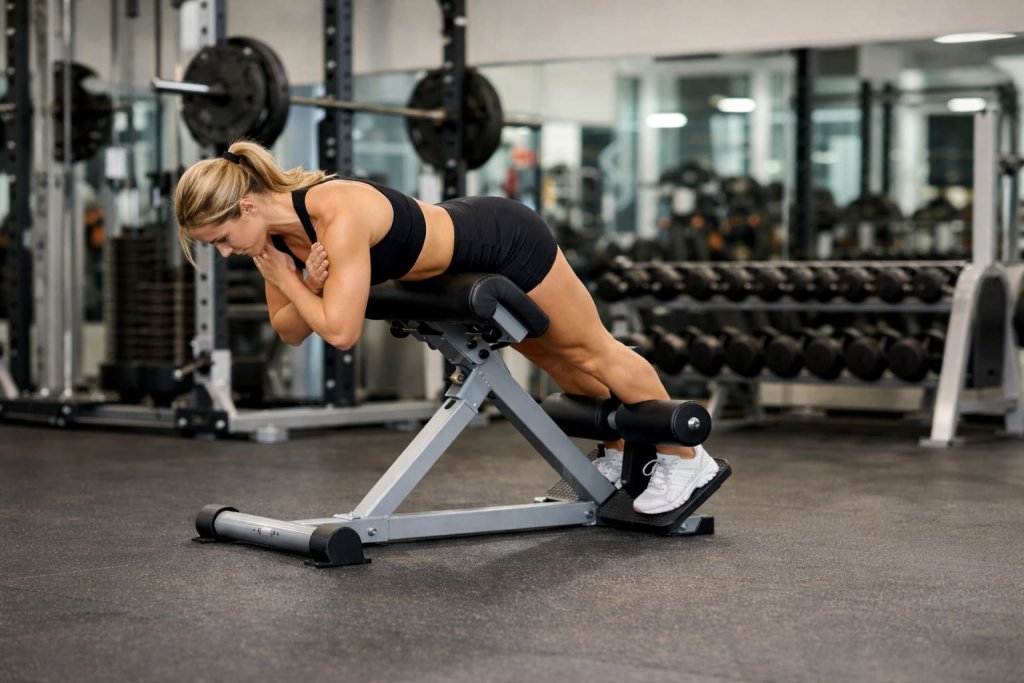
Because the name “hyperextension” can make people over-arch their lower back, understanding correct form matters for both comfort and results.
What is the hyperextension exercise
The hyperextension exercise is typically performed on a back extension bench (45-degree or 90-degree). You lock your ankles in, place the pad on your upper thighs/hips, then hinge at the hips to lower your torso and come back up under control.
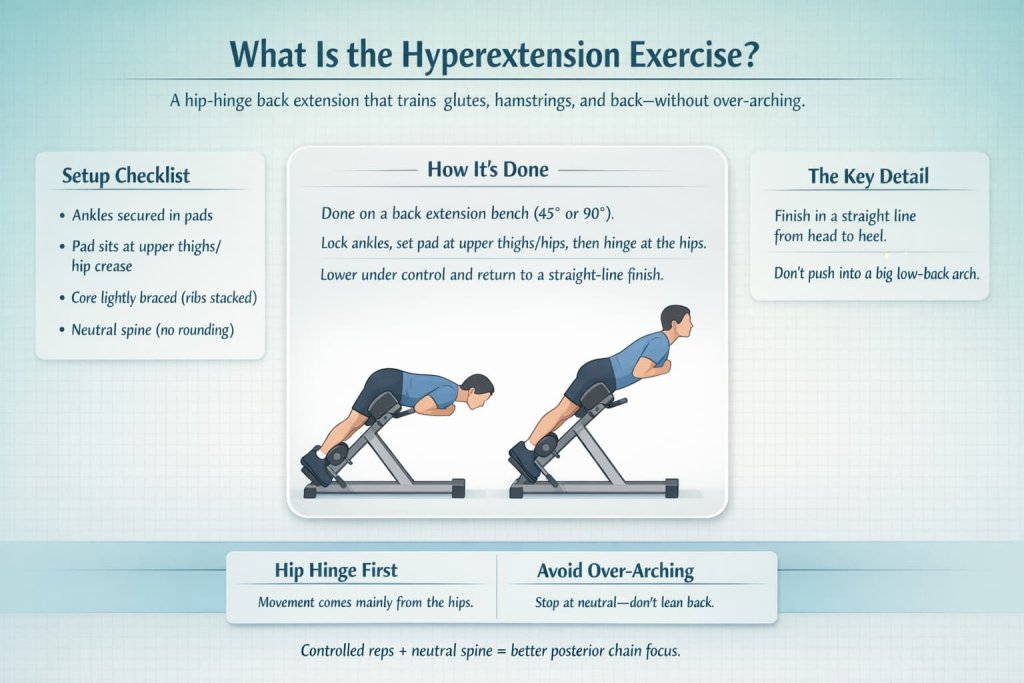
A key detail: many coaches cue you to finish in a straight-line position (head-to-heel) rather than pushing into an exaggerated low-back arch. That “hip hinge first” approach is the difference between training the posterior chain well and turning the rep into a low-back crank.
How to do the hyperextension exercise with proper form
Use this checklist to make the movement feel strong in your glutes and hamstrings—not pinchy in your lower back.
Step-by-step setup and execution
- Set the pad height: The pad should contact your upper thighs/hip crease so you can hinge freely (not jam your stomach into the pad).
- Lock in your ankles and squeeze the bench lightly with your legs for stability.
- Brace your trunk: Think “ribs down,” keep your spine neutral, and avoid flaring your ribs as you move.
- Hinge down slowly: Push your hips back and lower until you feel a stretch in your hamstrings or you reach a comfortable range.
- Come up by driving hips forward: Squeeze glutes and return to a straight line from head to heels.
- Stop at neutral: Avoid throwing your chest up and cranking into a big low-back arch.
Simple coaching cues that work
- “Hips back, then hips through.”
- “Finish tall, not arched.”
- “Move slow enough to own the bottom position.”
Variations of the Hyperextension Exercise
Variations include the 45-degree bodyweight back extension, weighted back extension (plate/dumbbell), and banded back extension for gradual progression. Advanced options like single-leg back extensions, isometric back extension holds, and reverse hypers (if available) add stability, endurance, and glute-focused overload without changing the core hip-hinge pattern.
1. 45-degree back extension (bodyweight)
Why it works: This is the most beginner-friendly option because the 45-degree angle helps you control the hinge and feel the posterior chain without needing heavy load. It’s ideal for learning the “finish in a straight line” position without over-arching your lower back.
How to do it:
- Set the pad so it sits at your upper thighs/hip crease (not your stomach).
- Lock your feet in and brace your core (ribs down).
- Hinge at the hips and lower your torso under control.
- Pause briefly at the bottom if you can stay braced.
- Squeeze glutes and return to a straight line (do not lean back past neutral).
Trainer Tip: Cross your arms over your chest first. If you feel it mostly in your low back, shorten the range and focus on pushing hips back, then squeezing glutes to come up.
2. Weighted back extension (plate/dumbbell)
Why it works: Adding load increases mechanical tension for stronger glutes, hamstrings, and spinal erectors, making it a great progression once you can do clean bodyweight reps. It also helps build strength carryover for hinging movements like deadlifts and RDLs.
How to do it:
- Start with bodyweight form first and keep the same controlled tempo.
- Hold a plate to your chest or hug a dumbbell vertically (“goblet” style).
- Hinge down slowly while keeping your spine neutral.
- Drive hips forward and squeeze glutes to return to a straight line.
- Stop at neutral—avoid “showing off” by leaning back.
Trainer Tip: Hold the weight at your chest, not overhead or behind your head, until your form is rock-solid. Keep reps slower than you think you need.
3. Banded back extension
Why it works: Bands increase resistance most at the top, where you’re strongest. This makes it easier to get more glute-focused tension without needing heavy weights and encourages a strong, controlled lockout.
How to do it:
- Loop a resistance band around the bench/anchor point behind you and around your upper back or shoulders (secure and comfortable placement).
- Set up as usual with pad at the hip crease and feet locked.
- Hinge down slowly while maintaining tension in the band.
- Drive hips forward and stand tall into the band’s resistance.
- Finish in a straight line without over-arching.
Trainer Tip: Choose a lighter band than you think. If the band pulls you into a fast rep, reduce tension and slow the lowering phase.
4. Single-leg back extension (advanced)
Why it works: This variation adds a big stability demand, exposing side-to-side weaknesses and forcing your glutes and hips to control rotation. It’s useful for athletes and for anyone working on hip control and symmetry.
How to do it:
- Set up on the bench and lock both feet in at first.
- Extend one leg slightly behind you (or keep it bent) while keeping hips square.
- Hinge down slowly without twisting or shifting your pelvis.
- Drive up by squeezing the working-side glute.
- Stop at a straight-line finish and reset your balance each rep.
Trainer Tip: Keep your pelvis level like headlights facing forward. If you rotate or crank into your low back, regress to bodyweight two-leg reps or do slower tempos first.
5. Back extension hold (isometric)
Why it works: Isometrics build endurance and positional strength—especially helpful if you lose form when you get tired. It teaches you to brace and hold neutral spine alignment without relying on momentum.
How to do it:
- Set up on the bench and hinge down slightly to your strongest braced position.
- Lift to a straight-line posture and hold (avoid leaning back).
- Keep ribs down and breathe slowly through the hold.
- Maintain even tension in glutes and hamstrings.
- Step off and rest before repeating.
Trainer Tip: The goal is steady breathing, not a max grimace. Start with 10–20 seconds and build up gradually while keeping perfect alignment.
Hyperextension exercise muscles worked
When performed as a hip-dominant hinge, the hyperextension exercise primarily trains:
- Glutes (hip extension and lockout strength)
- Hamstrings (assist hip extension and control the lowering phase)
- Spinal erectors (help maintain trunk position and resist rounding)
How you feel it depends on how you move:
- More glutes/hamstrings: you hinge from the hips, keep ribs stacked, and stop at a straight-line finish.
- More low back: you “lift with your spine,” over-arch at the top, or lose hip hinge mechanics.
Hyperextension exercise benefits
Builds posterior chain strength for everyday movement and lifting
Strong hips and back support common patterns like hinging, bracing, lifting objects, and keeping posture under fatigue. This matches the general spine-conditioning approach explained by the AAOS OrthoInfo program, which emphasizes strengthening the muscles that support and stabilize the spine.
Supports trunk strength and resilience when programmed appropriately
Trunk-focused exercise programs are commonly used in back-related exercise plans, and research summaries in peer-reviewed rehab sources like JOSPT discuss how trunk-focused exercise can improve outcomes in chronic non-specific low back pain populations (program details and individual needs still matter).
Easy to scale for beginners and progress for strength
You can start with bodyweight and a shorter range of motion, then progress to:
- Holding a plate/dumbbell
- Pauses (1–2 seconds) at the top
- Tempo reps (3 seconds down)
- Single-leg variations (advanced)
45-degree vs 90-degree hyperextension bench
Both can work well. Your best choice is the one you can control and hinge on cleanly.
| Option | Best for | What it feels like |
|---|---|---|
| 45-degree back extension | Many beginners; easier to control | Often more glute/hamstring-friendly |
| 90-degree hyperextension | More range and challenge | Can feel more demanding on trunk control |
If you’re unsure, start with the setup that keeps your spine neutral and your reps smooth.
Hyperextension exercise mistakes to avoid
Over-arching at the top
This is the classic “hyperextension” error. Instead of finishing in a straight line, people push past it into a hard lumbar arch. Use the cue: stop when your body is straight.
Turning it into a low-back lift instead of a hip hinge
If the movement comes mostly from your spine, you’ll often feel it in the low back first. Fix it by:
- softening knees slightly
- pushing hips back first
- squeezing glutes to stand tall
Bad pad position
If the pad is too high or too low, you’ll lose the hinge and compensation shows up fast. Adjust until you can hinge comfortably at the hips.
Using momentum
Fast reps can turn this into a “bounce.” Slow down, pause briefly, and keep tension through the full rep.
How to program hyperextensions for strength and muscle
Here are simple, safe starting points you can include in a full plan.
For beginners (technique + endurance)
- 2–3 sets of 8–12 reps
- bodyweight only
- 2–3 days per week (leave a day between sessions)
For strength (after you own form)
- 3–4 sets of 6–10 reps
- add load gradually (plate, dumbbell, or band)
- keep reps controlled (no swinging)
Weekly “big picture” activity target
If your goal includes general health and body composition support, match your training with widely used public health targets. For example, the adult guidelines explained by the CDC include aerobic activity plus muscle-strengthening work each week.
Safety, who should be cautious, and when to get help
If you have a history of back injury, nerve symptoms, or you’re starting exercise because of ongoing back pain, it’s smart to get professional guidance on what’s appropriate for you. The back exercise guidance from Mayo Clinic also emphasizes checking in with a healthcare professional if you’re beginning a program due to ongoing back pain or after an injury.
Seek medical care promptly if you have severe or worsening symptoms, progressive weakness, balance/walking issues, or bladder/bowel changes.
FAQ:
Is the hyperextension exercise safe for everyone?
It can be safe when done with controlled form and appropriate loading, but people with back injuries or concerning symptoms should get individualized advice first.
Should I feel hyperextensions in my lower back?
You may feel some work in the spinal erectors, but many people get better results and comfort when they feel strong engagement in the glutes and hamstrings and avoid excessive arching.
How far down should I go?
Go only as far as you can maintain control and a neutral spine. A hamstring stretch sensation is common; sharp pain is not.
What’s the difference between “back extension” and “hyperextension”?
In gyms, the terms are often used interchangeably. The key is how you perform it: hinge at the hips and finish in a straight line rather than over-arching.
Can hyperextensions help posture?
They can support the muscles that help you maintain upright posture under fatigue, especially when combined with balanced core and hip training.
How many times per week should I do hyperextensions?
Most people do well with 2–3 sessions per week, depending on intensity and the rest of their training plan.
What’s a good alternative if I don’t have the machine?
Try hip hinges like Romanian deadlifts (light), good mornings (very light), or bird dogs for trunk control—choose options you can do with perfect control.
Conclusion
The hyperextension exercise is one of the most practical posterior-chain builders you can do—if you keep it hip-driven, controlled, and neutral. Set the bench correctly, hinge at the hips, squeeze glutes to finish tall, and avoid the common “over-arch” mistake.
References
- Adult physical activity guidelines (weekly targets + strength training inclusion). CDC
- Practical guide to adding physical activity as an adult (behavioral + weekly plan support, updated guidance). CDC
- Resistance training progression models for healthy adults (sets/reps/intensity progression concepts). PubMed