
The French press exercise is a triceps isolation movement that emphasizes the long head of the triceps, helping support arm strength, size, and definition. It is commonly used in structured resistance-training programs because it allows controlled elbow extension through a large range of motion.
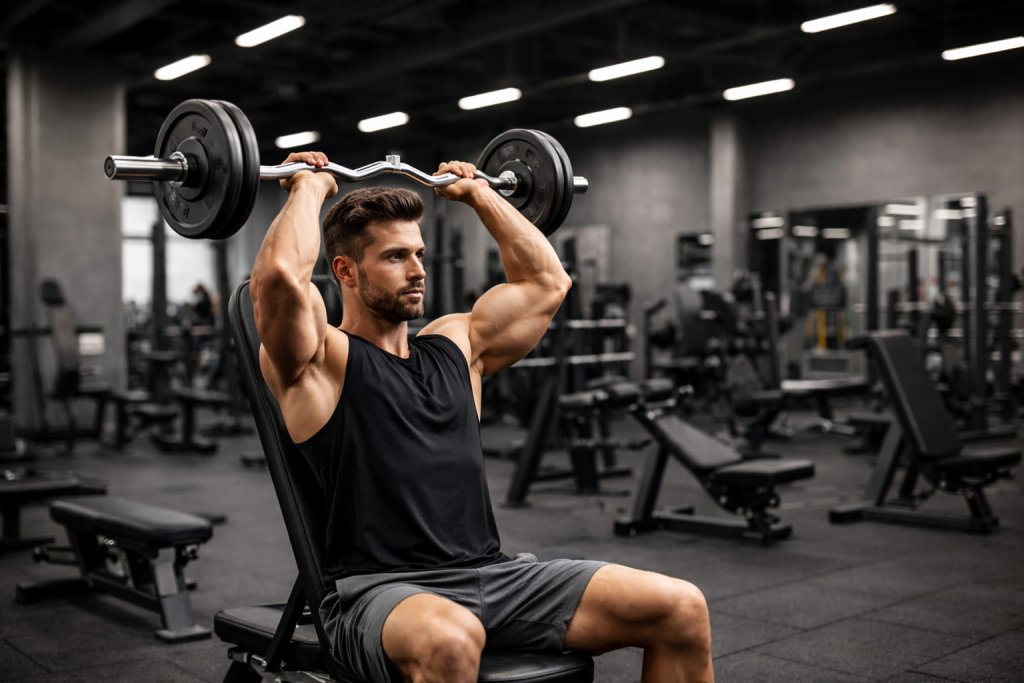
Understanding how the French press exercise works is important because many arm workouts rely heavily on pressing movements, which may not fully engage all parts of the triceps. When performed correctly, this exercise helps support balanced upper-arm development and long-term training progress.
What Is the French Press Exercise?
The French press exercise is an overhead elbow-extension movement designed to isolate the triceps brachii. The exercise involves bending and straightening the elbows while keeping the upper arms relatively fixed.
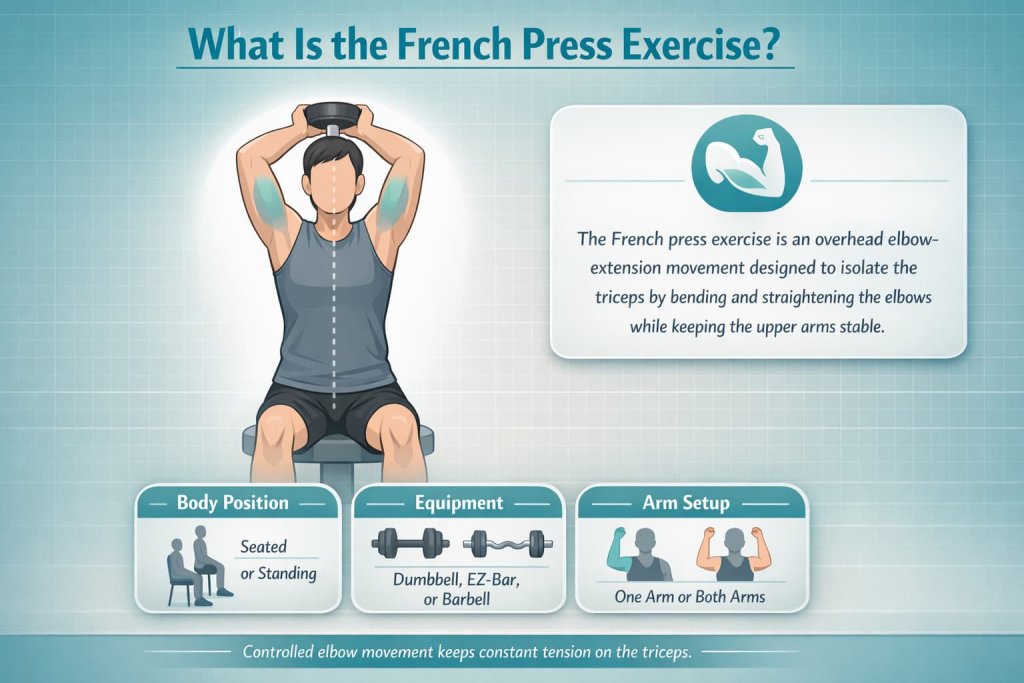
It can be performed in several ways, including:
- Seated or standing
- Using a dumbbell, EZ-bar, or barbell
- With one arm or both arms together
The core goal across all variations is controlled elbow movement with consistent tension on the triceps.
How to Do the French Press Exercise Correctly
How to do it
- Sit or stand upright holding a dumbbell or EZ-bar overhead
- Keep your upper arms close to your head and elbows facing forward
- Brace your core and maintain a neutral spine
- Slowly lower the weight by bending the elbows
- Lower only within a comfortable, pain-free range
- Extend the elbows to return to the starting position
- Avoid locking the elbows at the top
Slow, controlled movement helps keep tension on the triceps and reduces unnecessary stress on the joints.
French Press Exercise Variations
1. Single-Arm Dumbbell French Press
Why it works:
This variation trains each arm independently, which helps address left–right strength imbalances and improves neuromuscular control. Using one arm at a time often reduces overall joint stress and allows better focus on elbow positioning.
Muscles worked:
The triceps brachii is the primary muscle, with strong emphasis on the long head. The shoulder stabilizers and core assist in maintaining control and posture.
How to do it:
- Hold a single dumbbell overhead with one hand
- Keep the upper arm close to your head and elbow pointing forward
- Brace your core and maintain a neutral spine
- Lower the dumbbell slowly by bending the elbow
- Stop within a comfortable, pain-free range
- Extend the elbow to return to the start
- Complete reps, then switch arms
Trainer Tip:
Use lighter weight than two-arm versions and focus on slow tempo to improve elbow control and muscle engagement.
2. Seated French Press
Why it works:
Performing the French press seated increases upper-body stability and limits momentum from the lower body. This helps maintain consistent tension on the triceps and supports better form control.
Muscles worked:
The triceps brachii (all three heads), with the long head emphasized. The core and upper back assist in maintaining upright posture.
How to do it:
- Sit upright on a bench with feet flat on the floor
- Hold a dumbbell or EZ-bar overhead
- Keep elbows close to your head and pointing forward
- Lower the weight slowly by bending the elbows
- Pause briefly at the bottom
- Extend the elbows to return to the starting position
Trainer Tip:
Avoid leaning back as the weight gets heavy; if posture changes, reduce the load.
3. Standing French Press
Why it works:
The standing variation increases core engagement while still targeting the triceps. It challenges postural control and coordination, making it suitable for more experienced lifters.
Muscles worked:
Primary: triceps brachii
Secondary: core stabilizers, shoulders, and upper back
How to do it:
- Stand tall with feet shoulder-width apart
- Hold the weight overhead with arms extended
- Engage your core and keep your ribcage down
- Bend the elbows to lower the weight behind your head
- Keep upper arms steady
- Extend the elbows to return to the start
Trainer Tip:
If lower-back arching occurs, switch to the seated version for better stability.
4. EZ-Bar French Press
Why it works:
The angled grip of an EZ-bar places the wrists in a more neutral position, which many people find more comfortable. This variation may allow slightly heavier loading with improved joint comfort.
Muscles worked:
All three heads of the triceps, with consistent long-head involvement due to the overhead position.
How to do it:
- Hold the EZ-bar using the angled grips
- Press the bar overhead with arms fully extended
- Keep elbows pointing forward and close together
- Lower the bar slowly behind your head
- Stop within a pain-free range
- Extend the elbows to lift the bar back up
Trainer Tip:
Focus on elbow movement only—avoid letting the shoulders take over the motion.
5. Lying French Press
Why it works:
This variation reduces shoulder flexion demands while still emphasizing elbow extension. It allows good triceps loading with added bench support for stability.
Muscles worked:
Triceps brachii (long, lateral, and medial heads), with assistance from forearm and shoulder stabilizers.
How to do it:
- Lie flat on a bench holding a dumbbell or bar above your chest
- Extend your arms upward with elbows slightly bent
- Bend the elbows to lower the weight toward your forehead or behind the head
- Keep upper arms steady
- Extend the elbows to return to the starting position
Trainer Tip:
Lower the weight under control and stop before elbow discomfort—range of motion matters more than depth.
Muscles Worked by the French Press Exercise
The French press exercise primarily targets the triceps brachii, which consists of three heads:
- Long head (most emphasized due to the overhead arm position)
- Lateral head
- Medial head
Because the long head crosses the shoulder joint, overhead positioning places it under greater stretch and tension. The shoulders and core also assist as stabilizers to maintain posture and control during the movement.
Why the French Press Exercise Works
The French press exercise works because it loads the triceps while the arms are positioned overhead. This increases mechanical tension on the long head of the triceps, which may not be fully challenged during traditional pushing exercises such as bench presses or push-ups.
By limiting shoulder movement and focusing on elbow extension, the exercise allows more targeted triceps engagement.
Benefits of the French Press Exercise
Including the French press exercise in a resistance-training routine may help support:
- Increased triceps strength
- Improved arm size and muscle definition
- Better elbow-extension control
- Balanced upper-arm development
It is commonly used as an accessory movement alongside compound upper-body exercises.
Common French Press Exercise Mistakes to Avoid
To perform the exercise effectively and safely, avoid:
- Excessive elbow flaring
- Using momentum instead of muscle control
- Lowering the weight too quickly
- Using loads that cause elbow discomfort
Moderate resistance and strict form are more effective than heavier weights with poor control.
How to Program the French Press Exercise
For general strength and muscle-building goals:
- Sets: 2–4
- Repetitions: 8–12
- Rest: 60–90 seconds
The French press exercise is typically performed after compound pushing movements as part of an arm or upper-body workout.
Who Should Be Careful With the French Press Exercise?
People who experience elbow or shoulder sensitivity should:
- Start with lighter resistance
- Use a controlled range of motion
- Consider seated or single-arm variations for added stability
If discomfort continues, the exercise should be modified or avoided.
When to Modify or Stop the French Press Exercise
The French press exercise should always be performed in a controlled, pain-free range of motion. Modifying or stopping the exercise at the right time helps protect the elbows and shoulders while supporting long-term training consistency.
Modify the exercise if:
- You feel mild discomfort at the bottom of the movement but no sharp pain
- Your elbows begin to flare or drift due to fatigue
- You cannot maintain a neutral spine or upright posture
- The weight feels manageable at the start but control decreases mid-set
In these cases, reducing the load, slowing the tempo, shortening the range of motion, or switching to a seated or single-arm variation may help improve comfort and control.
Stop the exercise if:
- You experience sharp or persistent pain in the elbows or shoulders
- Pain increases with each repetition rather than improving with warm-up
- You feel joint strain instead of muscle fatigue
- Tingling, numbness, or loss of control occurs during the movement
If symptoms continue despite modification, the exercise should be removed from your routine and replaced with a more comfortable triceps option.
Prioritizing proper technique and joint comfort ensures the French press exercise supports triceps development without unnecessary stress.
Frequently Asked Questions
Is the French press exercise suitable for beginners?
Yes. With light resistance and proper technique, beginners can safely include it.
Does the French press exercise help build bigger arms?
It may help support triceps hypertrophy when combined with progressive overload and recovery.
Is the French press the same as skull crushers?
They are similar but not identical. Skull crushers are usually performed lying down, while French presses are commonly overhead.
How often should I do the French press exercise?
Most programs include triceps isolation work 1–3 times per week.
Can I do the French press exercise at home?
Yes. A single dumbbell or resistance band can be used.
Is the French press safe for elbows?
It can be safe when performed with controlled weight and a pain-free range of motion.
Conclusion
The French press exercise is a practical and effective way to target the triceps, particularly the long head. When performed with proper technique and sensible programming, it supports balanced arm development and overall upper-body strength.
References
- ACSM Position Stand: Progression Models in Resistance Training for Healthy Adults (2009)
- Schoenfeld BJ. The Mechanisms of Muscle Hypertrophy and Their Application to Resistance Training (2010)
- Schoenfeld BJ, et al. Dose-Response Relationship Between Weekly Resistance Training Volume and Increases in Muscle Mass (2017)