
Banded face pulls are a simple upper-body exercise that may help strengthen the rear shoulders, upper back, and shoulder-support muscles while reinforcing better posture mechanics. They are popular because they are joint-friendly, easy to scale, and practical for home workouts with minimal equipment. The movement also fits well into warm-ups, strength sessions, and posture-focused routines when done with good form, as broader scapular-focused exercise research discussed in PMC helps support.
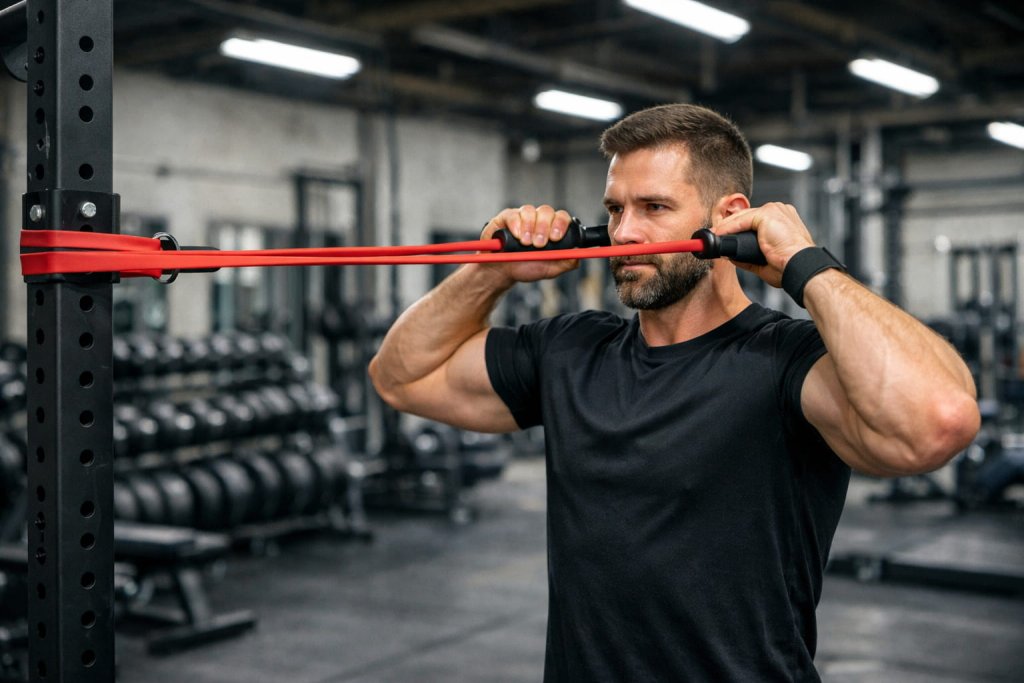
Understanding banded face pulls matters because many people spend hours sitting, typing, or training pressing movements without enough upper-back work. That imbalance can leave the shoulders feeling stiff, tired, or less stable. A properly coached banded face pull gives you a simple way to train scapular retraction and external rotation, two movement patterns often used in shoulder-strengthening and postural exercise programs described by Mayo Clinic.
What Are Banded Face Pulls?
Banded face pulls are a resistance-band version of the face pull exercise. You anchor a band around face height, hold the ends or handles, and pull toward your face while letting the elbows move out and back. At the end of the rep, the shoulder blades draw together and the shoulders rotate outward. That combination is one reason face pulls are often included in programs focused on upper-back strength and shoulder control, which aligns with exercise guidance discussed by the NSCA.
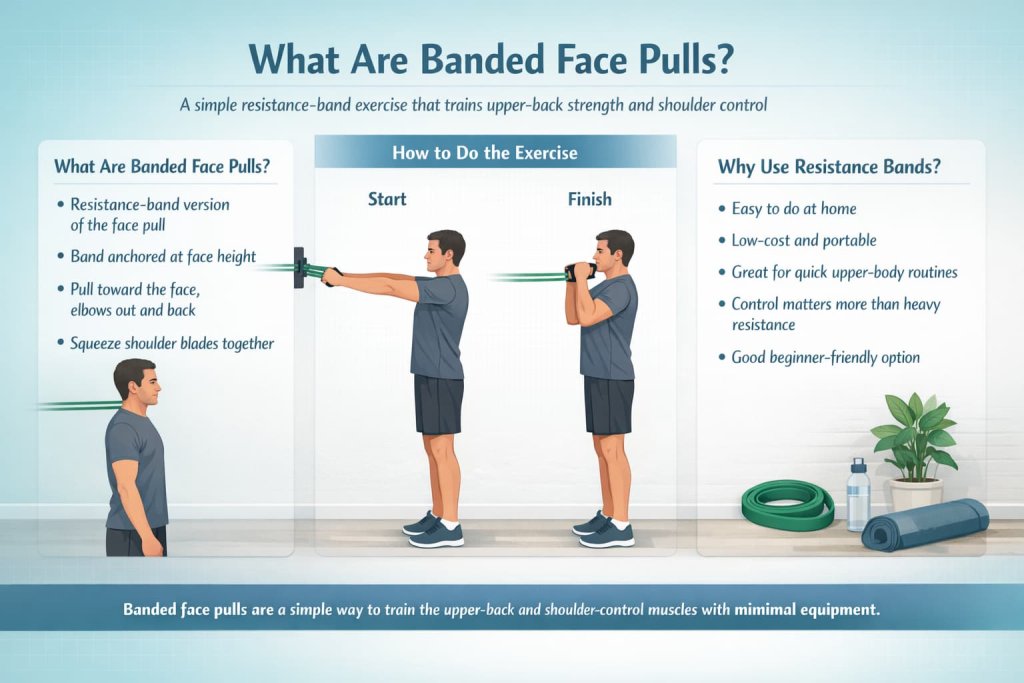
Compared with cable face pulls, the banded version is more accessible for home use and easier to add to a quick routine. The tradeoff is that resistance changes more through the range of motion, so control matters more than load. For most people, that is not a problem. In fact, the band version is often a smart place to start because it makes the exercise simple and low-cost.
How to Do Banded Face Pulls Correctly
Use a resistance band attached securely at about upper-chest to face height.
Step-by-step instructions
- Stand tall and hold the band with both hands.
- Step back until there is light tension on the band.
- Keep your ribs stacked over your hips and avoid leaning back.
- Pull the band toward your face or upper chest while letting your elbows move out to the sides.
- As you finish the rep, think about drawing your shoulder blades back and slightly down.
- Pause briefly under control.
- Return slowly to the starting position.
A useful coaching cue is to think “pull apart and back” rather than simply “pull straight in.” That often helps people avoid turning the movement into a row.
Why Banded Face Pulls Work
Banded face pulls work because they train muscles that are often underused in desk-heavy lifestyles and pressing-heavy gym routines. The exercise encourages you to pull the shoulder blades back, keep the chest open, and control the upper arm as it moves into external rotation. These qualities are relevant to both strength training and shoulder-focused exercise programs.
They are also practical because the setup is easy. You do not need a cable machine, heavy weights, or a full gym. A resistance band and a secure anchor point are enough for most people.
Muscles Worked in Banded Face Pulls
Banded face pulls mainly challenge the muscles that help stabilize and move the shoulder girdle well.
Primary muscles worked
- Rear deltoids
- Rhomboids
- Middle trapezius
- Lower trapezius
Supporting muscles
- Rotator cuff muscles, especially the external rotators
- Posterior shoulder stabilizers
- Upper back muscles that help control scapular position
This muscle emphasis is one reason banded face pulls are often paired with presses, push-ups, bench work, or long periods of sitting. The exercise helps bring more attention to the back side of the shoulders and upper torso.
Banded Face Pulls Benefits
Banded face pulls are popular for good reason. Their benefits are practical, not flashy.
May support stronger shoulder mechanics
Scapular-focused exercise programs are commonly used in shoulder rehabilitation and performance settings. Recent reviews suggest scapular stabilization work may improve pain and function in some shoulder-related populations, although that does not mean one exercise alone fixes every shoulder issue.
May help balance pressing-heavy training
Many workouts include pressing but not enough pulling. Banded face pulls can add rear-shoulder and upper-back volume without much fatigue, which makes them useful as accessory work.
Reinforces posture-friendly movement
Patient-education materials from major health systems often include shoulder-blade squeezing and scapular-setting drills to reinforce upright posture. Banded face pulls build on that same general pattern in a more strength-oriented way. Guidance from Cambridge University Hospitals NHS and James Paget University Hospitals NHS Foundation Trust supports that broader movement pattern.
Easy to use at home
A band is inexpensive, portable, and quick to set up. That makes the exercise realistic for beginners, home exercisers, and busy people who want a short upper-body routine.
Best Form Tips for Banded Face Pulls
Good banded face pulls look controlled, not rushed. Focus on quality over resistance.
Use these cues
- Keep your neck relaxed
- Do not shrug your shoulders upward
- Keep your chest tall without flaring your ribs
- Pull to face level or slightly below, depending on comfort and setup
- Finish with control, not by yanking the band
- Use a band that lets you feel the upper back working without losing form
If you cannot pause cleanly at the end of the rep, the band is probably too strong.
Common Banded Face Pull Mistakes
This exercise is simple, but a few form mistakes can reduce its value.
Pulling too low
If the band path turns into a low row, you lose some of the posture and external-rotation emphasis.
Shrugging the shoulders
This often shifts tension away from the upper-back muscles you are trying to train.
Leaning back to cheat
Using body momentum makes the movement less controlled and less useful.
Using too much resistance
Heavy bands often cause people to rush the rep, flare the ribs, or shorten the range of motion.
Letting the wrists collapse
Keep the hands and wrists organized so the finish position stays controlled.
Banded Face Pulls for Posture
Banded face pulls are often described as a posture exercise, and that is partly true. They can strengthen muscles associated with scapular control and help you practice a more open upper-body position. However, posture is not fixed by one movement alone. Daily habits, total training balance, workstation setup, mobility, and general activity levels all matter too, which is consistent with the broader posture guidance from Mayo Clinic.
A better way to frame it is this: banded face pulls may support better posture by strengthening muscles that help counter long periods of slouching or forward-shoulder positioning. That is a realistic, evidence-based claim.
Who Should Do Banded Face Pulls?
Banded face pulls can be a strong fit for:
- People who sit for long hours
- Lifters who do a lot of pressing
- Home exercisers with limited equipment
- Beginners who want a shoulder-friendly pulling exercise
- People looking for a warm-up or accessory movement for upper-body days
They are especially useful when paired with rows, pull-aparts, and general upper-back training.
Who Should Be Careful With Banded Face Pulls?
Not every shoulder likes the same angle or range of motion. You should be more cautious if you have:
- Current shoulder pain during pulling or rotation
- Recent shoulder injury or surgery
- Painful clicking, pinching, or loss of range of motion
- A medical diagnosis that requires exercise modification
The American Academy of Orthopaedic Surgeons notes that shoulder-conditioning programs should be matched to the individual and, when needed, supervised by a clinician. If banded face pulls reproduce pain rather than just normal muscle effort, stop and get qualified guidance.
Banded Face Pulls vs Cable Face Pulls
Both exercises train a similar movement pattern, but there are practical differences.
Banded face pulls
- Better for home workouts
- Cheaper and easier to set up
- Great for warm-ups and moderate-rep accessory work
- Resistance increases more as the band stretches
Cable face pulls
- More consistent resistance through the movement
- Easier to fine-tune loading
- Often better for progressive overload in a gym setting
For most general fitness users, either version can work well. The best choice is usually the one you can perform consistently with good form.
How Many Reps and Sets Should You Do?
For most people, banded face pulls work best as a moderate-rep exercise.
Good starting ranges
- 2 to 4 sets
- 10 to 20 reps
- Slow, controlled tempo
- 2 to 4 times per week depending on your program
If you are using them in a warm-up, stay lighter and keep reps crisp. If you are using them as accessory strength work, choose a band that makes the last few reps challenging without breaking form. Programming guidance from the NSCA supports using face pulls more as accessory or horizontal-pull work than as a maximal-load exercise.
Where Banded Face Pulls Fit in Your Workout
You can place banded face pulls in several useful spots:
Before training
They work well as part of an upper-body warm-up to bring attention to the rear shoulders and upper back.
During training
They fit nicely after pressing exercises or between sets of heavier lifts.
At the end of training
Many people use them as a low-joint-stress finisher for extra upper-back volume.
Do Banded Face Pulls Actually Help Shoulder Health?
They may help support shoulder function as part of a broader program, but they should not be presented as a cure. Evidence around scapular stabilization and shoulder-focused exercise is promising in some populations, especially when the full program is individualized. Still, shoulder pain has many causes, and exercise results vary depending on the person and the problem.
That is why the most accurate takeaway is simple: banded face pulls are a useful strengthening exercise that may support shoulder mechanics and upper-back function, but they are not a diagnosis, a guaranteed pain fix, or a replacement for medical evaluation when symptoms are persistent.
Frequently Asked Questions About Banded Face Pulls
Are banded face pulls good for beginners?
Yes. They are often beginner-friendly because the band version is light, portable, and easy to scale. The key is using a manageable band and focusing on slow, controlled reps.
Do banded face pulls help posture?
They may help support better posture by strengthening the upper back and shoulder-support muscles. But posture is influenced by many factors, not just one exercise.
What muscles do banded face pulls target most?
They mainly target the rear deltoids, rhomboids, middle traps, lower traps, and supporting rotator cuff muscles.
Should I do banded face pulls on push day or pull day?
Either can work. Many people place them on push day to add more upper-back balance, while others use them on pull day as accessory work.
How high should the band be for face pulls?
A face-height or upper-chest-to-face-height anchor usually works best. The ideal setup is the one that lets you pull with control and keep the shoulders from shrugging.
Are banded face pulls better than rows?
Not better, just different. Rows usually allow more total loading, while banded face pulls place more emphasis on scapular control and external rotation.
Can banded face pulls replace rehab exercises?
Not always. They may overlap with some shoulder-strengthening patterns, but rehab should be individualized. If you have pain, weakness, or a recent injury, follow guidance from a qualified professional.
Conclusion
Banded face pulls are one of the simplest ways to add useful upper-back and shoulder-support work to your routine. They are accessible, effective for light-to-moderate resistance training, and easy to use in home or gym programs. Most importantly, they help train movement patterns that are often neglected in modern routines.
If you want stronger shoulders, better upper-back balance, and a practical posture-support exercise, banded face pulls are worth adding to your weekly program. Start light, use strict form, and make them part of a balanced routine rather than relying on them as a one-exercise solution.