
Band pull-aparts can help you build stronger upper-back and shoulder-support muscles, which may improve shoulder positioning and postural control over time when they are done consistently and with good form. They are not a magic posture fix, but they are a simple, low-cost exercise that fits well into warm-ups, accessory training, and shoulder-health routines.

That matters because many people spend hours sitting, typing, and reaching forward, which can leave the upper back undertrained. Band pull-aparts give you an easy way to train the muscles that pull the shoulders back and help the shoulder blades move well. The good news is that you only need a resistance band, a few minutes, and a controlled technique to make them useful. Research published in PMC also shows that hand position and pull angle can change which muscles work the hardest, so small setup changes matter.
What Are Band Pull-Aparts?
Band pull-aparts are a resistance-band exercise where you hold the band in front of your body and pull your hands apart until the band reaches your chest or upper chest area. The movement mainly trains the rear shoulders, mid-back, and scapular stabilizers while reinforcing controlled shoulder-blade movement.
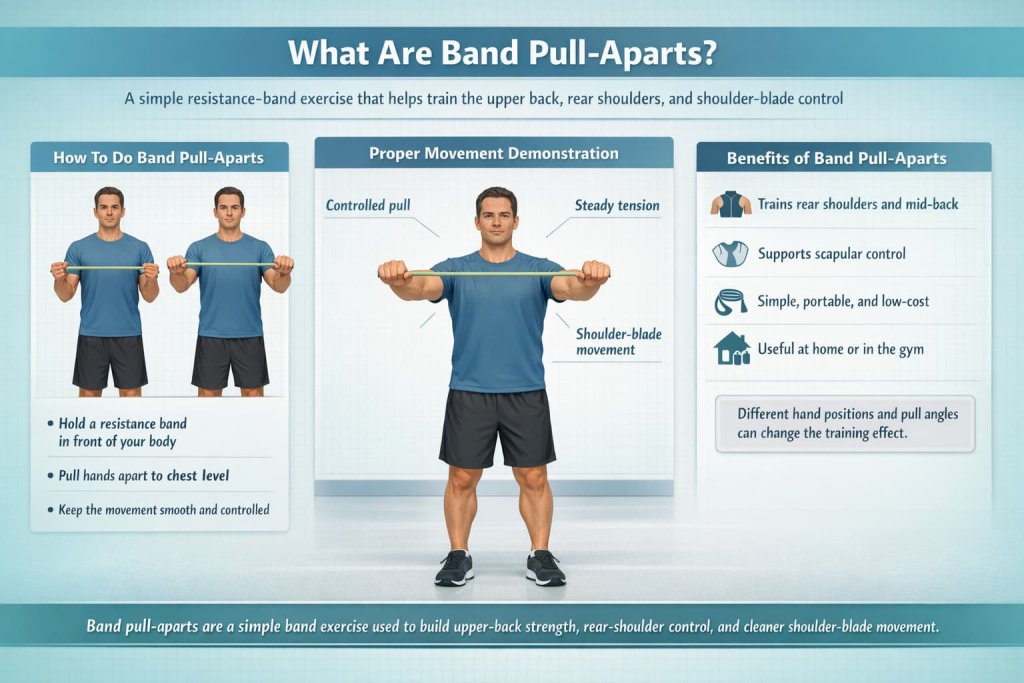
They are popular because they are simple, portable, and easy to scale. You can use them at home, in a gym, before upper-body training, or as part of a shoulder-control routine. Unlike heavier rowing exercises, band pull-aparts are usually used for clean reps, steady tension, and positional control rather than maximum load. Findings from a 2022 study published in PMC showed that movement direction and hand position can meaningfully change muscle activation during the band pull-apart.
How to Do Band Pull-Aparts With Proper Form
Good form matters more than band thickness. The goal is to move with control, not to yank the band apart.
How to do it
- Stand tall with your ribs stacked over your hips.
- Hold a light-to-moderate resistance band at about shoulder height.
- Keep your arms straight or slightly soft at the elbows.
- Start with your hands about shoulder-width apart.
- Pull the band apart by moving your arms outward.
- Let your shoulder blades move back smoothly without shrugging.
- Pause briefly when the band reaches your chest or upper chest area.
- Return slowly to the starting position.
- Repeat for controlled reps.
Form cues that usually help
- Keep your neck relaxed.
- Do not let your shoulders creep toward your ears.
- Do not arch your low back to finish the rep.
- Think “spread the band and stay tall.”
- Stop before your form breaks down.
Band Pull-Aparts Muscles Worked
Band pull-aparts mainly work the muscles on the back side of the shoulders and upper back. Depending on the variation, the exercise may emphasize some muscles more than others.
Primary muscles worked
- Rear deltoids
- Middle trapezius
- Lower trapezius
- Rhomboids
- Infraspinatus and other shoulder external rotators
Secondary muscles involved
- Posterior shoulder stabilizers
- Upper back postural muscles
- Forearm and grip muscles
- Core muscles that help you stay steady
This muscle pattern is one reason band pull-aparts are often included in programs for shoulder balance. In the 2022 band pull-apart study, diagonal-up pulling increased upper, middle, and lower trapezius activity, while a palms-up position increased infraspinatus and lower-trapezius activity and reduced upper-trapezius and posterior-deltoid dominance.
Best Band Pull-Aparts Variations
Small adjustments can change the training effect. This is one of the most useful things to understand about band pull-aparts. By changing your hand position, pull angle, body position, or rep tempo, you can shift the feel of the exercise and make it better suited to your goal. Some variations are better for beginners, some are better for shoulder-control work, and others are useful when you want more time under tension without using a heavier band.
1. Standard Pull-Apart
Why it works:
This is the basic version most people should learn first. It teaches you how to pull the band apart in a straight line while keeping the shoulders down, the ribs controlled, and the upper back active. Because the setup is simple, it is easier to focus on clean form and consistent reps. It is also one of the best options for building familiarity with the movement before trying more specialized variations.
Muscles worked:
The standard pull-apart mainly targets the rear deltoids, middle trapezius, rhomboids, and other upper-back muscles that help retract the shoulder blades. The lower traps and rotator cuff also assist, while the core helps keep the torso steady.
How to do it:
- Stand tall with your feet about hip-width apart.
- Hold a light resistance band in front of you at shoulder height.
- Keep your arms straight or slightly bent.
- Begin with your hands about shoulder-width apart.
- Pull the band apart until it reaches your chest area.
- Let your shoulder blades move back smoothly without shrugging.
- Pause briefly at the end of the rep.
- Return slowly to the start.
- Repeat for controlled reps.
Trainer Tip:
Do not rush this version just because it looks easy. The standard pull-apart is often the cleanest way to learn proper shoulder-blade control and build a strong base.
2. Palms-Up Band Pull-Apart
Why it works:
Turning the palms up changes the shoulder position and can make the movement feel smoother for some people. It may also increase the contribution of muscles such as the infraspinatus and lower trapezius, which is one reason this variation is often used when shoulder control is the priority. It can be a smart choice for lifters who do a lot of pressing and want a variation that encourages better upper-back balance.
Muscles worked:
This variation still trains the rear deltoids, rhomboids, and mid-back, but it may place more emphasis on the infraspinatus and lower trapezius compared with a standard pull-apart. The scapular stabilizers also work to keep the shoulder blades moving well.
How to do it:
- Stand tall and hold the band at about shoulder height.
- Rotate your hands so your palms face upward.
- Keep your elbows straight or softly bent.
- Pull the band apart in a controlled motion.
- Focus on keeping your shoulders relaxed and away from your ears.
- Pause when the band reaches the upper chest area.
- Return slowly without losing tension.
- Repeat for smooth, even reps.
Trainer Tip:
If this version feels awkward in your wrists, use a lighter band and reduce the range slightly until the position feels more natural.
3. Diagonal-Up Pull-Apart
Why it works:
Instead of pulling straight across, this variation adds an upward angle. That small shift can change the training effect and increase trapezius involvement. It is useful when you want a variation that feels a little different from the standard pull-apart and gives more challenge to the upper-back muscles that help control scapular upward movement and positioning.
Muscles worked:
The diagonal-up pull-apart trains the rear deltoids, middle trapezius, lower trapezius, and upper trapezius more noticeably than some other versions. The rhomboids and shoulder stabilizers also assist.
How to do it:
- Stand tall with the band held in front of you around chest or shoulder height.
- Start with your hands about shoulder-width apart.
- Pull the band apart and slightly upward on a diagonal path.
- Keep your neck relaxed and avoid shrugging excessively.
- Finish with control rather than throwing the arms upward.
- Pause briefly at the end position.
- Return slowly to the starting point.
- Repeat for controlled reps.
Trainer Tip:
Think “up and apart,” not “up and tense.” The goal is quality upper-back work, not hiking your shoulders toward your ears.
4. Seated Band Pull-Apart
Why it works:
Sitting down removes some of the balance and lower-body involvement that people sometimes use without realizing it. That can make it easier to focus on the upper-body action and keep the rib cage and torso from leaning back. This variation is helpful for beginners who compensate a lot when standing, or for anyone who wants stricter upper-body mechanics.
Muscles worked:
The seated version still trains the rear deltoids, rhomboids, trapezius, and scapular stabilizers. Because the lower body is quieter, many people feel the upper back working more clearly.
How to do it:
- Sit tall on a bench, box, or chair.
- Plant your feet flat on the floor.
- Hold the band in front of you at shoulder height.
- Keep your chest tall and your core lightly braced.
- Pull the band apart with steady control.
- Let the shoulder blades move back without leaning your torso.
- Pause briefly at the end.
- Return slowly to the start.
- Repeat for clean reps.
Trainer Tip:
Do not let sitting turn into slouching. Stay tall through the spine so the exercise still trains posture-support muscles the way you want.
5. Tempo Band Pull-Apart
Why it works:
This variation increases time under tension by slowing down part or all of the rep. That makes a light band feel more challenging without needing to jump to thicker resistance too soon. Tempo work can improve body awareness, reinforce better positions, and stop you from snapping through reps. It is especially useful when your goal is control rather than just getting more reps done.
Muscles worked:
Tempo pull-aparts work the same main muscles as the standard version, including the rear deltoids, rhomboids, middle trapezius, lower trapezius, and rotator cuff support muscles. The difference is that these muscles stay under tension for longer.
How to do it:
- Stand or sit tall with the band at shoulder height.
- Begin with your hands about shoulder-width apart.
- Pull the band apart over 2 to 3 seconds.
- Pause at the end for 1 to 2 seconds.
- Return to the starting position slowly over 2 to 4 seconds.
- Keep your shoulders down and your ribs controlled the whole time.
- Repeat for a lower number of high-quality reps.
Trainer Tip:
When you slow the reps down, you usually need fewer reps than usual. Focus on perfect control instead of chasing burn alone.
Do Band Pull-Aparts Help Posture?
They can help, but the claim needs to be realistic. Band pull-aparts do not permanently “fix” posture on their own. What they can do is strengthen muscles that support the shoulder girdle and improve your ability to control shoulder-blade position during daily life and training.
That makes them useful for people who want more upper-back work, better shoulder balance, or a simple exercise to offset lots of pressing and desk time. A broader review of upper-extremity elastic resistance training found positive effects on shoulder strength and performance, while a 2024 meta-analysis found that adding scapular-focused exercise improved shoulder function, especially when programs lasted at least 6 weeks. Those findings support band pull-aparts as a helpful tool within a bigger training plan, not as a one-exercise cure. See the research in PMC and PMC.
Common Band Pull-Aparts Mistakes
Even though the exercise looks easy, a few mistakes can make it less effective.
1. Using too much resistance
A band that is too heavy often turns the rep into a shrugging or jerking motion. That usually shifts tension away from the muscles you want to train.
2. Flaring the ribs
Many people lean back and arch their lower back to finish the rep. Keep your torso steady so the work stays in the upper back and shoulders.
3. Shrugging the shoulders
Your shoulders should not rise toward your ears during the pull. Excess shrugging can reduce the quality of the movement.
4. Snapping through reps
Band pull-aparts work best with controlled tension. Slow, clean reps usually beat fast, sloppy ones.
5. Pulling too low or too high
The exact path can vary by variation, but random rep paths usually reduce consistency. Pick one variation and perform it well.
How Many Reps and Sets Should You Do?
For most people, band pull-aparts work best as a quality-based accessory exercise rather than a max-effort strength lift.
A practical starting point is:
- 2 to 4 sets
- 10 to 20 reps
- 2 to 4 times per week
Use the lower end when learning the exercise and the higher end when using it in a warm-up or shoulder-health circuit. If the last few reps look messy, the set is probably too long or the band is too heavy.
You can also place band pull-aparts into a broader weekly routine that follows CDC physical activity guidance, which recommends that adults do muscle-strengthening activity at least 2 days per week.
Where Band Pull-Aparts Fit in Your Workout
Band pull-aparts are flexible, which is one reason they are so useful.
Before training
Use them in a warm-up before pressing, rowing, pull-ups, or shoulder sessions.
Between heavier sets
Some lifters use them between bench press or push-up sets for extra upper-back volume.
After training
They also work well as light accessory work at the end of an upper-body workout.
On recovery or mobility days
Because they are low impact and easy to recover from, they can fit well into lighter sessions focused on movement quality.
Who Should Do Band Pull-Aparts?
Band pull-aparts can be a good fit for:
- Desk workers who want more upper-back activity
- Lifters who do a lot of pressing
- People who want a simple home shoulder exercise
- Beginners who need an easy band movement
- Athletes who want more scapular-control work
They are especially useful when you want an exercise that is simple, cheap, portable, and easy to repeat consistently.
Who Should Be Careful With Band Pull-Aparts?
Band pull-aparts are not a good “push through pain” exercise. Use caution if you have:
- Current shoulder pain with pulling or reaching
- Recent shoulder surgery
- Acute neck pain that worsens with arm movement
- Significant mobility limits that change your form
If you feel sharp pain, pinching, numbness, or symptoms that keep getting worse, stop and get guidance from a qualified clinician.
Do Band Pull-Aparts Actually Work?
Yes, band pull-aparts can work well for their intended purpose. They are not meant to replace every rowing or shoulder exercise, but they can be effective for building upper-back training volume, improving shoulder-control practice, and supporting a more balanced upper-body program.
The strongest support comes from the broader evidence around elastic resistance and scapular exercise, not from posture promises alone. Research suggests elastic resistance training can improve upper-body strength and shoulder performance, and scapular-focused exercise can improve shoulder function. That makes band pull-aparts a practical option when they are programmed well and performed consistently.
Band Pull-Aparts vs Face Pulls
Band pull-aparts and face pulls are related, but they are not the same.
Band pull-aparts
- Simpler to learn
- Easy to do anywhere
- Great for light accessory work
- Usually use less setup
Face pulls
- Often allow a more obvious external-rotation finish
- Can be easier to load progressively on a cable machine
- May feel more natural for some people with shoulder-training experience
Both can be useful. If you want the easiest entry point, band pull-aparts often win. If you want a more complex pulling pattern with a cable or rope, face pulls may be a better choice.
Frequently Asked Questions
Are band pull-aparts good every day?
They can be, if the volume is modest and they do not irritate your shoulders or neck. Many people do better with 2 to 4 sessions per week rather than automatically doing them daily.
Do band pull-aparts fix rounded shoulders?
Not by themselves. They may help support better shoulder control and upper-back strength, but posture is influenced by many factors, including habits, overall training, mobility, and time spent in certain positions.
What band should I use for band pull-aparts?
Most people should start with a light band. If you have to jerk, shrug, or bend your elbows a lot to finish the rep, the band is too heavy.
Should my arms stay straight?
Your arms can stay straight or slightly bent. The key is to keep the elbow position consistent and avoid turning the rep into a row.
Are band pull-aparts better before or after a workout?
Both can work. Before a workout, they are useful for activation and movement prep. After a workout, they work well as light accessory volume.
How long does it take to notice results?
That depends on your program and consistency, but strength and control changes usually take repeated practice over several weeks, not a few days. The 2024 scapular exercise meta-analysis found better outcomes in programs lasting 6 weeks or longer.
Can beginners do band pull-aparts?
Yes. They are one of the most beginner-friendly upper-body band exercises, as long as the band is light enough and the form stays controlled.
Conclusion
Band pull-aparts are simple, effective, and easy to add to almost any routine. They may help you build stronger upper-back and shoulder-support muscles, improve movement control, and add useful pulling volume without much equipment. The key is to keep the claims realistic, use clean form, and stay consistent.
If you are building a stronger, more balanced upper body, band pull-aparts are a smart exercise to keep in your program.
References
- Schory A, et al. A Systematic Review of the Exercises That Produce Optimal Muscle Ratios of the Scapular Stabilizers in Normal Shoulders. PubMed, 2016.
- Escamilla RF, Yamashiro K, Paulos L, Andrews JR. Shoulder Muscle Activity and Function in Common Shoulder Rehabilitation Exercises. PubMed, 2009.
- Cools AM, et al. Rehabilitation of Scapular Muscle Balance: Which Exercises to Prescribe? PubMed, 2007.
- Zhong Z, et al. Effect of Scapular Stabilization Exercises on Subacromial Pain Syndrome: A Systematic Review and Meta-Analysis. PMC, 2024.
- Mullaney M, et al. Evidence Based Arm Care: The Thrower’s 10 Revisited. PMC, 2021.