
Reverse lunges with dumbbells are a simple, beginner-friendly way to build single-leg strength, improve balance, and train your glutes and quads with clean, controlled reps. They’re worth understanding because the reverse step often feels easier to control than stepping forward, which can help you stay stable while you progressively add weight.
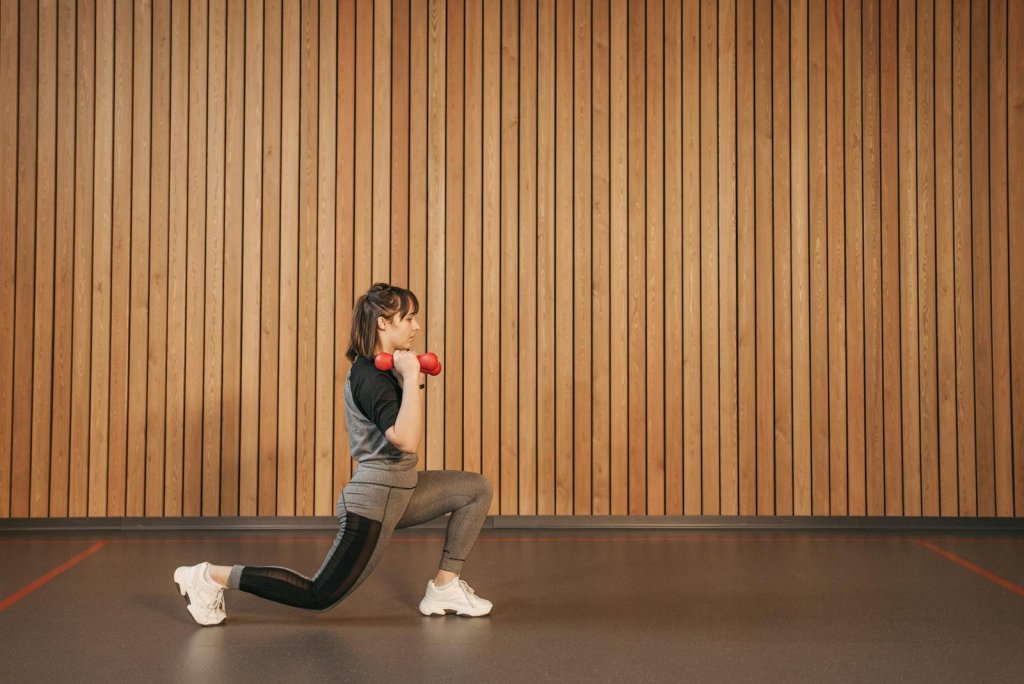
In this guide, you’ll learn proper form, muscles worked, common mistakes, smart progressions, and the best dumbbell reverse lunge variations—so you can train hard while keeping reps smooth and consistent.
What Are Reverse Lunges With Dumbbells?
A dumbbell reverse lunge is a stationary lunge where you hold dumbbells (usually at your sides), step one foot back, lower under control until both knees bend, then push through the front foot to return to standing. Unlike walking lunges, you typically return to your start position each rep.
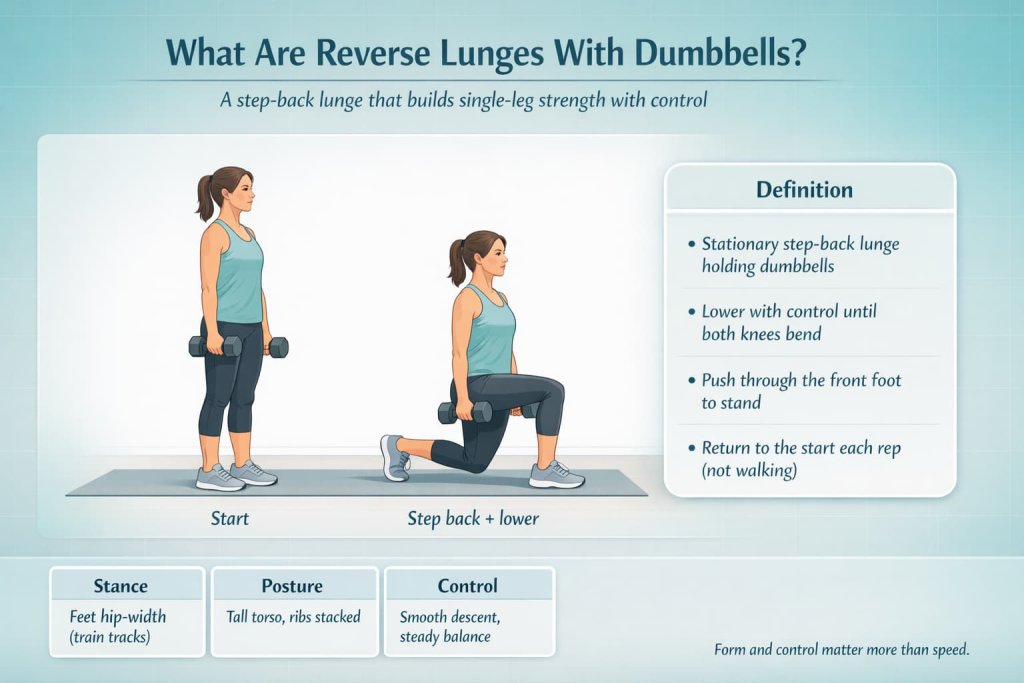
Coaching resources like the NSCA Strength & Conditioning Journal emphasize controlled technique and stable alignment for lunge patterns, while ACE’s exercise library reinforces common setup cues like hip-width stance and an upright torso.
How to Do Reverse Lunges With Dumbbells
How to do it:
- Stand tall with feet about hip-width apart, holding dumbbells at your sides (neutral grip).
- Brace your core and keep your chest up with ribs stacked over your pelvis.
- Step one leg back far enough that you can lower straight down with control (don’t step onto a “tightrope” line).
- Lower until your front thigh is close to parallel and your back knee points toward the floor (stop earlier if your form breaks).
- Keep most of your weight through the front foot, with the front knee tracking in line with your toes.
- Push the floor away with the front foot to return to standing.
- Reset your balance at the top before the next rep.
Why it works: Because you step back and lower under control, the reverse lunge encourages steady positioning and reduces the urge to “dive” forward. That control helps you load the glutes and quads while building single-leg stability.
Trainer Tip: If you feel wobbly, widen your stance slightly (think “train tracks,” not a straight line). Stability usually improves instantly when your feet aren’t too narrow.
Reverse Lunges With Dumbbells: Muscles Worked
Reverse lunges train your lower body through a split stance, so one leg does more of the work at a time.
Primary muscles: gluteus maximus, quadriceps, and hamstrings.
Key stabilizers: gluteus medius (hip stability), calves, and core muscles that help keep your torso stacked and steady.
A 2024 paper describing muscle activation during the reverse lunge reported meaningful activation in major thigh and hip muscles across phases of the movement, supporting why this pattern is commonly used in strength and rehab settings. Applied Sciences (MDPI)
Dumbbell Reverse Lunge Variations and When to Use Them
Dumbbell reverse lunge variations include bodyweight, suitcase-hold, goblet, and knee-drive options to match your skill and goal. Start with the most stable version you can control, then progress by adding load or balance demand without losing form.
1. Bodyweight Reverse Lunge
Why it works: It lets you learn balance, depth, and knee tracking without worrying about load. This is the best starting point if you’re new to lunges or returning after time off.
Muscles worked: Glutes, quads, hamstrings, calves, and core stabilizers.
How to do it:
- Start tall with feet hip-width apart and hands on hips.
- Step back into a stable stance and lower under control.
- Keep your torso upright and your front foot planted.
- Push through the front foot to stand, then reset.
Trainer Tip: Pause for one second at the bottom to prove you control the position. If you can’t pause, shorten the range slightly.
2. Dumbbell Reverse Lunge (Suitcase Hold)
Why it works: Holding dumbbells at your sides is the most straightforward way to progressively overload the pattern while keeping your torso natural and balanced.
Muscles worked: Glutes and quads lead the work; hamstrings and calves assist; core/hips stabilize.
How to do it:
- Hold dumbbells at your sides with shoulders down and back.
- Step back under control and lower smoothly.
- Keep your front knee tracking over your toes.
- Drive up through the front foot to stand tall.
Trainer Tip: If your torso leans forward, reduce the weight and focus on “zipper up” posture (tall chest, stacked ribs).
3. Goblet Dumbbell Reverse Lunge
Why it works: A goblet hold can make it easier to stay upright, which helps many people feel their quads and glutes more clearly while keeping the rep controlled.
Muscles worked: Quads and glutes with strong core bracing; hip stabilizers keep alignment.
How to do it:
- Hold one dumbbell at your chest (vertical, elbows slightly down).
- Step back and lower while keeping your torso tall.
- Keep the dumbbell close and your core braced.
- Push through the front foot to return to standing.
Trainer Tip: Think “sternum up, ribs down.” If your low back arches, exhale gently as you descend and keep the dumbbell close.
4. Reverse Lunge to Knee Drive (Light Dumbbells or Bodyweight)
Why it works: Adding a knee drive increases balance demand and can build single-leg control for athletic movement, as long as you keep it smooth and controlled.
Muscles worked: Glutes, quads, hamstrings, calves, and core stabilizers (balance and posture).
How to do it:
- Step back and perform a controlled reverse lunge.
- Stand up and drive the back knee forward to hip height.
- Pause briefly to balance, then repeat.
- Keep the movement smooth (no jerky speed).
Trainer Tip: Balance first, intensity second. If you wobble, remove the knee drive or lightly tap the toes down between reps.
Benefits of Dumbbell Reverse Lunges
Reverse lunges with dumbbells are popular because they combine strength and stability in one move.
They can help you build lower-body strength with less reliance on momentum because each rep starts from a stable stance and ends in a stable stance. They also train balance and coordination, which matter for everyday movement and many sports.
If your goal is a strong, athletic lower body without needing a barbell setup, reverse lunges are a high-return option that fits well into most training plans.
Common Mistakes (and Quick Fixes)
The reverse lunge is simple, but small errors can steal tension or irritate joints.
- Stepping too narrow: This turns the rep into a balance test instead of a strength set. Use a hip-width “train track” stance.
- Front knee collapsing inward: Lighten the load, slow the descent, and focus on keeping the knee tracking over the middle toes.
- Pushing off the back leg: The front leg should do most of the work. Use the back foot mainly as a kickstand.
- Rushing the bottom: Slow down, own the depth you can control, and stand up smoothly.
For technique-focused cues and lunge mechanics, NSCA’s coaching resources are a strong reference point. NSCA Strength & Conditioning Journal
Forward vs. Reverse Lunges (Which Should You Choose?)
If you want a lunge that often feels more controlled and easier to repeat with consistent form, the reverse lunge is usually a strong pick. Stepping backward can reduce the tendency to slam into the front leg and can feel more stable for many lifters.
Forward lunges can be excellent too, but they often demand more braking control as you step into the rep. If forward lunges bother your knees or feel unstable, reverse lunges are a smart alternative to try first.
How to Program Dumbbell Reverse Lunges for Results
Most people do best with reverse lunges as a main lower-body accessory or a primary unilateral strength move.
For general strength and muscle:
- Use 2–4 sets of 6–12 reps per side.
- Start with a load you can control with consistent depth and no wobbling.
- Progress by adding small weight increases, adding reps, or slowing the lowering phase.
For conditioning (without turning form sloppy):
- Use 2–3 sets of 10–15 reps per side at a lighter load.
- Keep rest short enough to raise effort, but long enough to maintain clean reps.
General guidelines for muscle-strengthening activity commonly recommend training major muscle groups at least two days per week, which fits well with using lunges as part of a balanced plan. CDC physical activity guidelines
Quick Safety Checklist
If you’re training for general fitness, these checks help you keep the move joint-friendly and repeatable.
Keep the range of motion you can control. If your knee, hip, or back feels sharp or “pinchy,” reduce depth and load and focus on stable alignment. Use a slower tempo if you tend to rush the bottom. If balance is the limiter, start with bodyweight and a slightly wider stance, or hold onto a stable support lightly until your control improves.
If you have a recent injury, persistent pain, or a medical condition affecting balance or joints, consider getting form guidance from a qualified professional.
Frequently Asked Questions
Are reverse lunges with dumbbells better than forward lunges?
They’re not automatically “better,” but many people find reverse lunges easier to control because the backward step can reduce the tendency to crash into the front leg. If forward lunges feel unstable, reverse lunges are often a smart first choice.
Do dumbbell reverse lunges build glutes?
Yes. Reverse lunges load the glutes strongly, especially when you use a controlled descent and drive up through the front foot without pushing off the back leg.
How heavy should my dumbbells be for reverse lunges?
Start light enough to keep balance and consistent depth for all reps. When you can hit your target reps with clean form and no wobbling, increase the load gradually.
Why do I feel reverse lunges more in my front thigh than my glutes?
That’s common, especially if your stride is short or you stay very upright. Try a slightly longer step back, keep control, and focus on pushing through the whole front foot.
Should my back knee touch the floor?
Not required. Lower to the deepest position you can control without losing posture or knee tracking. A soft hover above the floor is fine.
Can beginners do dumbbell reverse lunges?
Yes, with the right progression. Start with bodyweight, use a stable stance, and add dumbbells only after your reps look consistent.
Conclusion
Dumbbell reverse lunges are a simple, repeatable way to train legs with control while building single-leg strength, balance, and strong glutes and quads. Start with clean bodyweight reps, add dumbbells gradually, and use the variation that helps you stay stable while progressing.
References
- ACE Fitness: Reverse Lunge (Exercise Library)
- PubMed Central (PMC): EMG of Hip and Thigh Muscles During Lunge Exercises (with and without suspension strap)
- PubMed Central (PMC): Balance and Lower-Limb Muscle Activation—In-Line vs Traditional Lunge
- PubMed: Patellofemoral Joint Loading During Forward vs Backward Lunge
- ACSM: Physical Activity Guidelines (ACSM Resources)