
Six large eggs have about 420 to 468 calories, with a practical average of around 432 calories if they are plain and cooked without added fat. The exact number depends mostly on egg size and how you cook them.
That matters because 6 eggs can be a high-protein meal, but it is also a fairly large portion. If you are tracking calories, trying to manage weight, or watching cholesterol and saturated fat, it helps to know what this serving really adds up to.
How many calories are in 6 eggs?
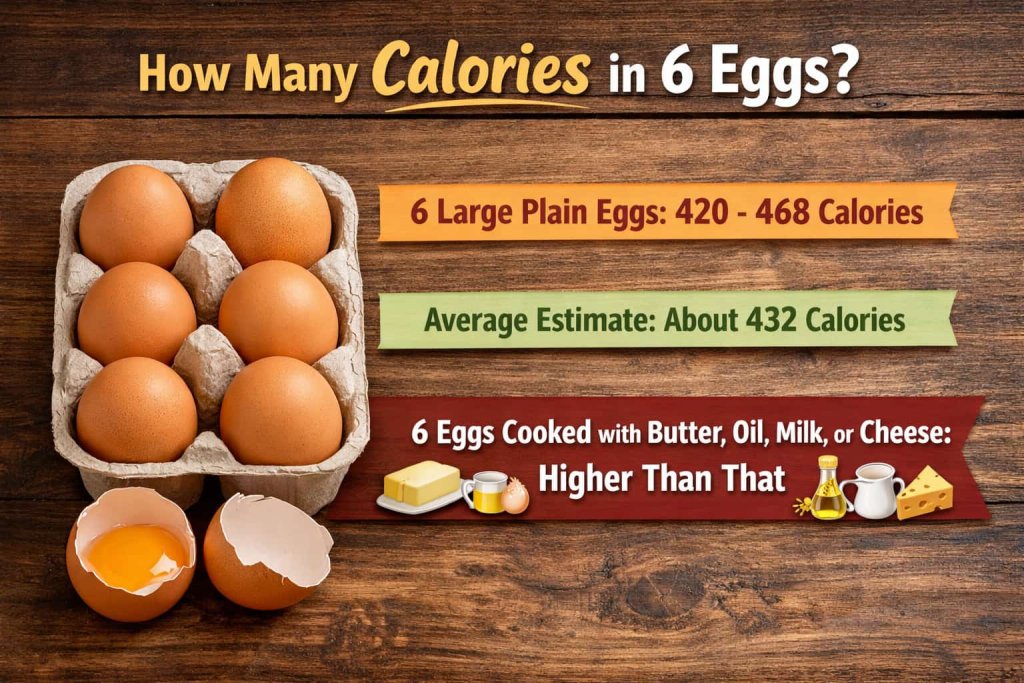
A standard large egg is commonly around 70 to 78 calories. Based on nutrition data from MedlinePlus, 1 large egg has about 70 calories, so 6 large eggs come to about 420 calories. Using another common reference point of about 77 to 78 calories per large hard-boiled egg gives a total closer to 465 to 468 calories.
For most readers, the simplest answer is:
- 6 large plain eggs: about 420 to 468 calories
- Average practical estimate: about 432 calories
- 6 eggs cooked with butter, oil, milk, or cheese: higher than that
Calories in 6 eggs by egg size
Egg size changes the total more than many readers expect. A rough practical guide looks like this:
- 6 medium eggs: about 380 to 400 calories
- 6 large eggs: about 420 to 468 calories
- 6 extra-large eggs: about 480 to 510 calories
This is why carton size matters. If you are counting calories closely, checking whether your eggs are medium, large, or extra-large gives you a more accurate total.
Calories in 6 eggs by cooking method
Cooking method changes the final number more than many people expect.
6 raw or hard-boiled eggs
If the eggs are plain, raw, poached, or hard-boiled, the calories usually stay close to the base amount:
- About 420 to 468 calories total
6 scrambled eggs
Plain scrambled eggs are usually similar to boiled eggs, but many people cook them with butter, oil, milk, or cheese. That can push the meal noticeably higher.
6 fried eggs
Fried eggs are often the highest-calorie option because the pan fat adds extra calories. The more oil or butter used, the more the total rises.
Per the current Dietary Guidelines for Americans, cooking method matters, and baked, broiled, roasted, stir-fried, or grilled methods are generally preferred over deep-fried approaches when you want to keep meals lighter.
Nutrition profile of 6 eggs
Using the 1-egg nutrition label from MedlinePlus as a practical baseline, 6 large eggs provide about:
| Nutrient | Approximate amount in 6 large eggs |
|---|---|
| Calories | 420 |
| Protein | 36 g |
| Total fat | 30 g |
| Saturated fat | 9 g |
| Cholesterol | 1,110 mg |
| Sodium | 420 mg |
| Carbohydrates | 0 g |
This is one reason eggs are popular. A 6-egg serving gives you a lot of protein with very few carbs. But it also delivers a large amount of dietary cholesterol and a meaningful amount of saturated fat, especially for one meal.
On their own, eggs are not extremely high in sodium compared with many processed breakfast foods. Sodium usually becomes a bigger issue when eggs are served with bacon, sausage, cheese, packaged seasonings, or salty bread products.
Key nutrients in 6 eggs
Eggs are more than just a calorie source. They also provide several useful nutrients.
Protein
Six eggs give you about 36 grams of protein, which is a substantial amount for one meal. Protein can help with fullness and supports muscle maintenance.
Choline
Eggs are one of the best-known food sources of choline. According to the NIH Office of Dietary Supplements, choline is an essential nutrient involved in cell structure, brain function, and many normal metabolic processes.
Vitamin D
Eggs provide some vitamin D, which supports bone health and other important body functions.
Vitamin A, iron, and potassium
Eggs also contribute smaller but useful amounts of vitamin A, iron, and potassium.
Is 6 eggs good for weight management?
It can be, but context matters.
A 6-egg meal is high in protein, and protein-rich foods often help people feel full. That may support weight management when the rest of the meal is balanced and your total daily calories stay in a reasonable range.
At the same time, 6 eggs is a large serving. If you eat them with buttered toast, cheese, sausage, bacon, or fried potatoes, the total calories can rise fast.
For weight management, 6 eggs may fit better when:
- they replace a more calorie-dense breakfast
- they are cooked with little or no added fat
- they are paired with vegetables instead of higher-calorie sides
- they fit within your total daily energy needs
In real life, many people will find that 2 to 4 eggs is a more practical portion, especially if the meal includes other protein foods or sides.
How 6 eggs fit into a day’s calories
For most people, 6 eggs is not just a snack-sized amount. At roughly 420 to 468 calories, it can take up a meaningful share of the day’s intake, especially if you add toast, cooking fat, cheese, or breakfast meats.
That does not make it a bad choice. It simply means portion size matters. For someone trying to stay in a calorie deficit, 6 eggs may work better as a full meal rather than as one part of a large breakfast. For someone with higher calorie needs, it may fit more easily.
This is why the best question is not only “How many calories are in 6 eggs?” but also “What else am I eating with them?”
Are 6 eggs too much for one meal?
For some people, yes. For others, not necessarily.
A 6-egg meal is not automatically unhealthy, but it is a larger-than-average portion. The main issue is less about eggs in isolation and more about the full eating pattern across the day and week.
The American Heart Association notes that healthy people can include eggs in a heart-healthy diet, but overall dietary pattern still matters most. If your meals already contain a lot of saturated fat, processed meat, or ultra-processed foods, adding 6 eggs regularly may not be the best fit.
Who should be a little more careful with 6 eggs?
Some people may want to be more cautious with a 6-egg serving, especially if they eat that amount often.
People with high LDL cholesterol or heart disease risk
If you have been told to follow a heart-healthy eating plan, a large egg portion may deserve more attention because 6 eggs can deliver over 1,100 mg of cholesterol and around 9 grams of saturated fat before you add any cooking fat.
People who usually eat eggs with processed meats
Pairing eggs with bacon, sausage, butter, and cheese increases saturated fat and sodium further, which may matter more than the eggs alone.
People trying to stay in a calorie deficit
Six eggs can absolutely fit into a fat-loss plan, but 420 to 468 calories is still a meaningful part of the day’s total intake.
People advised to limit certain foods by a clinician
If your doctor or dietitian has given you specific nutrition advice, that should come first.
It is also worth noting that people do not all respond to dietary cholesterol in exactly the same way. Some people see a bigger rise in blood cholesterol than others, while for many people the overall eating pattern matters more than one food alone. That is another reason to look at your full diet, health history, and lab results instead of judging eggs by themselves.
What is the healthiest way to eat 6 eggs?
If you choose to eat 6 eggs, these tips make the meal lighter and more balanced:
- boil, poach, or dry-scramble them with minimal added fat
- pair them with vegetables like spinach, tomatoes, peppers, or mushrooms
- skip or reduce processed meat sides
- keep cheese, cream, and butter moderate
- balance the rest of the day with fiber-rich foods such as beans, fruit, vegetables, and whole grains
The American Heart Association also emphasizes that your overall pattern matters more than one food by itself.
Food safety note for egg meals
Eggs need safe handling. According to the U.S. Food and Drug Administration, even clean, uncracked eggs can contain Salmonella. That means proper refrigeration, careful handling, and thorough cooking matter, especially for children, older adults, pregnant people, and anyone with a weakened immune system.
If you prefer runny eggs or recipes with lightly cooked eggs, food safety becomes even more important.
How 6 eggs compares with more common portions
For context, here is how 6 eggs compares with more typical servings:
- 2 large eggs: about 140 to 156 calories
- 3 large eggs: about 210 to 234 calories
- 4 large eggs: about 280 to 312 calories
- 6 large eggs: about 420 to 468 calories
This comparison helps show that 6 eggs is a much larger serving than the 2-egg or 3-egg portions many people eat at breakfast.
Practical bottom line
Six eggs contain about 420 to 468 calories, with around 432 calories being a useful everyday estimate for plain large eggs. They also provide about 36 grams of protein, along with choline, vitamin D, and other important nutrients.
For some people, 6 eggs can fit into a balanced diet and even support fullness. But it is still a large serving, and the health impact depends a lot on cooking method, added fats, sides, and your overall eating pattern.
If your goal is weight management or heart health, eggs can still work well. The key is to look at the whole meal, not just the eggs.
FAQs
How many calories are in 6 boiled eggs?
Usually about 420 to 468 calories, depending on the size of the eggs.
How much protein is in 6 eggs?
About 36 grams of protein using a practical large-egg estimate.
Are 6 eggs a good breakfast for weight loss?
They can be, especially because they are high in protein. But 6 eggs is a fairly large portion, so it depends on your calorie target and the rest of your meal.
Are 6 eggs too much cholesterol?
Six eggs contain a large amount of cholesterol, so this may matter more for people with high LDL cholesterol, certain heart-risk factors, or people told to follow a more specific eating plan.
Sources/References
- MedlinePlus — Perfect Hard-Cooked Eggs
- NIH Office of Dietary Supplements — Choline Fact Sheet for Health Professionals
- U.S. Food and Drug Administration — What You Need to Know About Egg Safety
- American Heart Association — Here’s the latest on dietary cholesterol and how it fits in with a healthy diet
- Dietary Guidelines for Americans — Dietary Guidelines for Americans, 2025–2030