
A pound of stored body fat is commonly estimated at about 3,500 calories, while a pound of pure fat is closer to 4,082 calories. That is the short answer most readers need, and the difference matters because people often use “fat” to mean two different things: pure dietary fat and stored body fat tissue.
According to the FDA, fat provides 9 calories per gram. Using the exact pound conversion from the National Institute of Standards and Technology, 1 pound equals 453.59237 grams, so one pound of pure fat works out to about 4,082 calories.
The quick answer to how many calories are in a pound of fat
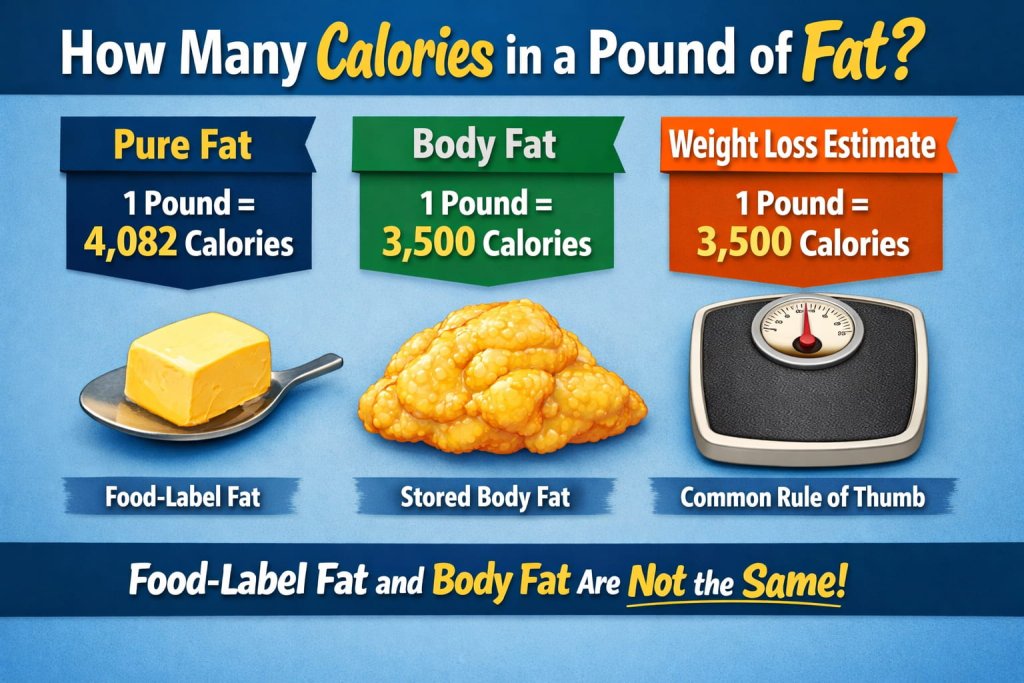
Here is the practical breakdown:
- 1 pound of pure fat: about 4,082 calories
- 1 pound of stored body fat: about 3,500 calories
- What most people mean in weight-loss conversations: the 3,500-calorie estimate for body fat tissue
A quick way to keep this straight is to remember that food-label fat and body fat are not the same measurement. For example, a food with 10 grams of fat contains about 90 calories from fat, but that does not mean eating 10 grams of fat adds 10 grams of body fat directly or instantly.
That is why the phrase “how many calories in a pound of fat” can be misleading unless you clarify what kind of fat you mean. In nutrition math, pure fat uses the 9-calories-per-gram rule. In body-weight discussions, people usually mean adipose tissue, which is not 100% pure fat.
Why a pound of body fat is not the same as a pound of pure fat
The old 3,500-calorie figure came from treating a pound of body fat tissue as if it stored roughly that much energy. Research in PubMed Central explains that the classic rule traces back to adipose tissue being about 87% fat, not 100% pure fat. That is why a pound of body fat lands near 3,500 calories instead of matching the higher pure-fat calculation.
Put simply, pure fat and body fat tissue are not interchangeable terms. Pure fat is a nutrient. Body fat tissue contains fat, but it also contains water and supporting tissue. That is the main reason the two numbers are different.
Why the 3,500-calorie rule is only a rough estimate
The 3,500-calorie rule is useful as a simple mental shortcut, but it is not a precise way to predict real-world fat loss week after week. The National Institute of Diabetes and Digestive and Kidney Diseases explains that as you eat less and lose weight, your body adapts. Energy expenditure changes over time, so weight loss usually slows down instead of continuing in a perfectly linear way.
That means cutting 500 calories a day does not guarantee you will lose exactly 1 pound of body fat every 7 days forever. It may work as a rough starting estimate, but it becomes less accurate over time because the body is dynamic, not a fixed calculator.
What this means for weight loss in real life
For most readers, the smartest way to use this number is as a general reference, not a promise. If your goal is weight loss, the 3,500-calorie figure can help you understand why a consistent calorie deficit matters. But it should not be treated like a strict law of the body.
The Centers for Disease Control and Prevention says people who lose weight at a gradual, steady pace of about 1 to 2 pounds per week are more likely to keep it off than people who lose weight faster. That advice fits well with the idea that sustainable change usually works better than chasing exact weekly math from the scale.
Just as important, weight loss is not always the same as fat loss on a one-to-one basis. In the early stages of dieting, the scale may drop partly because your body is using stored glycogen and releasing associated water. The Mayo Clinic notes that early weight changes can reflect water loss as glycogen stores are used. Over time, changes in hydration, sodium intake, exercise, and lean mass can also affect the number you see on the scale. That is why a short-term drop of a few pounds does not automatically mean you lost that exact amount of body fat.
A better way to estimate progress than using 3,500 calories alone
For adults, a better tool is the NIDDK Body Weight Planner. It creates a more personalized estimate based on your current weight, calorie intake, activity, and goal timeline. NIDDK notes that the tool is designed for adults and helps users make calorie and physical activity plans to reach and maintain a goal weight.
This is more useful than relying on the 3,500 rule alone because it accounts for the fact that calorie needs and weight-loss response change as body weight changes.
How to think about a pound of fat without getting confused
A simple way to remember it is this:
Use 4,082 calories for pure fat math
If you are talking about the nutrient fat itself, use the FDA rule of 9 calories per gram. With one pound equal to 453.59237 grams, that gives you about 4,082 calories in a pound of pure fat.
Use 3,500 calories as a rough body-fat estimate
If you are talking about stored body fat in a weight-loss context, 3,500 calories is still the familiar shorthand. It is close enough for basic education, but not accurate enough to predict exactly what the scale will do over time. As explained in another PubMed Central review, the old rule tends to overpredict long-term weight loss because the body adapts as weight changes.
Do not expect exact week-by-week results
Real weight change depends on more than calorie math alone. The body adapts during weight loss, which is why long-term progress is usually slower and less linear than the old rule suggests.
FAQ
Is there really 3,500 calories in a pound of fat?
There are about 3,500 calories in a pound of stored body fat, which is why the number became so common. But a pound of pure fat is closer to 4,082 calories, so the answer depends on what “fat” means in the question.
Why do some sources say 3,500 and others say more than 4,000?
They are talking about different things. The lower number refers to body fat tissue. The higher number comes from the calorie content of pure fat using the FDA’s 9-calories-per-gram rule.
Can I use the 3,500-calorie rule to plan weight loss?
You can use it as a rough guide, but not as an exact prediction. NIDDK explains that the body adapts to calorie changes, so actual weight loss usually slows over time.
What is the most accurate way to estimate fat loss?
For adults, the NIDDK Body Weight Planner is a better option than simple 3,500-calorie math because it gives a more personalized estimate based on your own numbers.
Bottom line
How many calories in a pound of fat? In everyday weight-loss talk, the answer is usually about 3,500 calories for a pound of body fat. But if you mean pure fat, the more precise number is about 4,082 calories per pound.
Use 3,500 as a simple rule of thumb, not a guarantee. For a more realistic target, focus on steady habits, watch your longer-term trend, and use a personalized tool like the NIDDK Body Weight Planner instead of relying on one fixed formula.
Sources and References
- FDA — Interactive Nutrition Facts Label: Total Fat
- National Institute of Standards and Technology — Units of Mass Conversion Tables
- National Institute of Diabetes and Digestive and Kidney Diseases — NIH Body Weight Planner
- National Institute of Diabetes and Digestive and Kidney Diseases — About the Body Weight Planner
- Centers for Disease Control and Prevention — Steps for Losing Weight
- Mayo Clinic — Weight-loss plateau: Why weight loss slows down
- PubMed Central — What is the Required Energy Deficit per unit Weight Loss?
- PubMed Central — Why is the 3500 kcal per pound weight loss rule wrong?