
For most healthy people, a normal blood oxygen level on a pulse oximeter is 95% to 100%, and that usual range is largely the same for older children, adults, and seniors. That means a simple “blood oxygen level chart by age” can be misleading. In practice, the most important factors are symptoms, altitude, chronic lung or heart conditions, and whether you are talking about a newborn rather than an older child or adult. According to MedlinePlus and Cleveland Clinic, healthy readings are generally interpreted in the same normal range after the newborn period.
Blood Oxygen Level Chart by Age
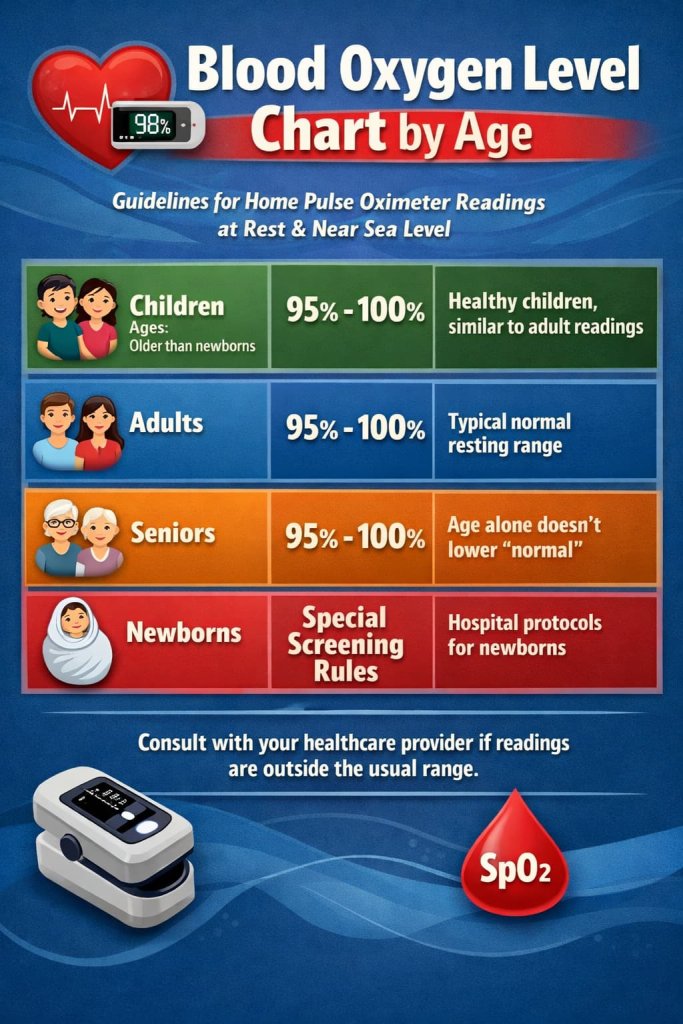
Here is the most practical chart for home pulse-ox readings taken at rest and near sea level.
| Age group | Usual resting SpO2 range | What it means |
|---|---|---|
| Children, older than newborns | 95% to 100% | Usually interpreted much like adult readings in healthy children |
| Adults | 95% to 100% | Typical normal resting range |
| Seniors | 95% to 100% | Age alone does not usually create a separate lower “normal” range |
| Newborns | Separate screening rules | Newborn oxygen screening follows a hospital protocol, not a simple home chart |
The key takeaway is simple: after the newborn period, “normal” oxygen saturation is usually not divided into separate healthy ranges for children, adults, and seniors. Newborns are the major exception because they are screened with a specific hospital algorithm after birth.
Does Normal Blood Oxygen Level Change With Age?
Not much for healthy people. A common myth is that seniors normally run much lower oxygen levels just because they are older. The better evidence-based message is that healthy older children, adults, and seniors usually share the same normal resting pulse-ox range of 95% to 100%. Cleveland Clinic states that 95% to 100% is normal for all ages.
What does change with age is the chance of having health conditions that affect oxygen levels or how they should be interpreted. Older adults are more likely to have COPD, pneumonia, heart disease, sleep-related breathing disorders, or reduced mobility. Those issues often matter more than age itself. MedlinePlus and the FDA also note that readings may run lower in people with lung disease or at higher altitude.
What Is Normal for Adults, Seniors, and Children?
For most healthy adults, a resting SpO2 of 95% to 100% is the usual normal range. For most healthy seniors, the same range still applies unless a clinician has given a different personal target because of a diagnosed condition. For older children, home readings are generally interpreted much like adult readings, with the same caution that symptoms always matter.
For children, symptoms can matter even more than a single number. The American Academy of Pediatrics notes warning signs such as fast breathing, nostril flaring, grunting, head bobbing, chest or rib retractions, and poor feeding. In infants, persistent blue or gray skin color is also a red flag.
When a Pulse Oximeter Reading May Be Concerning
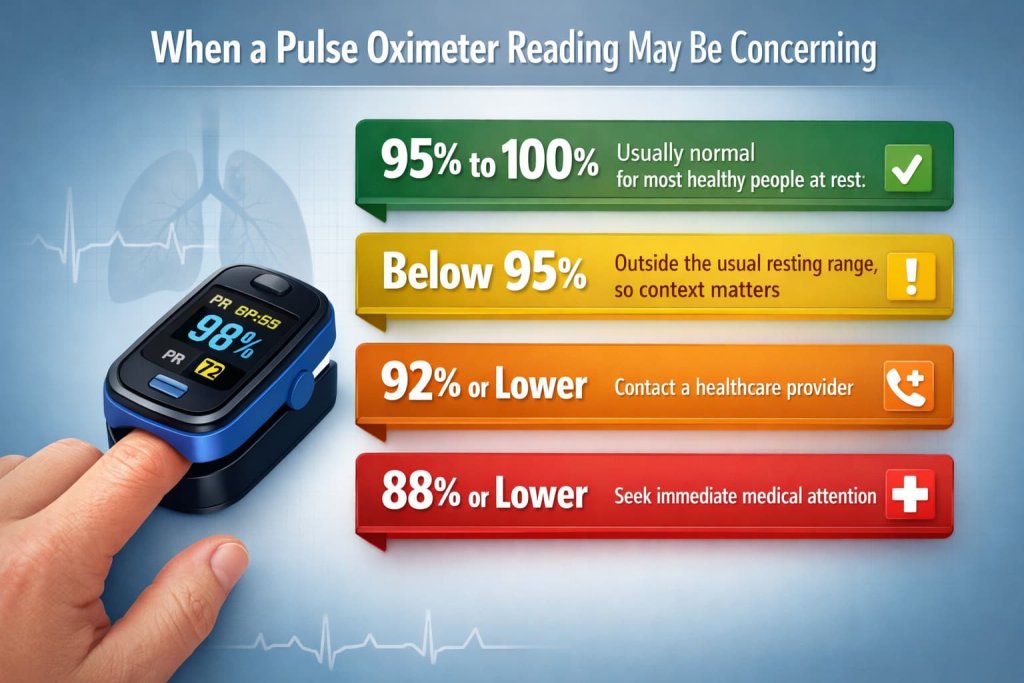
A practical way to interpret a home reading looks like this:
- 95% to 100%: Usually normal for most healthy people at rest
- Below 95%: Outside the usual resting range, so context matters
- 92% or lower: Contact a healthcare provider
- 88% or lower: Seek immediate medical attention
Those numbers should be interpreted together with symptoms. The FDA says pulse-ox numbers should be considered alongside how you feel, not in isolation. Shortness of breath, bluish lips or face, chest pain, confusion, or rapidly worsening symptoms need urgent attention even if the number does not look dramatic.
A pulse oximeter can help estimate oxygen saturation, but it does not diagnose the cause of a low reading. Get urgent help right away for severe breathing trouble, blue lips or face, chest pain, confusion, or rapidly worsening symptoms.
Why Newborns Are Different
Newborns should not be placed into the same simple “blood oxygen level chart by age” used for adults and older children. The Centers for Disease Control and Prevention recommends pulse-ox screening for critical congenital heart defects when a baby is at least 24 hours old, or as late as possible before discharge if earlier discharge is necessary.
Under the CDC screening algorithm, a newborn usually passes when oxygen saturation is 95% or higher in both the right hand and foot and the hand-foot difference is 3% or less. A screen is considered failed if any reading is below 90%, if saturation remains below 95% on repeat measures, or if the right hand and foot differ by more than 3% on repeat measures. The CDC also reports that mandated newborn pulse-ox screening has reduced early infant deaths from critical congenital heart defects by 33%, which it estimates as about 120 early infant deaths prevented per year.
What Can Make a Pulse Oximeter Inaccurate?
A pulse oximeter is helpful, but it is still an estimate. According to the FDA, several things can affect accuracy, including poor circulation, skin pigmentation, skin thickness, skin temperature, current tobacco use, fingernail polish, and artificial nails. In January 2025, the FDA also published updated draft recommendations aimed at improving the performance of medical-purpose pulse oximeters across skin tones.
Accuracy also drops as oxygen gets lower. NIH MedlinePlus Magazine explains that pulse oximeters are most accurate when oxygen saturation is between 90% and 100%, become less accurate between 80% and 90%, and are least accurate below 80%. The same source notes that readings can be off by a few percentage points.
Another important limitation is carbon monoxide exposure. Standard pulse oximeters should not be used to screen, diagnose, or make treatment decisions for suspected carbon monoxide poisoning, and FDA-cleared device labeling reflects that limitation. If carbon monoxide poisoning is suspected, a normal-looking SpO2 reading does not safely rule it out.
How to Get a Better Pulse-Ox Reading at Home
The FDA’s home-use advice is simple and practical:
- Warm and relax your hand
- Hold your hand below heart level
- Remove nail polish from the finger being tested
- Sit still while the device reads
- Wait until the number stops changing
- Write down the reading, date, and time if you are tracking changes
These small steps can make home readings more reliable and easier to compare over time.
What to Do If You Get One Unexpectedly Low Reading
One low reading does not always mean your oxygen level is truly low. If the number seems off, sit quietly for a few minutes, warm your hand, remove nail polish if needed, and repeat the test on a different finger. Make sure your hand is still and the reading has stopped changing before you trust the number.
A practical approach is:
- Recheck after resting quietly for about 5 minutes
- Try a different finger if the first reading looks unusual
- Pay attention to symptoms, not just the number
- Follow the more urgent thresholds if the reading stays low
If the number remains 92% or lower, contact a healthcare provider. If it is 88% or lower, or you have severe shortness of breath, chest pain, blue lips, confusion, or worsening symptoms, seek immediate medical care.
Who Should Be More Careful When Interpreting a Reading?
People With COPD or Other Lung Disease
MedlinePlus says oxygen saturation may run lower and still be acceptable in people with conditions such as COPD or pneumonia. In that situation, your personal target should come from your own clinician, not a generic chart.
People Living at High Altitude
The FDA and MedlinePlus both note that oxygen saturation can be lower at higher elevations because there is less oxygen in the air. That means a reading that looks low by sea-level standards may need different interpretation depending on where you live.
People Using Over-the-Counter Wellness Devices
The FDA says many over-the-counter pulse oximeters sold for general wellness or sports use are not reviewed by the agency for clinical decision-making. Its 2025 guidance update also notes that many consumer devices sold directly to the public fall into that general-wellness category rather than FDA-reviewed medical-purpose devices.
Is 92% Normal for a Senior?
Usually, no. A reading of 92% is not generally considered normal just because someone is older. Cleveland Clinic says the normal range is 95% to 100% for all ages, and MedlinePlus advises contacting a healthcare provider at 92% or lower. A senior with chronic lung disease may have a clinician-approved target that is different, but that is based on the medical condition, not age alone.
Is 94% Oxygen Level Okay?
It depends on the person and the situation. For a healthy person at rest, 94% is below the usual normal range of 95% to 100%. That does not automatically mean an emergency, but it does mean the reading deserves context. Rechecking the number carefully, watching symptoms, and following medical advice is more useful than relying on one isolated measurement.
Read also: Why Does My Blood Oxygen Drop When I Walk?
FAQ
What is a normal blood oxygen level by age?
For most healthy older children, adults, and seniors, the normal resting range is 95% to 100%. Newborns are different because they follow a separate screening protocol after birth.
Do seniors normally have lower oxygen levels?
Not just because of age. The usual normal range still applies to seniors, but chronic illness, altitude, and device limitations can change how a reading should be interpreted.
What oxygen level is too low?
MedlinePlus advises contacting a healthcare provider at 92% or lower and seeking immediate medical attention at 88% or lower. Symptoms can make a reading more urgent.
Can nail polish affect pulse-ox readings?
Yes. The FDA says fingernail polish can affect accuracy, which is why it recommends removing polish from the finger you are testing.
The Bottom Line
A trustworthy blood oxygen level chart by age is simpler than many people expect. For most healthy people after the newborn period, normal resting oxygen saturation is about 95% to 100%, whether you are a child, an adult, or a senior. What really changes interpretation is not age alone, but symptoms, health conditions, altitude, and device accuracy. If you or your child have symptoms of low oxygen, or a reading that stays low, use the number as a prompt to seek proper medical advice rather than as a diagnosis by itself.
Sources and References
- MedlinePlus — Pulse Oximetry
- Cleveland Clinic — Pulse Oximetry: Function, Method & Readings
- Centers for Disease Control and Prevention — Clinical Screening and Diagnosis for Critical Congenital Heart Defects
- FDA — Pulse Oximeter Basics
- FDA — FDA Proposes Updated Recommendations to Help Improve Performance of Pulse Oximeters Across Skin Tones
- FDA — Pulse Oximeters for Medical Purposes: Non-Clinical and Clinical Performance Testing, Labeling, and Premarket Submission Recommendations
- NIH MedlinePlus Magazine — Getting an Accurate Read on Pulse Oximeters
- American Academy of Pediatrics — RSV: When It’s More Than Just a Cold
- American Academy of Pediatrics — 11 Common Conditions in Newborns
This content is for informational purposes only and not medical advice.