
For adult men, a healthy BMI is 18.5 to 24.9, overweight is 25.0 to 29.9, and obesity starts at 30.0. According to the Centers for Disease Control and Prevention, these are the standard BMI categories for adults age 20 and older, and they are not different for men versus women. BMI is a useful screening tool, but it works best when you also consider waist size, muscle mass, fitness, and overall health.
If you are trying to understand whether your weight falls into a healthy range, this guide explains the official BMI chart for men, what the numbers mean, where BMI can be misleading, and how to use waist size to get a more accurate picture.
BMI Chart for Men
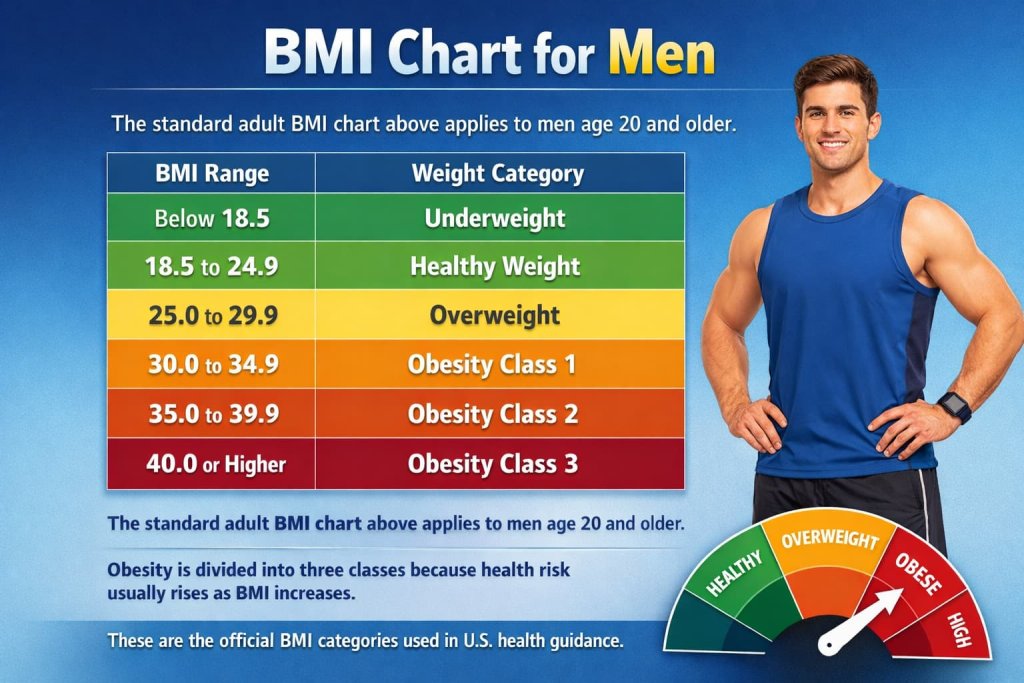
The standard adult BMI chart below applies to men age 20 and older.
| BMI range | Weight category |
|---|---|
| Below 18.5 | Underweight |
| 18.5 to 24.9 | Healthy weight |
| 25.0 to 29.9 | Overweight |
| 30.0 to 34.9 | Obesity Class 1 |
| 35.0 to 39.9 | Obesity Class 2 |
| 40.0 or higher | Obesity Class 3 |
These are the official adult BMI categories used in U.S. health guidance. Obesity is further divided into three classes because health risk usually rises as BMI increases.
BMI Chart for Men by Height and Weight
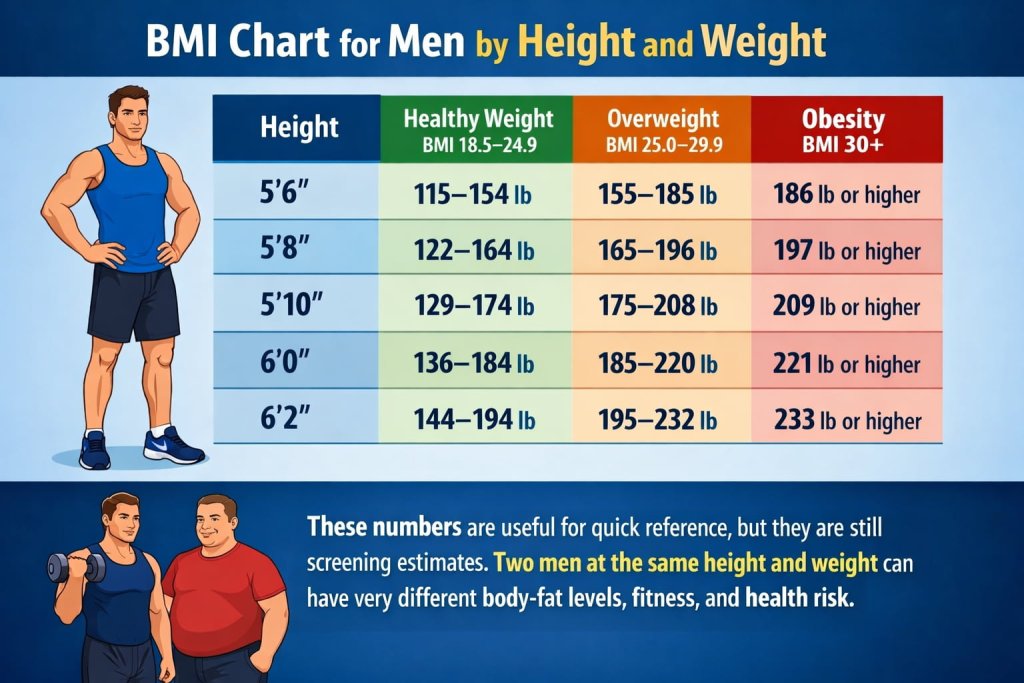
Many people searching for a BMI chart for men want to see what the categories look like in real body weights. The chart below gives approximate weight ranges for common heights using the standard BMI formula. For a full height-and-weight reference table, the National Heart, Lung, and Blood Institute provides official guidance on healthy weight and waist measurement.
| Height | Healthy weight BMI 18.5–24.9 | Overweight BMI 25.0–29.9 | Obesity BMI 30+ |
|---|---|---|---|
| 5’6″ | about 115 to 154 lb | about 155 to 185 lb | 186 lb or higher |
| 5’8″ | about 122 to 164 lb | about 165 to 196 lb | 197 lb or higher |
| 5’10” | about 129 to 174 lb | about 175 to 208 lb | 209 lb or higher |
| 6’0″ | about 136 to 184 lb | about 185 to 220 lb | 221 lb or higher |
| 6’2″ | about 144 to 194 lb | about 195 to 232 lb | 233 lb or higher |
These numbers are useful for quick reference, but they are still screening estimates. Two men at the same height and weight can have very different body-fat levels, fitness, and health risk.
What Is a Healthy BMI for a Man?
A healthy BMI for a man is 18.5 to 24.9. BMI below 18.5 is considered underweight, while BMI of 25 or higher falls into the overweight or obesity range.
That said, a healthy BMI on paper does not automatically mean everything else is healthy. Blood pressure, blood sugar, cholesterol, sleep, physical activity, and waist size still matter.
Is BMI Different for Men?
No. The standard adult BMI categories are the same for men and women.
What can differ is body-fat distribution. Men are more likely to carry extra fat around the abdomen, and that pattern can raise health risk even when BMI does not seem extremely high.
How to Calculate BMI for Men
BMI is calculated with this formula:
BMI = weight in kilograms ÷ height in meters²
In U.S. units, the shortcut formula is:
BMI = weight in pounds ÷ height in inches² × 703
Here is a quick example:
A man who weighs 190 pounds and is 5’10” has a BMI of about 27.3, which falls in the overweight range. That does not diagnose disease by itself, but it does mean it is worth checking other risk markers too.
Why BMI Can Be Misleading in Men
BMI is useful, but it is not a body-fat test. It does not directly measure body fat, cannot separate fat from muscle, and does not show where fat is stored.
Muscular men may look overweight by BMI
A man who lifts weights regularly or carries a lot of muscle may have a BMI above 25 without having excess body fat. BMI can place him in the overweight category even though his actual health risk may be lower than the number suggests.
BMI can also miss risk in men with lower muscle mass
BMI does not only overestimate risk in muscular men. It can also underestimate body-fat-related risk in men who have lost muscle mass over time, especially older men. A man may fall in the normal BMI range while still carrying more body fat than the number suggests.
Men with more belly fat may have higher risk than BMI alone suggests
BMI does not show whether fat is stored around the abdomen. That matters because abdominal fat is more strongly linked with cardiometabolic risk than body weight alone.
Older men can have a normal BMI but still need a closer look
As men age, body composition often changes. Muscle mass may go down while body fat goes up, even if body weight stays similar. That is one reason BMI works best as a starting point rather than a full health assessment.
Waist Size Matters for Men
If you want a more useful check than BMI alone, measure your waist. The National Institute of Diabetes and Digestive and Kidney Diseases says that men with a waist size of 40 inches or more have a higher risk of obesity-related health problems. NIDDK also notes that men are more likely than women to carry extra weight around the abdomen, and extra belly fat may raise health risk even if a person is not overweight.
How to measure your waist correctly
To measure your waist correctly, stand up and place a tape measure around your middle just above your hipbones. Measure your waist right after you breathe out, and do not pull the tape too tight. A waist measurement above 40 inches in men raises health risk.
A practical takeaway is this:
- BMI gives you a general screening category.
- Waist size helps show whether abdominal fat may be adding extra risk.
- Looking at both together is more useful than relying on BMI alone.
A useful point to remember is that BMI and waist size should be read together. A man can have a BMI that looks acceptable on paper but still carry enough abdominal fat to raise his health risk.
What Health Risks Can Go Up When BMI Is High?
Having overweight or obesity does not guarantee that a man will develop health problems, but risk can go up. According to NIDDK health risks guidance, excess weight is linked with a higher chance of conditions such as type 2 diabetes, heart disease, stroke, sleep apnea, and certain cancers. In men, higher body weight is also linked with greater risk for cancers such as colon, rectal, and prostate cancer.
This is why BMI is best used as an early warning sign. If your BMI is in the overweight or obesity range, it is smart to also check blood pressure, blood sugar, cholesterol, activity level, sleep, and waist circumference.
How Common Is Obesity in Men?
For context, the CDC National Center for Health Statistics reported that during August 2021 to August 2023, 39.2% of U.S. adult men had obesity. That same report found obesity prevalence of 40.3% among U.S. adults overall.
This does not mean BMI is perfect. It does show why weight screening remains a major men’s health topic.
When to Talk to a Healthcare Professional
It is worth getting medical guidance if:
- your BMI is below 18.5 or above 30
- your waist is 40 inches or more
- your weight has changed quickly without trying
- you have high blood pressure, high blood sugar, sleep apnea symptoms, or a strong family history of cardiometabolic disease
A clinician can look beyond BMI and check whether your body composition, waist size, lab results, symptoms, and medical history tell a different story.
FAQ About BMI Chart for Men
What is the best BMI for a man?
The standard healthy BMI range for adult men is 18.5 to 24.9. There is no single perfect BMI that fits every man because muscle mass, waist size, and overall health also matter.
Is a BMI of 27 bad for a man?
A BMI of 27 falls in the overweight category. It does not diagnose illness on its own, but it is a sign to also look at waist size, blood pressure, blood sugar, cholesterol, and activity level.
Can a muscular man have a high BMI?
Yes. BMI cannot separate muscle from fat, so a muscular man may have a BMI in the overweight range even if his body-fat level is not high.
Is BMI accurate for all men?
No. BMI is useful for screening and for spotting broad patterns, but it does not directly measure body fat or fat distribution. Waist size and other health markers help make the picture more accurate.
Is BMI for boys the same as BMI for men?
No. Adult BMI categories apply to men age 20 and older. Boys and teens use BMI-for-age charts, which are interpreted differently.
The Bottom Line on a BMI Chart for Men
A BMI chart for men is a useful first step, and the key numbers are simple: 18.5 to 24.9 is healthy, 25.0 to 29.9 is overweight, and 30 or higher is obesity. But BMI is only a screening tool. For men especially, waist size, muscle mass, and belly fat can change what the number really means.
Use BMI as a starting point, not a final judgment. If your BMI or waist size is high, or if your blood pressure, blood sugar, or cholesterol are heading in the wrong direction, take that as a reason to look deeper and make a practical plan.
Sources/References
- Centers for Disease Control and Prevention — Adult BMI Categories
- National Heart, Lung, and Blood Institute — Aim for a Healthy Weight
- National Institute of Diabetes and Digestive and Kidney Diseases — Am I at a Healthy Weight?
- National Institute of Diabetes and Digestive and Kidney Diseases — Health Risks of Overweight and Obesity
- CDC National Center for Health Statistics — Obesity and Severe Obesity Prevalence in Adults: United States, August 2021–August 2023