

For most people, there is not a separate official “normal blood sugar by age” chart. The same lab cutoffs are generally used to diagnose prediabetes and diabetes in nonpregnant adults, seniors, and children, while age matters more when setting blood sugar goals after diagnosis. According to the CDC — Diabetes Basics, more than 40 million Americans have diabetes, and more than 2 in 5 adults have prediabetes. That is why it helps to know which numbers are truly normal, which suggest prediabetes, and which may point to diabetes.
This guide covers nonpregnant adults, seniors, and children. Pregnancy uses different testing methods and targets, so gestational diabetes should be evaluated separately, as explained by NIDDK — Diabetes Tests & Diagnosis.
Blood Sugar Levels Chart by Age: The Most Accurate Chart
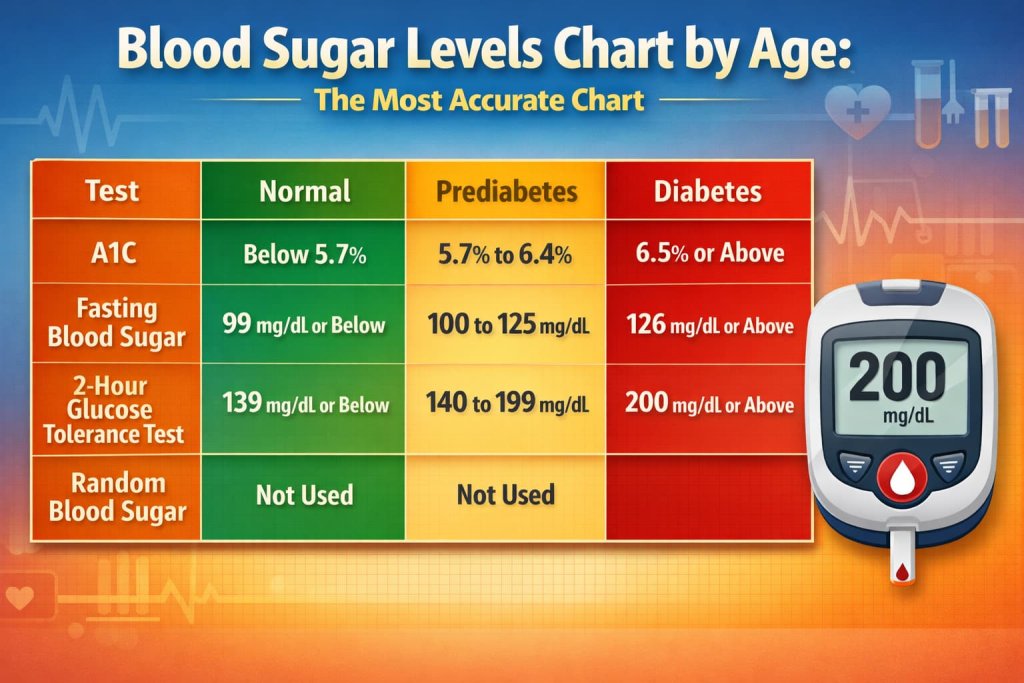
According to NIDDK, these are the standard diagnostic cutoffs used for nonpregnant people. In other words, this is the most accurate “blood sugar levels chart by age” because the diagnosis ranges themselves do not usually change just because someone is older or younger.
| Test | Normal | Prediabetes | Diabetes |
|---|---|---|---|
| A1C | Below 5.7% | 5.7% to 6.4% | 6.5% or above |
| Fasting blood sugar | 99 mg/dL or below | 100 to 125 mg/dL | 126 mg/dL or above |
| 2-hour oral glucose tolerance test | 139 mg/dL or below | 140 to 199 mg/dL | 200 mg/dL or above |
| Random blood sugar | Not used for a normal range | Not used for a prediabetes range | 200 mg/dL or above with symptoms |
If your lab report or glucose meter uses mmol/L instead of mg/dL, the same cutoffs look a little different. For fasting blood sugar, 3.9 to 5.5 mmol/L is normal, 5.6 to 6.9 mmol/L suggests prediabetes, and 7.0 mmol/L or higher suggests diabetes. For the 2-hour oral glucose tolerance test, below 7.8 mmol/L is normal, 7.8 to 11.0 mmol/L suggests prediabetes, and 11.1 mmol/L or higher suggests diabetes.
A few practical notes make this chart easier to use. A fasting test means no food or drink except small sips of water for at least 8 hours. An A1C test reflects your average blood sugar over about 2 to 3 months. In many cases, a doctor uses a second test to confirm diabetes unless symptoms and a clearly high random glucose are already present.
One important point is that a home glucose meter or a continuous glucose monitor can help track day-to-day patterns, but it cannot diagnose diabetes on its own. Diagnosis should be based on lab testing such as A1C, fasting plasma glucose, or a 2-hour oral glucose tolerance test. If a home reading looks unusually high or low, it is a reason to contact a clinician, not to self-diagnose.
When an A1C result may need a closer look
The CDC — Diabetes Testing explains that A1C is useful because it shows your average blood sugar over the past 2 to 3 months, but it is not perfect for everyone. NIDDK notes that some types of anemia, some hemoglobin variants, and certain other conditions can affect how reliable an A1C result is, so a clinician may use a fasting glucose or oral glucose tolerance test instead.
It is also possible for one diabetes test to be in the diabetes range while another is not. As described in NIDDK — Diabetes & Prediabetes Tests, some people have a diabetes-range A1C with a non-diabetes fasting glucose result, while others have the opposite pattern. When results do not line up, a clinician may repeat the same test or use another lab-based test to clarify the diagnosis.
How Age Changes Blood Sugar Goals After Diagnosis
Age matters much more in treatment goals than in diagnosis. This is where many readers get confused. The diagnosis chart stays largely the same across ages, but the target range after diabetes is diagnosed may be adjusted for safety, daily function, and risk of low blood sugar.
| Age group | What stays the same | What may change after diagnosis |
|---|---|---|
| Adults | Diagnostic cutoffs for A1C, fasting glucose, and OGTT | For many adults with diabetes, A1C is often targeted below 7% |
| Healthy older adults | Diagnostic cutoffs are generally the same | A1C goals are often individualized; healthy older adults may use a goal below about 7.0% to 7.5% |
| Children and adolescents | Diagnostic cutoffs are generally the same | For many children and teens with diabetes, an A1C below 7% is appropriate, but goals are individualized |
The key point is simple: “normal” for diagnosis does not automatically rise with age, but treatment goals often become more personalized in seniors and in children.
Day-to-Day Blood Sugar Targets If You Already Have Diabetes
According to MedlinePlus — Blood Glucose, typical blood glucose targets for many people with diabetes are 80 to 130 mg/dL before a meal and less than 180 mg/dL two hours after the start of a meal. These are management targets, not the same thing as diagnosis cutoffs.
| Situation | Typical target for many people with diabetes |
|---|---|
| Before a meal | 80 to 130 mg/dL |
| 2 hours after the start of a meal | Less than 180 mg/dL |
| Low blood sugar | Below 70 mg/dL |
| Often considered high | Above 180 mg/dL |
If you already have diabetes, these day-to-day targets are usually more useful than a diagnosis chart. Your own target range may still be different based on your age, medicines, pregnancy status, other health conditions, and risk of hypoglycemia.
What Is a Normal Blood Sugar for Adults?
For nonpregnant adults, a normal fasting blood sugar is below 100 mg/dL, and a normal A1C is below 5.7%. A fasting level of 100 to 125 mg/dL falls in the prediabetes range, while 126 mg/dL or higher falls in the diabetes range. An A1C of 5.7% to 6.4% suggests prediabetes, and 6.5% or higher suggests diabetes.
Adults should not assume that a single home reading tells the whole story. Timing matters. A fasting value, an after-meal value, and an A1C result each answer a different question.
What Is a Normal Blood Sugar for Seniors?
For seniors, the diagnosis chart is usually the same. A normal fasting blood sugar for a 70-year-old or 80-year-old is not automatically higher just because of age.
What often changes is the treatment goal after diagnosis, because older adults may be more vulnerable to low blood sugar, medication side effects, falls, cognitive changes, or multiple chronic conditions. The ADA — Older Adults: Standards of Care in Diabetes—2026 notes that healthy older adults with diabetes may use an A1C goal of below about 7.0% to 7.5%, while people with more complex health conditions may need less aggressive targets. Avoiding hypoglycemia is a major priority in this age group.
What Is a Normal Blood Sugar for Children?
Children do not usually use a separate routine “normal blood sugar by age” diagnosis chart either. The same core diagnostic cutoffs are generally used, but the context is different because children can develop both type 1 and type 2 diabetes, and symptoms may come on quickly in type 1 diabetes.
NIDDK says children and teens ages 10 to 18 who have overweight or obesity and at least one additional risk factor should be tested for type 2 diabetes. For children who already have diabetes, the ADA — Children and Adolescents: Standards of Care in Diabetes—2026 says an A1C below 7% is appropriate for most children and adolescents, with individual adjustments when needed.
When to Get Tested
The USPSTF — Prediabetes and Type 2 Diabetes: Screening recommends screening adults ages 35 to 70 who have overweight or obesity. If results are normal, screening every 3 years is often reasonable.
NIDDK also notes that adults and children with normal diabetes test results are often retested every 3 years, while follow-up may be more frequent when risk is higher or prediabetes is already present.
Symptoms That Should Not Be Ignored
The NIDDK — Symptoms & Causes of Diabetes explains that high blood sugar does not always cause obvious symptoms, especially early on. But common warning signs can include:
- urinating more often
- being very thirsty
- feeling more hungry than usual
- blurred vision
- fatigue
- slow-healing sores
- frequent infections
In children with type 1 diabetes, symptoms may appear quickly over a few days or weeks.
Low blood sugar can also be serious. According to NIDDK — Low Blood Glucose (Hypoglycemia), below 70 mg/dL is a common threshold for hypoglycemia in many people with diabetes. Symptoms may include shakiness, sweating, headache, confusion, or fainting.
FAQs
Do blood sugar levels normally rise with age?
The risk of diabetes rises with age, but the diagnostic cutoffs do not automatically rise just because you are older. That means a fasting blood sugar of 126 mg/dL is still in the diabetes range whether someone is 25 or 75.
What is a normal fasting blood sugar for a 70-year-old?
For a nonpregnant 70-year-old, a normal fasting blood sugar is below 100 mg/dL. There is no standard higher “normal” fasting range just for older adults.
Is 110 blood sugar normal?
If 110 mg/dL is a fasting blood sugar, it falls in the prediabetes range. If it is a random reading taken after eating, it may not mean the same thing, so timing matters.
What blood sugar level is too low?
For many people with diabetes, below 70 mg/dL is considered low blood sugar and should be treated promptly. Your personal threshold may differ, so it is worth reviewing your own low-blood-sugar plan with your clinician.
Is A1C different for adults, seniors, and children?
The diagnosis ranges are not usually different by age, but treatment goals often are. For many adults with diabetes, A1C is often targeted below 7%. Healthy older adults may use a goal below about 7.0% to 7.5%, and many children and adolescents may aim for below 7%, with individualized adjustments.
The Bottom Line
A true blood sugar levels chart by age is less about changing the diagnosis numbers and more about understanding how those numbers are used at different ages. For most nonpregnant people, the normal, prediabetes, and diabetes cutoffs stay the same. What changes is how clinicians tailor blood sugar goals for adults, seniors, and children after diagnosis.
If you have symptoms, risk factors, or readings that seem off, the most useful next step is to ask for an A1C or fasting blood sugar test and review the results with a qualified health professional.
Safety Note
A single reading does not always tell the whole story. Seek urgent medical care for symptoms such as confusion, fainting, trouble breathing, vomiting, or signs of diabetic ketoacidosis, especially in a child.
This content is for informational purposes only and not medical advice.
Sources and References
- CDC — Diabetes Basics
- CDC — Diabetes Testing
- NIDDK — Diabetes Tests & Diagnosis
- NIDDK — Diabetes & Prediabetes Tests
- NIDDK — Symptoms & Causes of Diabetes
- NIDDK — Low Blood Glucose (Hypoglycemia)
- MedlinePlus — Blood Glucose
- USPSTF — Prediabetes and Type 2 Diabetes: Screening
- ADA — Older Adults: Standards of Care in Diabetes—2026
- ADA — Children and Adolescents: Standards of Care in Diabetes—2026