
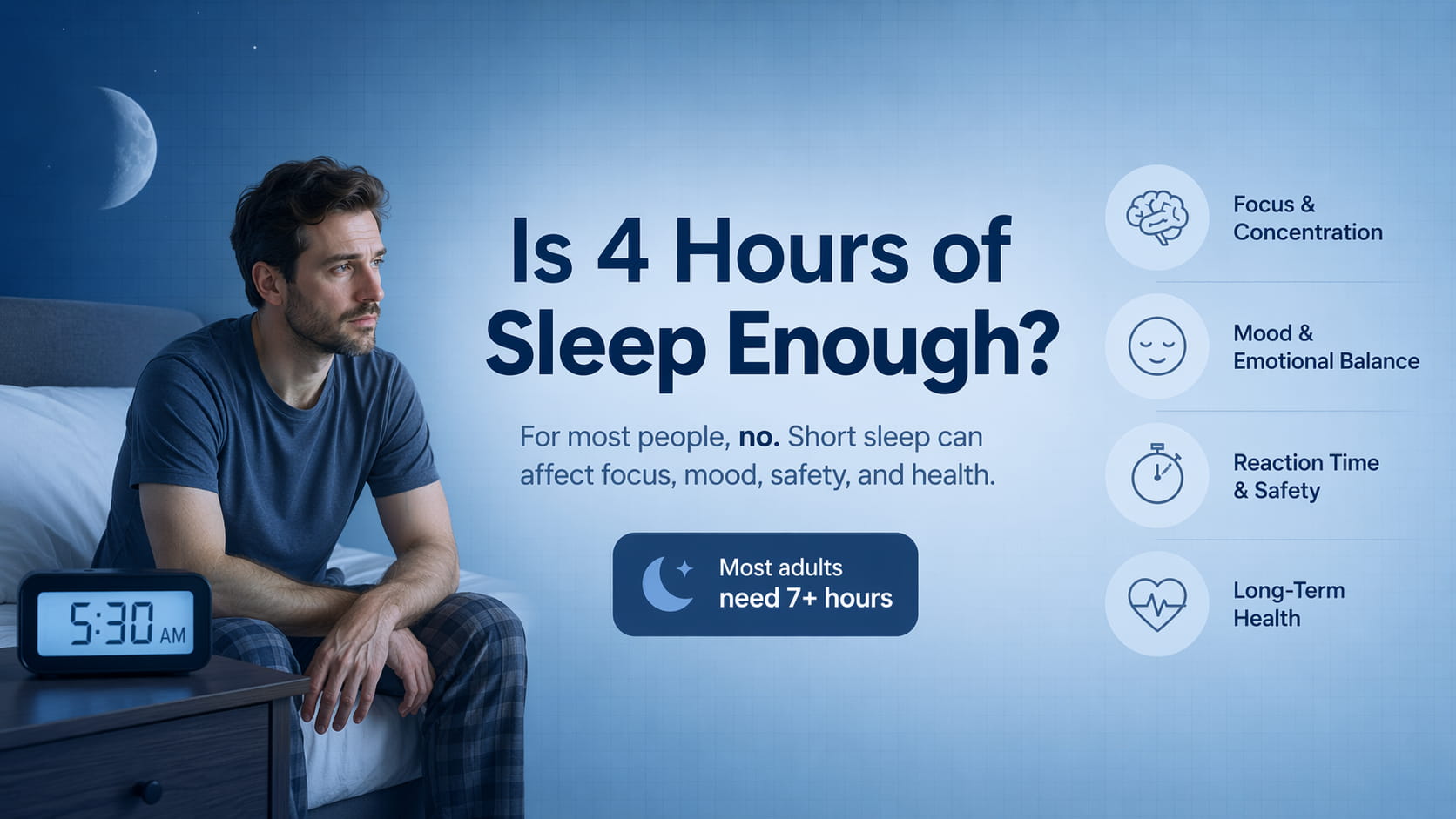
No. For most people, 4 hours of sleep is not enough. The CDC sleep recommendations and the American Academy of Sleep Medicine say adults should usually get at least 7 hours of sleep per night on a regular basis, while teens need even more.
That matters because sleep is not just about feeling tired. Short sleep can affect attention, reaction time, mood, daily performance, and long-term health. If you are only getting 4 hours most nights, the real issue is not whether you can survive on it. The issue is what that pattern may be doing to your body and brain over time.
How Much Sleep Do People Actually Need?
For most adults ages 18 to 60, the CDC says 7 or more hours is the recommended amount. Teens ages 13 to 17 generally need 8 to 10 hours, and older adults still need roughly 7 to 9 hours, not dramatically less. The National Institute on Aging also notes that older adults need about the same amount of sleep as other adults, even though their sleep patterns may shift earlier.
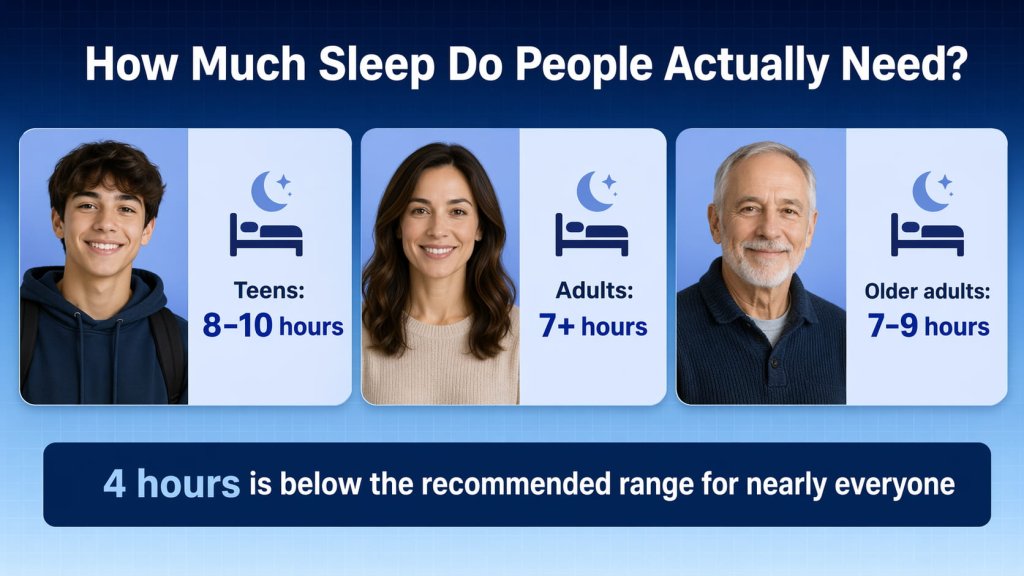
So if you are asking whether 4 hours is enough, the practical answer is simple: it falls well below the recommended range for nearly everyone. Occasional short nights happen. But as a regular habit, 4 hours is usually too little for healthy functioning and recovery.
Why 4 Hours of Sleep Is Usually Not Enough
The National Heart, Lung, and Blood Institute overview of sleep deprivation explains that sleep deficiency can happen because you sleep too little, sleep at the wrong time, sleep poorly, or have a sleep disorder that interrupts rest.
When your sleep is cut that short, your body misses part of the normal restorative work that sleep supports. The NHLBI page on how sleep affects your health says sleep deficiency can make it harder to learn, focus, react, make decisions, solve problems, remember things, and manage emotions.
In other words, 4 hours is not simply less than ideal. For most people, it is far enough below normal needs to affect next-day function and, if it keeps happening, raise health concerns.
What Happens if You Only Sleep 4 Hours?
The short-term effects are often noticeable the next day, especially if you need to drive, study, work, exercise, or make important decisions. Official health sources consistently link sleep deficiency with reduced alertness and worse daytime performance.
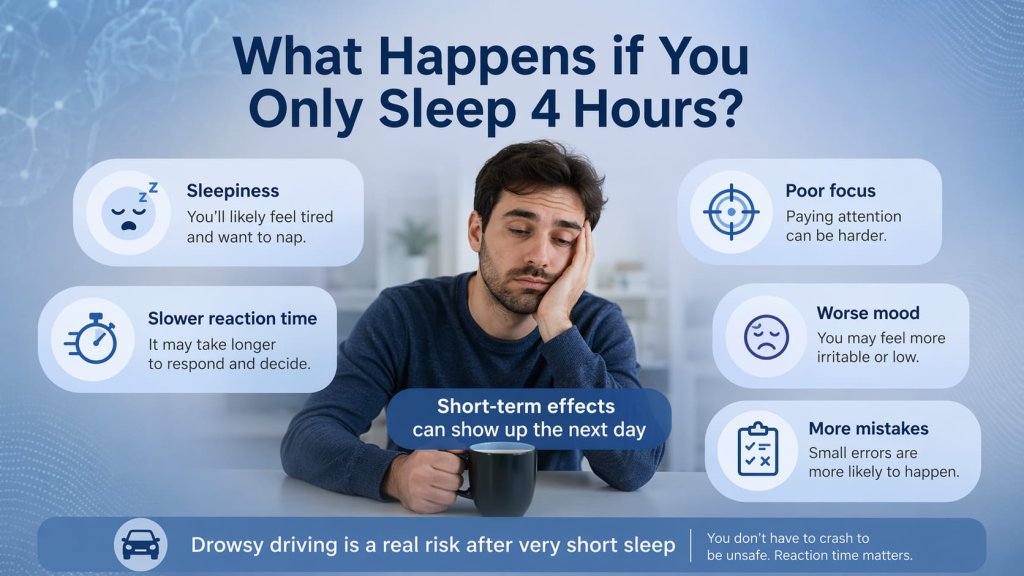
Common short-term effects can include:
- feeling very sleepy during the day
- slower reaction time
- trouble focusing
- worse memory and concentration
- more mistakes at work or school
- irritability or low mood
- poorer judgment and decision-making
If you only slept 4 hours and need to drive, treat that as a safety issue, not just an energy issue. The National Highway Traffic Safety Administration warns that coffee or energy drinks alone are not always enough when you are seriously sleep-deprived. If you become sleepy while driving, the safer move is to pull over in a safe place for a short 20-minute nap rather than trying to push through.
These effects are one reason short sleep can become a safety issue, not just a comfort issue. The CDC links insufficient sleep with injury risk, and older CDC reports note that sleep loss can contribute to driving errors and crashes.
Is 4 Hours of Sleep Okay for One Night?
One bad night is not the same as months of chronic short sleep. If you sleep 4 hours once because of travel, stress, a deadline, or a sick child, that does not automatically mean lasting harm. But it can still leave you less alert, slower to react, and more prone to mistakes the next day.
The bigger concern is when 4-hour nights become normal. CDC sleep data show that about one-third of U.S. adults do not get enough sleep, and the agency links insufficient sleep with anxiety, depression, obesity, heart disease, injury, and other serious conditions.
So the balanced answer is this: one short night may be manageable, but 4 hours is not a healthy long-term target.
That is also why catching up on the weekend should not be treated as a full fix. The NHLBI guidance on how much sleep is enough explains that repeated short sleep creates sleep debt, and while naps or extra sleep may improve alertness for a short time, they do not provide all the benefits of regular nighttime sleep. NIH research has also found that weekend recovery sleep did not reverse the metabolic disruptions caused by repeated sleep restriction.
What if You Feel Fine on 4 Hours?
Some people say they got used to sleeping 4 or 5 hours. But official sleep recommendations do not treat that as proof that short sleep is enough. The American Academy of Sleep Medicine still recommends 7 or more hours for adults on a regular basis, and the CDC still defines less than 7 hours in adults as insufficient sleep.
That means feeling functional is not the same as getting enough sleep. Some people can push through a busy schedule, especially with caffeine, but that does not change the recommendation or erase the health associations seen with chronic short sleep.
There is one important exception to keep in mind: a small number of people appear to have rare genetic forms of natural short sleep and can function well on unusually little sleep without obvious ill effects. The NIH research summary on a gene linked to natural short sleep highlights that this is unusual, not normal. For most people, feeling used to 4 hours says more about adaptation to chronic sleep restriction than about truly needing only 4 hours.
Who Should Be Especially Careful With Only 4 Hours of Sleep?
Some groups are more likely to be affected by very short sleep or more likely to face safety problems from it.
This matters especially for:
- Teens, because they need more sleep than adults and poor sleep is linked with attention, behavior, mental health, and injury problems.
- Drivers and shift workers, because inadequate sleep impairs alertness and reaction time in risky situations such as driving.
- Older adults, because they still need about 7 to 9 hours and should not assume shorter sleep is simply a normal part of aging.
- Anyone with snoring, gasping, or excessive daytime sleepiness, because those can be signs of sleep apnea or another sleep disorder that needs evaluation.
- Anyone who struggles to fall asleep or stay asleep for weeks, because insomnia can interfere with daily life and may need treatment.
Common Reasons You May Only Be Sleeping 4 Hours
If 4-hour nights are becoming normal, it helps to ask why. The NHLBI says short sleep can happen because you are not leaving enough time for sleep, sleeping at the wrong time, sleeping poorly, or dealing with a sleep disorder. The NHLBI guidance on causes of insomnia also lists common contributors such as shift work, stress, frequent schedule changes, caffeine, alcohol, late-night screen use, long daytime naps, and poor sleep environments.
That distinction matters. If you are cutting sleep short because of work, studying, parenting, or habits, the solution may be mostly behavioral and schedule-related. If you are allowing enough time for sleep but still cannot fall asleep, stay asleep, or wake up restored, a sleep disorder becomes more important to consider.
Signs You Should Talk to a Doctor
You do not need to wait until sleep becomes severe to bring it up. The NHLBI diagnosis guidance says to talk with a doctor if you often feel sleepy during the day, do not wake up refreshed and alert, or are having trouble adapting to shift work. The National Institute on Aging also suggests keeping a sleep diary for a couple of weeks if you are having trouble sleeping.
It is a good idea to get medical advice if you have:
- regular daytime sleepiness
- loud snoring, choking, or gasping during sleep
- trouble falling asleep or staying asleep most nights
- morning headaches or unrefreshing sleep
- several weeks of fatigue with no clear reason
How to Sleep Better if 4-Hour Nights Are Becoming Common
Evidence-based sleep advice is usually simple, even if following it consistently is hard. The NHLBI sleep habits guidance recommends habits that support both falling asleep and staying asleep.
Start with these basics:
- go to bed and wake up at the same time every day
- use the hour before bed for quiet wind-down time
- keep your bedroom quiet, cool, and dark
- avoid bright light before bed
- avoid caffeine, nicotine, and alcohol close to bedtime
- avoid heavy meals right before bed
- get regular exercise, but not too close to bedtime
- avoid long or late naps if they make nighttime sleep worse
If you have long-term insomnia, the NHLBI treatment guidance for insomnia says cognitive behavioral therapy for insomnia, or CBT-I, is usually the first treatment option rather than relying on sleep medicine as the main answer.
Does Needing Less Sleep Happen With Age?
This is a common question, and the short answer is not really. Older adults often go to sleep earlier and wake earlier, but the National Institute on Aging says they still need about 7 to 9 hours per night. So sleeping only 4 hours should not be brushed off as just getting older.
FAQ
Is 4 hours of sleep enough for adults?
No. Most adults need at least 7 hours on a regular basis, according to the CDC and the American Academy of Sleep Medicine. Four hours is well below that range.
Is 4 hours of sleep enough for a teenager?
No. Teens generally need 8 to 10 hours per night, so 4 hours is far below the recommended amount.
Can you function on 4 hours of sleep?
You may get through a day on 4 hours, but sleep deficiency is linked with slower reaction time, worse focus, poorer decision-making, and more mistakes. Functioning is not the same as getting enough sleep.
What is the first treatment for long-term insomnia?
The NHLBI says CBT-I is usually the first treatment option for long-term insomnia.
Conclusion
For most people, 4 hours of sleep is not enough. It may happen once in a while, but it is not a healthy target for adults, teens, or older adults. Over time, regularly sleeping that little can affect alertness, mood, safety, and overall health.
If 4-hour nights are becoming normal for you, focus first on improving your sleep habits and your schedule. If that does not help, or if you have symptoms like snoring, gasping, insomnia, or daytime sleepiness, talk to a healthcare professional rather than trying to push through it.
References
- American Academy of Sleep Medicine — Adult Sleep Duration Health Advisory
- National Heart, Lung, and Blood Institute — Sleep Deprivation and Deficiency: Diagnosis
- National Heart, Lung, and Blood Institute — Insomnia: Causes and Risk Factors
- National Heart, Lung, and Blood Institute — Insomnia: Treatment
- National Institute on Aging — Sleep and Older Adults
- National Highway Traffic Safety Administration — Drowsy Driving
- NIH — Gene Identified in People Who Need Little Sleep