
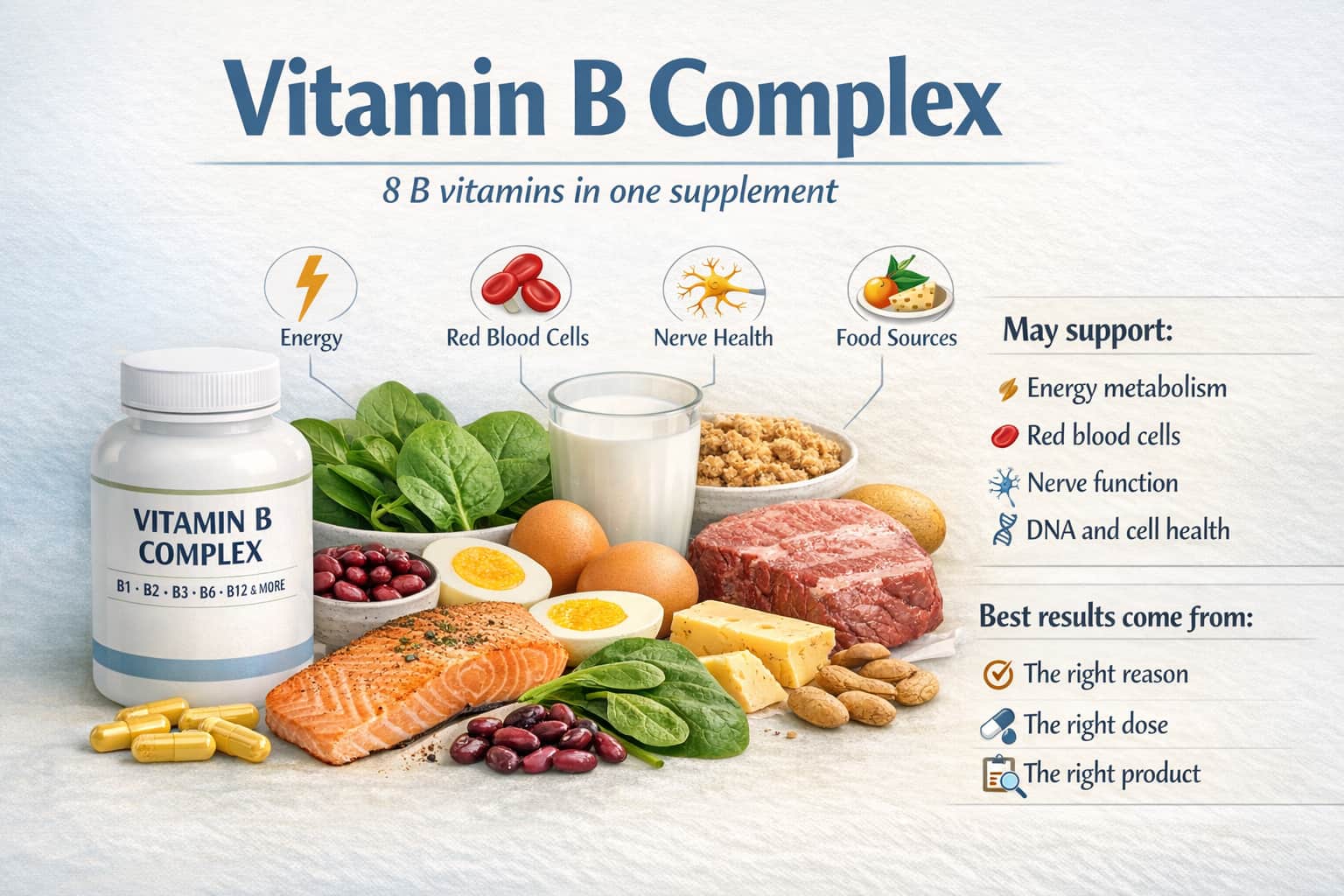
Vitamin B complex can be helpful when it fills a real nutritional gap, but it is not a cure-all and not everyone needs it. In simple terms, vitamin B complex is a supplement that combines the eight B vitamins—B1, B2, B3, B5, B6, B7, B9, and B12—which help your body use food for energy and support red blood cells, nerves, DNA, and normal cell function. The right choice depends on your diet, age, life stage, absorption, medicines, and the actual dose on the label. According to the MedlinePlus overview of B vitamins, B vitamins help your body get or make energy from food and help form red blood cells.
What Is Vitamin B Complex?
Vitamin B complex usually contains these eight vitamins:
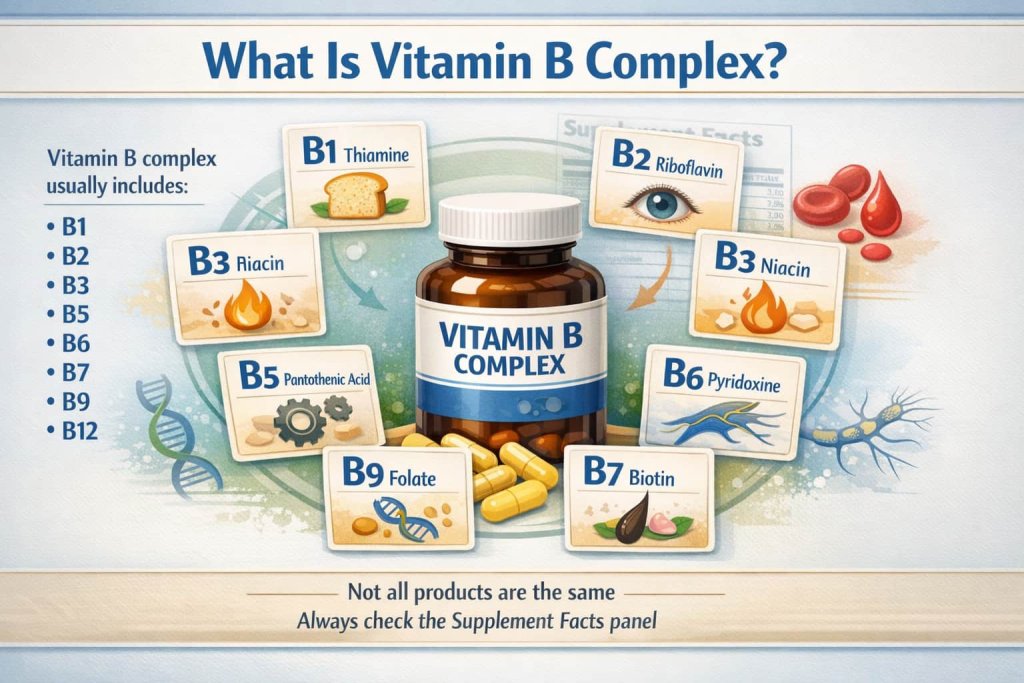
- B1 (thiamin) helps turn food into energy and supports cell growth and function.
- B2 (riboflavin) helps with growth, development, cell function, and energy use.
- B3 (niacin) helps turn food into energy and supports normal cell function.
- B5 (pantothenic acid) helps your body make and break down fats and supports many body processes.
- B6 is involved in more than 100 enzyme reactions related to metabolism and also supports brain development and immune function.
- B7 (biotin) helps your body use carbohydrates, fats, and proteins.
- B9 (folate/folic acid) is needed to make DNA and support cell division.
- B12 helps keep blood and nerve cells healthy and helps make DNA.
One important detail is that not all vitamin B complex products are the same. The FDA Daily Value guide for Supplement Facts labels lists adult Daily Values of 1.2 mg thiamin, 1.3 mg riboflavin, 16 mg niacin equivalents, 5 mg pantothenic acid, 30 mcg biotin, 400 mcg DFE folate, 1.7 mg vitamin B6, and 2.4 mcg vitamin B12. Many supplements go far above those amounts, so the label matters more than the front of the bottle.
Vitamin B Complex Benefits
1. Vitamin B Complex Helps With Energy Metabolism
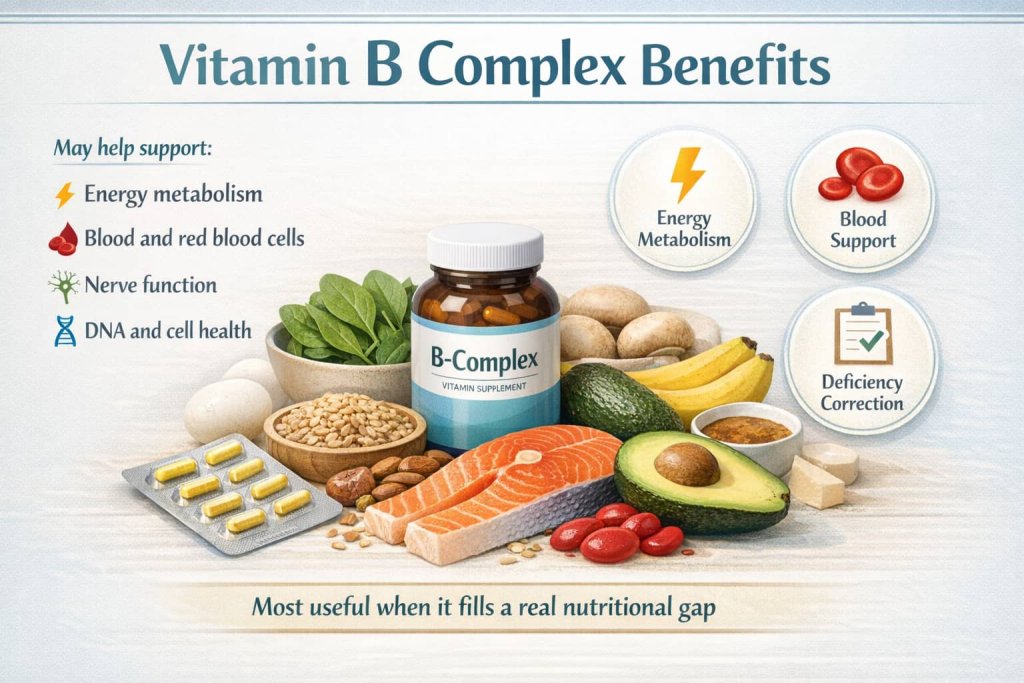
B vitamins help your body convert carbohydrates, fats, and proteins into usable energy. That is why vitamin B complex is often marketed for tiredness or low energy. But this point needs context: these vitamins support the energy-making process; they do not work like a stimulant.
2. Vitamin B Complex Supports Blood, Nerves, and DNA
Folate and vitamin B12 are especially important for making DNA and new cells, while vitamin B12 also helps keep blood and nerve cells healthy. That is one reason deficiencies can show up as anemia, fatigue, numbness, tingling, or balance and memory problems.
3. Vitamin B Complex Can Help Correct a Deficiency
The clearest reason to use a supplement is a real or likely deficiency. Vitamin B12 deficiency, for example, can happen because of low intake, poor absorption, pernicious anemia, gastrointestinal surgery, metformin use, or acid-reducing medicines. In those situations, a supplement can be useful, but the best form and dose depend on the problem.
4. Vitamin B Complex May Be Useful in Certain Life Stages
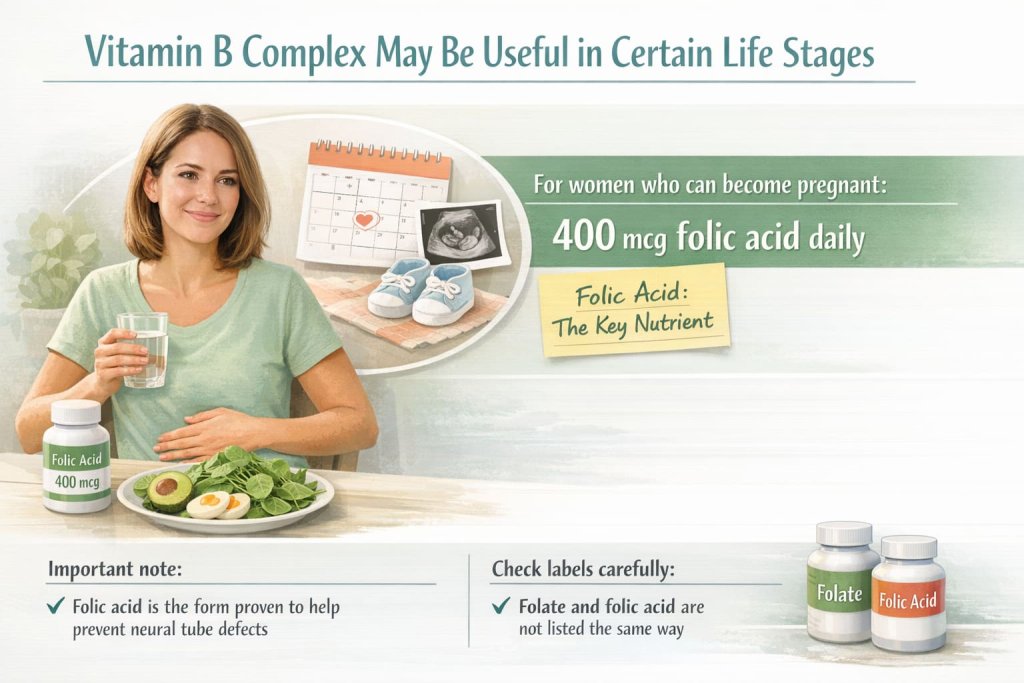
For women who can become pregnant, folic acid is the standout nutrient. The CDC folic acid guidance says all women capable of becoming pregnant should get 400 mcg of folic acid daily to help prevent neural tube defects. This is one of the strongest evidence-based reasons to pay attention to B-vitamin intake.
One detail that often confuses readers is that folate labels and pregnancy guidance do not use the same unit in the same way. Supplement labels usually list folate as mcg DFE, while pregnancy guidance is usually written as mcg of folic acid. They are not interchangeable.
The NIH folate fact sheet also notes that folic acid is the form proven to help prevent neural tube defects, and the 400 mcg daily recommendation still applies even for people with an MTHFR gene variant. If you previously had a pregnancy affected by a neural tube defect, talk with your healthcare provider before trying to self-manage with a standard B-complex, because CDC recommends a much higher folic acid intake in that situation.
Who May Benefit Most From Vitamin B Complex?
Some people have a stronger reason than others to consider a B-complex supplement or a targeted B-vitamin supplement:

- Women who can become pregnant: CDC recommends 400 mcg folic acid daily.
- Adults over 50: NIH says many older adults do not absorb food-bound B12 well and should get most of their B12 from fortified foods or supplements.
- Vegetarians and vegans: plant foods do not naturally provide vitamin B12 unless fortified.
- People with pernicious anemia, celiac disease, Crohn’s disease, or certain stomach or intestinal surgeries: absorption can be a major issue.
- People taking metformin or acid-reducing medicines: these can lower B12 absorption or status over time.
Common Signs of a Possible B-Vitamin Deficiency
Possible signs of a deficiency can include tiredness, weakness, pale skin, soreness of the mouth or tongue, numbness or tingling in the hands or feet, balance problems, memory changes, or mood changes. These symptoms are not specific to B-vitamin deficiency, but they are a good reason to get checked instead of guessing. This is especially important with vitamin B12 because NIH notes that deficiency can affect the nervous system even before anemia is obvious.
That does not mean everyone in these groups needs the same product. Sometimes a regular diet, a fortified food, a prenatal vitamin, or a B12-only supplement makes more sense than a broad B complex. The best match depends on which nutrient is low or likely to be low.
Who Should Be Careful With Vitamin B Complex?
Use more caution with vitamin B complex if you are pregnant, breastfeeding, taking long-term medicines, managing a medical condition, or planning to take a high-dose supplement for more than a short period. The FDA’s consumer advice on dietary supplements recommends talking with a doctor, pharmacist, or other healthcare professional before using supplements because they can carry risks and may interact with medicines.
It is also worth remembering that dietary supplements are not drugs. Under FDA rules, supplement structure/function claims must include a disclaimer that the product is not intended to diagnose, treat, cure, or prevent disease. So if a vitamin B complex label sounds like it can solve everything, treat that as marketing, not proof. The FDA page on structure/function claims explains this clearly.
Best Food Sources of Vitamin B Complex
Most people can get plenty of B vitamins from food. Good sources include:
- Fish, poultry, meat, eggs, and dairy
- Beans and peas
- Leafy green vegetables
- Whole grains, fortified cereals, and fortified breads
- Nuts, seeds, and some starchy vegetables
Vitamin B12 is the main exception for plant-based diets because it is naturally found in animal foods, while fortified cereals, fortified nutritional yeast, and other fortified products can help fill the gap. NIH also notes that people should get most nutrients from food and beverages when possible, with supplements used when needed.
How to Choose a Vitamin B Complex Supplement
Check the Supplement Facts Panel First
A smart first step is comparing the label to FDA Daily Values rather than looking only at buzzwords like “high potency” or “maximum strength.” Some products stay close to daily needs, while others provide very large amounts—especially of B6, biotin, folic acid, or B12. NIH notes that some B12 supplements contain 500 mcg or 1,000 mcg, which is far above the daily requirement, even though only a small percentage is absorbed.
If your main reason for taking a B-complex is vitamin B12, do not assume that methylcobalamin or sublingual tablets are automatically better. NIH says research has not shown that any supplemental form of vitamin B12 is better than the others, and oral and sublingual forms do not appear to differ meaningfully in effectiveness for most people. In practice, the dose and the reason you need B12 usually matter more than the marketing terms on the bottle.
Match the Supplement to the Reason You’re Taking It
- If your main concern is pregnancy planning, folic acid matters most.
- If your concern is a plant-based diet or low B12 intake, a B12-focused product may be more useful than a full B complex.
- If you have a diagnosed deficiency, your clinician may recommend a specific vitamin, dose, or prescription product rather than a general supplement.
Safety Box: What to Know Before Taking Vitamin B Complex
Safety box
- Vitamin B6: NIH sets the adult upper limit at 100 mg/day. High long-term intakes can cause sensory neuropathy, including nerve symptoms such as numbness or tingling.
- Niacin: NIH sets the adult upper limit for supplemental niacin at 35 mg/day. Supplemental niacin can cause flushing, itching, and burning sensations, and higher intakes can cause more serious adverse effects.
- Folic acid: NIH sets the adult upper limit at 1,000 mcg/day from supplements or fortified foods. Large amounts can correct anemia caused by B12 deficiency while allowing neurological damage to continue unnoticed.
- Biotin: High-biotin supplements can interfere with lab tests. NIH notes problems with some hormone tests, including some thyroid-related tests, and FDA warns about interference with certain troponin tests. Tell your clinician and lab if you take biotin before blood work.
A few medication interactions deserve a separate warning. NIH notes that folate supplements can interfere with methotrexate when it is used to treat cancer. Vitamin B6 supplements can interact with cycloserine, certain epilepsy medicines, and theophylline. Vitamin B12 status can also fall over time with metformin and some acid-reducing medicines. If you take prescription medicine regularly, it is smart to check with your clinician or pharmacist before starting a high-dose B-complex.
Can Vitamin B Complex Give You More Energy?
Maybe—but mainly if you are low in one or more B vitamins. This is where many articles oversimplify the topic. B vitamins are essential for energy metabolism, but that does not mean extra B vitamins automatically boost energy, exercise performance, or endurance in people who already get enough. NIH specifically says vitamin B12 supplementation does not appear to improve athletic performance or endurance in people with sufficient B12 status.
That same caution applies to beauty claims. The NIH biotin fact sheet says biotin supplements are often promoted for hair, skin, and nails, but there is little scientific evidence to support those claims for the general population. If you are tired, losing hair, or dealing with numbness, the better question is not “Which B complex is best?” but “Do I actually have a deficiency or another underlying cause?”
Vitamin B Complex FAQ
Is vitamin B complex the same as vitamin B12?
No. Vitamin B12 is just one of the eight B vitamins. A vitamin B complex supplement includes B12 plus the other B vitamins.
Is it okay to take vitamin B complex every day?
A daily vitamin B complex can be reasonable for some people, but daily use is not automatically necessary. The bigger issue is the dose. Check the label for B6, niacin, folic acid, biotin, and B12 rather than assuming more is better.
Is vitamin B complex good for hair, skin, and nails?
Not reliably for everyone. Biotin deficiency can affect hair and skin, but true biotin deficiency is rare, and NIH says the evidence for routine biotin supplements for hair, skin, and nails is limited.
What should I do if I think I have a B-vitamin deficiency?
Talk with a healthcare professional instead of guessing from symptoms alone. Fatigue, numbness, pale skin, balance problems, and brain fog can have many causes. FDA advises checking with a clinician or pharmacist before using supplements, especially if you take medicines or have a health condition.
Final Thoughts on Vitamin B Complex
Vitamin B complex can be useful, but the best results come from using it for the right reason. Food should still do most of the work, and supplements should fill specific gaps rather than promise impossible results. If you are choosing a vitamin B complex, read the Supplement Facts panel closely, compare it with Daily Values, and pay special attention to B6, niacin, folic acid, biotin, and B12. If you are pregnant, vegan, over 50, taking metformin or acid-reducing medication, or worried about deficiency symptoms, it is worth getting individualized advice before you buy.
This content is for informational purposes only and not medical advice.
References
- NIH Office of Dietary Supplements — Thiamin Fact Sheet for Consumers
- NIH Office of Dietary Supplements — Riboflavin Fact Sheet for Consumers
- NIH Office of Dietary Supplements — Biotin Fact Sheet for Consumers
- NIH Office of Dietary Supplements — Vitamin B12 Fact Sheet for Consumers
- Centers for Disease Control and Prevention — Folic Acid: Sources and Recommended Intake
- U.S. Food and Drug Administration — Daily Value on the Nutrition and Supplement Facts Labels
- U.S. Food and Drug Administration — Biotin Interference with Troponin Lab Tests