
A normal eGFR is usually above 90 mL/min/1.73 m² in adults, but average eGFR levels gradually decrease with age. An eGFR result should not be interpreted by age alone. Doctors also consider urine albumin, previous test results, medical conditions, medications, and whether the change has lasted for at least three months.
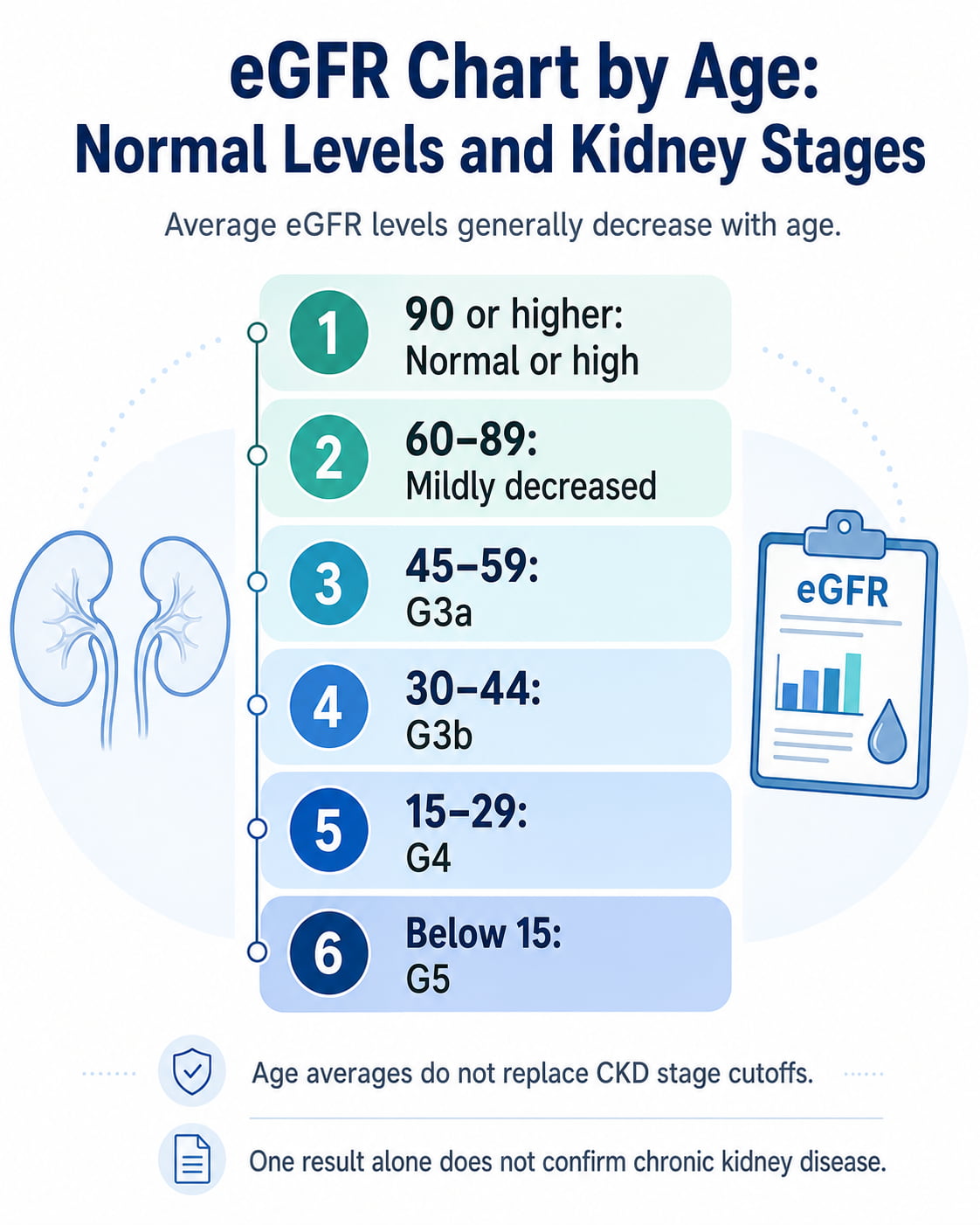
The eGFR chart by age below shows average adult values, not minimum healthy cutoffs. A lower-than-average result does not automatically confirm chronic kidney disease, and an eGFR above 60 does not always rule it out.
According to the National Kidney Foundation, eGFR naturally decreases with age, even among some people without kidney disease. However, the KDIGO 2024 CKD guideline recommends evaluating both eGFR and markers of kidney damage when diagnosing and classifying chronic kidney disease.
eGFR Chart by Age
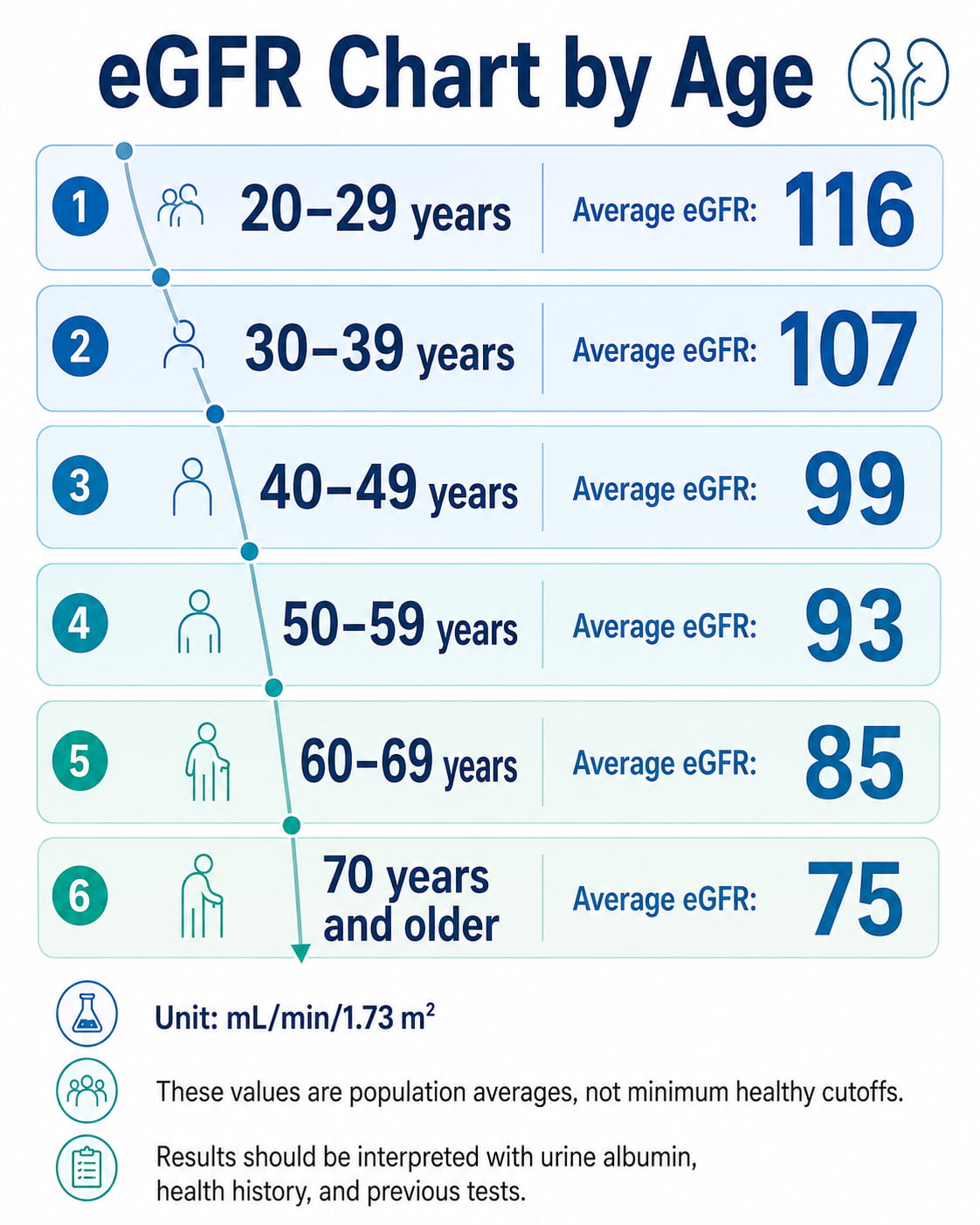
The following table shows average estimated glomerular filtration rate values for adults by age.
| Age | Average eGFR |
|---|---|
| 20–29 years | 116 |
| 30–39 years | 107 |
| 40–49 years | 99 |
| 50–59 years | 93 |
| 60–69 years | 85 |
| 70 years and older | 75 |
Unit: mL/min/1.73 m²
These numbers are population averages. They are not diagnostic thresholds and should not be used to determine whether an individual has kidney disease without additional testing.
For example, an eGFR of 75 may be near the reported average for an adult over age 70. However, age alone cannot confirm that the result is healthy. Doctors may also review the person’s urine albumin level, rate of eGFR decline, blood pressure, diabetes status, medications, symptoms, and overall health.
This adult eGFR chart should not be used for children. Pediatric and young-adult equations may include height and other age-specific factors.
What Is eGFR?
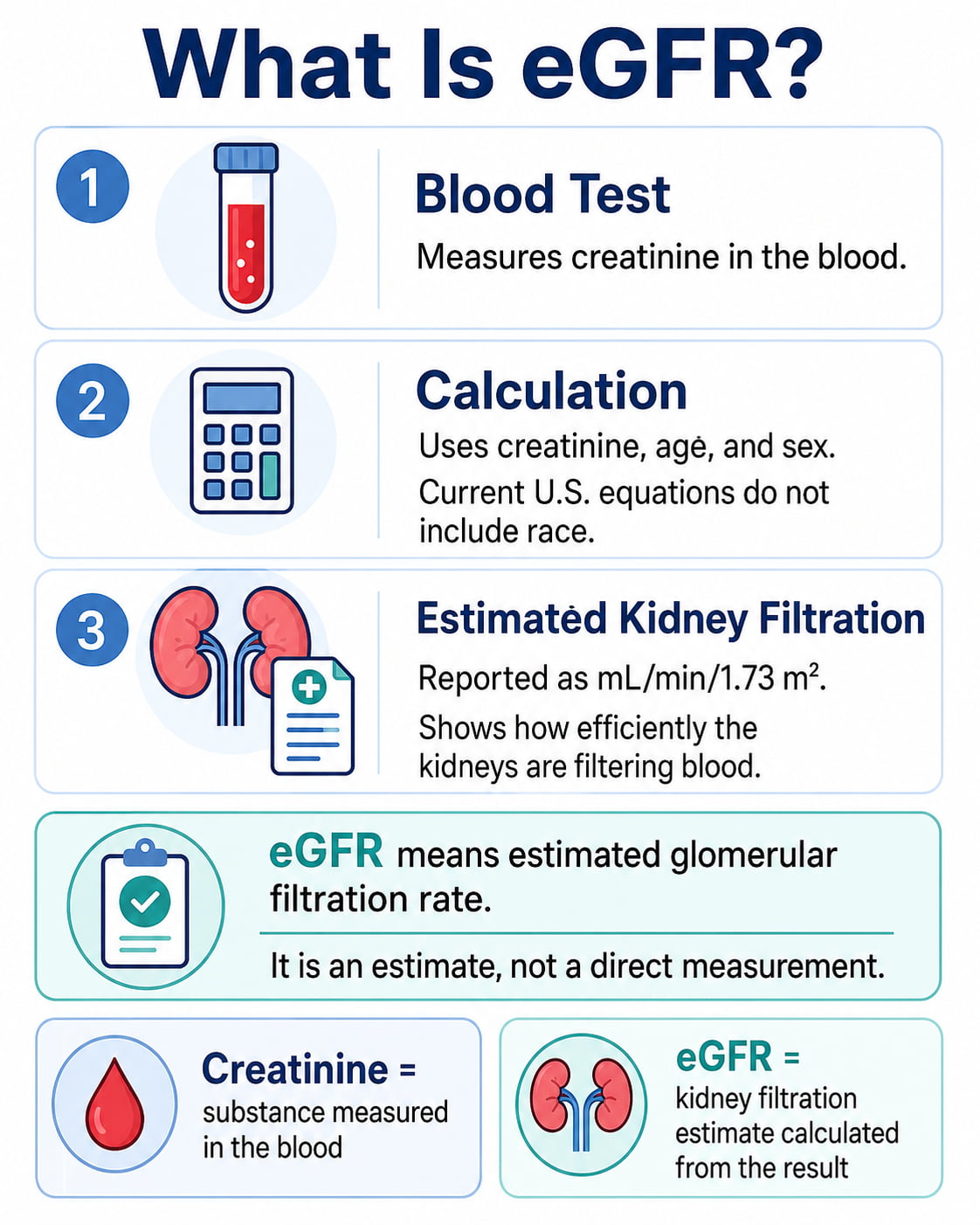
eGFR stands for estimated glomerular filtration rate. It estimates how much blood the kidneys filter each minute, adjusted to a standard body surface area of 1.73 square meters.
The kidneys remove waste products and excess fluid from the blood. When kidney filtration decreases, waste and fluid may begin to accumulate in the body.
Most laboratories calculate eGFR from a blood test that measures creatinine. Creatinine is a waste product created through normal muscle activity. Age and sex are also included in commonly used adult equations because they can affect expected creatinine levels.
eGFR vs. GFR
GFR is the actual glomerular filtration rate. Measuring it directly requires specialized procedures that are not routinely used for most patients.
eGFR is an estimate based on blood markers and an equation. It is easier to obtain, but it is not perfectly precise.
eGFR vs. Creatinine
Creatinine is the substance measured in the blood. eGFR is the calculation made from that creatinine result and other variables.
Generally:
- Higher creatinine may produce a lower eGFR.
- Lower creatinine may produce a higher eGFR.
- Changes in muscle mass can affect creatinine without representing an equal change in kidney filtration.
This is why doctors interpret creatinine and eGFR together rather than relying on either number alone.
What Is a Normal eGFR for Your Age?
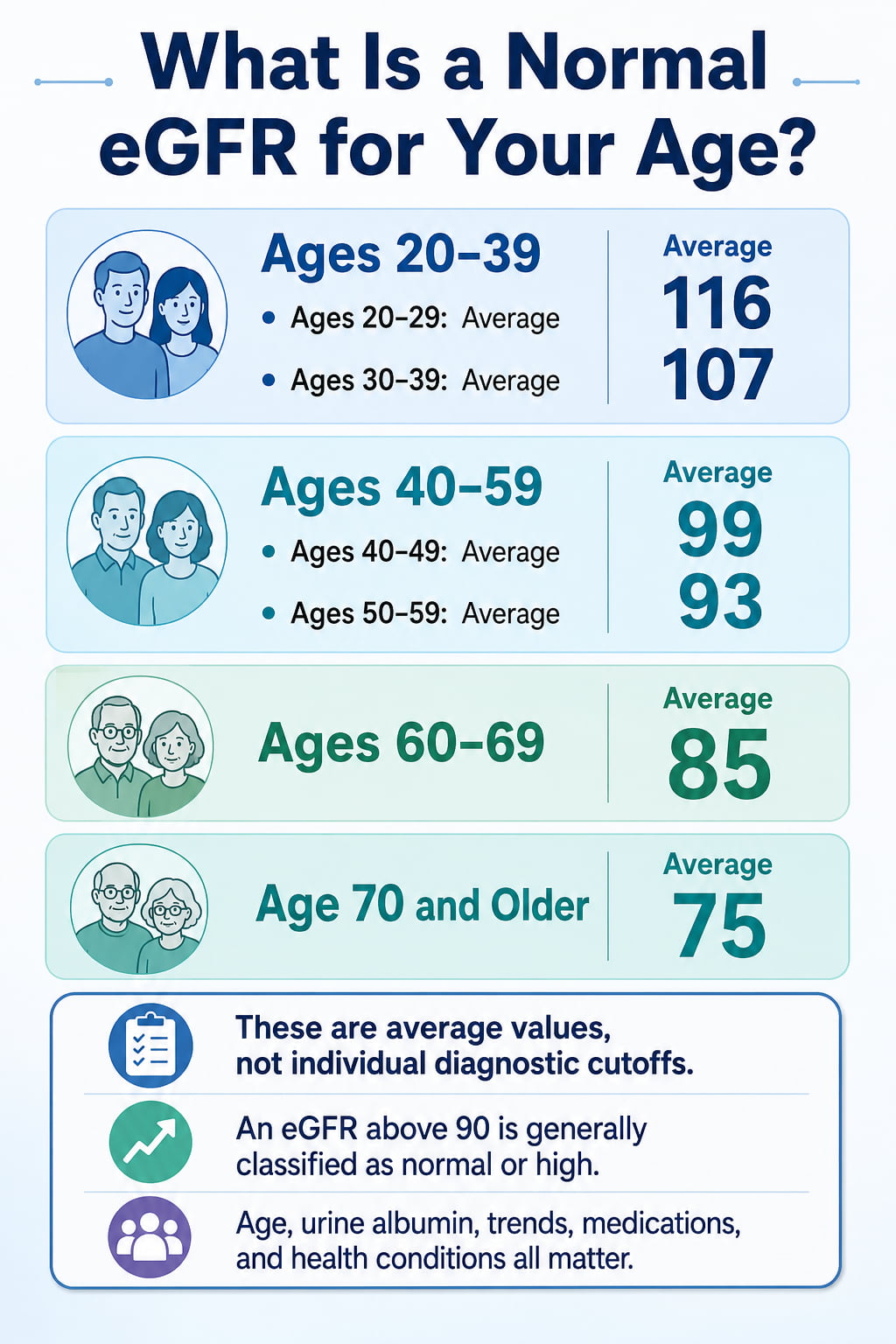
A result above 90 is generally considered normal or high for adults, but a normal result must still be interpreted alongside urine testing and other evidence of kidney health.
Normal eGFR for Ages 20–39
Average eGFR is highest during early adulthood.
- Ages 20–29: average eGFR of 116
- Ages 30–39: average eGFR of 107
A result that is noticeably lower than these averages is not automatically abnormal. The difference may be related to individual variation, muscle mass, the estimating equation, temporary illness, medications, or kidney disease.
Normal eGFR for Ages 40–59
Average kidney filtration gradually decreases during middle age.
- Ages 40–49: average eGFR of 99
- Ages 50–59: average eGFR of 93
An eGFR between 60 and 89 is classified as mildly decreased. However, that range is not considered chronic kidney disease unless another persistent marker of kidney damage is present.
Normal eGFR for Ages 60–69
The reported average eGFR for adults ages 60–69 is 85.
Although this is lower than the average for younger adults, a downward trend should still be reviewed. A gradual age-related decline is different from a sudden or rapid reduction caused by acute illness, medication effects, dehydration, urinary obstruction, or another medical problem.
Normal eGFR for Age 70 and Older
The National Kidney Foundation reports an average eGFR of 75 for adults age 70 and older.
This does not mean that 75 is an automatic cutoff between normal and abnormal. A clinician may consider whether the result is stable, whether albumin is present in the urine, whether other abnormalities exist, and how the result affects medication safety and overall health.
Why Does eGFR Decrease With Age?
Kidney structure and blood flow can gradually change with aging. As a result, average filtration levels tend to decline over time, even in some people without diagnosed kidney disease.
However, a reduced eGFR should not be dismissed as “just aging.” Diabetes, high blood pressure, cardiovascular disease, medication effects, urinary problems, and other conditions can also affect kidney function.
The Centers for Disease Control and Prevention reported in March 2026 that CKD affected an estimated 34% of U.S. adults age 65 or older, compared with 13% of adults ages 45–64 and 6% of adults ages 18–44. This does not mean aging alone causes CKD, but it shows why kidney testing becomes increasingly important with age.
eGFR Kidney Stages: G1 Through G5
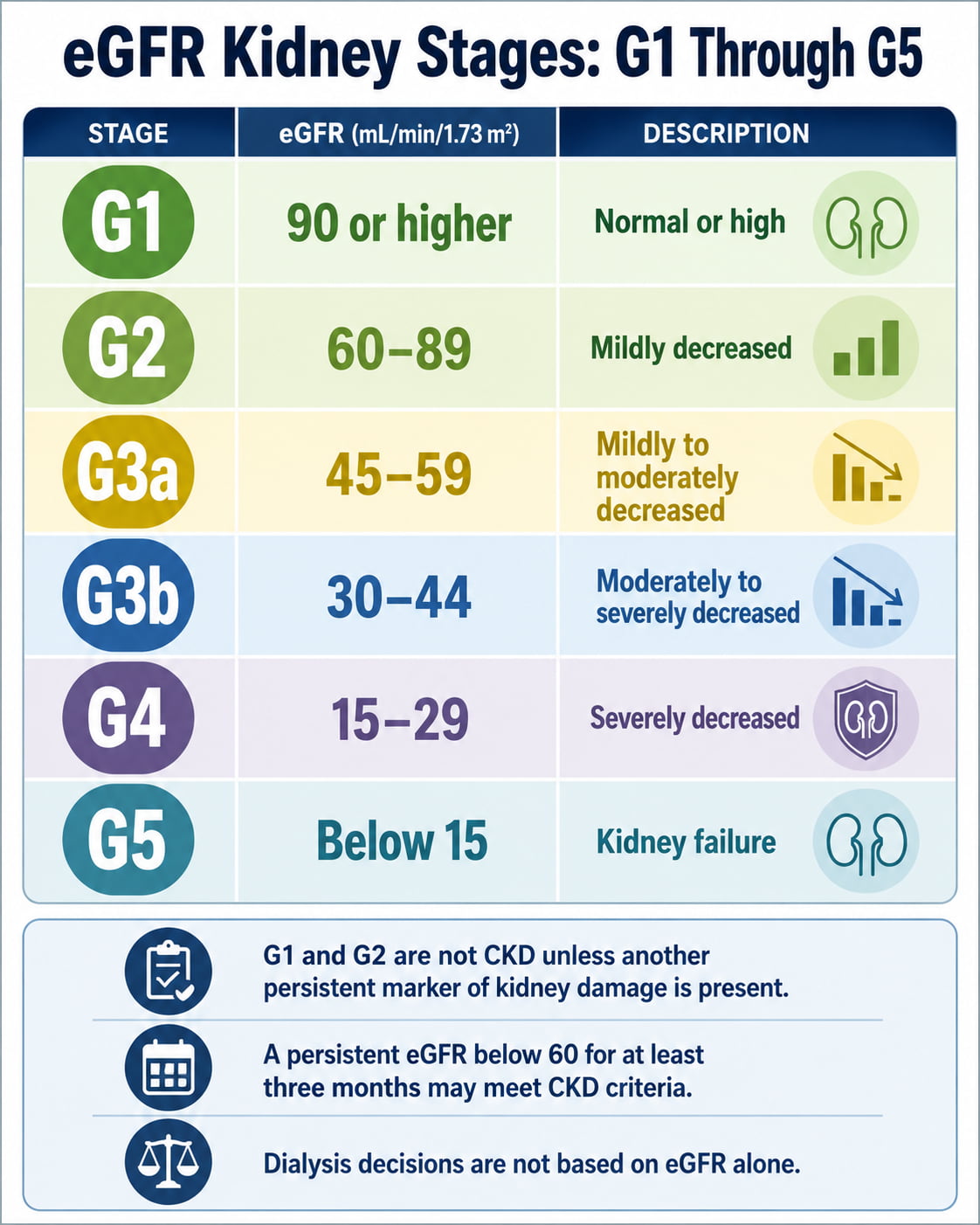
KDIGO classifies kidney function into six GFR categories, from G1 through G5. Stage 3 is divided into G3a and G3b because risks and care needs may differ within that range.
| GFR category | eGFR range | Official description |
|---|---|---|
| G1 | 90 or higher | Normal or high |
| G2 | 60–89 | Mildly decreased |
| G3a | 45–59 | Mildly to moderately decreased |
| G3b | 30–44 | Moderately to severely decreased |
| G4 | 15–29 | Severely decreased |
| G5 | Below 15 | Kidney failure |
Unit: mL/min/1.73 m²
These categories apply across adulthood. Age-related average values do not replace CKD stage cutoffs.
G1: eGFR 90 or Higher
G1 represents normal or high filtration.
An eGFR of 90 or higher is not CKD by itself. Stage 1 CKD is diagnosed only when there is evidence of kidney damage, such as persistent albumin in the urine, structural abnormalities, or another recognized kidney marker.
G2: eGFR 60–89
G2 represents mildly decreased filtration.
This range is common among older adults and does not automatically mean stage 2 kidney disease. CKD is present in G2 only when another marker of kidney damage persists.
G3a: eGFR 45–59
G3a represents mildly to moderately decreased filtration.
An eGFR that remains in this range for at least three months generally meets the reduced-filtration criterion for CKD. A doctor may review urine albumin, medications, blood pressure, diabetes control, cardiovascular risk, and the rate of change.
G3b: eGFR 30–44
G3b represents moderately to severely decreased filtration.
At this stage, doctors may monitor more closely for complications, medication dosing concerns, anemia, mineral and bone changes, electrolyte problems, and further decline.
G4: eGFR 15–29
G4 represents severely decreased filtration.
Specialist care is often appropriate, especially when kidney function is declining or complications are difficult to manage. The National Institute of Diabetes and Digestive and Kidney Diseases identifies preparation for possible kidney replacement therapy, particularly when eGFR is below 30, as one reason for nephrology involvement.
G5: eGFR Below 15
G5 is classified as kidney failure.
This level requires prompt medical evaluation and planning. However, an eGFR below 15 does not mean dialysis must begin immediately based on the number alone.
KDIGO recommends basing dialysis decisions on a combined assessment of symptoms, signs, laboratory abnormalities, quality of life, personal preferences, and GFR. Dialysis commonly begins at lower filtration levels, but timing varies by individual.
Does eGFR 60–89 Mean Kidney Disease?
Not necessarily.
An eGFR between 60 and 89 is categorized as G2, or mildly decreased filtration. It is considered CKD only when there is also persistent evidence of kidney damage.
Possible markers of kidney damage include:
- Albumin or protein in the urine
- Persistent blood in the urine from a kidney-related cause
- Abnormal kidney imaging
- Abnormal kidney tissue findings
- Certain electrolyte or tubular disorders
- A history of kidney transplantation
For example:
- An eGFR of 78 with normal urine albumin and no other kidney abnormalities may not represent CKD.
- An eGFR of 78 with persistent urine albumin of 100 mg/g may meet CKD criteria.
- An eGFR of 52 that remains below 60 for more than three months generally meets the CKD definition, even without elevated albumin.
KDIGO defines CKD as an abnormality of kidney structure or function that is present for at least three months and has implications for health.
Why One Low eGFR Result May Not Confirm CKD
One low eGFR result may occur during a temporary change in health or kidney function. Doctors commonly repeat testing to determine whether the result is persistent.
Possible reasons for a temporary or misleading result include:
- Acute illness
- Dehydration
- Recent intense exercise
- Eating a large amount of meat before testing
- Creatine supplement use
- Medication effects
- Rapidly changing kidney function
- Laboratory variation
Chronic kidney disease generally requires evidence that reduced filtration or another kidney abnormality has been present for at least three months. A sudden reduction may instead represent acute kidney injury or another short-term problem that needs faster evaluation.
Why the uACR Test Matters
eGFR measures filtration, while the urine albumin-to-creatinine ratio measures whether albumin is leaking into the urine.
Albumin is a protein that normally remains in the blood. Persistent albumin in the urine may indicate damage to the kidney’s filtering structures, even when eGFR is above 60.
The National Kidney Foundation recommends interpreting urine albumin together with eGFR for a more complete picture of kidney health.
uACR Levels Chart
| Albuminuria category | uACR result | Description |
|---|---|---|
| A1 | Below 30 mg/g | Normal to mildly increased |
| A2 | 30–300 mg/g | Moderately increased |
| A3 | Above 300 mg/g | Severely increased |
A uACR above 30 mg/g may indicate kidney disease, but the test is usually repeated because temporary factors may raise urine albumin. Persistent abnormalities are more meaningful than a single result.
Example of eGFR and uACR Together
Consider two adults who both have an eGFR of 72:
- Person A: uACR is 10 mg/g, and eGFR has been stable. CKD may not be present unless another kidney abnormality exists.
- Person B: uACR is repeatedly 120 mg/g. This persistent albuminuria may indicate CKD despite an eGFR above 60.
The same eGFR number can therefore carry a different level of risk depending on urine albumin and other health factors.
How Is eGFR Calculated?
Most U.S. laboratories use creatinine-based equations to estimate kidney filtration.
The 2021 CKD-EPI creatinine equation uses:
- Serum creatinine
- Age
- Sex
Race is not included in the 2021 equation. NIDDK also provides a combined equation that uses creatinine and cystatin C.
Creatinine-Based eGFR
Creatinine-based eGFR is widely available and usually used for routine kidney testing.
Its accuracy may be reduced when muscle mass, diet, acute illness, pregnancy, or another factor makes creatinine an unreliable marker.
Cystatin C-Based eGFR
Cystatin C is another blood marker that can be used to estimate kidney filtration.
It may be helpful when creatinine is difficult to interpret, although cystatin C can also be affected by factors unrelated to filtration, including steroid use, thyroid dysfunction, inflammation, and body composition.
Combined Creatinine–Cystatin C eGFR
Using both creatinine and cystatin C can improve accuracy in many situations because the two markers have different limitations.
A combined result may be particularly useful when eGFR is close to an important threshold for medication dosing, a medical procedure, referral, or another clinical decision.
Factors That Can Affect eGFR Accuracy
eGFR is an estimate, so it may not precisely match measured kidney filtration.
| Factor | How it may affect interpretation |
|---|---|
| High muscle mass | May increase creatinine and lower creatinine-based eGFR |
| Low muscle mass or frailty | May lower creatinine and make eGFR appear higher |
| Amputation or paralysis | May reduce creatinine production |
| Bodybuilding | May increase creatinine through greater muscle mass |
| Creatine supplements | May affect creatinine-based results |
| Recent meat intake | May temporarily increase creatinine |
| Pregnancy | Standard adult equations may be less reliable |
| Acute kidney injury | Creatinine may be changing too quickly for stable estimation |
| Hospitalization or critical illness | eGFR may be less accurate |
| Malnutrition | May reduce creatinine production |
| Vegetarian or low-meat diet | May affect creatinine levels |
| Certain medications | May affect creatinine production, secretion, or measurement |
| Steroid use or thyroid dysfunction | May affect cystatin C |
NIDDK advises extra caution when interpreting creatinine-based eGFR in people with unstable kidney function, unusual muscle mass, frailty, pregnancy, serious illness, cancer, muscle-wasting disorders, or major dietary differences.
What to Do After a Low eGFR Result
A low result should be reviewed in context rather than interpreted alone.
1. Compare It With Previous Results
A stable eGFR may have a different meaning from a rapid decline.
Ask whether the result is:
- New
- Gradually declining
- Stable over several years
- Significantly different from the previous test
2. Ask About Repeat Testing
Repeat testing can help distinguish a persistent condition from a temporary change.
The timing depends on the result, symptoms, medical history, and whether an acute problem is suspected.
3. Request or Review a uACR Test
A urine albumin-to-creatinine ratio helps detect kidney damage that may not be visible from eGFR alone.
Both tests are especially important for people with diabetes, high blood pressure, cardiovascular disease, or a family history of kidney failure.
4. Review Medications and Supplements
Some medications require dose adjustments when kidney filtration decreases. Others may affect creatinine or kidney function.
Do not stop prescribed medicine on your own. Bring a complete list of prescription drugs, over-the-counter pain relievers, vitamins, herbal products, and bodybuilding supplements to the appointment.
5. Ask Whether Cystatin C Would Be Helpful
Cystatin C or a combined creatinine–cystatin C calculation may clarify kidney function when the creatinine-based result appears inconsistent with age, muscle mass, or overall health.
6. Address Kidney Risk Factors
A healthcare professional may recommend steps to support kidney and cardiovascular health, such as managing blood pressure, blood glucose, smoking, medication use, and dietary sodium.
The appropriate plan depends on the cause, CKD category, urine albumin level, other health conditions, and current medications.
When Should You See a Kidney Specialist?
A primary care clinician can monitor many people with stable or early kidney abnormalities. Referral to a nephrologist may be appropriate when:
- The cause of reduced kidney function is unclear
- eGFR is declining rapidly
- eGFR is below 30
- Urine albumin is severely elevated
- Blood or protein in the urine is persistent
- Electrolyte or acid-base problems are difficult to control
- Blood pressure remains difficult to manage
- A primary kidney disorder is suspected
- Kidney replacement therapy may need to be discussed
Referral timing is individualized, and some people may need specialist input at a higher eGFR because of rapid change, heavy albuminuria, unusual test results, or another complex condition.
Seek prompt medical evaluation for a sudden major drop in kidney function or concerning symptoms such as sharply reduced urine output, worsening shortness of breath, significant swelling, confusion, persistent vomiting, chest pain, or severe weakness.
Can eGFR Improve?
An eGFR result may improve when a temporary cause resolves. Examples can include dehydration, infection, medication effects, urinary obstruction, or acute kidney injury.
In established chronic kidney disease, a large sustained increase may be less likely because some kidney damage can be permanent. However, stabilizing the number or slowing further decline can still be an important goal.
Avoid trying to raise eGFR through excessive water intake, drastic protein restriction, unverified supplements, or stopping medication without medical guidance. Fluid and nutrition needs can differ significantly, especially in advanced kidney disease or heart failure.
How Common Is Chronic Kidney Disease?
The CDC’s 2026 CKD report estimated that:
- 14% of U.S. adults, or approximately 37 million people, had CKD.
- About 87% of adults with CKD did not know they had it.
- Approximately 38% of adults with diabetes had CKD.
- Approximately 21% of adults with high blood pressure had CKD.
- CKD prevalence increased substantially with age.
The CDC notes that its estimates were based on single laboratory measurements and may overestimate confirmed CKD because clinical diagnosis generally requires persistent abnormalities.
Frequently Asked Questions
What is a good eGFR for my age?
An eGFR above 90 is generally considered normal or high in adults, but average values decline with age. The National Kidney Foundation reports average values ranging from 116 among adults ages 20–29 to 75 among adults age 70 and older. These are averages, not personal diagnostic cutoffs.
Is an eGFR of 60 normal for a 70-year-old?
An eGFR of 60 is lower than the reported average of 75 for adults age 70 and older. It does not confirm CKD from one result, but it should be reviewed with previous results, urine albumin, medical history, and possible temporary causes. A persistent eGFR below 60 generally meets the reduced-filtration criterion for CKD.
Is an eGFR of 75 normal for an older adult?
An eGFR of 75 is equal to the National Kidney Foundation’s reported average for adults age 70 and older. However, the meaning still depends on urine albumin, stability over time, medications, health conditions, and other kidney findings.
Does eGFR always decline with age?
Average eGFR tends to decline with age, but the rate varies. A sudden or unusually rapid decline should not be assumed to be normal aging and may require additional evaluation.
What eGFR level indicates chronic kidney disease?
A persistent eGFR below 60 for at least three months generally meets the CKD definition. An eGFR of 60 or higher may also occur with CKD when another marker of kidney damage, such as persistent albuminuria, is present.
What is the difference between stage 2 and stage 3 kidney disease?
Stage 2 corresponds to an eGFR of 60–89 plus evidence of kidney damage. Stage 3 begins below 60 and is divided into stage 3a, with eGFR 45–59, and stage 3b, with eGFR 30–44. The abnormality generally must persist for at least three months to be classified as chronic.
Does an eGFR below 15 mean dialysis is needed immediately?
Not always. An eGFR below 15 is classified as kidney failure, but dialysis timing is based on symptoms, laboratory abnormalities, quality of life, preferences, overall health, and the filtration level—not on one number alone.
Conclusion
An eGFR chart by age can provide useful context, but it cannot diagnose kidney disease by itself. Average eGFR decreases from young adulthood into older age, while CKD stages continue to use the same G1–G5 thresholds across adulthood.
The most useful approach is to review your eGFR trend, urine albumin-to-creatinine ratio, creatinine, medications, and health history together. Bring both current and previous results to your healthcare appointment and ask whether repeat testing, cystatin C, medication review, or specialist evaluation is appropriate.
This content is for informational purposes only and not medical advice.