
How many calories to maintain weight depends on your age, sex, body size, and activity level, but for many adults, maintenance often falls somewhere between about 1,600 to 2,400 calories a day for women and 2,000 to 3,000 calories a day for men. Those are broad starting ranges, not personal prescriptions. The best answer is a personalized estimate based on your own height, weight, and activity, then adjusted by what your weight actually does over time.
Understanding your maintenance calories matters because it helps you set a realistic target whether your goal is to stay the same weight, stop unplanned weight changes, or build a healthier eating routine without overthinking every meal. A good maintenance plan is not only about calories. It also depends on food quality, regular movement, sleep, and consistency.
What It Means to Eat at Maintenance
Maintenance calories are the amount of energy you eat that roughly matches the energy your body uses. When those two stay close over time, your weight tends to stay fairly stable. According to the CDC, healthy weight maintenance includes being mindful of calories, staying active, and getting adequate nutrition.
That is why there is no single maintenance calorie number that works for everyone. Two people of the same weight can still have different calorie needs because activity, age, body composition, sleep, medications, and some medical conditions can all affect weight and energy needs.
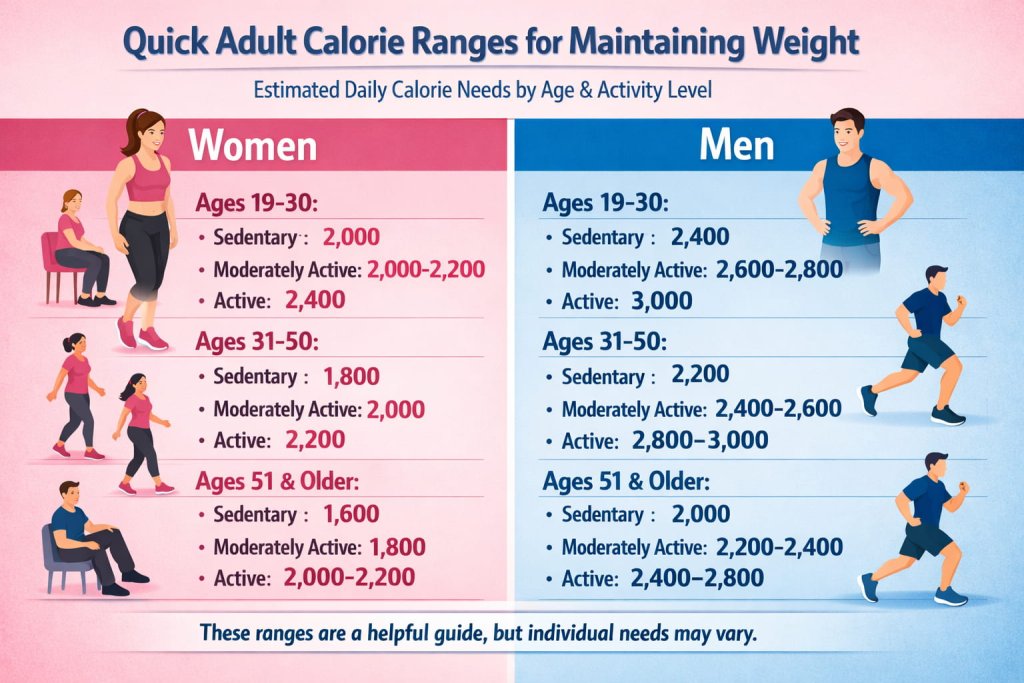
Quick Adult Calorie Ranges for Maintaining Weight

The NHLBI provides a practical chart for estimated daily calorie needs based on age and activity level.
Women
For adult women, estimated daily calorie needs are:
- Ages 19 to 30: about 2,000 if sedentary, 2,000 to 2,200 if moderately active, and about 2,400 if active
- Ages 31 to 50: about 1,800 if sedentary, about 2,000 if moderately active, and about 2,200 if active
- Ages 51 and older: about 1,600 if sedentary, about 1,800 if moderately active, and about 2,000 to 2,200 if active
Men
For adult men, estimated daily calorie needs are:
- Ages 19 to 30: about 2,400 if sedentary, 2,600 to 2,800 if moderately active, and about 3,000 if active
- Ages 31 to 50: about 2,200 if sedentary, 2,400 to 2,600 if moderately active, and 2,800 to 3,000 if active
- Ages 51 and older: about 2,000 if sedentary, 2,200 to 2,400 if moderately active, and 2,400 to 2,800 if active
These ranges are useful as a quick reference, but they still do not replace a personal estimate.
Activity level labels are easy to misjudge, so it helps to define them. According to NHLBI, sedentary means only the light movement of normal daily life. Moderately active means activity roughly equal to walking about 1.5 to 3 miles a day at a moderate pace, in addition to normal daily life. Active means activity roughly equal to walking more than 3 miles a day at that pace.
What Changes Your Maintenance Calories
The biggest drivers of maintenance calories are your body size and activity level, but they are not the only ones. The CDC notes that age, sleep, genes, medications, medical conditions, and environment can also influence body weight. Older adults also tend to lose muscle and become less active over time, which can lower calorie needs.
Physical activity matters because it increases the number of calories your body uses. The CDC also notes that people vary a lot in how much activity they need for weight management, so two people with the same calorie intake may not maintain the same weight.
The Best Way to Estimate How Many Calories to Maintain Weight
The most useful starting point is a personalized calculator rather than a generic chart. The NIDDK Body Weight Planner creates personalized calorie and physical activity plans and can also estimate what is needed to maintain weight afterward.
Another helpful tool is USDA MyPlate Plan. The CDC explains that MyPlate Plan calculates daily calories needed to maintain your current weight using your age, sex, height, weight, and physical activity level, then shows recommended daily amounts from the major food groups for that calorie level.
In real life, a calculator gives you a starting estimate, not a perfect answer on day one. If your weight trend is staying roughly level, your estimate is probably close to maintenance. If it keeps trending up or down, your real maintenance level is likely different from the estimate and may need a small adjustment. That is a practical way to understand calorie balance over time.
A practical next step is to track your weight regularly under similar conditions and watch the trend over time. NIDDK recommends keeping track of your weight, because that is what helps turn a calculator estimate into a real maintenance target. If your weight stays fairly stable over the next few weeks, your intake is probably close to maintenance. If it keeps trending up or down, your actual maintenance calories are likely different from the estimate.
How Much Activity Helps Maintain Weight
The Office of Disease Prevention and Health Promotion says adults should aim for at least 150 to 300 minutes of moderate-intensity aerobic activity each week, plus muscle-strengthening activity at least 2 days a week. That is the general baseline for health.
For weight maintenance, some people may need more. The CDC says 150 minutes a week is a good place to start, but the exact amount needed to reach or maintain a healthy weight varies from person to person. People trying to keep lost weight off often need a higher amount of activity unless they also adjust calorie intake.
If your goal is to maintain a lower weight after losing weight, the activity target may be higher than the basic weekly minimum. According to NIDDK guidance on eating and physical activity, aiming for at least 300 minutes a week of moderate-intensity physical activity may help prevent weight regain. That gives readers a more practical benchmark for long-term maintenance after weight loss.
Food Quality Still Matters at Maintenance Calories
Maintenance is not just about eating the right number. The Dietary Guidelines for Americans recommend a healthy eating pattern that emphasizes vegetables, fruits, whole grains, lean proteins, seafood, beans, peas, lentils, nuts, seeds, and fat-free or low-fat dairy or fortified soy alternatives. The guidelines also recommend limiting added sugars to less than 10% of calories per day, saturated fat to less than 10% of calories per day, and sodium to less than 2,300 milligrams per day.
That means two diets with the same calories can still affect how you feel, how full you stay, and how easy your routine is to maintain. The CDC notes that a healthy eating pattern for weight management should include a variety of nutritious foods and adequate nutrition, not just calorie counting alone.
Can You Maintain Weight Without Counting Calories?
Yes. The CDC says counting calories all the time is not necessary, although it can help to know your approximate needs. Many people maintain weight by using consistent meal patterns, paying attention to portions, staying active, and checking their weight trend from time to time instead of logging every bite forever.
For some people, though, even a short period of tracking can be useful. Writing down what you eat and drink can help you compare your routine with your estimated calorie needs and spot patterns that may be pushing intake higher than you realized.
Why You Might Gain Weight Even if Your Calories Seem Normal
A maintenance target can shift over time. Changes in activity, sleep, stress, aging, medications, hormones, and health conditions can all affect weight. The CDC specifically notes that sleep, age, genes, medications, and medical conditions can influence body weight, and NIDDK notes that regular physical activity is important for maintaining weight over time.
This is one reason a calorie number that worked last year may not work the same way now. If your weight is changing without a clear reason, or if you suspect a medication or medical issue is involved, it is smart to get personalized guidance rather than keep cutting or adding calories on your own.
Who Should Not Rely on Generic Calorie Charts Alone
Generic adult charts are a rough guide, not a diagnosis or a treatment plan. NIDDK states that its Body Weight Planner is for adults age 18 and older and is not for children, teens, or people who are pregnant or breastfeeding.
You should also get more individualized advice if you have a history of disordered eating, a chronic medical condition, major recent weight changes, or take medicines that affect appetite or weight. The CDC notes that some medical conditions and drugs, including steroids and some antidepressants, can contribute to weight gain.
FAQs
Is 2,000 calories enough to maintain weight?
Sometimes, yes. For some adults, 2,000 calories is close to maintenance. For others, it is too low or too high. Official charts show that 2,000 calories can be a sedentary maintenance level for some adult women, a moderately active level for some women, and a sedentary level for some older men, but it is not a universal maintenance number.
What is the most accurate way to find maintenance calories?
A personalized calculator is usually the best starting point. NIDDK’s Body Weight Planner and USDA’s MyPlate Plan are two of the strongest official options because they use your personal details instead of a one-size-fits-all average.
Do I need exercise to maintain weight?
Physical activity is not the only factor, but it is a major one. Federal guidelines recommend regular aerobic activity and strength work for health, and the CDC notes that being physically active can help you maintain a healthy weight.
The Bottom Line on How Many Calories to Maintain Weight
How many calories to maintain weight is personal. A broad adult estimate may put you somewhere between 1,600 and 3,000 calories a day depending on sex, age, and activity, but the most useful answer comes from a personalized calculator and your real-world weight trend. Start with an official estimate, build meals around a healthy eating pattern, stay active, and adjust only when your trend shows you need to.
If you want a more accurate number, use an official calculator first, then match it to what your body is doing over the next few weeks instead of relying on a random online guess.
This content is for informational purposes only and not medical advice.
Sources and References
- CDC — Tips for Maintaining Healthy Weight
- NHLBI — Following DASH
- NIDDK — Body Weight Planner
- NIDDK — Eating and Physical Activity
- Office of Disease Prevention and Health Promotion — Physical Activity Guidelines for Americans
- Dietary Guidelines for Americans — Dietary Guidelines for Americans, 2020–2025