
Mullein leaf is a traditional herbal remedy mainly used for cough and chest-throat comfort, but modern clinical evidence is limited, and it should not be treated as a proven therapy for respiratory disease. That is the most important thing to understand before you buy or use it. The details that matter most are the exact plant part, the type of product, the safety warnings, and whether your symptoms need real medical care instead of self-treatment.
What Is Mullein Leaf?
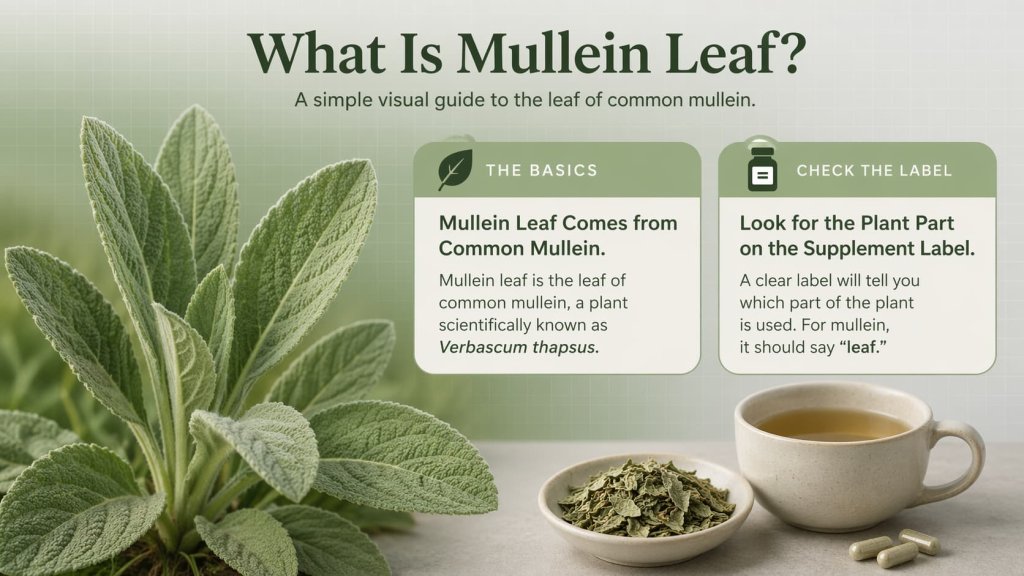
Mullein leaf usually refers to the leaf of common mullein, Verbascum thapsus. In supplements, the plant part matters because U.S. labeling rules require the Supplement Facts panel to identify which part of the plant is used. That means “mullein leaf” and “mullein flower” are not automatically the same thing, even when both products are sold under the broader name “mullein.” See the USDA PLANTS profile for Verbascum thapsus and the FDA dietary supplement labeling guide.
What Is Mullein Leaf Traditionally Used For?
The clearest official support for mullein leaf is traditional use, not high-quality modern proof. A licensed Health Canada product entry for Verbascum thapsus describes it as traditionally used in herbal medicine as an expectorant to help relieve chest complaints such as catarrh, coughs, and bronchitis. That tells you how regulators have allowed certain traditional-use products to be described, but it does not mean mullein leaf has strong clinical trial evidence behind all of those uses.
Mullein Leaf vs. Mullein Flower
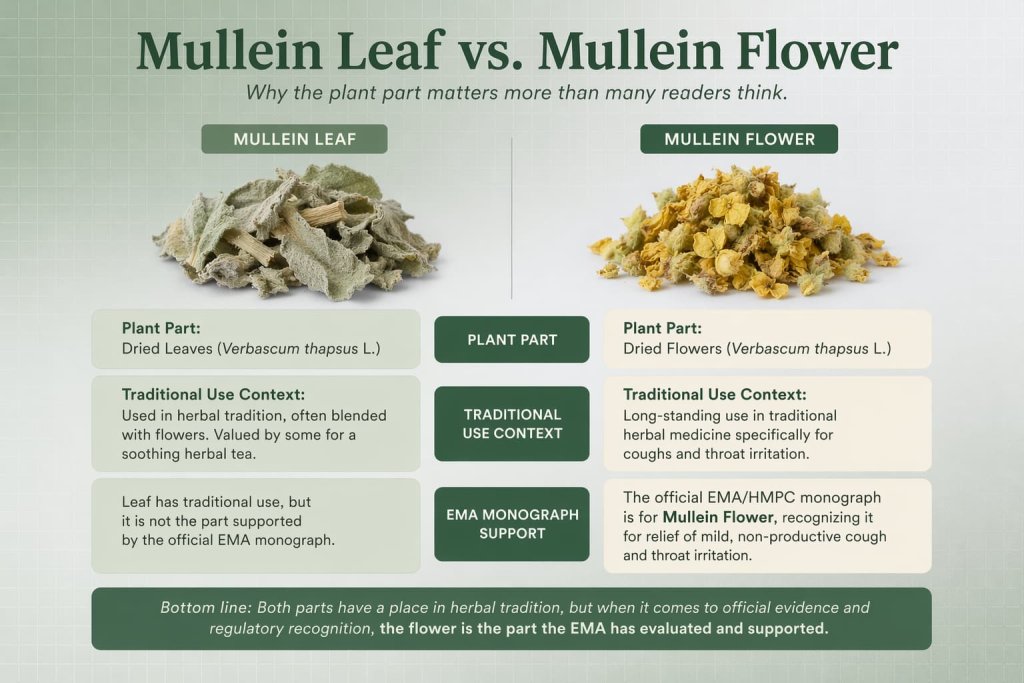
This is where many articles get sloppy. The current official European Medicines Agency herbal monograph is for mullein flower, not leaf. Its accepted traditional indication is relief of sore throat associated with dry cough and cold, and the monograph says this traditional use is based on long-standing use rather than well-established clinical evidence.
The EMA’s assessment report also notes that older herbal references included leaves and stems, and that the British Herbal Pharmacopoeia 1996 had a monograph for mullein leaf. But the current EU monograph still supports flower, not leaf. In practical terms, that means mullein leaf has historical and traditional use behind it, but the most formal current European monograph support is narrower and tied to flower.
Potential Benefits of Mullein Leaf
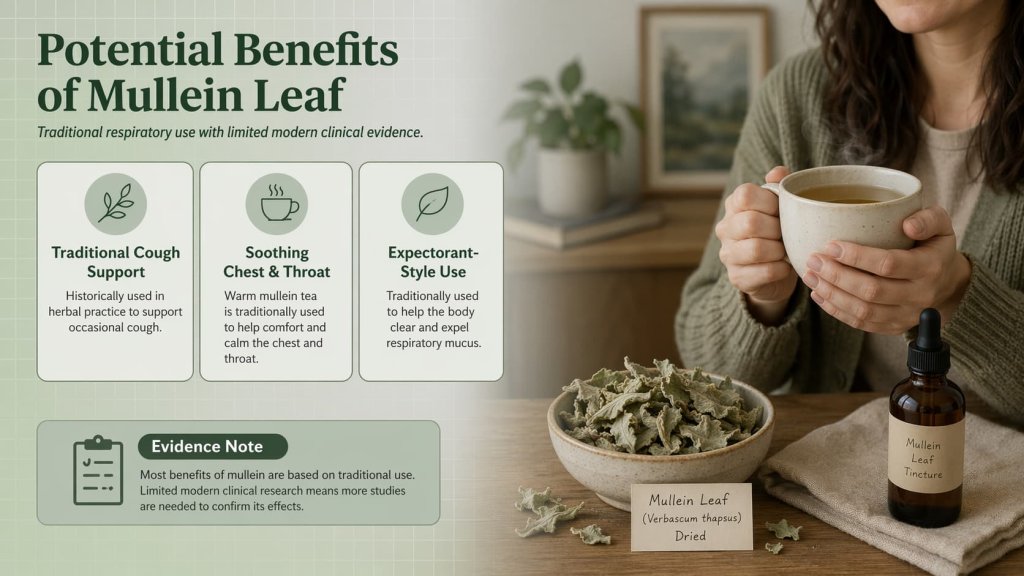
Mullein leaf may support traditional cough and mucus-clearing use
Based on the Health Canada traditional-use product listing, mullein leaf is most reasonably described as a traditional herb people use for cough-related chest complaints and expectorant-style support. That is the safest, most evidence-aligned way to describe its potential benefit. It may fit readers looking for a traditional herbal option, especially when they want short-term symptom support rather than sweeping health promises.
The evidence for mullein leaf is still limited
You should keep expectations realistic. In the EMA assessment report, even mullein flower did not have clinical efficacy data supporting well-established medicinal use. The report says no clinical studies were found and that there are no clinical pharmacology or efficacy data for mullein flower. Since current official support is stronger for flower than leaf, it is fair to say the evidence base for mullein leaf is limited and largely traditional.
What the Evidence Really Says About Mullein Leaf
Mullein leaf should not be presented as a proven treatment for bronchitis, lung infection, asthma, COPD, or any other diagnosed respiratory disease. In the U.S., the FDA’s questions and answers on dietary supplements explain that supplements are not approved like drugs before sale and are not intended to diagnose, treat, cure, or prevent disease. The NIH Office of Dietary Supplements consumer guide also notes that dietary supplements are not medicines and are regulated differently from drugs.
That matters because mullein leaf often sounds more established online than it really is. The evidence supports a traditional herbal use story, not a strong modern clinical one. For readers, the practical takeaway is simple: mullein leaf may be reasonable as a modest, traditional supplement, but it is not a substitute for diagnosis, prescription treatment, or medical follow-up when symptoms are persistent or severe.
Is Mullein Leaf Safe?
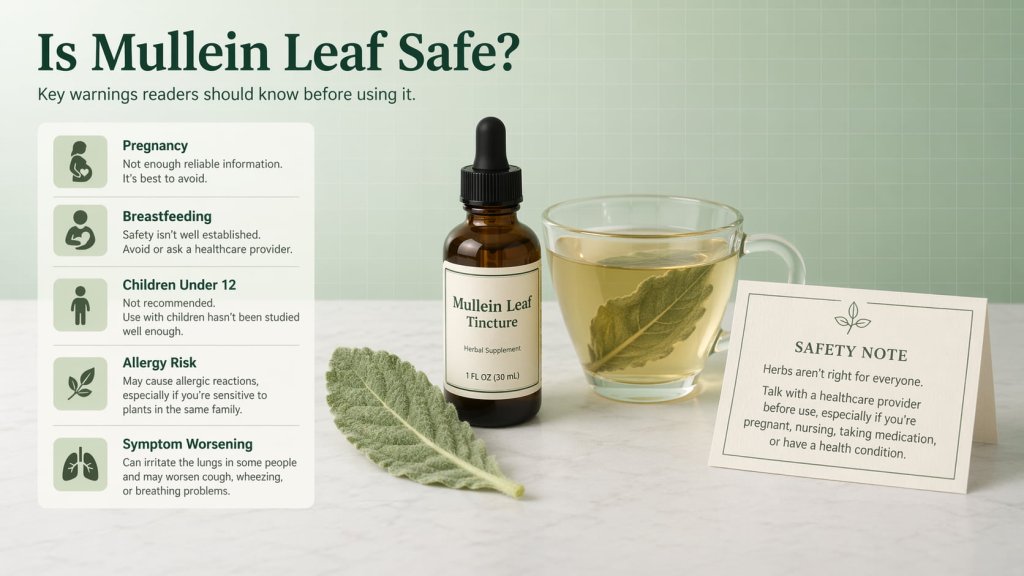
Safety is where caution matters most. The EMA monograph for mullein flower says use is not recommended during pregnancy or lactation, is not recommended in children under 12, and is contraindicated in people with hypersensitivity to the herb. The Health Canada mullein leaf tincture entry likewise says do not use if you are pregnant or breastfeeding and advises consulting a healthcare practitioner if symptoms persist or worsen.
Just as important, the EMA monograph says a clinician should be consulted if symptoms last longer than 1 week, get worse, or are accompanied by dyspnea, fever, or purulent sputum. Those are red flags because they can point to conditions that need proper medical evaluation rather than self-care with an herb.
Safety box
Be extra careful with mullein leaf if you are:
- pregnant or breastfeeding
- giving it to a child
- allergic to mullein or related botanicals
- taking prescription or over-the-counter medicines
- dealing with breathing trouble, fever, or worsening respiratory symptoms
When Mullein Leaf Is Not Enough
Mullein leaf is not the right response to every cough. See a healthcare professional sooner rather than later if you have shortness of breath, chest pain, bloody mucus, repeated episodes of bronchitis, fever that lasts more than 5 days or is very high, or a cough that lasts more than 3 weeks. Those symptoms can point to a condition that needs medical evaluation rather than self-treatment with an herbal product, as CDC guidance on acute bronchitis makes clear.
Possible Side Effects and Interactions

One challenge with mullein leaf is that the side-effect profile is not well defined in strong human studies. The EMA assessment report says safety data are limited and nonclinical safety data are scarce. Lack of strong safety data does not mean an herb is unsafe by default, but it also does not mean it is risk-free.
Interactions are another gray area. The EMA monograph lists no reported interactions for mullein flower, but broader NCCIH guidance on herb-drug interactions warns that supplements can either decrease the effects of medicines or increase side effects, and that for many herbs there is still too little interaction research. That is a good reason to tell your doctor or pharmacist about any mullein leaf product you use, especially if you take regular medication.
Also remember that a mullein product may contain more than mullein. For example, the licensed Health Canada tincture lists grain alcohol and purified water as non-medicinal ingredients. Other commercial products may differ. In real life, the full ingredient list matters just as much as the herb name on the front label.
If you think mullein leaf caused a bad reaction, stop using the product and contact a health professional. You can also report the reaction to the manufacturer using the contact information on the label, and a report can be submitted to FDA. That makes it easier to identify product problems and helps protect other consumers, according to NIH ODS consumer guidance.
How to Choose a Mullein Leaf Product
If you decide to try mullein leaf, read the label like a careful buyer, not like a hopeful shopper.
Look for these details:
- the exact plant part, such as leaf rather than just “mullein”
- the serving size and amount per serving in the Supplement Facts panel
- all other ingredients, including sweeteners, alcohol, fillers, or blended herbs
- disease-style claims that should raise skepticism
- quality testing or verification language from independent programs
The FDA says the plant part must be listed in the Supplement Facts panel for botanical supplements, and the ODS frequently asked questions page explains that independent seals such as NSF, USP, and ConsumerLab may indicate identity and quality testing, but they do not guarantee that a product is safe or effective.
How to Use Mullein Leaf Safely
There is no single evidence-based mullein leaf dose that applies to every product. Tea, tincture, capsules, and powders can vary a lot in strength and preparation, so the safest approach is to follow the product label instead of copying directions from a different format. For example, one licensed Health Canada mullein fluid extract lists an adult dose of 0.8 to 1.3 mL three times daily, while the official EMA monograph gives infusion directions for mullein flower, not mullein leaf. In practice, that means a mullein leaf tincture, a mullein leaf tea, and a mullein flower infusion should not be treated as interchangeable.
Who Mullein Leaf May Be For
Mullein leaf may appeal to adults who:
- want a traditional herbal product for short-term cough or chest-throat comfort
- understand that the evidence is limited
- are willing to use it as a supplement, not as a replacement for medical care
- can review labels carefully and choose reputable products
Who Should Be Careful Before Using Mullein Leaf
You should be more cautious, or skip it unless a clinician says otherwise, if you are:
- pregnant or breastfeeding
- under 12
- managing a chronic illness
- taking medicines with important interaction risks
- preparing for surgery
- dealing with worsening cough, shortness of breath, fever, or mucus that looks infected
The NIH Office of Dietary Supplements advises people to tell healthcare providers about all supplements they use, and NCCIH notes that some medication-supplement interactions can be serious.
Can You Smoke Mullein Leaf?
Smoking mullein leaf is not a smart “lung cleanse” strategy. The American Cancer Society says even herbal cigarettes with no tobacco still give off tar, particulates, and carbon monoxide. So even if a product is plant-based, inhaling burned plant material is not the same thing as supporting lung health.
FAQ About Mullein Leaf
Is mullein leaf good for lungs?
Mullein leaf has a history of traditional respiratory use, but that is not the same as proof that it improves lung disease. The evidence is limited, and it should not replace medical treatment for asthma, infection, COPD, or other serious breathing problems.
Is mullein leaf tea the same as mullein flower tea?
No. The plant part matters. Current official EMA support is for flower, while some historical and traditional sources also describe leaf use. Always check the label so you know which plant part you are actually buying.
How long should you use mullein leaf?
There is no strong modern clinical standard for long-term mullein leaf use. The safest approach is to follow the product label and get medical advice if symptoms last more than a week, worsen, or come with shortness of breath, fever, or purulent sputum.
Is mullein leaf approved by the FDA?
Dietary supplements are regulated by the FDA, but they are not approved like drugs before sale. A mullein leaf supplement is not the same thing as an FDA-approved medicine.
Conclusion
Mullein leaf is best understood as a traditional herbal product with limited modern evidence. It may fit short-term, cautious use for adults who want a traditional cough-support herb, but the plant part, label details, safety warnings, and symptom severity all matter. Read the label carefully, avoid exaggerated claims, and talk with a qualified health professional if you take medicines, are pregnant, or have symptoms that are not improving.
This content is for informational purposes only and not medical advice.