
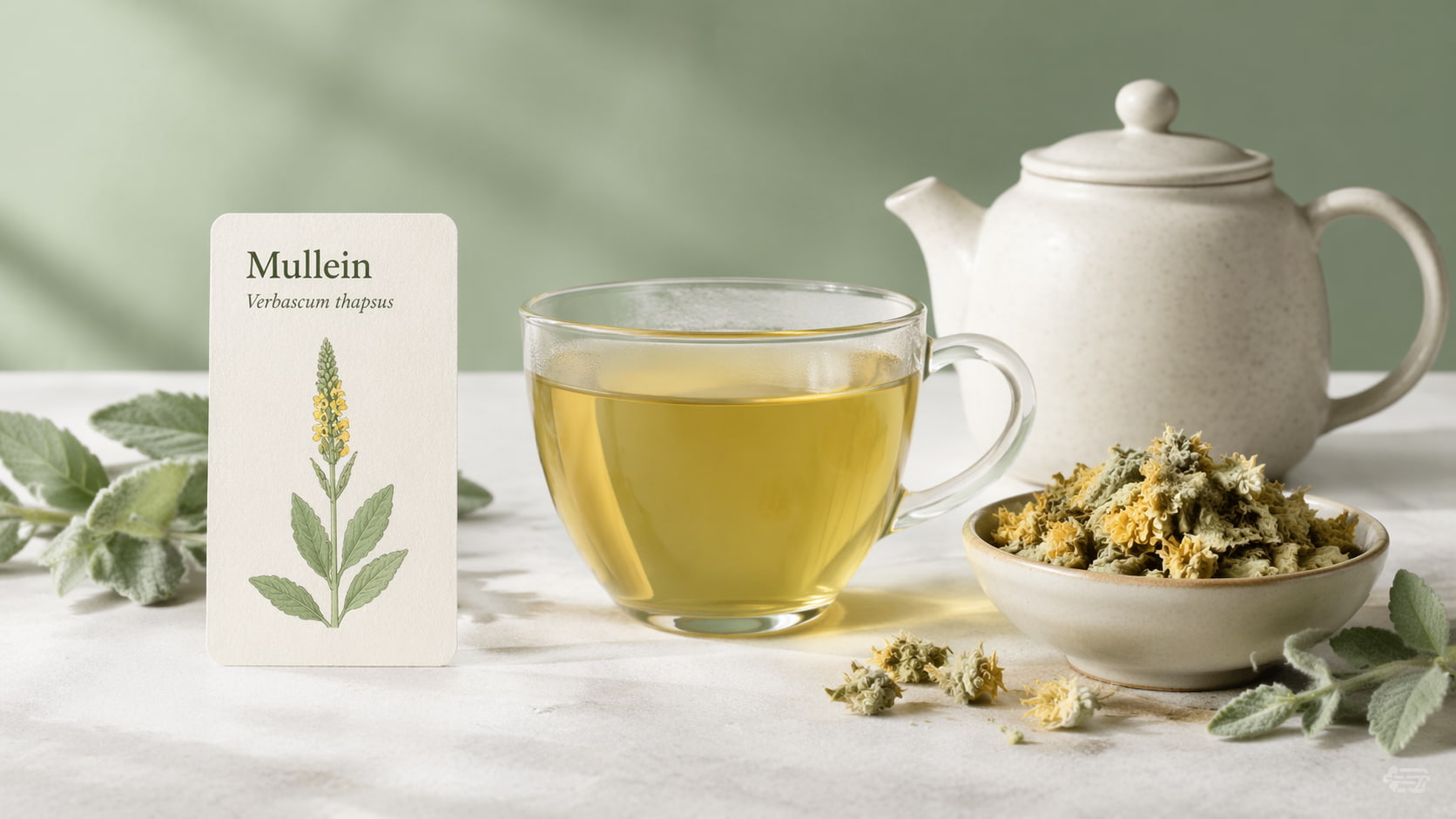
Mullein tea is best understood as a traditional herbal tea used mainly for temporary sore-throat comfort linked to dry cough and colds, not as a proven modern treatment. That distinction matters because the strongest official guidance applies to mullein flower tea, and current authorities do not treat mullein as a clinically proven remedy for broad lung or respiratory conditions. According to the European Medicines Agency, the recognized use is traditional and narrowly defined.
If you are researching mullein tea, the key things to know are simple:
- The plant part matters.
- The evidence is traditional rather than strongly clinical.
- The main safety questions involve children, pregnancy, breastfeeding, allergy risk, product labeling, and when symptoms need medical care.
What Is Mullein Tea?
Mullein tea is an herbal tea made from plants in the Verbascum genus. The most important official reference here is the European Medicines Agency monograph for mullein flower from Verbascum thapsus, V. densiflorum, and V. phlomoides, which specifically describes the flower as a traditional herbal tea for oral use.
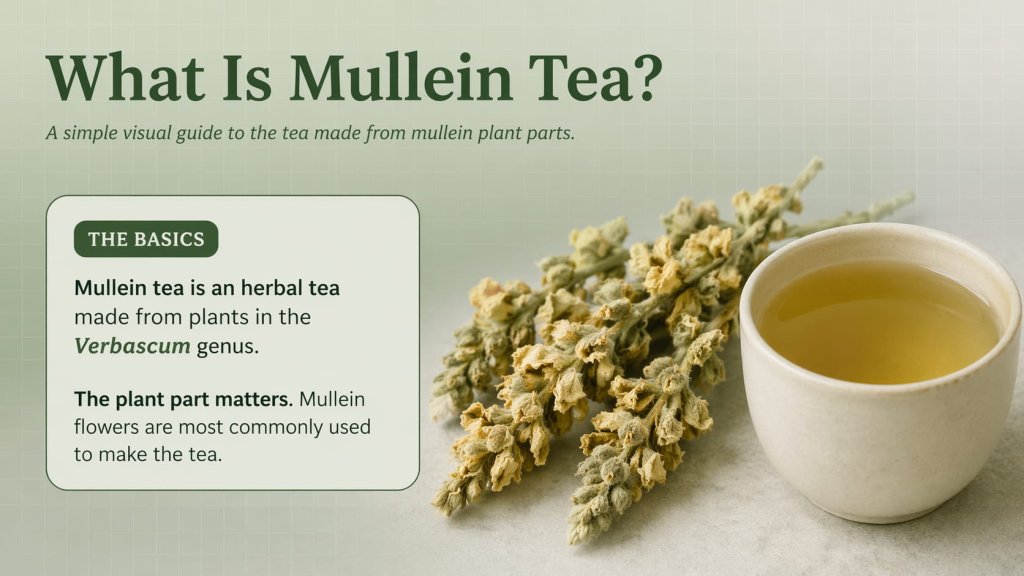
That means “mullein tea” is not always one uniform product.
- Some products use the flower.
- Some use the leaf.
- Some are blends.
From an evidence and policy standpoint, the clearest official traditional-use language applies to mullein flower tea, not automatically to every product sold under the name mullein.
What Is Mullein Tea Used For?
According to the EMA monograph, mullein flower tea is a traditional herbal medicinal product used to relieve symptoms of sore throat associated with dry cough and cold.
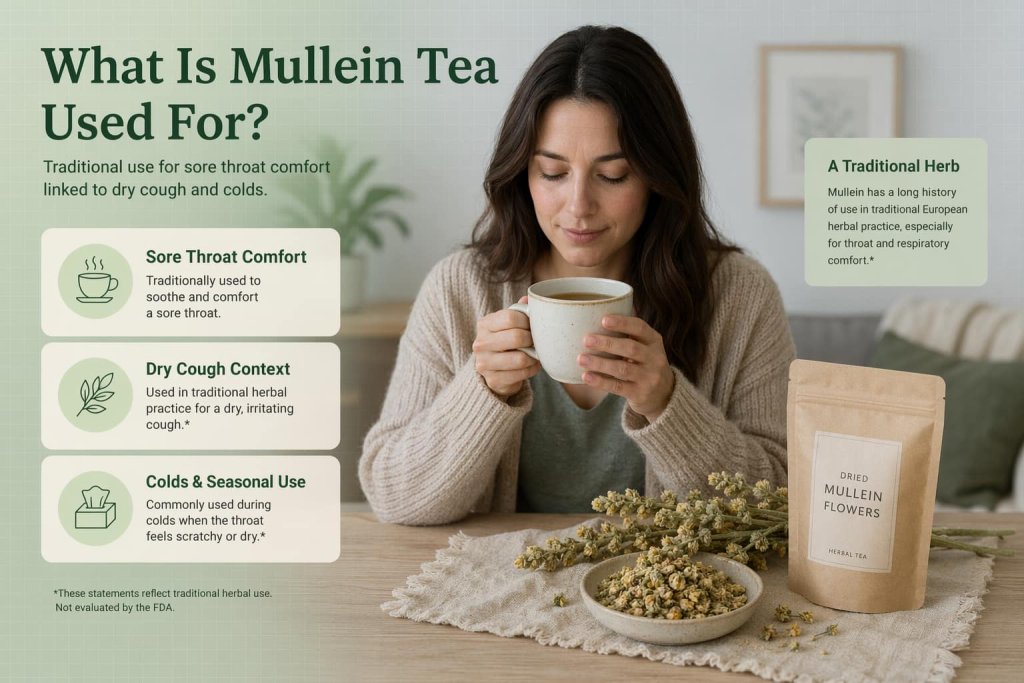
That official wording is narrower than many online claims. The EMA assessment report says there are no clinical data available to meet the standard for well-established medicinal use. In plain English:
- Mullein tea has a long history of traditional use.
- It does not have strong modern clinical proof for a wide range of health claims.
Potential Benefits of Mullein Tea
The most supportable way to describe mullein tea’s potential benefits is conservative. It may help with short-term throat comfort when dry cough and a cold are part of the picture, because that is the traditional use recognized by EMA.
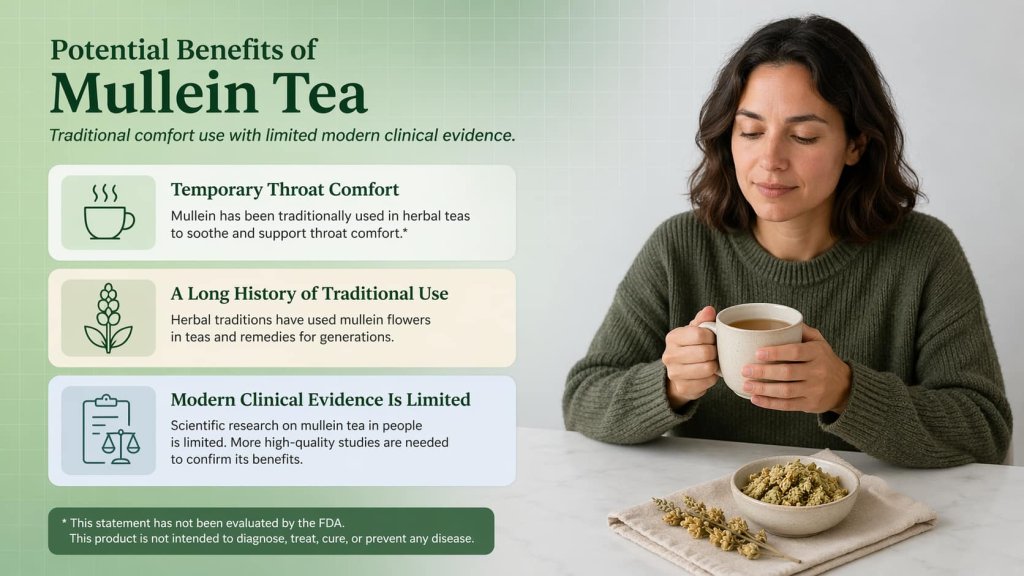
It is just as important to be clear about what the evidence does not show.
- It is not established as a proven treatment for infections.
- It is not established as a proven treatment for chronic lung disease.
- It is not established as a proven treatment for asthma.
- It should not be presented as a proven remedy for other serious respiratory problems.
The official EMA position remains based on long-standing traditional use, and the assessment report states that adequate clinical data are not available.
Mullein Tea vs. Mullein Leaf Tea
This is one of the biggest points readers miss. The strongest official monograph is for mullein flower, not generic “mullein” in every form.
So if a package says only “mullein tea” or “mullein leaf tea,” do not assume it carries the exact same official traditional-use support as mullein flower tea.
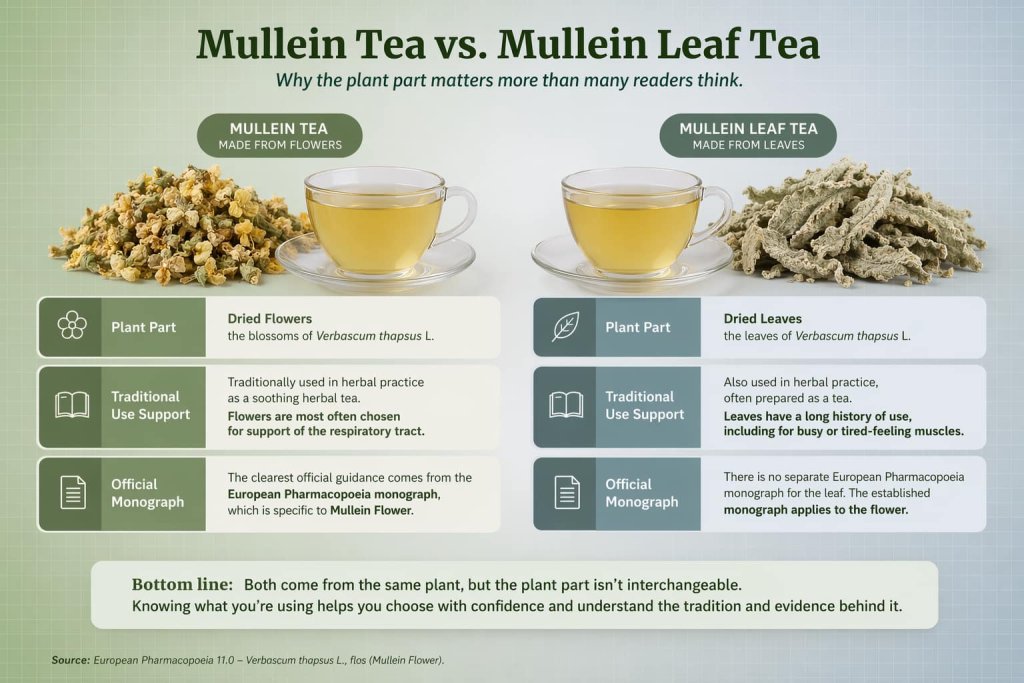
That does not automatically mean leaf tea is unsafe. It means:
- The official evidence base is not identical.
- The official wording is not identical.
- The plant part should be checked carefully before assuming a product matches the monograph.
How to Prepare Mullein Tea
For mullein flower tea, official traditional-use guidance gives a specific preparation range. Here is the clearest way to present it:
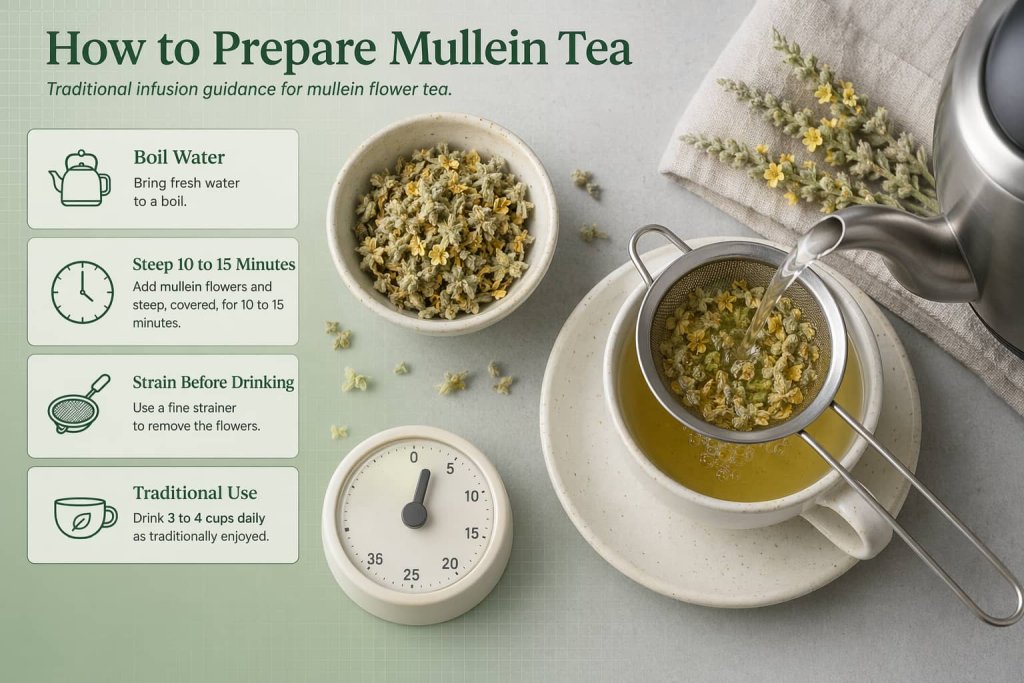
- Use 1.5 to 2 grams of mullein flower in 150 mL of boiling water.
- Steep for about 10 to 15 minutes.
- Strain before drinking.
- Drink 3 to 4 cups per day.
- The EMA monograph lists a daily total of 4.5 to 8 grams, divided across those cups.
- This guidance applies to adolescents over 12, adults, and older adults.
This is meant for short-term use, not ongoing daily use for chronic symptoms.
- If symptoms last longer than 1 week, consult a doctor or qualified healthcare practitioner.
- If the same symptoms keep returning, get medical advice instead of continuing to self-treat.
It is also important to treat this as guidance for mullein flower tea, not every mullein product.
- Commercial teas, tinctures, and supplement blends may use different amounts.
- Some products use different plant parts.
- Some include additional ingredients, so label directions still matter.
Is Mullein Tea Safe?
The current EMA monograph does not list known side effects in its traditional-use section, and the EMA assessment report says no cases of overdose from mullein flower have been reported. The same report concludes that mullein flower can be recognized as safe when used in recommended dosages under the specified conditions.
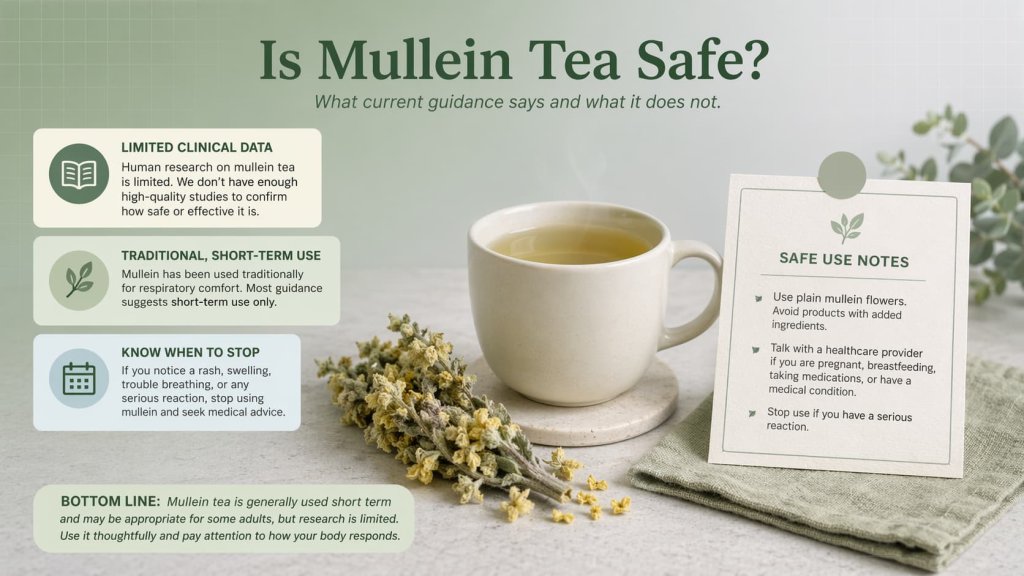
Still, that is not the same as saying every safety question is fully settled.
- There are no adequate clinical data available.
- Limited evidence is not the same as proof of zero risk.
One practical point is what to do if a problem happens.
- Stop using the product right away if it seems to cause a serious reaction or illness.
- The U.S. Food and Drug Administration advises consumers to report serious problems through the Safety Reporting Portal.
- If the product is sold as a dietary supplement, the label should include a domestic address or phone number for reporting serious adverse events to the manufacturer or distributor.
Who Should Be Careful With Mullein Tea?
Some groups should be more cautious with mullein tea, especially when safety data are limited.
- Children under 12: Use is not recommended because adequate data are lacking.
- Pregnancy and lactation: Use is not recommended because safety has not been established.
- People with hypersensitivity or allergy: Anyone allergic to the active substance should avoid it.
Some symptoms are more important than self-treating with tea.
- Get medical help if symptoms worsen.
- Get medical help if shortness of breath, fever, or purulent sputum occur.
Medication use also deserves attention. The EMA assessment report says no mullein-specific drug interaction data were found, but the National Center for Complementary and Integrative Health notes that herbal products can interact with medicines in harmful ways.
- Tell your healthcare provider about all medicines and supplements you take.
- Do not assume “herbal” always means risk-free with medications.
How to Choose a Mullein Tea Product
The first thing to check is the plant part. For this topic, that matters more than many readers realize.
- Look for mullein flower if you want the product that most closely matches the official EMA monograph.
- Do not rely on a vague “mullein” label alone.
If the product is sold as a dietary supplement in the United States, the FDA says the label should include key details that help you compare products more accurately.
- A Supplement Facts panel
- The serving size
- The number of servings per container
- Each dietary ingredient
- An Other Ingredients list, when applicable
These details help you see whether the product contains only mullein or also includes sweeteners, herbs, fillers, or other added ingredients.
It also helps to compare the actual amount per serving instead of relying on the front label.
- FDA notes that serving size and the amount of a dietary ingredient per serving are generally set by the manufacturer.
- Front-of-package wording may sound stronger than what the label actually shows.
Some claims should make you more cautious.
- Be careful with products that claim to treat bronchitis, clear infections, or heal the lungs.
- Those claims sound more like drug claims than supplement claims.
FDA also says that dietary supplements making structure/function claims must carry a disclaimer.
- The claim has not been evaluated by FDA.
- The product is not intended to diagnose, treat, cure, or prevent any disease.
It is also worth remembering that FDA does not approve dietary supplements for safety and effectiveness before they are marketed.
- Read labels carefully.
- Stay skeptical of broad or dramatic health promises.
When to See a Doctor Instead of Relying on Mullein Tea
Mullein tea is a short-term traditional option, not a substitute for evaluation when symptoms are more concerning.
Get medical advice if:
- Symptoms last more than 1 week
- Symptoms worsen
- You develop shortness of breath
- You develop fever
- You develop purulent sputum
That is especially important for persistent cough, breathing difficulty, or recurrent symptoms. In those situations, the safer move is to treat mullein tea as secondary at most, not as the main response.
Is Mullein Tea FDA Approved?
No. In the United States, herbs and other dietary supplements are not FDA-approved to treat or prevent disease, and FDA does not approve dietary supplements for safety and effectiveness before they are sold.
That does not automatically mean a mullein product is unsafe. It does mean:
- Consumers should not mistake supplement marketing for drug-style approval.
- Readers should be cautious about any product that sounds like a cure or quick fix.
FAQ About Mullein Tea
Is mullein tea good for cough?
The best-supported answer is that mullein flower tea has a traditional use for sore throat associated with dry cough and cold. That is narrower than saying it is a proven cough treatment in general.
Can you drink mullein tea every day?
Current official guidance supports short-term traditional use, not open-ended daily use for everyone.
- If symptoms continue beyond 1 week, get medical advice.
- Do not treat mullein tea as an indefinite self-care solution for ongoing symptoms.
Is mullein tea the same as mullein flower tea?
Not always.
- “Mullein tea” may refer to flower tea.
- It may refer to leaf tea.
- It may refer to a mixed product.
The clearest official monograph applies to mullein flower.
Does mullein tea have proven clinical benefits?
Not in the strong modern sense. The EMA assessment report says there are no clinical data available to establish well-established medicinal use, so the recognized use remains traditional rather than strongly clinical.
Conclusion
Mullein tea can be a reasonable option to explore if you want a traditional herbal tea for short-term throat comfort with dry cough and colds, but it should be described carefully.
The most important takeaways are simple:
- The strongest official support is for mullein flower tea.
- The evidence is traditional rather than strongly clinical.
- Important cautions apply to children under 12, pregnancy, breastfeeding, allergies, product labeling, and worsening symptoms.
If you plan to try mullein tea, choose a clearly labeled product, check the plant part, follow the package directions, and do not ignore symptoms that persist or get worse. That approach is much safer than assuming every “mullein” product means the same thing.
Safety Box
Mullein tea is not a replacement for medical care when breathing symptoms, fever, or worsening illness are present.
- Avoid using it during pregnancy or breastfeeding unless a clinician advises otherwise.
- Do not give it to children under 12 based on current EMA guidance.
This content is for informational purposes only and not medical advice.
References
- European Medicines Agency — Verbasci flos – herbal medicinal product
- European Medicines Agency — European Union herbal monograph on Verbascum thapsus L., V. densiflorum Bertol. (V. thapsiforme Schrad) and V. phlomoides L., flos
- European Medicines Agency — Assessment report on Verbascum thapsus L., V. densiflorum Bertol. (V. thapsiforme Schrad) and V. phlomoides L., flos
- U.S. Food and Drug Administration — Questions and Answers on Dietary Supplements
- U.S. Food and Drug Administration — 10 Facts about What FDA Does and Does Not Approve
- U.S. Food and Drug Administration — How to Report a Problem with Dietary Supplements
- National Center for Complementary and Integrative Health — 6 Tips: How Herbs Can Interact With Medicines