
Nattokinase may offer modest blood pressure support, but it is not proven to prevent blood clots, heart attack, or stroke. That is the most accurate evidence-based answer right now. Understanding that difference matters because nattokinase is sold as a supplement, not an FDA-approved cardiovascular treatment, and the biggest real-world issue is balancing possible benefit against bleeding risk, medication interactions, and overstated marketing claims.
In plain terms, the current picture looks like this:
- Best-supported benefit: modest blood pressure reduction in some studies
- Possible but unproven benefit: changes in clotting or fibrinolysis markers
- Not proven: preventing stroke, heart attack, deep-vein thrombosis, or replacing anticoagulants
- Biggest concern: bleeding risk and medication interactions, especially with aspirin or blood thinners
That summary matches the balance of current clinical evidence and official supplement guidance.
What Is Nattokinase?
Nattokinase is an enzyme derived from natto, a traditional Japanese food made from soybeans fermented with Bacillus subtilis. In supplements, it is usually marketed for circulation, heart health, or clot-related support, but those claims are broader than the strongest human evidence currently supports. A widely cited 2018 review on nattokinase explains its fibrinolytic background and why it has attracted so much cardiovascular interest.
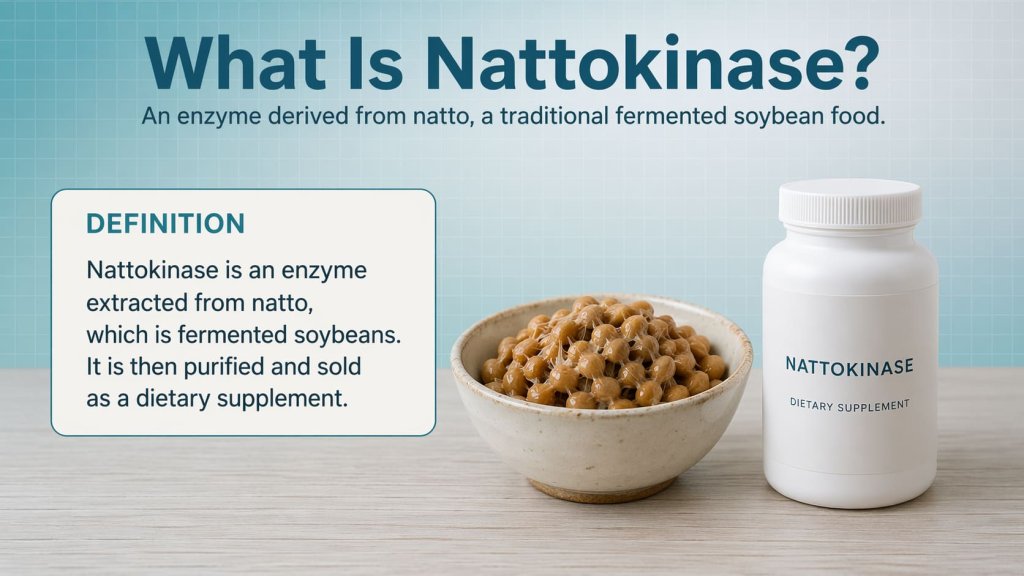
One practical distinction is easy to miss: natto the food and nattokinase supplements are not the same thing. Natto itself is high in vitamin K, which can interfere with warfarin, while nattokinase supplements are sold for the enzyme rather than as a vitamin K food source.
Even so, because nattokinase comes from fermented soybeans, people with natto or soy allergy should be cautious; severe allergic reactions have been reported in the medical literature and are also noted by Memorial Sloan Kettering Cancer Center and PubMed case literature.
Nattokinase Benefits With the Best Evidence
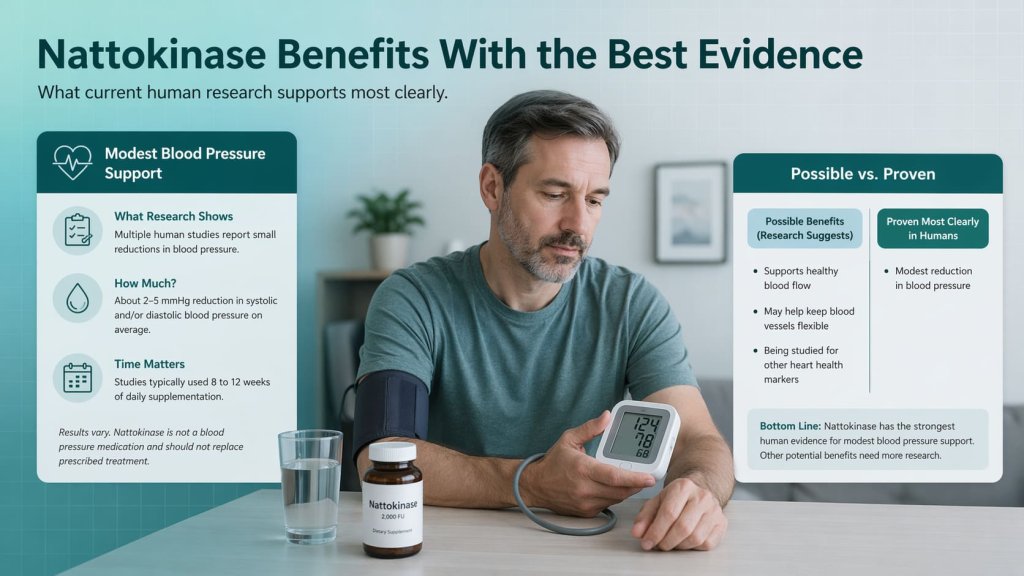
Nattokinase benefits for blood pressure look the most credible
The clearest potential benefit is blood pressure support. A randomized controlled trial published in PubMed in adults with prehypertension or stage 1 hypertension found that 2,000 FU daily for 8 weeks lowered systolic blood pressure by about 5.5 mmHg and diastolic pressure by about 2.8 mmHg compared with placebo.
A 2024 systematic review and meta-analysis reached a similar overall conclusion: pooled randomized trial data suggest a modest blood pressure-lowering effect, especially for systolic pressure.
That does not make nattokinase a replacement for standard hypertension care. Still, it does mean “may help support healthy blood pressure” is a more defensible claim than the much stronger promises often seen on supplement labels.
It may affect clot-related lab markers, but that is not the same as preventing clots
Researchers are interested in nattokinase because it appears to influence fibrinolysis and coagulation-related pathways. Some small studies and reviews describe favorable changes in markers linked to clot breakdown or vascular risk, and a 2024 trial in Frontiers in Nutrition found changes in several cardiometabolic and thrombosis-related markers in patients with stable coronary artery disease.
But that same trial found the strongest effects in the combined nattokinase-plus-red-yeast-rice group, which means the results cannot be credited to nattokinase alone.
This is an important line to keep clear in a health article: better lab markers can be promising, but they are not proof that a supplement lowers the risk of stroke, pulmonary embolism, or heart attack in everyday clinical use.
Benefits That Are Still Unproven
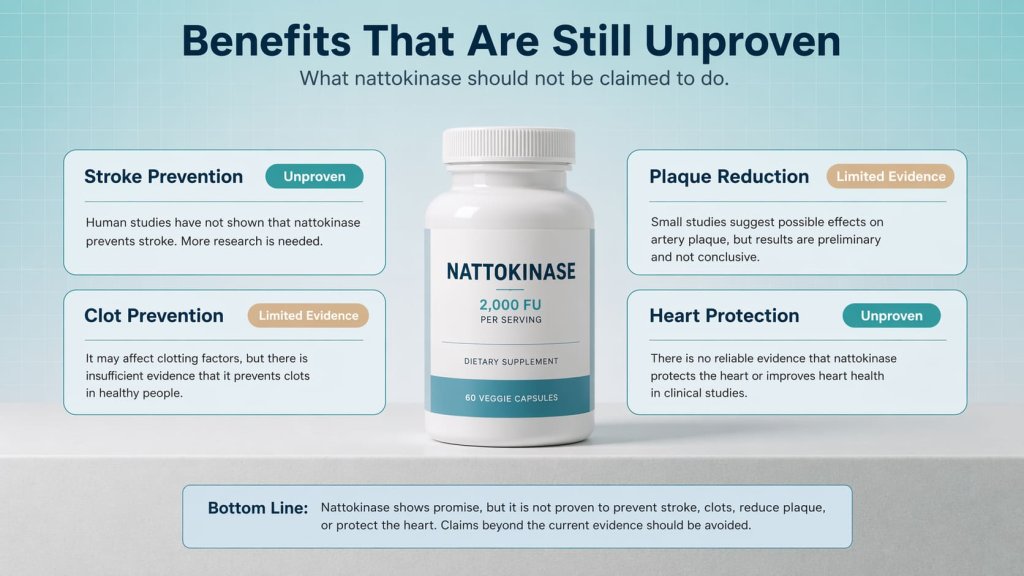
Nattokinase is not proven to prevent heart attack or stroke
Right now, the evidence is not strong enough to present nattokinase as a proven way to prevent major cardiovascular events. The studies are still relatively small, often use surrogate markers instead of hard outcomes, and do not establish that taking nattokinase changes long-term event rates.
The FDA’s dietary supplement guidance also makes clear that supplements cannot legally claim to diagnose, treat, cure, or prevent disease the way approved drugs can.
Plaque, cholesterol, and circulation claims are mixed
This is where nattokinase marketing often gets ahead of the evidence. Some publications report possible benefits for lipids or atherosclerosis, and some higher-dose research has looked encouraging. But the overall picture is inconsistent.
The Nattokinase Atherothrombotic Prevention Study found a null effect on subclinical atherosclerosis progression in healthy adults at low cardiovascular risk after long-term randomized treatment. The 2024 meta-analysis also did not show a clear lipid-lowering benefit at the relatively low doses used in many trials.
A more accurate way to say it is this: nattokinase may have cardiovascular potential, but claims that it “cleans arteries,” “dissolves dangerous clots,” or “protects against stroke” are not supported strongly enough to be presented as established facts.
Is Nattokinase a Natural Blood Thinner?
Not in the same sense as a prescribed anticoagulant or antiplatelet drug. Nattokinase may influence fibrinolysis and clot-related pathways, which is why it is often described as having blood-thinning or clot-support effects in consumer marketing.
But that does not mean it is a safe substitute for medications such as warfarin or other prescribed antithrombotic therapy. A PubMed Central review of oral antithrombotic effects discusses this area, but the clinical limits are important.
That distinction matters because there are published case reports of serious harm when people treated nattokinase like a medication alternative. A 2008 case report described acute cerebellar hemorrhage in a patient taking aspirin plus nattokinase.
Another case report described a patient who substituted nattokinase for warfarin after mechanical valve replacement and developed valve thrombosis. A later case report described fatal hemoperitoneum in an older adult using nattokinase.
Nattokinase Side Effects, Interactions, and Who Should Be Careful
The biggest safety concern is bleeding risk. Because nattokinase may affect clotting-related pathways, extra caution is warranted for anyone who already has a higher bleeding risk or takes medications that affect clotting. Official guidance from NCCIH and the FDA consumer update on mixing supplements and medications is especially relevant here.
People who should be especially careful include:
- anyone taking warfarin, apixaban, rivaroxaban, dabigatran, heparin, aspirin, or clopidogrel
- anyone with a bleeding disorder or a history of bleeding complications
- anyone preparing for surgery or a medical procedure
- anyone who is pregnant, breastfeeding, or choosing supplements for a child, because many dietary supplements have not been well tested in those groups
- anyone thinking about stopping a prescribed cardiovascular medicine and replacing it with a supplement
Red-Flag Warning:
Stop using nattokinase and seek urgent medical attention if you experience black or tarry stools, blood in vomit, unusual heavy bleeding, fainting, sudden severe headache, chest pain, shortness of breath, or stroke symptoms such as face drooping, arm weakness, or difficulty speaking.
The National Institute of Diabetes and Digestive and Kidney Diseases lists black stools and blood in vomit as signs of acute gastrointestinal bleeding, and the CDC advises urgent action for stroke symptoms.
How to Choose a Nattokinase Supplement More Carefully
If you are researching nattokinase products, the best approach is to focus on quality and honesty, not hype. Start with the Supplement Facts panel, check the exact dose, and be skeptical of products that promise to treat clots, reverse artery disease, or prevent stroke.
The FDA has specifically warned companies about illegally selling supplements with cardiovascular disease treatment claims.
It also helps to explain the dose more clearly. Nattokinase labels may use fibrinolytic units (FU) or milligrams, and those measures are not interchangeable at a glance. I
n human blood pressure research, a common studied amount was 2,000 FU daily for about 8 weeks, but there is no universally established standard dose for every goal, so a higher number on a label should not be assumed to mean a better or safer product.
This is the kind of detail readers need before comparing supplements. A 2024 review in PubMed Central adds context on composition, dosing, and the limits of current standardization.
It also helps to look for independent quality verification. The USP Dietary Supplement Verification Program is one example of third-party testing that checks whether a product contains what the label says and is made according to quality standards. That kind of seal does not prove the supplement works, but it can reduce some basic quality concerns.
A simple reality check is useful here: even a well-made supplement is still just a supplement. Good manufacturing and accurate labeling matter, but they do not turn nattokinase into an FDA-approved treatment for blood clots or heart disease.
Who Might Consider Nattokinase, and Who Probably Should Not
The most reasonable audience for nattokinase is an adult who wants to discuss a supplement with a clinician for general cardiovascular support, especially around mild blood pressure concerns, while understanding that the evidence is limited and modest. That is very different from using it to self-treat a serious clotting problem or to replace prescribed care.
It is a poor choice for anyone looking for a do-it-yourself alternative to anticoagulants, anyone with a meaningful bleeding risk, or anyone who wants certainty that the supplement will prevent cardiovascular events. On the current evidence, nattokinase simply does not support that level of confidence.
FAQ About Nattokinase Benefits
Does nattokinase really help with blood pressure?
Possibly, yes. That is the strongest potential benefit in the current human evidence. The effect appears modest rather than dramatic, and it does not replace standard blood pressure treatment or medical follow-up.
Does nattokinase dissolve blood clots?
It has fibrinolytic activity in research settings, but clinical proof that routine supplement use safely prevents or treats blood clots in patients is not established. That is why it should not be used instead of prescribed anticoagulants or emergency medical care.
Can nattokinase clean out arteries?
That claim is too strong. Some studies have explored plaque-related outcomes, but results are mixed, and a randomized prevention study found no benefit on subclinical atherosclerosis progression in low-risk adults.
Is nattokinase safe with aspirin or blood thinners?
Do not assume it is. Case reports and official supplement warnings support caution because combining supplements and medications can increase risk, including bleeding risk.
How long does nattokinase take to work?
The blood pressure trials that showed benefit generally ran for weeks, not days. That means any measurable effect, if it happens, is more likely to be gradual, and it still would not prove broader cardiovascular protection.
The Bottom Line on Nattokinase Benefits
Nattokinase is not useless, but it is also not the miracle cardiovascular supplement that many sales pages make it sound like. The best current evidence supports a possible modest benefit for blood pressure, while stronger claims about clot prevention, plaque reversal, and major heart protection remain unproven.
The safest next step is to treat nattokinase like any other biologically active supplement: check the evidence, avoid disease-treatment claims, and review it with a clinician or pharmacist before using it, especially if you take medications or have any bleeding risk.
Safety note: Because nattokinase may affect clotting-related pathways, get medical advice before using it if you take blood thinners, use aspirin regularly, have surgery planned, or have a history of bleeding problems.
This content is for informational purposes only and not medical advice.
References
- FDA — FDA Issues Warning Letters to Companies Selling Dietary Supplements that Claim to Treat Cardiovascular Disease
- PubMed — Nattokinase Supplementation and Cardiovascular Risk Factors: A Systematic Review and Meta-Analysis of Randomized Controlled Trials
- PubMed — Effects of nattokinase on blood pressure: a randomized, controlled trial
- PubMed — Nattokinase atherothrombotic prevention study
- Frontiers in Nutrition — Lipid-lowering, antihypertensive, and antithrombotic effects of nattokinase combined with red yeast rice in patients with stable coronary artery disease: a randomized, double-blinded, placebo-controlled trial
- PubMed Central — Nattokinase: A Promising Alternative in Prevention and Treatment of Cardiovascular Diseases