
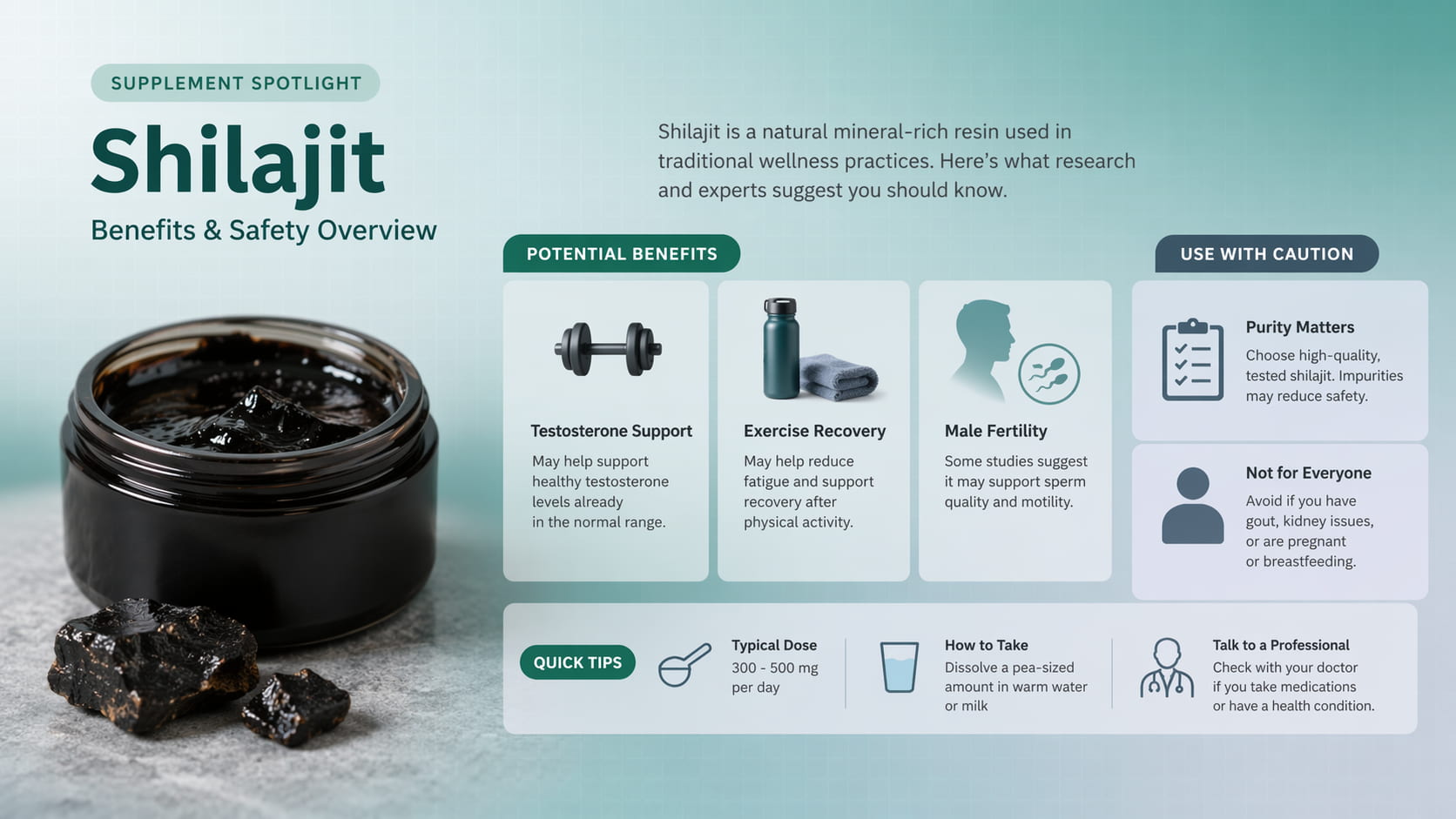
Shilajit may offer some benefits, but the evidence is still limited and product safety matters as much as the claimed effects. The most useful human research points to possible benefits for testosterone, exercise-related strength retention, and male fertility in specific groups, but official safety sources also warn about contamination risks, especially heavy metals, and emphasize that supplement quality can vary widely. OPSS, the FDA, and NCCIH all support a careful, evidence-first approach.
What Is Shilajit?
Shilajit is a blackish-brown, tar-like substance that seeps from rocks and is used in traditional Ayurvedic medicine. It is commonly sold as resin, paste, powder, tablets, or capsules and is often marketed for energy, stamina, vitality, memory, and testosterone support.
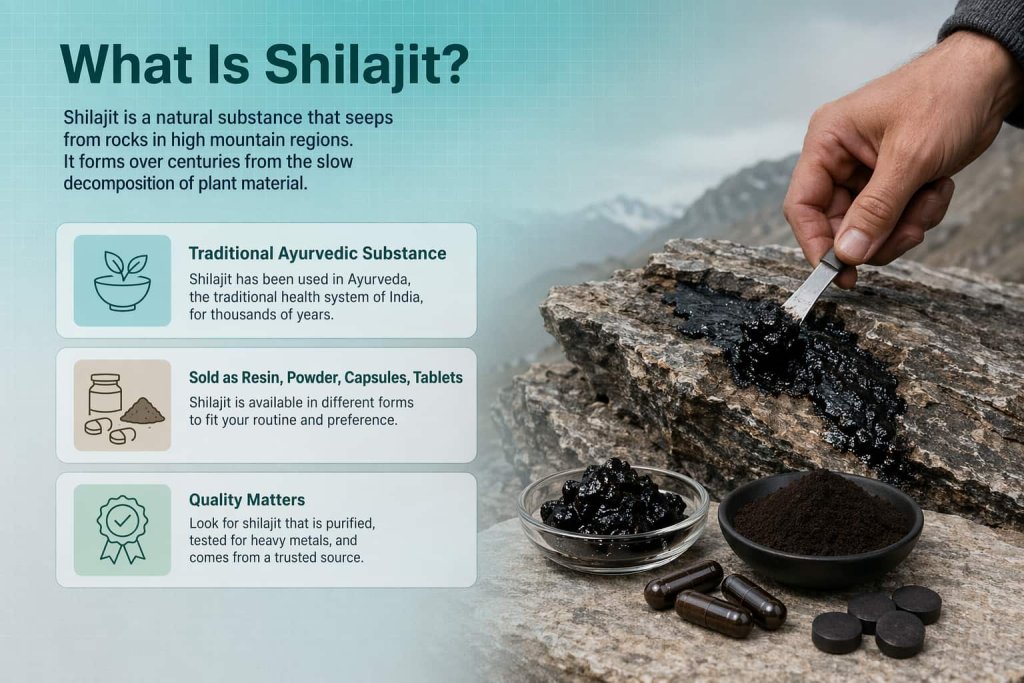
According to OPSS, shilajit can also contain heavy metals such as lead, cadmium, arsenic, and mercury, which is one reason product quality matters so much.
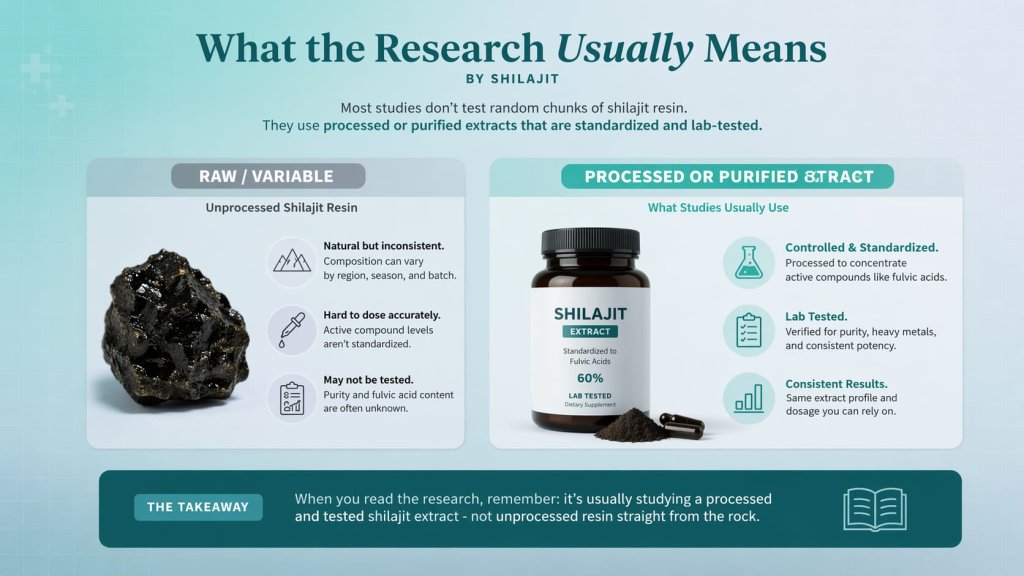
What the research usually means by “shilajit”
This detail matters more than it may seem. In the human studies most often cited for shilajit benefits, researchers did not test random raw shilajit gathered from the market. They typically used processed or purified shilajit extract in controlled amounts. That distinction is important because OPSS notes that without laboratory testing, there is no way to know the actual ingredients in a shilajit product or whether it is free of heavy metals, and NCCIH notes that supplements sold online or in stores may differ in important ways from products tested in studies.
Shilajit Benefits: What the Research Actually Shows
Testosterone support
This is one of the better-known claims, and there is some human evidence behind it, but it is still limited. A randomized, double-blind, placebo-controlled study indexed by PubMed found that purified shilajit taken at 250 mg twice daily for 90 days increased total testosterone, free testosterone, and DHEAS in healthy men ages 45 to 55 compared with placebo. That said, one positive study does not mean the benefit is proven for everyone, especially younger adults, women, or people with hormone-related conditions.
Exercise recovery and strength retention
A 2019 study indexed by PubMed examined 8 weeks of shilajit supplementation at 250 mg or 500 mg per day in recreationally active men. The study looked at maximal strength, fatigue-related decline in strength, and serum hydroxyproline, a marker related to collagen breakdown. The results suggest that 500 mg per day helped reduce the fatigue-related drop in maximal muscular strength and lowered hydroxyproline levels, but this is still a narrow finding from a specific exercise setting rather than proof that shilajit broadly improves athletic performance.
Male fertility support in a specific population
There is also a human study in men with oligospermia, which means low sperm count. A PubMed-indexed clinical study reported that men who completed 90 days of processed shilajit had improvements in semen volume, total sperm count, motility, normal sperm count, and testosterone. The reported changes included a 61.4 percent increase in total sperm count and a 23.5 percent increase in testosterone. This is one of the stronger clinical signals for shilajit, but it applies to a specific fertility population and should not be treated as proof that shilajit will improve fertility in the general population.
Energy, stamina, vitality, and brain-health claims remain weak
This is where marketing often runs ahead of the science. OPSS says the effectiveness of shilajit in humans has not been thoroughly evaluated, that only a few small human studies exist, and that there is little reliable evidence to support claims that it enhances energy, vitality, stamina, endurance, or mental performance. OPSS also notes that some study results may be biased because supplement companies selling shilajit funded some of the research.
What Dose of Shilajit Has Actually Been Studied?
One practical gap in many shilajit articles is that they talk about benefits without explaining the study amounts. The main human studies used specific processed or purified preparations, not just any shilajit product.
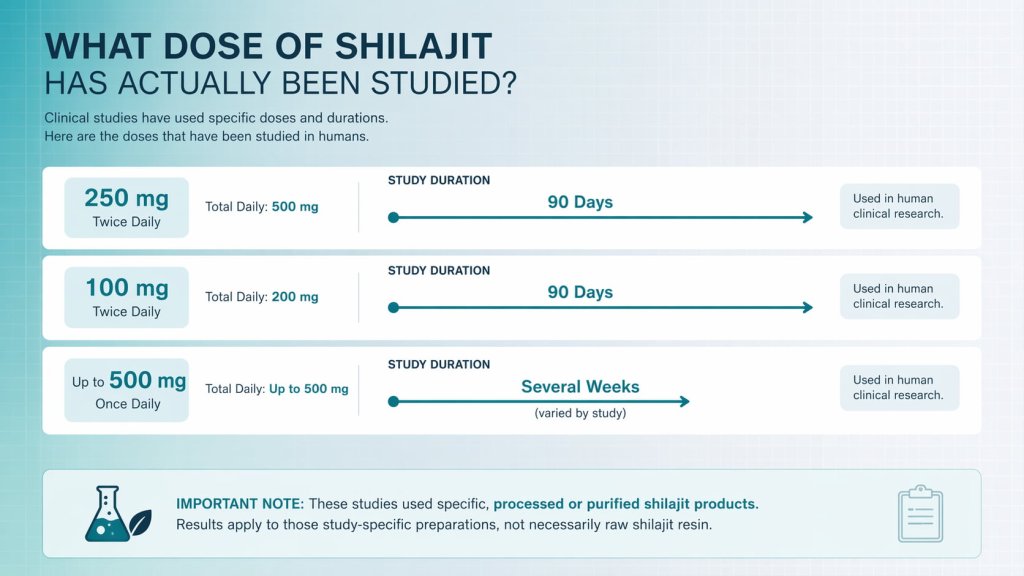
- The testosterone study used 250 mg twice daily for 90 days
- The male fertility study in men with oligospermia used 100 mg twice daily for 90 days
- Exercise research has studied doses up to 500 mg per day for several weeks
That does not mean there is a proven best dose for the general public. OPSS says studies using up to 500 mg of shilajit extract suggest it may be safe for short-term use, but the same source also emphasizes that product quality varies and heavy metal exposure remains a concern. A more accurate takeaway is that the evidence is based on short-term, product-specific dosing, not a universally established daily recommendation.
Why Shilajit Safety Deserves Equal Attention
The safety side of shilajit should never be a footnote. OPSS says shilajit can contain heavy metals and lists possible adverse effects including allergic reactions, increased blood pressure, disorientation, and dizziness. The FDA has also warned that certain unapproved Ayurvedic products have contained harmful levels of heavy metals and that heavy metal poisoning can lead to high blood pressure, kidney injury, fatigue, gastrointestinal distress, and neurologic symptoms. The FDA further states that there are no FDA-approved Ayurvedic products.
Safety box
Shilajit may be especially risky when product sourcing is poor or testing is unclear.
- Heavy metal exposure is a real concern, not just a theoretical one
- Raw or loosely sourced products may carry more uncertainty
- Possible short-term side effects include dizziness, allergic reactions, and blood-pressure changes
- Disease-treatment claims are a red flag for supplements. NCCIH notes that supplement labels cannot legally claim to diagnose, treat, cure, mitigate, or prevent disease
When to stop taking shilajit and get medical advice
Do not keep using shilajit just because a label says it is natural. NCCIH advises stopping a supplement and contacting a health care provider if side effects occur. The FDA also says possible signs of heavy metal toxicity from Ayurvedic products can include:
- abdominal pain, nausea, vomiting, constipation, or diarrhea
- unusual fatigue
- dizziness
- burning or tingling in the fingers or toes
- weakness in the limbs
- confusion or difficulty thinking clearly
These symptoms do not prove shilajit is the cause, but they are important enough that the supplement should not be ignored or continued casually.
Why Supplement Labels Do Not Tell the Whole Story
A major issue with shilajit is that the label may not tell you what is actually in the product. The FDA dietary supplement guidance says dietary supplements are not approved for safety and effectiveness before they are marketed, and NCCIH explains that the FDA typically acts after a product is already on the market rather than reviewing most products in advance. NCCIH also notes that what is on the label may not always match what is in the product, and that strong evidence behind supplement claims is often lacking.
That does not mean all supplements are unsafe. It means the burden is on the buyer to be selective, especially with products like shilajit that have contamination concerns and wide variation in formulation.
How to Choose a Safer Shilajit Supplement
No supplement can be made risk-free, but you can lower the risk by being selective.
Look for third-party testing
This is the single most practical filter. OPSS says that without laboratory testing, there is no way to know the actual ingredients or whether a shilajit product is free of heavy metals. It specifically points readers to third-party certification seals such as NSF Certified for Sport, Informed Sport, BSCG Certified Drug Free, or USP. NSF explains that its certification programs verify label claims and screen for undeclared ingredients, and its Certified for Sport program also screens for many banned substances relevant to athletes.
Be cautious with vague quality language
Words like “pure,” “authentic,” “premium,” or “lab tested” are not enough on their own. NCCIH notes that a manufacturer’s use of terms such as standardized, verified, or certified does not necessarily guarantee product quality or consistency. Look for a recognized third-party testing program, not just marketing language.
Avoid products making disease claims
Supplements are not supposed to be marketed as treatments for disease. If a shilajit product claims to cure infertility, fix low testosterone, reverse fatigue syndromes, or treat chronic illness, that is a strong reason to be cautious. NCCIH states that supplement labels cannot legally claim to diagnose, treat, cure, mitigate, or prevent disease.
Check the form and manufacturer information
Choose products with clear labeling, a named manufacturer or distributor, and specific testing information. The FDA questions-and-answers page on dietary supplements advises consumers to read labels carefully and contact the manufacturer directly if they need more information than the label provides.
Who Should Be Careful With Shilajit?
This is not a supplement to take casually if you have health risks or take medications. NCCIH says some supplements may harm people with certain medical conditions or interact with prescription or over-the-counter medicines. NCCIH also advises extra caution in pregnancy, breastfeeding, children, and before surgery because many supplements have not been adequately tested in those groups and some may affect bleeding or anesthesia response. The NIH Office of Dietary Supplements also advises talking with a health care provider about supplement use instead of treating supplement decisions as routine self-care.
You should be especially careful with shilajit if you are:
- pregnant or breastfeeding
- giving supplements to a child or teenager
- taking prescription medicines or multiple supplements
- managing blood pressure, kidney, liver, or hormone-related conditions
- preparing for surgery
- a competitive athlete who needs stricter supplement screening
Are Shilajit Benefits Worth the Risk?
That depends on what you are hoping it will do and how much confidence you need before trying a supplement. If your goal is a proven treatment for fatigue, low testosterone, fertility problems, or performance, shilajit is not at that level of evidence. The current research is too limited, too product-specific, and too vulnerable to quality issues to treat shilajit as a reliable, first-line solution.
But if you are simply asking whether there is any evidence at all, the answer is yes: there are a few human studies showing possible benefit signals. The problem is that the evidence is still much smaller than the marketing claims, and the contamination risk is real enough that product selection becomes part of the health question.
Frequently Asked Questions About Shilajit Benefits
Does shilajit increase testosterone?
It may in some men, based on limited clinical evidence. A placebo-controlled study indexed by PubMed found increases in total testosterone, free testosterone, and DHEAS after 90 days of purified shilajit in healthy men ages 45 to 55. That does not prove the same effect in all users or make shilajit a substitute for medical evaluation of hormone symptoms.
Is shilajit good for energy and stamina?
That claim is popular, but official evidence reviews are much more cautious. OPSS says there is little reliable evidence to support claims that shilajit improves energy, vitality, stamina, endurance, or mental performance.
Is raw shilajit safe?
That is not a good assumption. OPSS notes that shilajit can contain heavy metals, and the FDA has warned that unapproved Ayurvedic products may contain harmful levels of heavy metals. Raw or poorly tested products create more uncertainty, not less.
How should you think about shilajit supplements overall?
Think of shilajit as a supplement with possible benefits but incomplete proof. It is not a proven cure, not a guaranteed testosterone booster, and not something to judge by marketing alone. The smarter question is not only “What are the benefits?” but also “Is this specific product tested well enough to trust?”
Conclusion
Shilajit benefits are real enough to study, but not strong enough to oversell. The best human evidence suggests possible support for testosterone, exercise-related strength retention, and male fertility in specific settings.
At the same time, official safety sources warn that shilajit products can vary widely and may carry contamination risks, especially heavy metals. If you are considering shilajit, focus less on hype and more on evidence, third-party testing, and a conversation with a qualified health professional.
This content is for informational purposes only and not medical advice.