
Most adults burn about 45 to 90 calories an hour while sleeping, or roughly 360 to 725 calories in 8 hours, depending mostly on body weight. The simplest evidence-based estimate comes from the 2024 Adult Compendium of Physical Activities, which lists sleeping at 1.0 MET. In practical terms, that means you burn about 1 calorie per kilogram of body weight per hour of sleep.
That does not mean sleep is a fat-burning trick. It means your body is still using energy all night to keep you alive and functioning. According to Cleveland Clinic, basal metabolic rate is the energy your body needs for basic functions like breathing, circulation, and body temperature, and it typically makes up about 60% to 70% of total daily energy use.
How many calories do you burn sleeping per hour?
A simple estimate looks like this:
Calories burned sleeping per hour = body weight in kilograms × 1.0
If you know your weight in pounds, divide it by 2.2 to get kilograms. Then multiply by the number of hours you sleep. This is why heavier people usually burn more calories during sleep than lighter people.
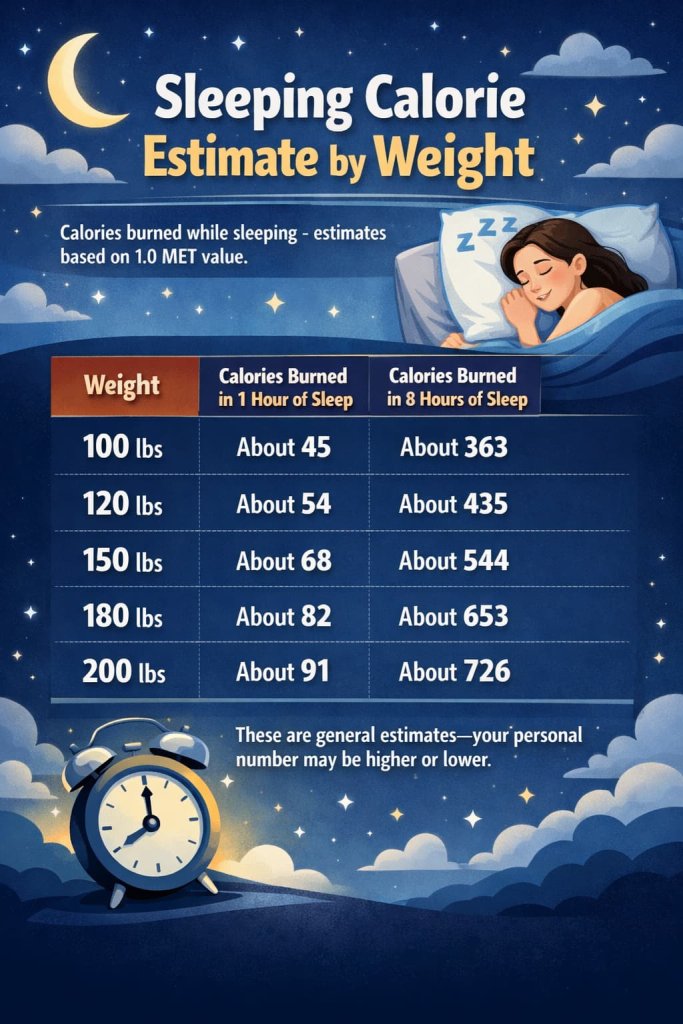
Sleeping calorie estimate by weight
Here are practical examples based on the current 1.0 MET sleep value:
| Body weight | Calories burned in 1 hour of sleep | Calories burned in 8 hours of sleep |
|---|---|---|
| 100 lb | about 45 | about 363 |
| 120 lb | about 54 | about 435 |
| 150 lb | about 68 | about 544 |
| 180 lb | about 82 | about 653 |
| 200 lb | about 91 | about 726 |
These are useful real-world estimates, not lab measurements. Your personal number can be somewhat higher or lower.
Why sleeping calorie burn is different for different people

The biggest drivers are body size and body composition. Cleveland Clinic notes that basal metabolic rate is influenced by body size, lean muscle mass, body fat, sex, age, genetics, and temporary factors such as illness, fasting, thyroid hormone levels, stimulant use, and environmental temperature. In general, larger bodies burn more at rest, and people with more lean mass often use more energy even during sleep.
That is why two people can both sleep for 8 hours and get different calorie-burn estimates. One person might be closer to 400 calories, while another may be well over 600.
Do you burn more calories sleeping or lying awake?
Not by much in a simple estimate. The current Adult Compendium lists both sleeping and lying quietly in bed awake at 1.0 MET, so the calorie difference is minimal when you are completely still.
How many calories do you burn sleeping for 8 hours?
For many adults, 8 hours of sleep burns roughly 400 to 700 calories, with the exact number depending mostly on body weight.
A quick shortcut is:
8-hour sleep calories = body weight in kilograms × 8
Examples:
- 120 lb: about 435 calories
- 150 lb: about 544 calories
- 180 lb: about 653 calories
- 200 lb: about 726 calories
These numbers are best used as realistic estimates, not exact personal measurements.
Does sleeping more help with weight loss?
Not because it burns dramatically more calories. The bigger value of sleep is that it supports appetite control, recovery, energy levels, and overall weight regulation.
The CDC says adults ages 18 to 60 generally need 7 or more hours of sleep per night, with slightly different ranges for older adults. The National Heart, Lung, and Blood Institute explains that poor sleep can affect hunger-related hormones and contribute to increased food intake and weight gain risk.
So yes, sleep matters for weight management, but mostly because too little sleep can work against healthy eating and daily activity habits.
Is sleeping enough to count as meaningful calorie burn?
It counts, but it is still resting calorie burn. These calories are part of your normal daily energy needs, not the same thing as calories burned through walking, strength training, or other intentional activity. Cleveland Clinic makes the same distinction by describing BMR as the energy your body needs just to keep basic functions running.
Are sleep calories already included in your daily calorie burn?
Yes. The calories you burn while sleeping are already part of your normal daily energy use. They are not “extra” calories you add on top of your usual daily calorie needs.
Because BMR usually accounts for about 60% to 70% of daily energy use, sleep calories are generally already built into any total daily calorie estimate from a calculator, app, or nutrition plan.
Why online calculators and fitness trackers often disagree
This is where a lot of confusion comes from. Some tools use the Compendium sleep value. Others estimate from BMR or resting metabolic rate formulas based on age, sex, height, and weight. Cleveland Clinic notes that resting metabolic rate is usually about 10% higher than BMR because it includes small low-effort activities, which is one reason different tools can produce different numbers.
A practical shortcut if you already know your BMR
If you already know your daily BMR, you can make a rough sleep estimate with this shortcut:
Sleep calories ≈ daily BMR ÷ 24 × hours slept
For example, if your BMR is 1,680 calories a day, that works out to about 70 calories an hour. Over 8 hours of sleep, that would be about 560 calories. This will often land fairly close to the Compendium-based method, though not always exactly the same.
Who should be a little more careful with sleep calorie estimates?
A simple formula is fine for general curiosity, but it is less reliable if your energy needs are changing for medical or life-stage reasons. Be more cautious if you are pregnant or breastfeeding, have thyroid disease, are sick or recovering from injury, have had a major recent weight change, or think you may have a sleep disorder such as sleep apnea or chronic insomnia. Cleveland Clinic notes that pregnancy, lactation, illness, thyroid hormone changes, and other temporary conditions can affect energy use, and CDC advises speaking with a healthcare professional if you regularly have trouble sleeping.
Practical takeaway for how many calories you burn sleeping
For most adults, the easiest accurate estimate is:
Calories burned while sleeping = body weight in kilograms × hours slept
That usually works out to:
- about 45 to 90 calories an hour for many adults
- about 360 to 725 calories in 8 hours
- more for larger bodies and less for smaller bodies
That is a real amount of energy, but the bigger health benefit is not “burning more while asleep.” It is getting enough quality sleep so your appetite, recovery, and daily energy are more likely to stay on track.
FAQs
How many calories do you burn sleeping for 7 hours?
Use the same formula: body weight in kilograms × 7. A 150-pound adult weighs about 68 kilograms, so 7 hours of sleep would come out to about 476 calories based on the current 1.0 MET estimate.
How many calories do you burn in a nap?
You can use the same formula for naps:
Calories burned during a nap = body weight in kilograms × hours slept
For example, a 150-pound person weighs about 68 kilograms. A 30-minute nap would burn about 34 calories, and a 90-minute nap would burn about 102 calories using the current sleep value of 1.0 MET. A nap does burn calories, but like overnight sleep, it is still part of your normal resting energy use.
Do heavier people burn more calories while sleeping?
Usually yes. Larger bodies generally require more energy at rest, which is why sleep calorie burn tends to rise with body weight. Body composition matters too, because lean muscle mass uses more energy than fat tissue even at rest.
Do men burn more calories sleeping than women?
Often yes, but not always. Cleveland Clinic explains that males generally have a faster BMR because they are often larger and tend to have more lean muscle mass. Still, body size and body composition matter more than sex alone.
Is burning calories while sleeping good for weight loss?
It is normal and necessary, but it is not enough by itself to drive weight loss. Sleep supports healthy weight management mainly by helping regulate hunger, energy, and recovery, while poor sleep can make healthy habits harder to maintain.
Conclusion
If you want a realistic answer to how many calories you burn sleeping, use the current Compendium-based estimate: about 1 calorie per kilogram of body weight per hour of sleep. For many adults, that works out to roughly 45 to 90 calories an hour.
Use that number as a helpful estimate, not a perfect personal measurement. Then focus on what matters most in real life: getting enough quality sleep, eating well, and staying active. Those habits do far more for long-term health and weight management than trying to squeeze extra calorie burn out of sleep.