
Face pulls are a simple cable or band exercise that helps strengthen the rear delts, upper back, and shoulder-supporting muscles that often get neglected in pressing-heavy workouts. That matters because better-balanced shoulder training can support posture, improve shoulder control, and make your upper-body routine more joint-friendly over time.
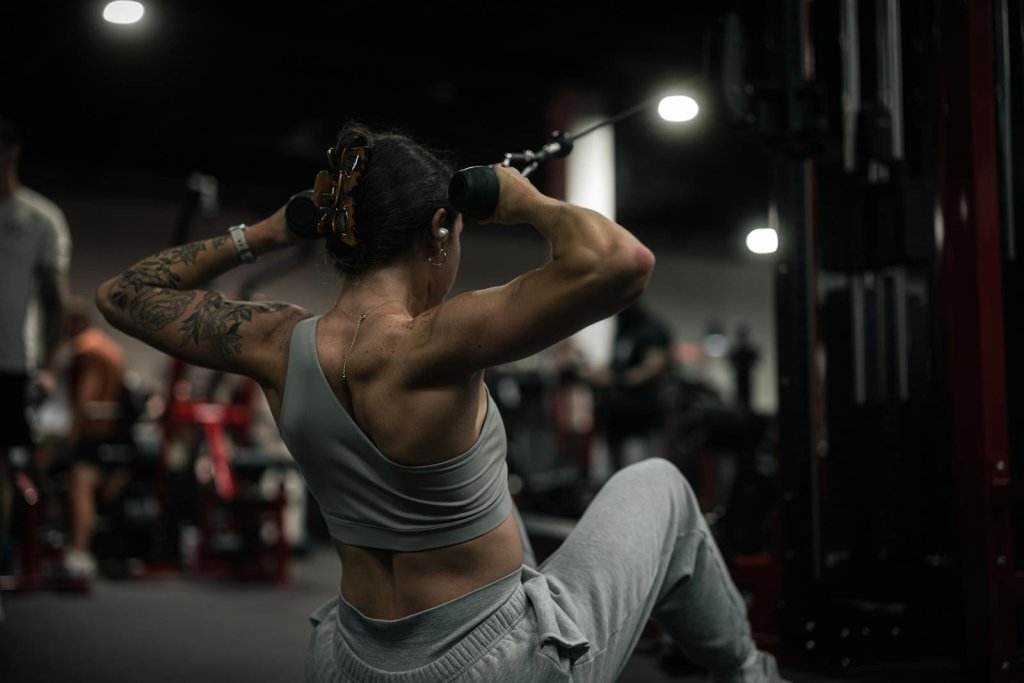
Guidance from NASM, Mayo Clinic, and AAOS OrthoInfo points in the same direction: use controlled reps, train the upper back and external rotators, and prioritize quality over load.
What are face pulls?
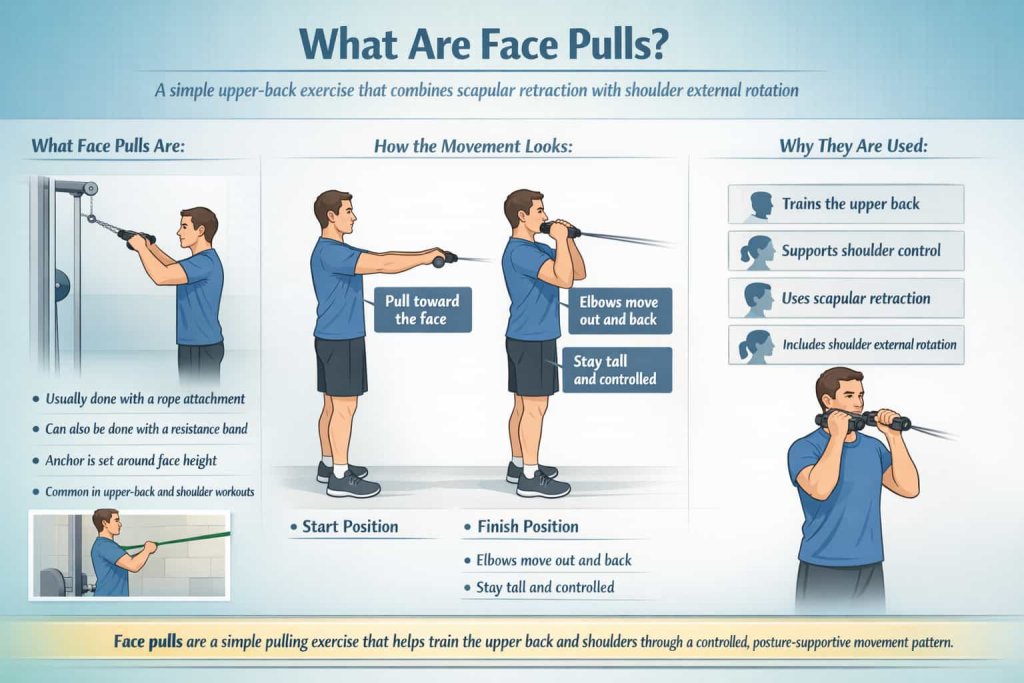
Face pulls are a pulling exercise usually done with a rope attachment on a cable machine or with a resistance band anchored at about face height. You pull the handles toward your face while letting the elbows move out and back, which combines scapular retraction with shoulder external rotation. That movement pattern is one reason face pulls are commonly used in upper-back and shoulder programs.
How to do face pulls correctly
Set a cable pulley or band anchor around upper-chest to face height. Use a rope attachment if you have one.
Step-by-step form
- Stand tall with feet about hip- to shoulder-width apart.
- Brace your core and keep your ribs stacked over your pelvis.
- Grab the rope with a neutral grip.
- Step back until you feel light tension at the start.
- Pull the rope toward your face.
- Let your elbows travel out and back.
- Finish with your hands near your temples or ears.
- Think about separating the rope slightly at the end.
- Pause briefly without shrugging.
- Return slowly to the start under control.
What muscles do face pulls work?
Face pulls mainly train the rear deltoids, trapezius, rhomboids, and the shoulder external rotators, especially the infraspinatus and teres minor. AAOS shoulder-conditioning material also highlights the value of rowing and external-rotation patterns for the middle and lower trapezius plus the back of the shoulder, which fits closely with why face pulls are so often used in shoulder-balance routines.
Do face pulls actually help posture?
Face pulls can help support better posture, but they do not magically fix posture by themselves. They strengthen muscles that help counter the rounded-shoulder, desk-heavy pattern many people develop, especially if their training overemphasizes pressing and front-delt work. Research and clinical reviews on scapular function suggest scapular-focused exercise can improve shoulder function, while PMC explains that strengthening the muscles that support the shoulder can help improve control around the joint.
A practical way to say it is this: face pulls are a useful tool for posture support, shoulder balance, and upper-back strength, especially when paired with a well-rounded program that also includes rowing, mobility work, and sensible training volume.
Why face pulls are worth adding to your routine
They train muscles many lifters undertrain
A lot of gym routines lean heavily on bench presses, push-ups, shoulder presses, and chest isolation work. Face pulls help bring more attention to the back of the shoulders and the upper back, which can improve balance across the shoulder girdle.
They reinforce external rotation
External-rotation strength matters because it supports shoulder mechanics and joint control. AAOS includes external-rotation drills in its shoulder-conditioning program, and rehabilitation research has long treated these muscles as important contributors to shoulder function.
They can be shoulder-friendlier than some heavy pulling options
Because face pulls are usually performed with light to moderate loads and a strong focus on control, they are often easier to recover from than heavier compound lifts. That makes them a useful accessory movement for general fitness, physique goals, and shoulder-focused programming. Mayo Clinic also emphasizes that proper form and a manageable load are key parts of safe strength training.
Best face pull form cues
Use these cues to make the exercise feel cleaner and more effective:
- Pull to your face, not your chest
- Keep your neck relaxed
- Do not shrug up
- Lead with the elbows
- Separate the rope at the finish
- Control the lowering phase
- Stop before your lower back arches
These cues match the broader principles in Mayo Clinic strength-training guidance and AAOS shoulder work: controlled reps, proper positioning, and no sloppy compensations.
Common face pull mistakes
Using too much weight
This is the most common problem. Heavy weight often turns face pulls into a half-row with neck tension and poor finishing position. Mayo Clinic recommends choosing a load you can control with good form rather than forcing reps with momentum.
Pulling too low
If you pull to the upper chest instead of the face, you usually lose some of the external-rotation component that makes the movement special.
Shrugging the shoulders
Shrugging usually means the upper traps are taking over. One small EMG study indexed in PubMed found that pulling direction changes muscle emphasis, with an overhead pulling angle increasing rhomboid activity while reducing upper-trapezius tension compared with other setups. That does not prove one exact version is best for everyone, but it does support paying attention to angle and scapular control.
Hyperextending the low back
If your ribs flare and your low back arches hard, you are probably using too much load or standing too far back. Keep the torso stacked and the movement smooth.
Cable face pulls vs band face pulls
Cable face pulls
Cable face pulls usually feel smoother and more consistent because the resistance stays more even through the range of motion. They are great in most gym settings.
Band face pulls
Band face pulls are more convenient for home workouts and travel. The resistance increases as the band stretches, so the end range can feel harder. They are still a solid option when the anchor point is stable and the movement stays controlled. AAOS shoulder-conditioning exercises also use elastic bands effectively for rows and external rotation work.
Are face pulls better before or after your main workout?
For most people, face pulls work best after heavier compound lifts as an accessory exercise. They fit well after rows, pulldowns, presses, or upper-body supersets.
There are two main exceptions. First, some lifters like very light face pulls in the warm-up to help groove scapular movement before pressing. Second, if shoulder balance is a major priority, you can place them earlier while you are fresh. Either way, keep the load moderate and the quality high.
How many sets and reps should you do?
A practical starting point for face pulls is:
- 2 to 4 sets
- 10 to 20 reps
- 1 to 3 times per week
That rep range makes sense because face pulls are usually an accessory movement focused on control and muscle quality rather than max loading. NASM’s upper-back corrective example uses 10 to 20 reps for face pulls, and ACSM notes that adults should perform muscle-strengthening activity at least two days per week.
Who benefits most from face pulls?
Face pulls tend to be especially useful for:
- people who sit a lot
- lifters who do a lot of pressing
- overhead athletes
- people wanting more rear-delt work
- general exercisers who want more shoulder balance
- lifters building a healthier upper-back routine
Scapular-focused exercise is often used when shoulder control and function need improvement, although the exact program should match the person and the problem.
When to be careful with face pulls
Face pulls are usually well tolerated, but they are not for every shoulder in every phase.
Be cautious or get professional guidance first if you have:
- sharp shoulder pain during pulling
- recent shoulder surgery
- major pain with external rotation
- new weakness or numbness
- a known shoulder injury that has not been evaluated
AAOS states its shoulder program is general education and should be performed under a doctor’s supervision when needed, especially after injury or surgery.
People also ask about face pulls
Are face pulls a back exercise or a shoulder exercise?
They are both, but most people treat them as an upper-back and rear-delt accessory exercise.
Can face pulls replace rows?
Not really. Face pulls are great for rear delts, scapular control, and external rotation, but rows usually allow more total loading for general back development.
Should you go heavy on face pulls?
Usually no. Most people get better results with lighter, cleaner reps and a good end position.
FAQs
1. Are face pulls good for shoulder health?
They can be a useful part of a shoulder-friendly routine because they train the rear delts, scapular retractors, and external rotators. They are not a cure or stand-alone fix, but they often fit well in balanced upper-body training.
2. Do face pulls work rear delts?
Yes. Rear delts are one of the main muscles involved, especially when you pull high and finish with the elbows out and back.
3. Can beginners do face pulls?
Yes, most beginners can start with light cable or band face pulls. Keep the resistance low enough that you can control the full motion without shrugging or leaning back.
4. Are bands as good as cables for face pulls?
Bands can work very well, especially at home, but cables usually provide a smoother resistance curve. Both can be effective if the setup is stable and the form is good.
5. How often should I do face pulls?
Most people do well with face pulls 1 to 3 times per week within a broader strength routine. Adults should generally include muscle-strengthening work at least two days per week.
6. Why do face pulls hurt my neck?
Neck discomfort usually means the weight is too heavy, the shoulders are shrugging, or the finish position is off. Reducing the load and keeping the neck relaxed often helps. If pain is sharp or persistent, stop and get it checked.
7. Should face pulls be done on push day or pull day?
Either can work. Many people place them on push day to balance pressing volume, while others put them on pull day as extra rear-delt and upper-back work.
Conclusion
Face pulls are one of the simplest ways to give your upper back and shoulders more balance. They are easy to learn, easy to scale, and useful for rear-delt strength, scapular control, and posture support when done with clean form. Keep the weight honest, use controlled reps, and make them part of a broader upper-body plan instead of expecting one exercise to do everything. That is usually where face pulls shine most.
If you are building a smarter upper-body routine, face pulls are a very good accessory exercise to add this week.
References
- PubMed: Shoulder Retractor Strengthening Exercise to Minimize Rhomboid Muscle Activity and Maximize Middle Trapezius Muscle Activity
- PMC: Effectiveness of Specific Scapular Therapeutic Exercises in Patients With Shoulder Pain
- PMC: A Systematic Review of the Exercises That Produce Optimal Muscle Ratios of the Scapular Stabilizers