
Gorilla rows are a bent-over rowing exercise that mainly builds your back while also challenging your core to keep your torso stable. They are worth learning because they train pulling strength, grip, and anti-rotation control in one movement, using only dumbbells or kettlebells.
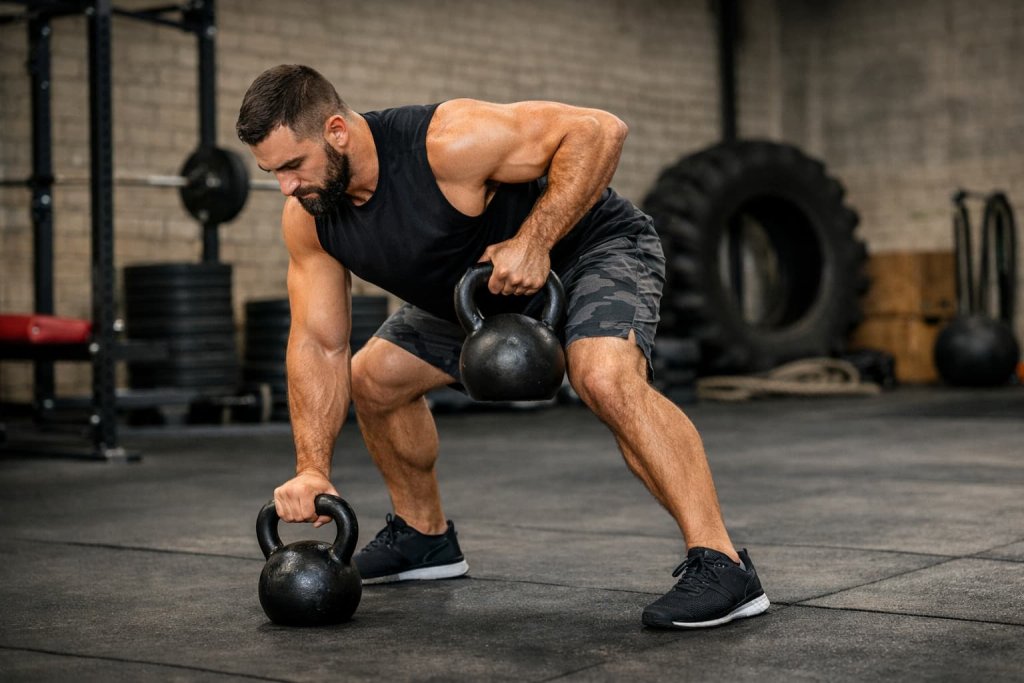
If you want a practical row that fits many home and gym workouts, gorilla rows can be a strong option. The keys are simple: hinge properly, keep your spine neutral, row with control, and avoid twisting too much as you alternate sides. For general health, the CDC recommends muscle-strengthening work on 2 or more days per week, which gives this kind of exercise a useful place in a balanced routine.
What Are Gorilla Rows?
Gorilla rows are usually performed with two dumbbells or kettlebells on the floor. You set up in a hip hinge with a flat back, grip both weights, and row one side at a time while the other weight stays grounded or controlled in the start position.
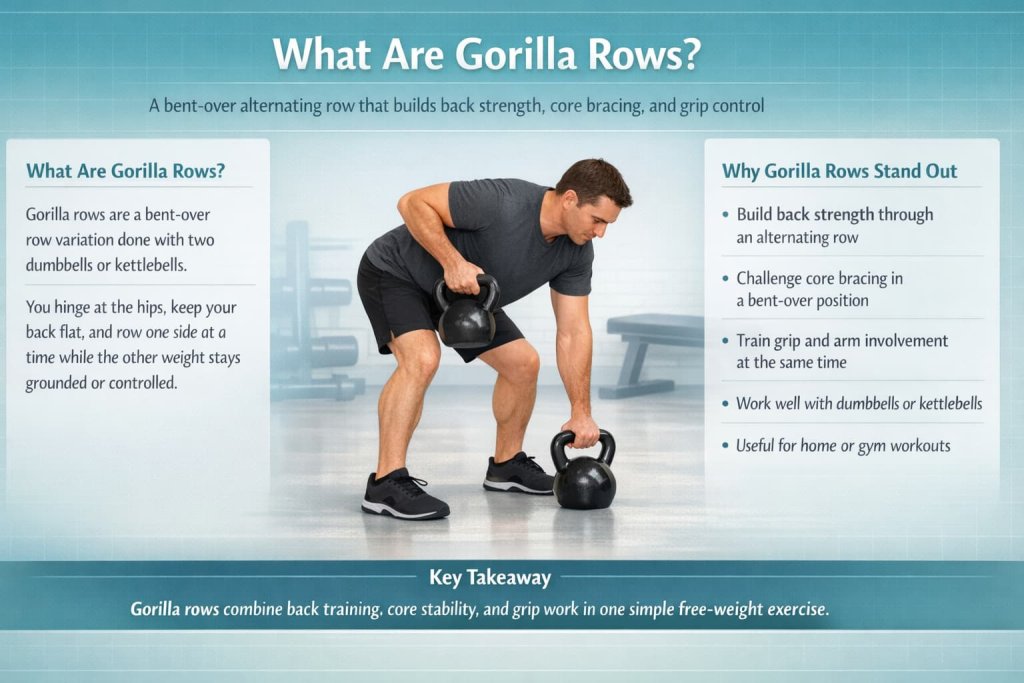
In plain language, gorilla rows combine three useful training demands at once:
- Back strength from the rowing motion
- Core bracing from the bent-over position
- Grip and arm work from holding the weights
That combination is a big reason the exercise is popular in dumbbell- and kettlebell-based programs.
How to Do Gorilla Rows
- Place two dumbbells or kettlebells on the floor between your feet or just inside them.
- Stand with your feet about shoulder-width apart or a little wider.
- Push your hips back and bend your knees slightly until your torso is hinged forward.
- Grip both weights with a neutral grip.
- Brace your core and keep your spine neutral.
- Row one weight toward your ribs or hip without shrugging your shoulder up.
- Lower it back down under control.
- Repeat on the other side.
- Continue alternating reps while keeping your hips and torso as steady as possible.
Gorilla Rows Muscles Worked
Gorilla rows mainly work the lats, rhomboids, mid-back, rear delts, biceps, and forearms. Your trunk and lower body also help stabilize the position while you row. That lines up with exercise guides describing gorilla rows as a compound back move and with ACE research showing that row variations can strongly recruit key back muscles.
The main muscles involved include:
- Latissimus dorsi
- Rhomboids
- Middle trapezius
- Rear deltoids
- Biceps
- Forearms and grip muscles
- Core and spinal stabilizers
Your abs are not the prime movers here, but they matter. Research from PubMed and PMC supports the idea that trunk strength helps stabilize the body and transfer force, which is why the “back and core strength” angle fits when explained accurately.
Gorilla Row Variations
1. Dumbbell Gorilla Rows
Why it works:
This is the most common and accessible version of the exercise. Dumbbell gorilla rows are easy to set up, simple to load progressively, and practical for both home and gym workouts. They help build back strength, grip, and trunk stability while letting you train each side in an alternating pattern.
Muscles worked:
Dumbbell gorilla rows mainly work the lats, rhomboids, middle traps, rear delts, biceps, forearms, and grip muscles. Your core, spinal stabilizers, glutes, and hamstrings also help you hold the bent-over position.
How to do it:
- Place two dumbbells on the floor between your feet or just inside them.
- Stand with your feet about shoulder-width apart.
- Hinge at the hips and bend your knees slightly.
- Grip both dumbbells with a neutral grip.
- Brace your core and keep your back flat.
- Row one dumbbell toward your lower ribs or hip.
- Lower it under control.
- Repeat on the other side and continue alternating reps.
Trainer Tip:
Use a weight that lets you keep your torso steady. If you start twisting or jerking the dumbbells up, go lighter and clean up the hinge first.
2. Paused Gorilla Rows
Why it works:
Paused gorilla rows increase time under tension and reduce the temptation to use momentum. Holding the top position briefly can help you feel the back muscles working more clearly and improve control of the shoulder blade and elbow path. This makes the exercise useful for people who want cleaner technique and better mind-muscle connection.
Muscles worked:
This variation still targets the lats, rhomboids, middle traps, rear delts, biceps, forearms, and grip muscles. The core has to work hard as well because the pause increases the challenge of staying stable in the hinge.
How to do it:
- Set up for a normal gorilla row with two weights on the floor.
- Hinge into position and brace your core.
- Row one weight toward your lower ribs or hip.
- Hold the top position for one to two seconds.
- Lower the weight slowly back to the floor.
- Repeat on the other side with the same pause.
- Continue alternating while keeping your hips and torso as still as possible.
Trainer Tip:
Do not turn the pause into a shrug. Hold the top with your elbow back and your shoulder controlled, not jammed up toward your ear.
3. Tempo Gorilla Rows
Why it works:
Tempo gorilla rows make lighter weights feel harder by slowing the lowering phase. This improves control, reinforces better technique, and increases muscular tension without needing to load the exercise heavily. It can be especially useful when your goal is form practice, hypertrophy, or joint-friendly training.
Muscles worked:
Tempo gorilla rows work the same main muscles as the standard version: lats, rhomboids, traps, rear delts, biceps, forearms, and grip muscles. Because the rep lasts longer, your trunk and hip stabilizers also stay under tension for more time.
How to do it:
- Set up in your normal gorilla row stance with two weights.
- Hinge at the hips and brace your core.
- Row one weight up with control.
- Lower it slowly for two to three seconds.
- Keep your spine neutral and resist twisting.
- Repeat on the other side using the same slow lowering tempo.
- Continue alternating reps for the full set.
Trainer Tip:
Count the lowering phase in your head to stay consistent. A simple “one-two-three” on the way down can help prevent the tempo from getting faster as fatigue builds.
Benefits of Gorilla Rows
They build practical back strength
Because gorilla rows are still a rowing pattern, they help train the muscles that pull the elbow back and support upper-back strength. That can make them useful for people who want a free-weight row without needing a bench or cable machine.
They challenge your core without turning into an ab exercise
The bent-over setup forces you to brace while resisting unwanted movement. Your trunk helps hold posture and control rotation as one side rows and the other side stays anchored. That is not the same as direct ab training, but it is still valuable core work.
They train grip and coordination
Holding two weights near the floor while alternating reps adds a grip and coordination element that many fixed-machine rows do not emphasize as much. That can make the exercise feel athletic and efficient, especially in dumbbell or kettlebell sessions.
They fit home workouts well
You do not need a bench or cable station. A pair of dumbbells or kettlebells is enough, which makes gorilla rows practical for home training. For many people, that convenience is a real advantage.
Proper Gorilla Row Form Tips
Keep the hinge first, then row
The exercise works best when your hip hinge is stable before you start pulling. If the hinge falls apart, the row usually gets sloppy too. Back-exercise coaching from ACE also supports the idea that bent-over row patterns require solid hinge and trunk strength.
Row toward the lower ribs or hip
This cue often helps keep the lats and mid-back involved. Pulling too high can turn the rep into more of a shrug or upper-trap-heavy movement.
Do not rush the lowering phase
A controlled lowering phase helps maintain position and keeps the rep cleaner. Many current exercise guides specifically cue a slow, deliberate return.
Limit torso twisting
A small amount of natural motion may happen depending on your style and equipment, but large rotation usually means you are using momentum instead of controlled pulling. If your hips keep swinging, lower the weight.
Common Gorilla Row Mistakes
Using too much weight
When the load is too heavy, many people start jerking the weight up or rounding the back. That takes stress away from clean rowing mechanics and can make the position harder to control.
Turning it into a shrug
If your shoulder rides up toward your ear, you are usually losing the intended pulling path. Think about drawing the elbow back and keeping the shoulder blade controlled.
Losing the neutral spine
A rounded or overextended back is a common issue in bent-over positions. Your goal is a strong, neutral trunk, not a dramatic arch or slump. General row coaching from ACE reflects the same principle of maintaining clean alignment during pulling work.
Twisting too much side to side
The alternating style should not look like a full-body sway. Some people need to slow down and shorten the range slightly until they can hold steadier posture.
Gorilla Rows vs One-Arm Dumbbell Rows
One-arm dumbbell rows usually give you more support because one hand or one knee can rest on a bench. Gorilla rows remove that support and demand more from your hinge, grip, and trunk control. That does not make gorilla rows automatically better. It just makes them different.
Choose one-arm dumbbell rows if:
- You want more support
- You are still learning rowing mechanics
- You want to focus hard on one side at a time
Choose gorilla rows if:
- You want a more athletic alternating pattern
- You want extra bracing and anti-rotation demand
- You need a simple two-weight home setup
Who Should Try Gorilla Rows?
Gorilla rows can work well for:
- Intermediate lifters who already understand the hip hinge
- Home exercisers with dumbbells or kettlebells
- People who want to train back, grip, and core together
- Lifters looking for a free-weight alternative to cable rows
They may be less ideal for beginners who still struggle to hold a stable bent-over position. In that case, a chest-supported row or bench-supported one-arm row may be easier to learn first.
Who Should Be Careful With Gorilla Rows?
Use extra caution or get professional guidance first if you have:
- Current low back pain that worsens with hinging
- A recent shoulder, elbow, or wrist injury
- Trouble maintaining a neutral spine under load
- Sharp pain, numbness, or symptoms that spread down an arm or leg
This is especially important because the exercise combines load with a sustained bent-over posture. Research on trunk stabilization from PMC supports the value of control and neutral positioning under load, but that does not mean every row variation is appropriate for every person or every stage of recovery.
Best Rep Ranges for Gorilla Rows
Your rep range depends on your goal.
For general strength and muscle
Try 6 to 12 reps per side for 2 to 4 sets.
For technique and control
Try 8 to 10 lighter reps per side with a slow lowering phase.
For muscular endurance
Try 12 to 15 reps per side, but only if you can keep your hinge and torso stable.
The best choice is the range you can perform with clean control. Since the CDC recommends muscle-strengthening work at least 2 days per week, gorilla rows can fit into a broader back or full-body plan rather than needing to stand alone as a main lift every session.
How to Add Gorilla Rows to Your Workout
Gorilla rows usually work well in one of these spots:
- As a main back exercise in a dumbbell or kettlebell workout
- As a secondary row after pull-ups or pulldowns
- In a full-body circuit when you want a pull pattern plus core demand
- In a home workout paired with push-ups, split squats, and carries
A simple example looks like this:
- Gorilla rows: 3 sets of 8 to 10 reps per side
- Push-ups: 3 sets
- Goblet squats: 3 sets
- Farmer carries: 2 to 3 rounds
Frequently Asked Questions
Are gorilla rows good for your back?
Yes, gorilla rows can be very good for back training when done with proper form. They mainly target the lats, rhomboids, and other upper-back muscles while also asking your trunk to stabilize the bent-over position.
Do gorilla rows work the core?
Yes, but mostly as a stabilizing demand. Gorilla rows are not a direct ab-isolation move. Your core helps brace the spine and resist excess movement while you row.
Are gorilla rows better than bent-over rows?
Not automatically. Gorilla rows are better for some people because they add alternating unilateral work and a stronger anti-rotation challenge. Traditional bent-over rows may be better if you want to load both sides together more directly.
Can beginners do gorilla rows?
Some can, but many beginners do better starting with a more supported row. If you cannot hold a stable hinge yet, use a bench-supported dumbbell row first and come back to gorilla rows later.
Should gorilla rows be done with dumbbells or kettlebells?
Either can work. Dumbbells are common and easy to find. Kettlebells can feel smoother from the floor because of the handle shape and height.
How heavy should gorilla rows be?
Use a load that lets you keep your back flat, hips steady, and lowering phase controlled. If you have to jerk the weight or twist hard to finish reps, it is too heavy.
Are gorilla rows good for home workouts?
Yes. They are one of the more practical home row options because they only require two weights and enough space to hinge safely.
Conclusion
Gorilla rows are a smart, efficient exercise for building back strength while also training bracing, grip, and control. The move is simple on paper, but good form matters. Set your hinge first, keep your spine neutral, row with control, and do not let momentum take over.
If you want a versatile pulling move for your home or gym program, gorilla rows are worth adding. Start light, master the position, and build from there.