
Rows exercise is one of the best ways to build a stronger back because it trains the muscles that pull your arms back, support your shoulder blades, and help you stay stable through your torso when you use good form. It matters because strong rowing patterns can support lifting strength, shoulder control, and balanced upper-body training.

Guidance from ACE and the CDC also fits rows into a practical strength routine: keep your spine neutral, brace your core, pull with control, and include muscle-strengthening work at least 2 days per week.
What Is a Rows Exercise?
A rows exercise is a pulling movement where you bring a handle, bar, dumbbell, or cable toward your torso. Most row variations are horizontal pulls, which means the resistance travels toward your body rather than straight down from above. Common examples include the bent-over row, seated row, standing cable row, and single-arm row. ACE describes each of these as back-focused pulling exercises that also involve the arms and shoulders.
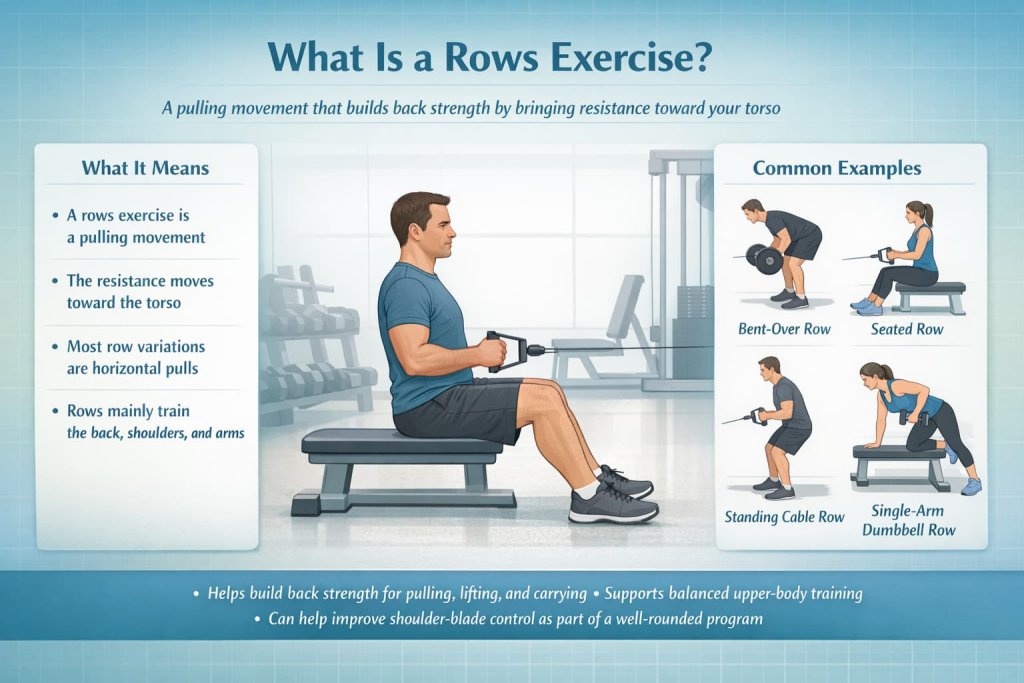
In simple terms, rows help train the muscles that let you pull, lift, carry, and keep your shoulders from drifting forward too much during daily life and training. That does not mean one exercise can “fix” posture by itself, but rows can be a useful part of a balanced program. This is a practical training inference supported by ACE technique guidance and public-health strength recommendations from the CDC.
How to Do a Basic Rows Exercise
The bent-over row is one of the most common row variations and a strong choice for building overall back strength.
How to do it
- Stand with your feet about hip-width apart.
- Hold a barbell with a pronated grip.
- Hinge forward at the hips with a slight bend in the knees.
- Keep your back flat and your head in line with your spine.
- Let the bar hang with your elbows straight.
- Pull the bar toward your lower ribs or belly button.
- Pause briefly, then lower it with control.
Trainer tip
If your lower back rounds before your set ends, the load is probably too heavy or the hinge position is too fatiguing for your current level.
Rows Exercise Muscles Worked
Rows mainly train the upper and mid-back, but they are not a one-muscle movement.
Primary muscles worked usually include:
- Latissimus dorsi
- Rhomboids
- Middle trapezius
- Rear deltoids
- Biceps and forearm flexors
Depending on the version, rows also challenge the core, spinal stabilizers, hips, and trunk muscles. In ACE instructions for the bent-over row and single-arm row, bracing the torso and keeping the back flat are key setup points, which is one reason unsupported row variations feel harder than chest-supported or machine versions. A PubMed study comparing rowing exercises also found meaningful differences in trunk muscle activation, lumbar motion, and spinal loading across row types.
Best Rows Exercise Variations
Different row variations suit different goals, equipment setups, and comfort levels. Here is the same section rewritten in your requested format.
1. Seated Row
Why it works:
The seated row is a beginner-friendly variation because the machine or cable setup gives you more support and helps reduce extra body movement. That usually makes it easier to focus on smooth pulling mechanics, controlled shoulder-blade movement, and steady posture throughout the set.
Muscles worked:
The seated row mainly works the latissimus dorsi, rhomboids, middle trapezius, rear deltoids, and biceps. The core also helps stabilize your torso, but usually less than in unsupported row variations.
How to do it:
- Sit at the row machine or cable station with your feet planted firmly.
- Grab the handle with your arms extended in front of you.
- Sit tall with your chest up and shoulders relaxed.
- Brace your core and keep your spine neutral.
- Pull the handle toward your lower ribs or mid-torso.
- Squeeze your shoulder blades together briefly at the end.
- Return the handle slowly to the starting position.
Trainer Tip:
Do not lean too far back to move the weight. Keep the motion controlled so your back muscles do the work instead of turning it into a body swing.
2. Standing Cable Row
Why it works:
The standing cable row adds a posture and balance challenge while still allowing a controlled pulling pattern. Because you are standing, your trunk and lower body have to help keep you stable, which can make the movement feel more functional than a fully seated version.
Muscles worked:
This variation mainly targets the lats, rhomboids, middle traps, rear delts, and biceps. It also increases demand on the core, hips, and postural stabilizers compared with more supported row setups.
How to do it:
- Set a cable handle around chest height.
- Stand facing the machine with your feet about hip-width apart.
- Hold the handle with your arms extended and step back to create tension.
- Stand tall with your knees softly bent and core braced.
- Pull your elbows back close to your sides.
- Bring the handle toward your torso with control.
- Pause briefly, then return to the start slowly.
Trainer Tip:
Keep your ribs down and avoid arching your lower back. A stable body position will help you feel the row more in your upper and mid-back.
3. Single-Arm Dumbbell Row
Why it works:
The single-arm dumbbell row is useful for unilateral training, which means each side works on its own. This can help improve side-to-side control, make it easier to focus on the pulling path, and allow you to notice if one side feels weaker or less coordinated than the other.
Muscles worked:
This exercise mainly works the lats, rhomboids, middle traps, rear delts, and biceps. The trunk, obliques, and spinal stabilizers also help keep your body steady during the pull.
How to do it:
- Place one knee and the same-side hand on a bench for support.
- Keep the other foot flat on the floor.
- Hold a dumbbell in your free hand with your arm hanging straight down.
- Keep your back flat and core braced.
- Pull the dumbbell up toward your lower ribs or hip area.
- Pause briefly at the top without twisting your torso.
- Lower the dumbbell slowly and repeat before switching sides.
Trainer Tip:
Do not yank the weight or rotate your chest open. Keep your torso quiet and let the arm and back muscles drive the movement.
4. Chest-Supported or Machine Row
Why it works:
Chest-supported and machine row variations reduce how much your trunk has to stabilize, which can help you focus more directly on the back muscles. These options are often useful when you want solid rowing volume with less lower-back fatigue or when your form starts to break down in unsupported versions.
Muscles worked:
These rows mainly target the lats, rhomboids, middle trapezius, rear deltoids, and biceps. Because your chest is supported, the core and lower back usually do less stabilizing work than in bent-over or standing row variations.
How to do it:
- Adjust the bench or machine so your chest stays supported comfortably.
- Place your feet in a stable position.
- Grab the handles and let your arms extend fully.
- Keep your chest in contact with the pad and your neck neutral.
- Pull the handles toward your torso by driving your elbows back.
- Squeeze your shoulder blades together briefly.
- Return to the starting position under control.
Trainer Tip:
Use the chest support instead of lifting your body off the pad. Staying connected to the support helps keep tension on the back muscles and reduces unnecessary momentum.
Why Rows Exercise Matters
Rows matter because many training plans have plenty of pressing but not enough pulling. Adding rows can help balance upper-body work, build back strength, and improve control around the shoulder blades.
Well-programmed rows may help with:
- Back strength for lifting and carrying
- Better pulling performance in other exercises
- Shoulder-blade control during upper-body training
- More balanced upper-body development
- General muscle-strengthening goals recommended by the CDC
The CDC says adults need at least 150 minutes of moderate-intensity aerobic activity each week and at least 2 days of muscle-strengthening activity. Rows are one practical option for meeting the strength side of that guidance.
Common Rows Exercise Mistakes
A row only works well if the right muscles are doing the job. These mistakes often reduce quality.
Using momentum
Swinging the torso or jerking the weight turns the exercise into a full-body heave instead of a controlled pull.
Rounding the back
This is especially common in bent-over rows. ACE repeatedly emphasizes a flat or neutral back position in its technique guidance.
Shrugging the shoulders
When your shoulders rise toward your ears, upper traps can take over too much and the movement often feels less smooth.
Pulling too high
Many people turn a row into something closer to an upright pull. For most row versions, think about pulling toward the ribs or torso, not the neck.
Going too heavy too soon
Too much load often causes torso swing, short range of motion, and poor shoulder-blade control.
Rows Exercise Benefits
The rows exercise can be a smart addition to many strength routines.
Stronger back muscles
Rows load several major back muscles together, which makes them efficient for general strength work. ACE lists row variations among core back exercises in its exercise library and programming materials.
Better pulling balance
If your program includes push-ups, bench presses, or shoulder presses, rows can help add pulling volume so your training is not too press-heavy. This is a standard strength-programming principle and a practical inference from balanced movement-pattern design.
More trunk involvement in unsupported versions
Bent-over and some standing rows can challenge the core and spinal stabilizers more than fully supported versions. The rowing comparison in PubMed supports this idea by showing differences in torso muscle activation and loading between exercise setups.
Useful exercise variety
Because rows come in cable, dumbbell, machine, band, and barbell versions, they are easy to scale for beginners and advanced lifters.
Who Should Modify or Be Cautious With Rows Exercise
Rows are not automatically right for everyone in every form.
You may need a modified version or professional guidance if you have:
- Active low-back pain that worsens in a bent-over position
- A recent shoulder, elbow, or upper-back injury
- Trouble maintaining a neutral spine under load
- Pain that increases during pulling
In those cases, supported options such as a seated row, chest-supported row, or lighter band row may be more comfortable. That is a practical modification based on findings in PubMed suggesting supported setups can reduce trunk demand compared with unsupported row variations.
A Simple Rows Exercise Routine Idea
A basic starting point for general strength might look like this:
- 2 to 4 sets
- 8 to 12 reps
- Controlled tempo
- 1 to 2 row variations per workout
- 2 strength sessions per week for the back
This is a general training framework, not a fixed medical or rehab prescription. Adjust based on your experience, goals, recovery, and equipment.
How to Choose the Best Row Variation for You
Choose a bent-over row if
You want a classic free-weight back exercise and can maintain a solid hip hinge.
Choose a seated row if
You want more support and a simpler setup for learning the movement.
Choose a standing cable row if
You want a controlled pulling pattern with a posture challenge.
Choose a single-arm row if
You want unilateral work and a little more focus on one side at a time.
FAQs About Rows Exercise
Is rows exercise good for beginners?
Yes, especially supported versions like the seated row or a light cable row. They usually make it easier to learn posture and pulling control, as shown in ACE.
What muscles does rows exercise work the most?
Rows mainly work the lats, rhomboids, traps, rear delts, and biceps, with additional help from the core and trunk depending on the setup, based on ACE exercise guidance.
Are seated row and bent-over row the same?
No. Both are row patterns, but the seated row is more supported while the bent-over row places more demand on the hip hinge and trunk, according to ACE.
How often should I do rows exercise?
For general fitness, rows can fit into a strength routine 1 to 3 times per week depending on your total training volume and recovery. The CDC recommends muscle-strengthening activity at least 2 days per week.
Can rows exercise help posture?
Rows can support stronger upper-back muscles and better shoulder-blade control, which may help support posture as part of a balanced routine. They are helpful, but not a standalone fix.
What is the safest row variation for many people?
A seated row or chest-supported row is often easier to control because it reduces the demand on the lower back. The best choice still depends on your pain history, skill level, and equipment.
Should I pull the weight to my chest?
Usually no. In many standard row variations, the weight comes toward the torso, lower ribs, or belly button area rather than high toward the neck. ACE specifically uses a pull toward the belly button in its bent-over row guide.
Conclusion
Rows exercise deserves a place in most strength programs because it builds back strength, improves pulling balance, and gives you plenty of options from beginner-friendly machine rows to more demanding bent-over rows. Start with a version you can control, keep your spine neutral, and focus on smooth reps instead of chasing load too early.