
The snatch exercise is a full-body Olympic lift that trains power, speed, coordination, and overhead strength in one continuous movement. It is one of the most technical lifts in the gym, so understanding proper setup, progression, and safety matters before you try to load it heavily. The good news is that you do not need to start with a full competition-style barbell snatch on day one. Many people build toward it with hang snatches, dumbbell snatches, and mobility-focused drills first.
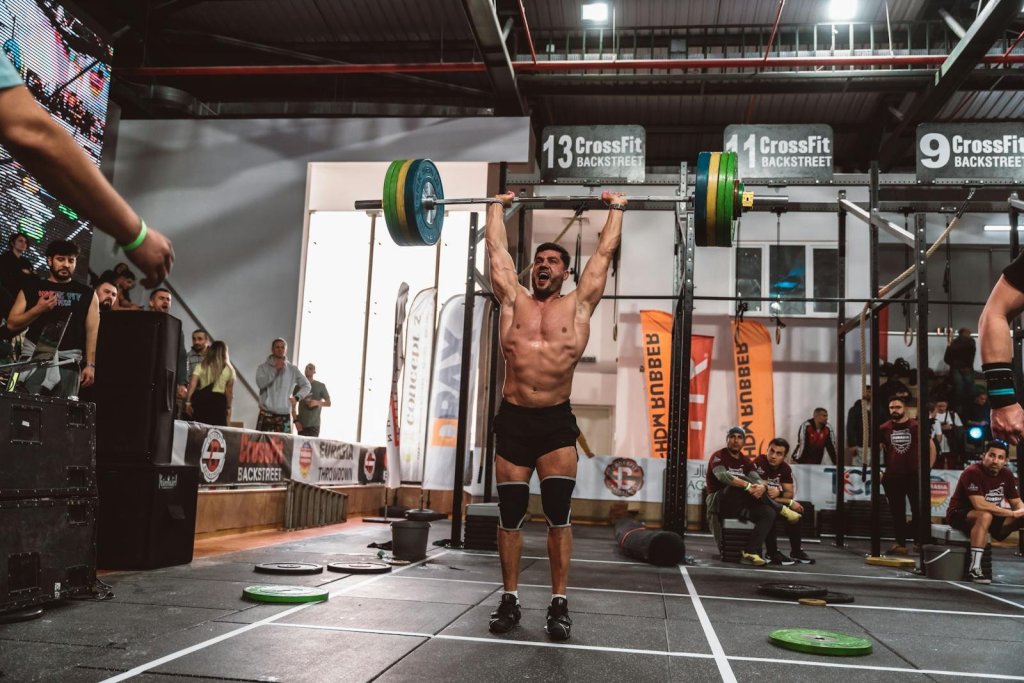
Official guidance from British Weight Lifting, and the NSCA supports treating the snatch as an advanced movement that rewards good coaching and gradual progression.
What Is the Snatch Exercise?
The snatch is an Olympic weightlifting movement in which you take a barbell from the floor to overhead in one smooth motion, usually with a wide grip. In the classic version, you pull the bar from the floor, extend explosively through the hips, knees, and ankles, then move under the bar and receive it overhead before standing up. That one-move floor-to-overhead pattern is what makes the lift unique.
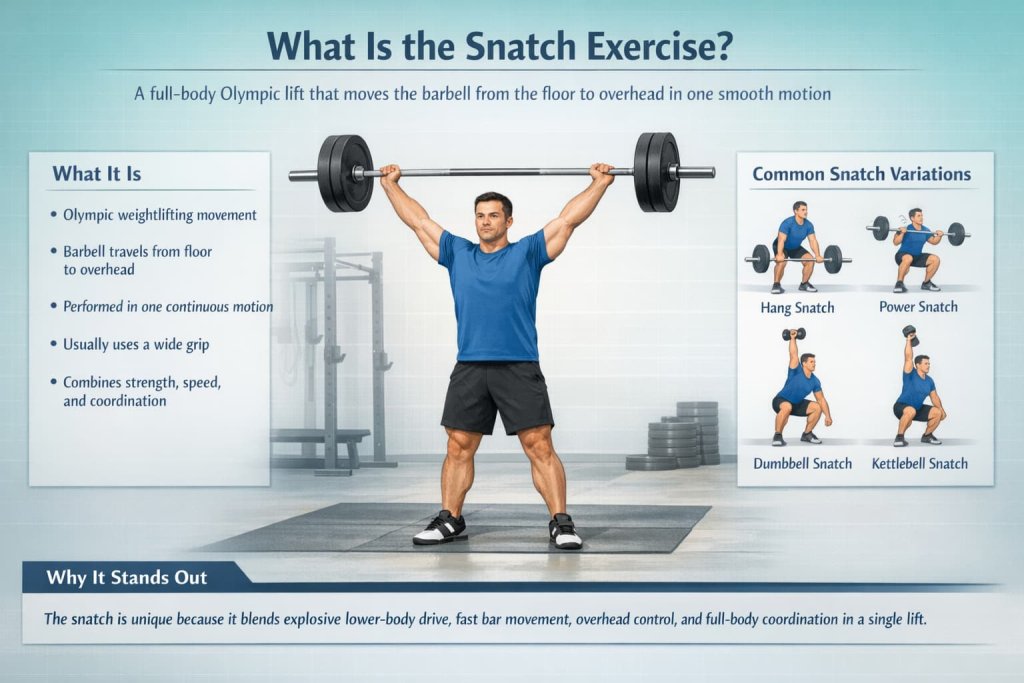
In real-world fitness content, “snatch exercise” can also refer to related versions such as the hang snatch, power snatch, dumbbell snatch, and kettlebell snatch. The barbell snatch is the traditional Olympic lift, while dumbbell and kettlebell versions are often used to build power, conditioning, and coordination with a slightly lower technical barrier. British Weight Lifting also notes that the hang snatch is commonly used as a teaching variation because it is often easier for beginners than pulling from the floor.
How to Do the Snatch Exercise
This section covers the classic barbell snatch at a simplified level. Because this is an advanced lift, it is best learned with light loads, video feedback, or qualified coaching.
- Set a barbell on the floor and take a wide grip.
- Place your feet around hip- to shoulder-width apart.
- Brace your trunk, keep your chest up, and start with a flat back.
- Push through the floor to begin the first pull.
- As the bar passes the knees, extend explosively through the hips and legs.
- Keep the bar close to the body as you pull upward.
- Move under the bar quickly and receive it overhead.
- Stand up with control once the bar is stable overhead.
- Lower or drop the bar safely according to your equipment and setting.
Muscles Worked in the Snatch Exercise
The snatch is a full-body lift, but some areas do more work than others.
Primary contributors include the glutes, quadriceps, hamstrings, calves, upper back, shoulders, and core. The traps help with the explosive pull, while the trunk and shoulder stabilizers help keep the bar secure overhead. The forearms and grip also matter, especially in the setup and pull from the floor. ACE’s exercise classification supports describing the snatch as an integrated whole-body movement rather than a single-muscle exercise.
Best Snatch Exercise Variations
Explore the best snatch exercise variations to match your skill level, mobility, and training goals. From beginner-friendly options to more advanced explosive lifts, these variations can help you build power, speed, and full-body strength more safely and effectively.
1. Hang Snatch
Why it works:
The hang snatch starts from a standing position above the floor, usually from mid-thigh or just above the knees. That shorter starting range makes it easier to focus on explosive hip drive, bar path, and timing without managing a full pull from the floor. It is often one of the best teaching options for lifters who are still learning how to extend powerfully and move under the bar with control.
Muscles worked:
The hang snatch works the glutes, quadriceps, hamstrings, calves, upper back, shoulders, traps, and core. Because you still have to accelerate the bar and stabilize it overhead, it remains a true full-body power movement even though the setup is simpler than a full snatch.
How to do it:
- Stand tall with the barbell in a wide snatch grip.
- Lower the bar to the hang position at mid-thigh or just above the knees.
- Brace your core and keep your chest up.
- Drive explosively through the hips, knees, and ankles.
- Keep the bar close as you pull upward.
- Drop under the bar quickly and catch it overhead.
- Stand up with control to finish the rep.
Trainer Tip:
Start from the high hang first before moving to a lower hang position. That makes it easier to learn speed and turnover without overthinking the lift.
2. Power Snatch
Why it works:
The power snatch trains explosive force and bar speed while removing some of the deep squat demands of a full snatch. Because you catch the bar higher, it can be a practical bridge between beginner drills and more advanced Olympic lifting. It is also useful for athletes and lifters who want the power benefits of snatch training without spending as much time in the bottom overhead squat position.
Muscles worked:
The power snatch targets the glutes, quads, hamstrings, calves, traps, shoulders, upper back, and core. The higher catch also demands fast coordination and strong overhead stability, especially through the shoulders and trunk.
How to do it:
- Set up with the barbell on the floor and take a wide snatch grip.
- Pull the bar smoothly from the floor while keeping your back flat.
- As the bar passes the knees, extend explosively through the hips and legs.
- Keep the bar close and pull yourself under it.
- Catch the bar overhead in a partial squat, not a full squat.
- Stand tall once the bar feels stable overhead.
Trainer Tip:
Do not turn the power snatch into a press-out. Catch the bar with your arms locked out quickly instead of trying to press it overhead after the catch.
3. Dumbbell Snatch
Why it works:
The dumbbell snatch is often more accessible than barbell snatch variations because it is unilateral and easier to set up. It helps build hip power, coordination, shoulder control, and athletic conditioning while also challenging anti-rotation core strength. Since one side works at a time, it can also reveal side-to-side differences in power or stability.
Muscles worked:
The dumbbell snatch works the glutes, hamstrings, quadriceps, shoulders, traps, upper back, core, and grip. Because it is performed one arm at a time, the obliques and trunk stabilizers also work hard to control rotation.
How to do it:
- Place a dumbbell on the floor between your feet.
- Hinge at the hips and grip the dumbbell with one hand.
- Keep your chest up and core braced.
- Drive through the legs and hips to accelerate the dumbbell upward.
- Pull the dumbbell close to your body as it rises.
- Punch your arm overhead and catch the dumbbell with a locked elbow.
- Stand tall and lower the dumbbell with control before repeating.
Trainer Tip:
Think “legs first, arm second.” The dumbbell should move because of your lower-body drive, not because you are curling it upward.
4. Kettlebell Snatch
Why it works:
The kettlebell snatch combines explosive hip extension with a strong conditioning effect. It can help improve power endurance, grip strength, and overhead control while also keeping the heart rate high. That blend of athletic power and metabolic demand is a big reason it is popular in both performance training and high-effort conditioning sessions.
Muscles worked:
The kettlebell snatch trains the glutes, hamstrings, quads, shoulders, upper back, core, forearms, and grip. The swing-to-overhead path also reinforces hip-driven power and shoulder stability at the top of the movement.
How to do it:
- Stand with the kettlebell slightly in front of you.
- Hinge at the hips and grip the handle with one hand.
- Hike the kettlebell back between your legs.
- Drive your hips forward powerfully to send the kettlebell upward.
- Guide the kettlebell close to your body instead of letting it swing far out.
- Punch through at the top so the kettlebell settles softly overhead.
- Lock out overhead, then return the kettlebell under control for the next rep.
Trainer Tip:
Avoid letting the kettlebell slam onto your forearm. A clean hand insertion at the top makes the movement smoother, safer, and much more efficient.
Why the Snatch Exercise Is So Effective
The snatch stands out because it combines several valuable training qualities in one exercise. It asks you to create force quickly, move fast, stabilize overhead, and coordinate your whole body under load. That is a rare combination.
The NSCA explains that weightlifting movements produce high forces, high rates of force development, and high power outputs. The same statement also notes that the snatch may be used to emphasize movement velocity and speed-strength. That makes the snatch especially useful for athletes and advanced lifters who want more than just slow, heavy strength work.
Snatch Exercise Benefits
Builds explosive power
The snatch teaches you to apply force fast. That explosive quality is one reason Olympic lift variations are often included in sports performance programs. The snatch is not just about lifting weight overhead. It is about how quickly and efficiently you can move it.
Improves speed-strength
The snatch can emphasize movement velocity and speed-strength more than some other weightlifting patterns. For athletes who sprint, jump, change direction, or compete in fast-paced sports, that training effect can be useful when paired with good coaching and smart loading.
Trains the whole body
The snatch is not an isolation lift. It involves the legs, hips, trunk, upper back, shoulders, and arms working together. ACE classifies the snatch as a full-body, integrated exercise, which is a good reminder that success depends on total-body coordination rather than just one muscle group.
Develops overhead stability and coordination
Catching and controlling a load overhead requires shoulder stability, trunk stiffness, balance, and timing. Even lighter snatch variations can help develop these qualities when form stays crisp and the lifter has enough mobility to reach a safe overhead position.
Keeps advanced training challenging
For experienced lifters, the snatch adds a technical and athletic element that standard strength lifts do not always provide. It can make training more dynamic and expose gaps in mobility, rhythm, bar path, and positioning that simpler lifts sometimes hide. This is one reason the lift remains so valuable in Olympic weightlifting and athletic performance settings.
Step-by-Step Breakdown of Snatch Technique
1. Setup
Start with a balanced stance and a wide grip. Your back should stay flat and your trunk braced before the bar even leaves the floor. A rushed setup often leads to a rushed pull.
2. First pull
The first pull takes the bar from the floor to around knee level. The goal is control, not yanking. You want the bar to rise smoothly while you maintain position.
3. Second pull
This is the explosive phase. As the bar moves past the knees, you drive hard through the floor and extend the hips and legs powerfully. This is where the speed element of the lift becomes obvious.
4. Pull under and catch
After generating upward momentum, you move under the bar and receive it overhead. In a full snatch, that receiving position is usually a deep squat. In a power snatch, you catch higher. Either way, overhead control matters more than forcing the load.
5. Recovery
Once the bar is fixed overhead and stable, you stand up under control. A stable finish matters because the lift is not complete until the weight is clearly under control.
Common Snatch Exercise Mistakes
Starting too heavy
This is probably the most common problem. The snatch is a skill lift. If you load it before you can control positions, timing, and overhead stability, technique usually breaks down first. USA Weightlifting also emphasizes starting with lighter weights rather than chasing fast progress.
Pulling with the arms too early
A lot of beginners try to muscle the bar up instead of driving with the legs and hips first. That usually weakens bar speed and makes the turnover less efficient. The lower body should do most of the force-producing work.
Letting the bar drift away
The farther the bar moves from your body, the harder it is to control overhead. A close, efficient bar path is one of the biggest technical differences between a smooth snatch and a messy one.
Catching overhead without enough mobility
If your shoulders, thoracic spine, hips, or ankles cannot support a safe overhead receiving position, forcing a full snatch is not a smart progression. ACE has also noted that overhead squat ability is an important prerequisite before jumping into full snatch work.
Skipping the warm-up
British Weight Lifting recommends a warm-up that includes at least five minutes of aerobic activity before lifting. For snatch work, it also makes sense to add shoulder, ankle, hip, and overhead pattern prep before the bar gets heavy.
Is the Snatch Exercise Safe?
The snatch can be safe when it is practiced with effective technique, appropriate progression, and proper supervision. British Weight Lifting states that Olympic lifts are highly technical, and its educational materials emphasize learning them correctly. It also notes that when Olympic lifts are practiced and performed with effective technique, they carry a low risk of injury. That does not mean the snatch is automatically beginner-friendly. It means the lift should be respected and taught well.
For most general gym users, the safest approach is to earn the movement in stages. Learn the overhead position, front-end mobility, and pulling mechanics first. Then progress through simplified snatch drills before trying to max out or copy competition lifting videos.
Who Should Do the Snatch Exercise?
The snatch can be a strong fit for experienced lifters, Olympic weightlifters, and athletes who need power, speed, and coordination. It may also suit intermediate trainees who already have solid hip hinge mechanics, overhead control, and coaching access.
Who Should Modify or Avoid It?
You may need to modify, delay, or avoid the snatch for now if you have:
- Limited overhead mobility
- Poor squat depth or balance
- Trouble stabilizing a load overhead
- Pain with fast pulling or overhead positions
- No coaching support and no experience with Olympic lift patterns
In those cases, a hang snatch, dumbbell snatch, kettlebell snatch, high pull, or landmine power movement may be a better starting point. British Weight Lifting specifically notes that the hang snatch is often easier for beginners to learn than a floor-based snatch.
Snatch Exercise vs. Clean and Jerk
The snatch and clean and jerk are the two Olympic lifts, but they feel very different. In the snatch, the bar travels from floor to overhead in one motion. In the clean and jerk, the bar first goes to the shoulders, then overhead in a second phase. The snatch usually demands more mobility, more precision, and faster turnover because the grip is wide and the catch happens overhead right away. British Weight Lifting’s introductory guide makes this distinction clear.
Quick Tips to Improve Your Snatch Exercise
- Use an empty bar or light training load first.
- Film your reps from the side to check bar path.
- Build overhead squat mobility before chasing weight.
- Practice hang snatches and high-pull drills.
- Focus on fast hips and patient arms.
- Stop sets when speed and position fade.
Frequently Asked Questions
Is the snatch exercise good for beginners?
The full barbell snatch is usually not the best true beginner lift because it is highly technical. Many beginners do better with hang snatches, dumbbell snatches, kettlebell snatches, or foundational drills first. British Weight Lifting specifically notes that the hang snatch is commonly used as a teaching exercise for beginners.
What muscles does the snatch exercise work?
It works the legs, hips, upper back, shoulders, core, and grip. ACE classifies it as a full-body integrated exercise, which is a good summary of how broad its training effect is.
Does the snatch build strength or power?
It does both, but it is especially valued for power, speed-strength, and explosive coordination. The NSCA supports this by highlighting high force, high rate of force development, and high power output in weightlifting movements, with the snatch often used to emphasize movement velocity.
Is the snatch exercise bad for your shoulders?
Not automatically. The bigger issue is whether you have the mobility, control, and technique to hold weight overhead safely. If overhead positions are limited or painful, the lift may need modification or replacement until those issues are addressed.
What is the easiest snatch variation to learn first?
For many people, the hang snatch or dumbbell snatch is easier to learn first than a full floor-based barbell snatch. British Weight Lifting specifically describes the hang snatch as a common beginner teaching variation.
Can the snatch exercise help athletic performance?
It may help support athletic performance because it trains force production, movement velocity, coordination, and power. That is one reason Olympic lift variations are widely used in strength and conditioning settings.
Should you use the snatch for general fitness?
You can, but it is not mandatory. For general fitness, simpler variations may be more practical and easier to learn. The best choice depends on your mobility, experience, coaching access, and goals.
Conclusion
The snatch exercise is one of the most powerful and athletic lifts you can learn, but it works best when you respect the technique. Start lighter than you think, build the overhead position first, and use easier snatch variations if needed. That approach gives you a better chance of improving power, speed, and full-body strength without rushing the process. For most lifters, the smartest next step is not to go heavier. It is to get cleaner.
References
- National Strength and Conditioning Association (NSCA) – Position Statement on Weightlifting for Sports Performance (2023)
- British Weight Lifting – How to Lift Weights Safely
- USA Weightlifting – Safety Measures in Weightlifting: Preventing Common Injuries
- USA Weightlifting – 10 Exercises for Beginner Weightlifters
- American Council on Exercise (ACE) – Kettlebell Training Study