
Scapular retraction exercises are movements that train you to pull your shoulder blades gently back toward your spine to support better posture and shoulder stability.
They matter because poor scapular control is commonly linked with rounded shoulders, upper-back weakness, and inefficient shoulder mechanics during daily tasks and workouts.
When practiced consistently, scapular retraction exercises may help support:
- Upright posture during sitting and standing
- Shoulder blade control during lifting and reaching
- Balanced upper-back strength to offset prolonged desk work
Authoritative exercise guidelines from organizations like the American College of Sports Medicine emphasize balanced upper-body training, including the muscles that control scapular movement, as part of healthy shoulder function.
What Are Scapular Retraction Exercises?
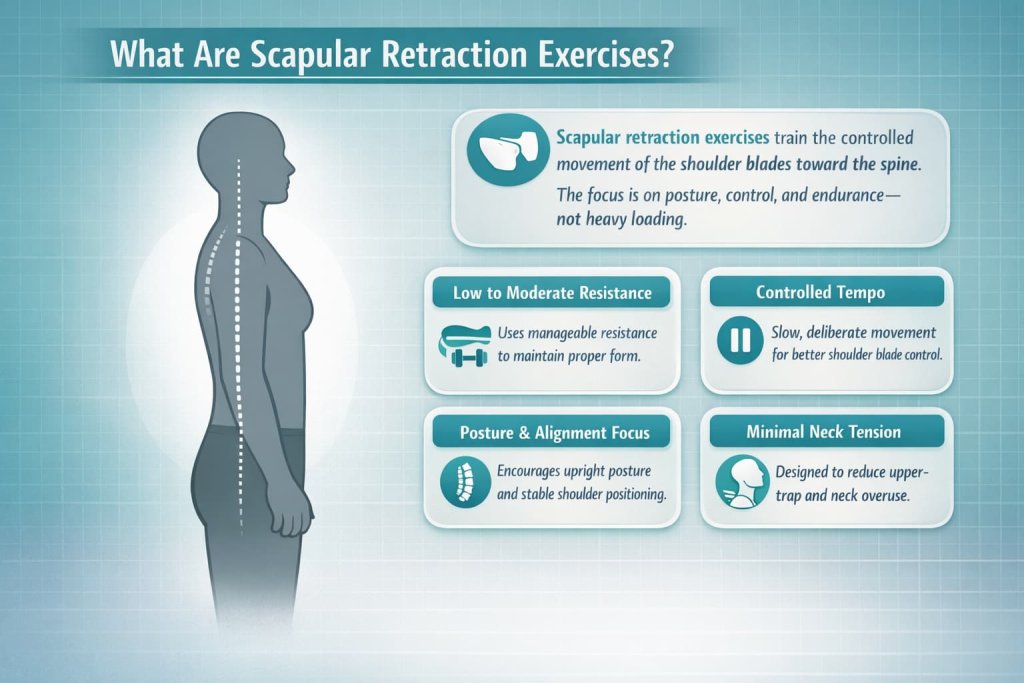
Scapular retraction exercises focus on the controlled movement of the shoulder blades toward the spine without excessive shrugging or arching. The goal is movement quality and endurance, not maximal load.
Unlike many chest-dominant or arm-dominant movements, these exercises train the mid-back stabilizers that help position the shoulder blades during pushing, pulling, and overhead activity.
Key characteristics:
- Low to moderate resistance
- Controlled tempo
- Emphasis on posture and alignment
- Minimal neck tension
10 Best Scapular Retraction Exercises
Scapular retraction exercises focus on strengthening the mid-back muscles that pull the shoulder blades back and down. They may help support better posture, shoulder stability, and controlled upper-body movement when performed with proper form and consistency.
1. Scapular Squeeze (Standing or Seated)
Why it works:
This foundational exercise builds awareness of proper scapular retraction by isolating shoulder blade movement without resistance. It helps retrain posture muscles that are often underactive due to prolonged sitting or slouched positions.
Muscles worked:
The movement primarily activates the middle trapezius and rhomboids, with light involvement from the lower trapezius. Neck and arm muscles should remain relaxed.
How to do it:
- Sit or stand tall with arms relaxed at your sides
- Gently pull your shoulder blades back and slightly down
- Avoid shrugging or arching your lower back
- Hold the squeeze for 3–5 seconds
- Slowly relax and repeat
Trainer Tip:
Think “shoulder blades slide into your back pockets,” not “chest puffing forward.”
2. Resistance Band Pull-Apart
Why it works:
Band pull-aparts add light resistance to scapular retraction, improving endurance and control of the upper-back muscles while remaining joint-friendly and easy to scale.
Muscles worked:
This exercise targets the rhomboids and middle trapezius, with support from the posterior deltoids and lower trapezius.
How to do it:
- Hold a resistance band at chest height with arms extended
- Keep elbows straight but not locked
- Pull the band apart by drawing shoulder blades together
- Pause briefly at full retraction
- Return slowly to the start position
Trainer Tip:
Move slowly on the return to maintain tension and avoid snapping the band back.
3. Seated Resistance Band Row
Why it works:
Seated rows reduce body sway and allow better focus on scapular movement. This makes the exercise effective for reinforcing posture while minimizing compensation from the lower body.
Muscles worked:
The middle trapezius and rhomboids are the primary movers, supported by the posterior deltoids and elbow flexors.
How to do it:
- Sit tall with legs extended and band looped around your feet
- Hold the band with palms facing each other
- Pull elbows back while squeezing shoulder blades together
- Keep chest lifted and neck relaxed
- Slowly extend arms to return
Trainer Tip:
Lead the movement with your shoulder blades, not your hands.
4. Prone I Raise
Why it works:
The prone I raise emphasizes controlled scapular retraction and depression while limiting upper-trapezius dominance. It encourages better shoulder blade positioning against gravity.
Muscles worked:
This movement targets the lower and middle trapezius, with secondary engagement of the spinal stabilizers.
How to do it:
- Lie face down on a bench or mat
- Arms extended overhead with thumbs pointing up
- Lift arms slightly off the surface while retracting shoulder blades
- Keep forehead and neck neutral
- Lower slowly with control
Trainer Tip:
If range is limited, lift only a few inches—quality matters more than height.
5. Prone T Raise
Why it works:
Prone T raises strengthen horizontal scapular retraction and help balance shoulder mechanics by reinforcing mid-back endurance.
Muscles worked:
The middle trapezius and rhomboids are the main contributors, with assistance from the posterior deltoids.
How to do it:
- Lie face down with arms extended out to the sides
- Thumbs point upward or slightly back
- Lift arms while squeezing shoulder blades together
- Pause briefly at the top
- Lower slowly under control
Trainer Tip:
Avoid lifting the arms too high—focus on squeezing the shoulder blades, not height.
6. Prone W Raise
Why it works:
This variation adds external rotation to scapular retraction, improving coordination between the shoulder blades and rotator cuff muscles.
Muscles worked:
Rhomboids and middle trapezius work alongside the rotator cuff and posterior deltoids.
How to do it:
- Lie face down with elbows bent and arms in a “W” shape
- Pull elbows toward your sides while retracting shoulder blades
- Keep forearms lifted and shoulders relaxed
- Hold briefly, then lower slowly
Trainer Tip:
Think “elbows down and back,” not “hands up.”
7. Face Pull (Band or Cable)
Why it works:
Face pulls encourage scapular retraction with external rotation, supporting shoulder balance and postural strength during pulling movements.
Muscles worked:
This exercise targets the rhomboids, middle trapezius, rear deltoids, and rotator cuff muscles.
How to do it:
- Set band or cable at face height
- Grip with thumbs pointing back
- Pull toward your face while spreading hands apart
- Squeeze shoulder blades at the end
- Return slowly to the start
Trainer Tip:
Keep elbows slightly below shoulder height to avoid neck tension.
8. Chest-Supported Dumbbell Row
Why it works:
Chest support removes momentum and reduces lower-back strain, allowing focused scapular retraction with controlled loading.
Muscles worked:
Primary muscles include the rhomboids and middle trapezius, with assistance from the lats and posterior deltoids.
How to do it:
- Lie chest-down on an incline bench
- Hold dumbbells with arms hanging straight down
- Pull elbows back while squeezing shoulder blades
- Pause briefly at the top
- Lower weights slowly
Trainer Tip:
Use lighter weights than standing rows to maintain clean scapular movement.
9. Wall-Supported Bent-Over Row
Why it works:
Using the wall for support helps reinforce proper hip hinge and spinal alignment while limiting excessive body movement. This allows greater focus on controlled scapular retraction without overloading the lower back.
Muscles worked:
The rhomboids and middle trapezius are the primary muscles involved, with support from the posterior deltoids and elbow flexors.
How to do it:
- Stand facing a wall with feet hip-width apart
- Hinge at the hips and lightly rest your chest or hands against the wall
- Hold dumbbells or a resistance band with arms hanging down
- Pull elbows back while squeezing your shoulder blades together
- Lower slowly to the starting position with control
Trainer Tip:
Keep your neck neutral and ribs down—if you feel strain in the lower back, reduce the hinge depth or resistance.
10. Isometric Scapular Hold
Why it works:
Isometric holds build endurance in posture-supporting muscles without joint movement, making them useful for posture awareness and control.
Muscles worked:
This exercise primarily targets the middle trapezius and rhomboids, with stabilization from the lower trapezius.
How to do it:
- Sit or stand tall with arms relaxed
- Pull shoulder blades back and slightly down
- Hold the position for 10–30 seconds
- Breathe normally throughout
- Relax and repeat
Trainer Tip:
Stop the hold if you feel neck tightening—reset and focus on gentle engagement.
How Often Should You Do Scapular Retraction Exercises?
General fitness and rehabilitation resources commonly recommend:
- 2–4 sessions per week
- 2–3 sets per exercise
- 8–15 controlled reps or 10–30-second holds
According to resistance-training guidelines from the American Council on Exercise, posture-supporting muscles often respond best to moderate volume and consistent practice rather than heavy loading.
Common Mistakes to Avoid
- Over-shrugging instead of retracting
- Arching the lower back to “fake” retraction
- Holding breath during isometric holds
- Using excessive resistance too early
- Pulling with the arms instead of the shoulder blades
Maintaining slow, deliberate movement helps reinforce correct motor patterns.
Why Scapular Retraction Exercises Matter for Posture and Shoulder Stability
Poor scapular control can contribute to:
- Forward head and rounded shoulder posture
- Reduced shoulder efficiency during exercise
- Increased fatigue of the neck and upper traps
Research in sports medicine and rehabilitation literature suggests that scapular-focused exercise programs may improve posture awareness and shoulder function when paired with proper progression and technique (Journal of Orthopaedic & Sports Physical Therapy).
Public health resources such as the Centers for Disease Control and Prevention and National Institutes of Health consistently highlight the importance of muscle-strengthening activities that support joint health and functional movement.
Muscles Involved in Scapular Retraction
Scapular retraction exercises primarily engage:
- Middle trapezius
- Rhomboid major and minor
Secondary support comes from:
- Lower trapezius
- Posterior deltoids
- Spinal stabilizers
Balanced activation across these muscles helps support efficient shoulder blade positioning during both static posture and dynamic movement.
How to Perform Scapular Retraction Exercises Safely
Performing scapular retraction exercises with proper technique helps support posture and shoulder stability while reducing unnecessary strain. These movements should feel controlled and comfortable, not forced.
- Maintain a tall, neutral posture with head, ribs, and spine aligned
- Pull shoulder blades back and slightly down without shrugging
- Move slowly and with control, avoiding momentum
- Use light to moderate resistance that allows proper form
- Breathe normally throughout each repetition or hold
- Stay within a pain-free range of motion
- Progress gradually as control and endurance improve
Who Should Be Cautious or Seek Professional Guidance?
You may want to consult a qualified professional if you:
- Have a history of shoulder surgery or dislocation
- Experience sharp or worsening shoulder pain
- Have diagnosed cervical spine conditions
This content is for informational purposes only and not medical advice.
Frequently Asked Questions
Are scapular retraction exercises good for rounded shoulders?
They may help support posture by strengthening the muscles that counter forward-shoulder positioning when combined with ergonomic adjustments.
Can I do scapular retraction exercises every day?
Light, low-load drills can often be practiced daily, but resistance-based exercises typically benefit from rest days.
Do scapular retraction exercises help shoulder pain?
They may support shoulder function and movement efficiency, but they are not a medical treatment.
Are bands better than dumbbells for scapular retraction?
Bands allow easier tension control, while dumbbells can increase loading once form is solid.
How long does it take to see posture improvements?
Many people notice awareness changes within weeks, while visible posture changes may take longer with consistent practice.
Should I combine these with chest stretching?
Yes, pairing retraction work with gentle chest mobility may support balanced shoulder positioning.
Conclusion
Scapular retraction exercises play a key role in supporting posture, shoulder stability, and upper-back strength. When performed with proper technique and consistency, they can help reinforce healthy movement patterns that carry over into daily life and training.
Start with low resistance, prioritize control, and progress gradually to build long-term shoulder confidence and stability.
References
- Clinical implications of scapular dyskinesis in shoulder injury: the 2013 consensus statement from the “Scapular Summit” (BJSM, 2013)
- Current Views of Scapular Dyskinesis and its Possible Clinical Relevance (International Journal of Sports Physical Therapy, 2022)
- The association of scapular kinematics and glenohumeral joint pathologies (JOSPT DOI page)
- Rotator cuff exercises: includes “Shoulder blade (scapular) retraction” instructions (MedlinePlus, updated June 4, 2025)
- Shoulder blade squeeze exercise instructions (Mayo Clinic)
- ACSM Position Stand: Progression models in resistance training for healthy adults (Med Sci Sports Exerc, 2009)
- Adult Activity Guidelines overview (CDC, updated Dec 20, 2023)