
The best exercises for lower back pain are gentle stretching, mobility drills, and core-strengthening movements that help reduce stiffness and support your spine. These exercises may ease discomfort by improving posture, strengthening stabilizing muscles, and increasing flexibility.
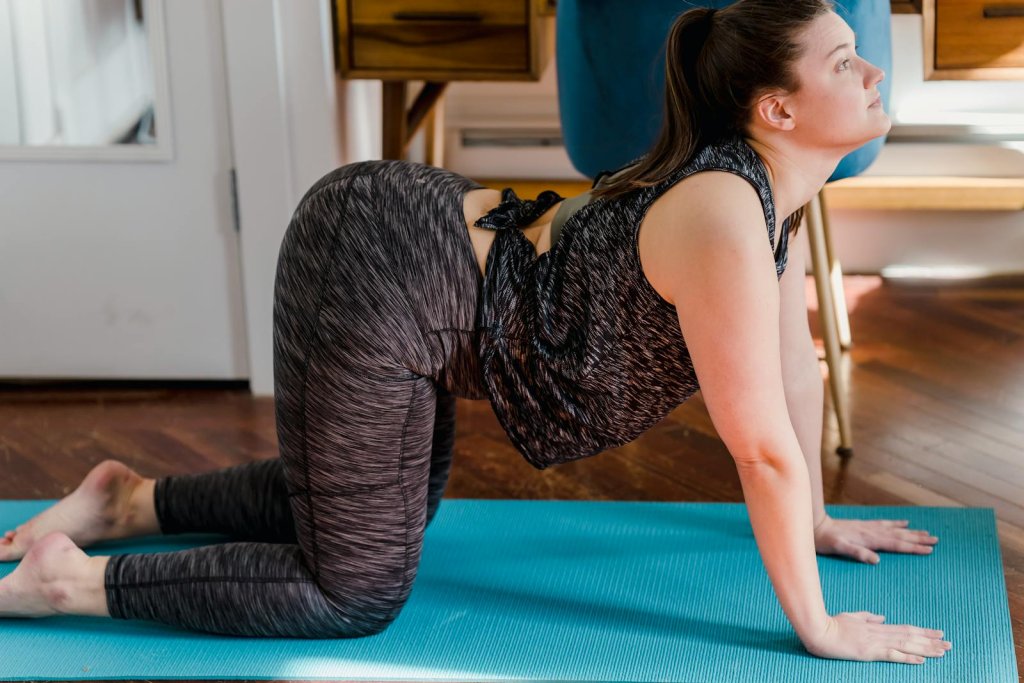
Lower back pain affects millions of people, and understanding how to manage it safely is important. Simple, controlled movements—such as pelvic tilts, bird dog, and glute bridges—can support your spine and improve daily comfort when done consistently.
In this guide, you’ll find 10 safe, beginner-friendly exercises, step-by-step instructions, safety notes, and when to seek medical care.
What Causes Lower Back Pain?
Lower back pain may occur due to:
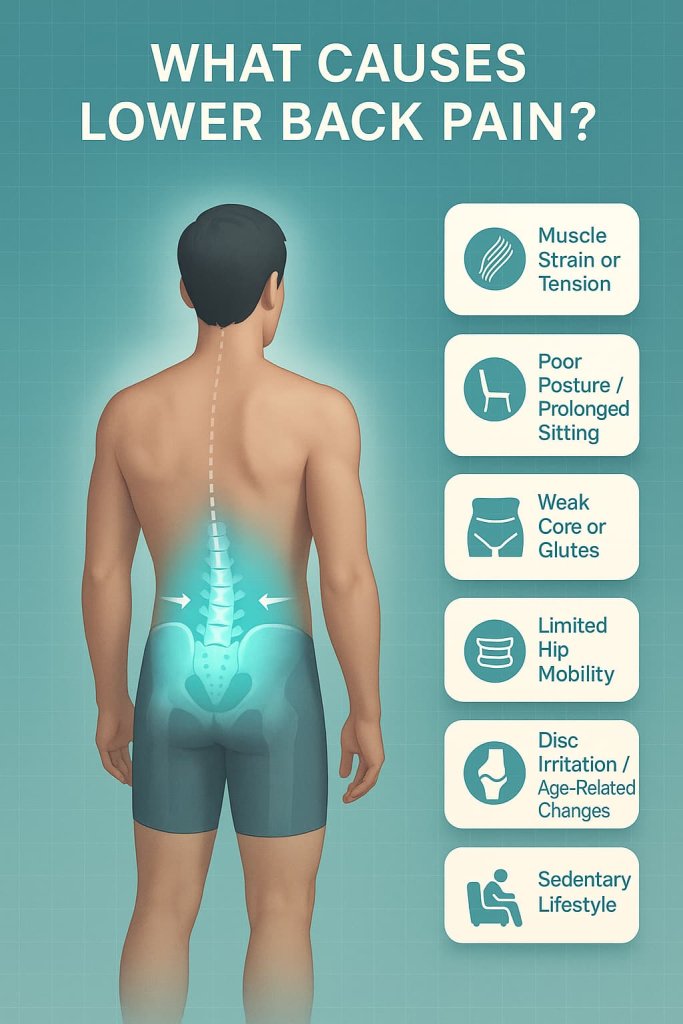
- Muscle strain or tension
- Poor posture or prolonged sitting
- Weak core or glute muscles
- Limited hip mobility
- Disc irritation or age-related changes
- Sedentary lifestyle
Most cases are non-specific, meaning no serious disease is involved. Regular movement is often part of the solution.
Are Exercises Good for Lower Back Pain?
Yes. According to the American College of Physicians, exercise and physical therapy are recommended as first-line treatment for most non-specific lower back pain. Research shows that:
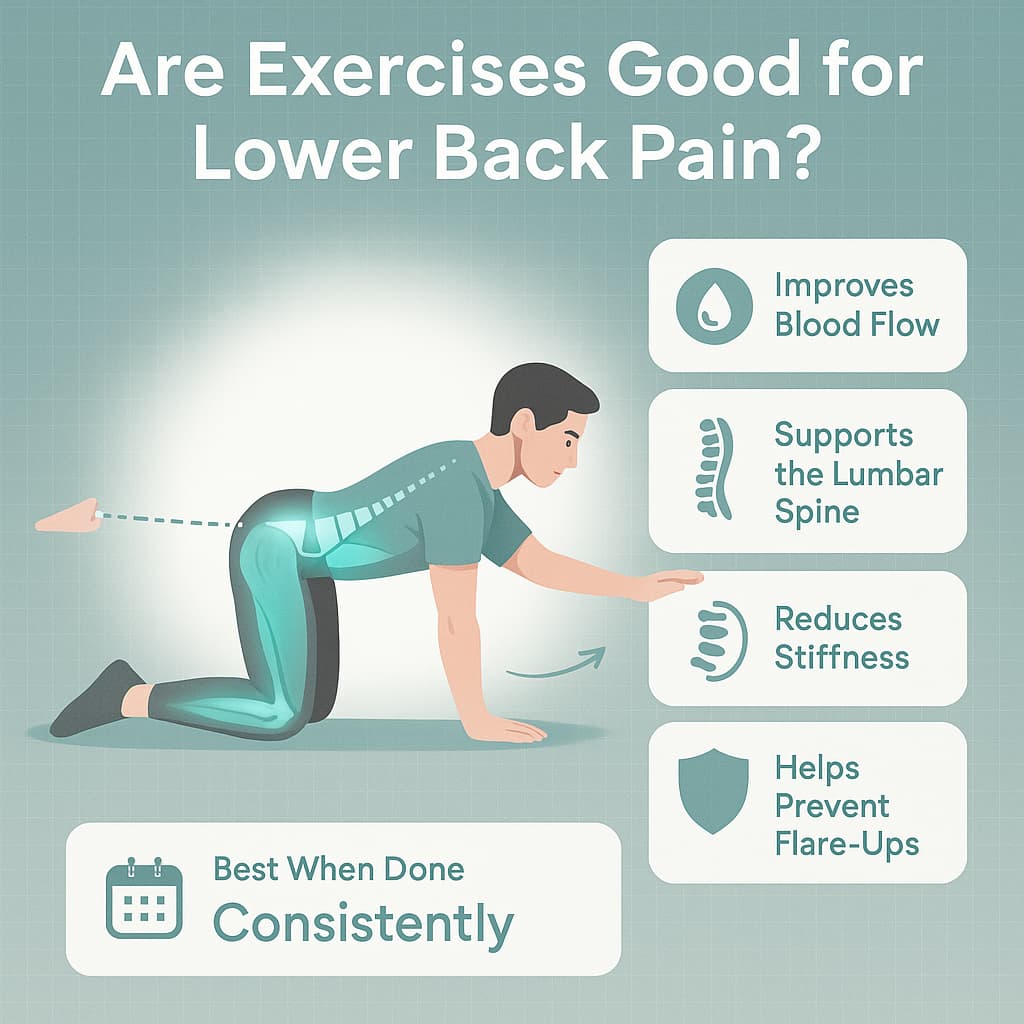
- Movement improves blood flow.
- Gentle core strengthening supports the lumbar spine.
- Flexibility exercises reduce stiffness.
- Consistent exercise may help prevent future flare-ups.
A balanced routine of mobility + stretching + strengthening works best.
How to Exercise Safely If You Have Lower Back Pain
Before starting:
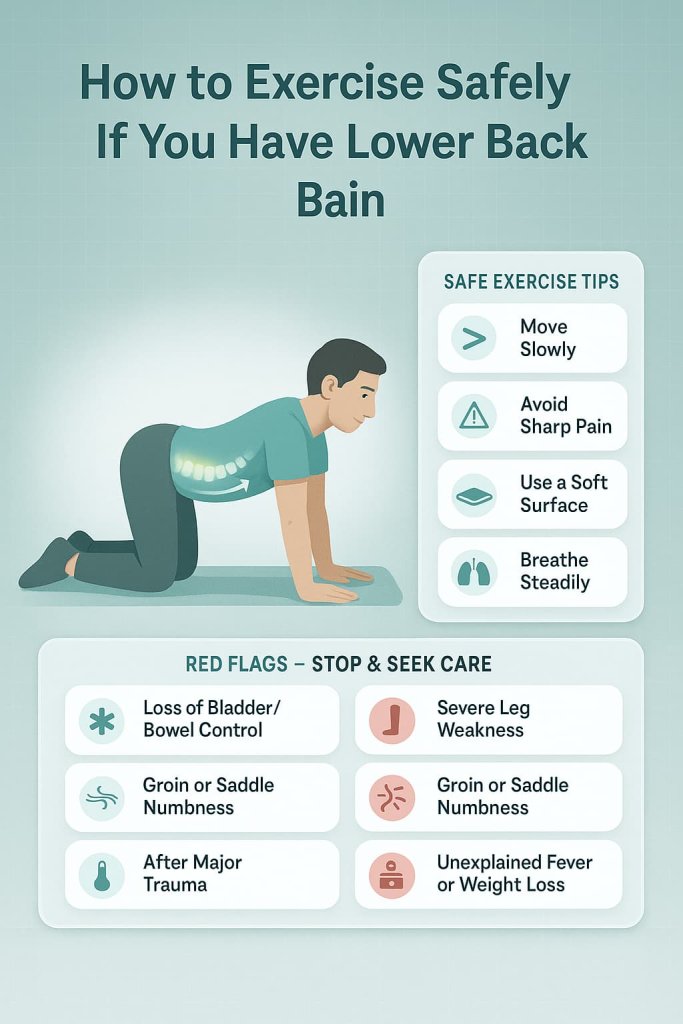
- Move slowly and avoid sharp pain.
- Stop if symptoms worsen.
- Use a mat or soft surface.
- Keep breathing steady during each movement.
Seek medical care immediately if you experience:
- Loss of bladder/bowel control
- Severe or worsening leg weakness
- Numbness in the groin or saddle area
- Pain after major trauma
- Unexplained weight loss or fever
10 Best Exercises for Lower Back Pain Relief (You Can Do at Home)
Below are the 10 exercises most often recommended by physical therapists for easing lower back pain and improving core support.
1. Pelvic Tilts
Why it works:
Pelvic tilts help activate the deep core and lumbar stabilizers that support your spine. This gentle movement increases mobility in the lower back and reduces stiffness caused by prolonged sitting or muscle tension.
Muscles worked:
Deep core muscles, transverse abdominis, lower back extensors, pelvic stabilizers.
How to do it:
- Lie on your back with knees bent and feet flat.
- Tighten your stomach muscles as you gently flatten your lower back against the floor.
- Hold the tilt for 3–5 seconds, then release back to neutral.
- Repeat 10–12 times with slow control.
Trainer Tip:
Avoid pushing with your legs—focus on using your lower abs to initiate the movement.
2. Cat–Cow Stretch
Why it works:
This dynamic stretch mobilizes the entire spine, relieving stiffness in the lumbar and thoracic regions. It encourages healthy motion between vertebrae and improves circulation to tight back muscles.
Muscles worked:
Erector spinae, abdominals, hip flexors, spinal stabilizers.
How to do it:
- Start on your hands and knees in a tabletop position.
- Arch your back upward while tucking your chin (Cat).
- Lower your back and lift your chest forward (Cow).
- Move slowly with each breath.
- Repeat 10–12 cycles.
Trainer Tip:
Keep movements smooth and controlled—avoid collapsing into your lower back during the Cow position.
3. Child’s Pose
Why it works:
This gentle stretch relaxes tight muscles around the lower back and hips, helping reduce tension. It also encourages deep breathing, which can ease pain-related muscle guarding.
Muscles worked:
Lower back extensors, glutes, hips, lats.
How to do it:
- Kneel on the floor and sit back on your heels.
- Reach your arms forward and lower your chest toward the floor.
- Relax your neck, shoulders, and back.
- Hold for 20–30 seconds.
Trainer Tip:
If your hips feel tight, widen your knees slightly to create space and deepen the stretch comfortably.
4. Knee-to-Chest Stretch
Why it works:
This stretch helps release tension in the lumbar spine and glute muscles, which often tighten and contribute to lower back discomfort. It also gently stretches the hip muscles that affect spinal alignment.
Muscles worked:
Lower back muscles, glutes, hip flexors.
How to do it:
- Lie on your back with legs extended.
- Pull one knee toward your chest until you feel a gentle stretch.
- Hold, then switch sides.
- Hold each stretch for 20–30 seconds.
Trainer Tip:
Keep your opposite leg relaxed and your lower back gently pressed into the floor for better support.
5. Lower-Trunk Rotations
Why it works:
This exercise improves rotational mobility in the spine and reduces stiffness by gently moving the lumbar region through a safe range of motion.
Muscles worked:
Obliques, lumbar extensors, hip muscles.
How to do it:
- Lie on your back with knees bent and feet flat.
- Slowly lower both knees to one side while keeping shoulders on the floor.
- Return to center and switch sides.
- Repeat 8–10 per side.
Trainer Tip:
Only rotate as far as comfortable—avoid forcing the knees lower than your mobility allows.
6. Hamstring Stretch (Supine or Seated)
Why it works:
Tight hamstrings can pull on the pelvis and increase stress on the lower back. Stretching them helps restore proper alignment and reduces low-back strain.
Muscles worked:
Hamstrings, calves, glutes (mild), lower back (indirectly).
How to do it:
- Lie on your back and loop a strap behind one foot.
- Slowly raise the leg until you feel a comfortable stretch.
- Keep the knee slightly bent to avoid nerve tension.
- Hold for 20–30 seconds.
Trainer Tip:
Avoid pulling the leg too high; the goal is a mild stretch, not a deep hamstring strain.
7. Glute Bridge
Why it works:
Strengthening the glutes reduces lower back workload and improves hip support. This exercise teaches proper hip extension—a key movement for reducing lower-back strain during daily activities.
Muscles worked:
Gluteus maximus, hamstrings, core stabilizers, pelvic muscles.
How to do it:
- Lie on your back with knees bent and feet hip-width apart.
- Press through your heels to lift your hips off the floor.
- Form a straight line from knees to shoulders.
- Squeeze your glutes at the top.
- Perform 10–12 reps.
Trainer Tip:
Don’t arch your lower back at the top—focus on lifting with your glutes, not your spine.
8. Bird Dog
Why it works:
This movement strengthens the deep stabilizing muscles that protect the spine. It trains core stability, balance, and coordination without loading the lower back.
Muscles worked:
Core stabilizers, lower back, glutes, shoulders.
How to do it:
- Start on hands and knees.
- Extend your opposite arm and leg while keeping your spine neutral.
- Hold briefly, then switch sides.
- Perform 8–10 reps per side.
Trainer Tip:
Keep your hips level—avoid twisting as you extend your arm and leg.
9. Modified Curl-Up (McGill Curl-Up)
Why it works:
This exercise activates the core muscles while maintaining a neutral spine, reducing unnecessary stress on lumbar discs. It’s widely recommended in back rehabilitation programs.
Muscles worked:
Rectus abdominis, transverse abdominis, deep spinal stabilizers.
How to do it:
- Lie on your back with one knee bent and one extended.
- Place hands under your lower back to maintain neutral alignment.
- Lift your head and shoulders slightly without rounding your back.
- Hold 5–10 seconds and repeat 6–8 reps.
Trainer Tip:
Keep your gaze on the ceiling to avoid pulling on your neck.
10. Side Plank (Knees Bent)
Why it works:
Side planks strengthen the lateral core muscles that stabilize your spine during movement. This reduces stress on the lumbar region and improves posture.
Muscles worked:
Obliques, transverse abdominis, gluteus medius, spinal stabilizers.
How to do it:
- Lie on your side with knees bent.
- Prop onto your forearm and lift your hips into a straight line.
- Hold 10–15 seconds, then switch sides.
- Repeat 2–3 times per side.
Trainer Tip:
Keep your elbow directly under your shoulder to avoid strain and maintain proper alignment.
How Often Should You Do These Exercises?
For best results:
- Perform these exercises 3–5 days per week.
- Spend 10–15 minutes per session.
- Increase reps and holds gradually as pain decreases.
Consistency matters more than intensity.
When Not to Do These Exercises (Red Flags & Warnings)
Do not perform these exercises if you experience any of the following, as they may indicate a serious condition:
- Loss of bowel or bladder control
- Numbness in the groin or saddle area
- Severe or worsening leg weakness
- Inability to stand or walk without increased pain
- Recent major trauma (fall, accident)
- Unexplained fever, chills, or significant weight loss
- Persistent night pain that doesn’t improve with position changes
Stop exercising and consult a healthcare professional if your pain becomes sharp, radiates down the leg, or continues beyond 4–6 weeks.
When to See a Doctor
Consult a professional if:
- Pain lasts longer than 4–6 weeks
- Pain radiates below the knee
- You have numbness, tingling, or weakness
- Symptoms impact walking or daily activities
A physical therapist can provide a personalized plan if needed.
FAQs About Lower Back Pain Exercises
1. Can these exercises work for chronic lower back pain?
Yes. Research shows that consistent, gentle strengthening and mobility work may reduce chronic symptoms.
2. Should I exercise during a flare-up?
Light movements like walking, pelvic tilts, and stretching are usually fine unless pain sharply increases.
3. How fast will I notice results?
Some people feel relief within a few sessions; others may need 2–4 weeks of consistent practice.
4. Are these exercises safe for beginners?
Yes—each movement is low-impact and beginner friendly.
5. Can I combine these with walking?
Absolutely. Walking is one of the top recommended activities for lower back pain.
6. Can these exercises replace medical treatment?
No. They support comfort and mobility, but do not replace professional diagnosis.
7. Should people with osteoporosis modify any moves?
Yes. They should avoid deep forward bending; consult a healthcare provider first.
Conclusion
Lower back pain is common—but with the right exercises, you can support your spine, reduce stiffness, and improve daily comfort. Start slow, stay consistent, and listen to your body. If pain persists or worsens, contact a healthcare professional for a personalized evaluation.
This content is for informational purposes only and not medical advice.
References
- American College of Physicians – Guideline Summary for Nonradicular Low Back Pain
ACP issues guideline for treating nonradicular low back pain - JOSPT & APTA Clinical Practice Guideline (2021)
Interventions for the Management of Acute and Chronic Low Back Pain - Cochrane Review – Exercise Therapy for Chronic Low Back Pain (2021)
Exercise therapy for chronic low back pain - Li Y, et al. – Network Meta-analysis (2023)
Exercise intervention for patients with chronic low back pain