
Bicep tendonitis exercises are structured, progressive movements that help reduce tendon irritation, restore shoulder function, and safely rebuild arm strength when performed correctly. Understanding how and when to use the right exercises matters because improper loading or rushing recovery may worsen symptoms or delay healing. This guide explains what bicep tendonitis is, which exercises are safest at each stage, and how to progress responsibly.
What Is Bicep Tendonitis?
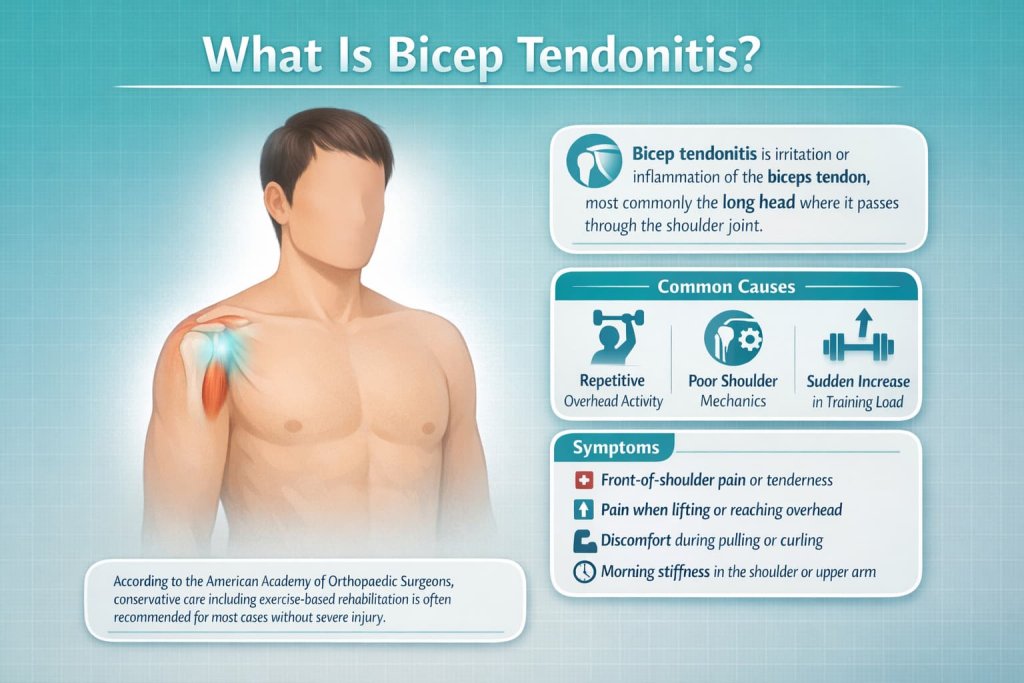
Bicep tendonitis refers to irritation or inflammation of the biceps tendon—most commonly the long head of the biceps tendon where it runs through the shoulder joint. It often develops from repetitive overhead activity, poor shoulder mechanics, or sudden increases in training load.
Common symptoms include:
- Front-of-shoulder pain or tenderness
- Pain when lifting or reaching overhead
- Discomfort during pulling or curling motions
- Morning stiffness around the shoulder or upper arm
According to the American Academy of Orthopaedic Surgeons, conservative management—including exercise-based rehabilitation—is the first-line approach for most people without severe injury.
Why Bicep Tendonitis Exercises Matter
Well-designed bicep tendonitis exercises do more than target the biceps muscle alone. They aim to:
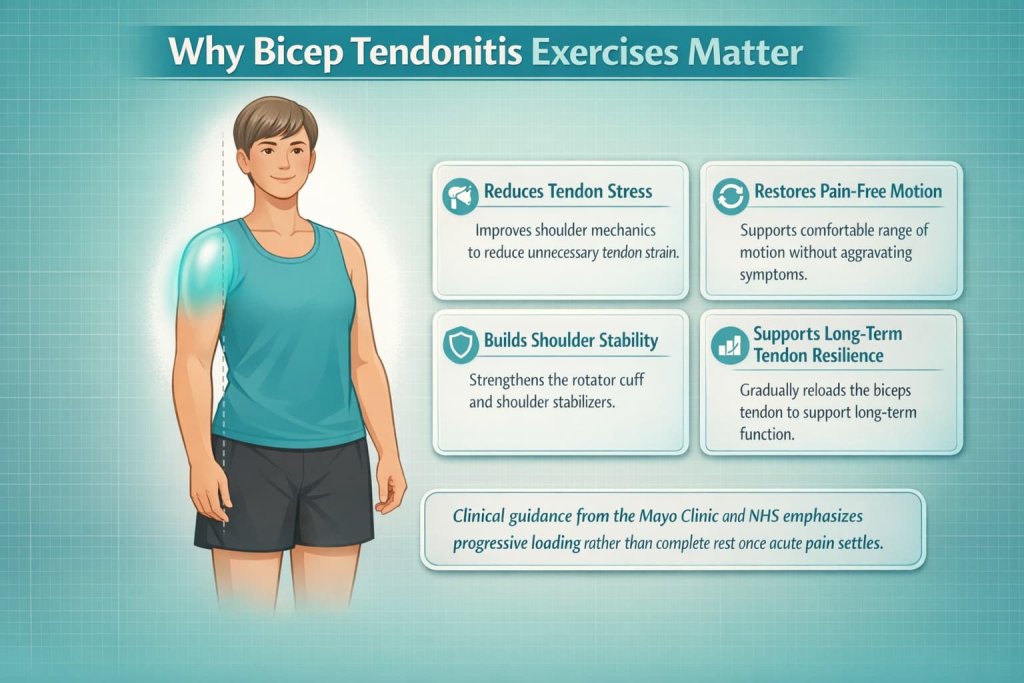
- Reduce tendon stress by improving shoulder mechanics
- Restore pain-free range of motion
- Strengthen the rotator cuff and shoulder stabilizers
- Gradually reload the biceps tendon to support long-term resilience
Clinical guidance from the Mayo Clinic and NHS consistently emphasizes progressive loading rather than complete rest once acute pain settles.
10 Best Bicep Tendonitis Exercises
These exercises focus on reducing shoulder and arm discomfort while gradually restoring strength and movement control. They progress from gentle mobility and stability work to carefully reintroducing biceps loading in a tendon-friendly way.
1. Pendulum Shoulder Swings
How to do it
- Lean forward from the hips with one hand supported on a chair, bench, or wall
- Allow the affected arm to hang completely relaxed toward the floor
- Gently shift your body to create small forward–backward swings
- Progress to side-to-side and small circular motions if comfortable
Why it works
Pendulum swings promote gentle shoulder joint movement without actively contracting the biceps tendon. This may help support joint lubrication, reduce stiffness, and maintain mobility during the early or painful phase of bicep tendonitis.
Trainer Tip
The arm should stay relaxed at all times—if you feel the shoulder or biceps actively working, reduce the range or slow the movement.
2. Shoulder Blade Squeezes
How to do it
- Sit or stand tall with your chest open
- Gently pull your shoulder blades back and slightly downward
- Hold the position briefly, then fully relax
Why it works
Improving scapular control helps normalize shoulder mechanics. Better shoulder blade positioning can reduce excessive strain placed on the biceps tendon during arm lifting and reaching tasks.
Trainer Tip
Think “wide collarbones” rather than forcing the shoulders backward to avoid over-tension.
3. Wall Slides
How to do it
- Stand facing a wall with forearms and hands resting against it
- Keep your ribs down and core gently engaged
- Slowly slide your arms upward as far as comfortable
- Return to the starting position with control
Why it works
Wall slides encourage coordinated movement between the shoulder joint and shoulder blades. This improves overhead mobility while limiting stress on irritated biceps tendon structures.
Trainer Tip
Stop the movement before discomfort appears—quality of motion is more important than height.
4. Isometric Biceps Hold
How to do it
- Bend your elbow to approximately 90 degrees
- Hold a very light weight or apply gentle resistance with the opposite hand
- Maintain the position without moving the elbow joint
Why it works
Isometric contractions load the biceps tendon without joint movement. This may help maintain muscle engagement while minimizing aggravation during early strengthening phases.
Trainer Tip
Mild effort is sufficient—pain should not increase during or after the hold.
5. External Rotation With Band
How to do it
- Attach a light resistance band at waist height
- Keep your elbow tucked against your side
- Rotate your forearm outward away from your body
- Slowly return to the starting position
Why it works
External rotation strengthens key rotator cuff muscles that stabilize the shoulder. Improved shoulder stability helps reduce compensatory strain on the biceps tendon.
Trainer Tip
Use a slow tempo and keep the elbow pinned to your side throughout the movement.
6. Internal Rotation With Band
How to do it
- Secure a light band at waist height
- Keep your elbow close to your side
- Pull your forearm inward across your body
- Return slowly with control
Why it works
Balancing internal and external shoulder strength supports proper joint mechanics, which may help distribute load more evenly during arm movements.
Trainer Tip
Avoid rotating your torso—only the arm should move.
7. Assisted Biceps Curl
How to do it
- Use a resistance band or very light dumbbell
- Curl the weight upward through a comfortable, pain-free range
- Lower the weight slowly and under control
Why it works
This exercise gently reintroduces dynamic loading to the biceps tendon, which is necessary for long-term tendon resilience when progressed appropriately.
Trainer Tip
If discomfort appears, reduce range of motion or resistance rather than pushing through.
8. Eccentric Biceps Curl
How to do it
- Use your non-affected arm to assist the lifting phase
- Transfer the weight to the affected arm at the top
- Slowly lower the weight down using only the affected arm
Why it works
Eccentric loading is commonly used in tendon rehabilitation programs because it exposes the tendon to controlled tension, which may support tendon adaptation over time.
Trainer Tip
Lowering should be slow and steady—aim for 4–6 seconds per repetition.
9. Cross-Body Shoulder Stretch
How to do it
- Bring the affected arm across your chest
- Use the opposite hand to gently pull the arm closer
- Hold the stretch comfortably without forcing
Why it works
This stretch improves posterior shoulder flexibility, which may reduce compensatory movement patterns that increase stress on the front of the shoulder and biceps tendon.
Trainer Tip
You should feel a gentle stretch, not sharp or pinching pain.
10. Chest-Opening Stretch
How to do it
- Clasp your hands behind your back
- Gently lift your arms while opening the chest
- Hold while breathing slowly and evenly
Why it works
Improving chest and shoulder posture helps counter forward-rounded shoulders, a common contributor to excessive biceps tendon loading.
Trainer Tip
Keep your neck relaxed and avoid arching your lower back.
When to Start Exercising With Bicep Tendonitis
You can usually begin gentle exercises when:
- Pain at rest is mild or improving
- Movements can be done without sharp or worsening pain
- Daily activities are tolerable
If pain is severe, sudden, or associated with visible deformity or major weakness, medical evaluation is recommended before starting any exercise program.
Common Mistakes to Avoid
- Pushing through sharp or worsening pain
- Starting strengthening before mobility improves
- Using heavy weights too early
- Ignoring shoulder blade and rotator cuff training
- Skipping rest days
How Often Should You Do Bicep Tendonitis Exercises?
General guidance from organizations such as the American College of Sports Medicine suggests:
- Mobility and light activation: daily or every other day
- Strengthening: 2–3 times per week
- Progress only if symptoms remain stable or improve
Who Should Be Cautious or Seek Professional Advice?
You should consult a qualified healthcare or rehabilitation professional if:
- Pain persists beyond several weeks
- Symptoms worsen despite exercise
- There is significant weakness or loss of function
- Pain follows a sudden injury or fall
Frequently Asked Questions
Can exercises cure bicep tendonitis?
Exercises do not cure tendonitis, but they may help reduce symptoms and support recovery when appropriately programmed.
Should I completely rest my arm?
Short-term relative rest may help early on, but prolonged inactivity is generally discouraged once pain allows gentle movement.
Are bicep curls bad for bicep tendonitis?
Heavy or poorly controlled curls may aggravate symptoms, but light, controlled variations are often used later in rehab.
How long does recovery usually take?
Recovery timelines vary but often range from several weeks to a few months, depending on severity and consistency.
Can I train other body parts during recovery?
Yes, as long as exercises do not aggravate shoulder or arm symptoms.
Is stretching enough to fix bicep tendonitis?
Stretching alone is usually insufficient; strengthening and movement control are also important.
Conclusion
Bicep tendonitis exercises play a key role in reducing pain, restoring shoulder function, and rebuilding arm strength when performed progressively and consistently. Focus on movement quality, patience, and gradual loading—and seek professional guidance if symptoms persist. Done correctly, these exercises can help you return to daily activities and training with greater confidence and comfort.
References
- Rotator Cuff and Shoulder Conditioning Program (OrthoInfo – AAOS)
- Diagnosis and Treatment of Biceps Tendinitis and Tendinosis (American Family Physician – AAFP, 2009)
- Tendinitis: Diagnosis and Treatment (Mayo Clinic)
- Bicep Tendonitis: Symptoms, Causes, and Treatment (Cleveland Clinic)
- Exercises for Shoulder Problems (NHS inform)
- Physical Therapy Interventions for Biceps Tendinopathy: International Delphi Study (IJSPT, 2022)
- Eccentric or Concentric Exercises for Tendinopathy Treatment (JOSPT, 2015)