
Hamstring tendonitis exercises are controlled strengthening movements that help the tendon tolerate load, reduce pain over time, and restore everyday and athletic function. Understanding how to load the hamstring gradually is important because tendons respond best to progressive strength work—not complete rest or aggressive stretching.

Current rehab guidance focuses on managing symptoms, building tendon capacity step by step, and avoiding sudden spikes in load. Below is a clear, evidence-based guide you can safely adapt to home or gym training.
What Are Hamstring Tendonitis Exercises?
Hamstring tendonitis (often called hamstring tendinopathy) involves irritation or overload of the hamstring tendon where it attaches near the hip or behind the knee. Exercises for this condition aim to:
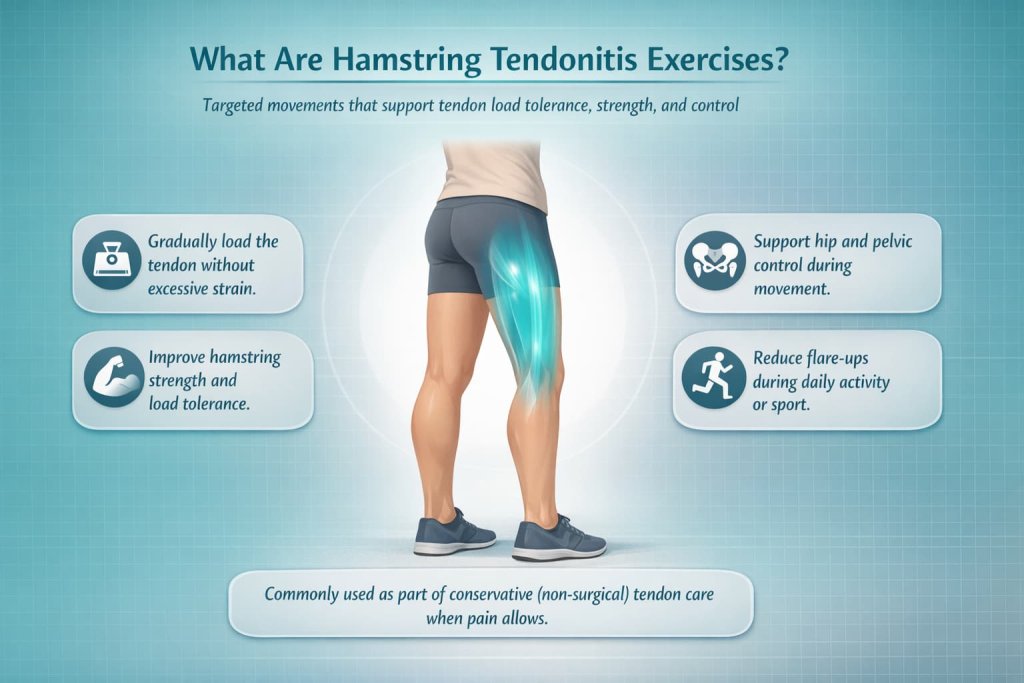
- Gradually load the tendon without excessive strain
- Improve hamstring strength and load tolerance
- Support hip and pelvic control during movement
- Reduce flare-ups during daily activity or sport
Medical resources such as Mayo Clinic note that exercise-based rehabilitation is commonly used as part of conservative tendon care when pain allows.
7 Best Hamstring Tendonitis Exercises
Below are seven carefully selected hamstring tendonitis exercises designed to reduce pain while gradually restoring strength and load tolerance. These movements follow tendon-rehab principles and progress from low-stress loading to controlled strengthening.
1. Isometric Hamstring Bridge Hold
How to do it:
- Lie on your back with knees bent and feet flat on the floor, hip-width apart
- Gently lift your hips a few inches off the ground
- Hold the position while keeping tension in the hamstrings
- Maintain steady breathing and a neutral spine
- Hold for the prescribed time, then lower slowly
Why it works:
This exercise loads the hamstring tendon without joint movement, which can be helpful during pain-sensitive phases. Isometric contractions allow the tendon to experience tension while limiting irritation from repeated motion, making it a common early-stage option in tendon rehabilitation.
Trainer Tip:
Think about gently pulling your heels toward your hips without actually moving them. This cue increases hamstring activation without increasing hip movement.
2. Double-Leg Glute Bridge
How to do it:
- Lie on your back with knees bent and feet planted on the floor
- Push through your heels and lift your hips upward
- Raise your hips until your torso forms a straight line from shoulders to knees
- Pause briefly at the top
- Lower slowly with control
Why it works:
The double-leg glute bridge introduces controlled movement while keeping hip flexion moderate. This allows the hamstrings to work through a comfortable range while sharing load with the glutes, helping rebuild strength without excessive tendon stress.
Trainer Tip:
Avoid arching your lower back at the top. If you feel the movement mostly in your low back, reduce the lift height and slow the tempo.
3. Standing Hamstring Isometric
How to do it:
- Place one heel lightly on a step, box, or chair
- Keep the knee slightly bent and torso upright
- Press the heel downward into the surface without visible movement
- Hold steady tension for the set duration
- Relax and switch sides if needed
Why it works:
This position allows hamstring loading without lying on the floor and keeps the hip in a more neutral position. It is useful when sitting or deep hip flexion aggravates symptoms and offers a practical alternative for home or workplace settings.
Trainer Tip:
Intensity should feel firm but controlled. You should feel effort without sharp pain or a strong pull behind the thigh.
4. Romanian Deadlift (Light Load)
How to do it:
- Hold light dumbbells or a barbell in front of your thighs
- Stand tall with feet hip-width apart
- Hinge at the hips while keeping knees slightly bent
- Lower the weight along your thighs and shins
- Return to standing by driving the hips forward
Why it works:
The Romanian deadlift loads the hamstrings through hip hinging, which is essential for restoring strength and tendon capacity. Using a light load and slow tempo helps reintroduce tensile stress in a controlled, predictable manner.
Trainer Tip:
Stop the descent as soon as you feel hamstring tension increase noticeably. Depth is less important than control and symptom tolerance.
5. Hamstring Curl (Machine or Band)
How to do it:
- Set up on a hamstring curl machine or attach a resistance band to your ankle
- Start with the knee slightly bent
- Bend the knee against resistance in a smooth motion
- Pause briefly, then lower slowly
- Maintain steady control throughout
Why it works:
Hamstring curls strengthen the muscle by focusing on knee flexion rather than deep hip flexion. This can be helpful for targeting the hamstrings while keeping overall tendon strain more manageable.
Trainer Tip:
Emphasize the lowering phase. Slower lowering improves control and increases time under tension without needing heavier resistance.
6. Single-Leg Bridge
How to do it:
- Lie on your back with one foot flat on the floor
- Extend the opposite leg while keeping thighs aligned
- Push through the planted heel to lift your hips
- Keep the pelvis level throughout the movement
- Lower slowly and repeat
Why it works:
Single-leg bridging increases load on one hamstring at a time while also challenging pelvic stability. This progression helps address side-to-side strength differences that are common after tendon irritation.
Trainer Tip:
If the pelvis drops or rotates, regress to a double-leg version until control improves.
7. Slider or Swiss Ball Hamstring Curl
How to do it:
- Start in a bridge position with heels on sliders or a Swiss ball
- Lift hips and keep them elevated
- Slowly extend the knees, moving the heels away
- Pull the heels back in with control
- Lower hips only after completing the set
Why it works:
This exercise places higher demand on hamstring strength and coordination while requiring sustained hip extension. It is often introduced later in rehab once baseline tolerance and control are established.
Trainer Tip:
If hips drop or movement becomes jerky, shorten the range or return to an earlier progression. Quality matters more than difficulty.
Why Exercise Important for Hamstring Tendonitis
Exercise does not “heal” a tendon instantly, but consistent, well-chosen loading supports long-term improvement. Research and clinical commentary published in British Journal of Sports Medicine highlight that tendons adapt best to progressive resistance rather than prolonged rest.
Appropriate exercise may help by:
- Increasing tendon load tolerance
- Reducing pain sensitivity over time
- Improving strength for walking, running, and sitting tolerance
- Lowering the risk of repeated flare-ups
How Often to Perform Hamstring Tendonitis Exercises
Most rehab programs suggest:
- 2–4 sessions per week
- Moderate effort with controlled tempo
- Monitoring symptoms during and 24 hours after exercise
If pain is worse the next day, reduce load or volume before progressing again.
Understanding Pain and Load Tolerance in Hamstring Tendonitis
Hamstring tendonitis is a load-related condition, meaning symptoms are influenced by how much stress the tendon is exposed to rather than injury severity alone.
- Mild discomfort during exercise can be acceptable
- Tendons adapt slowly and respond best to gradual loading
- The 24-hour response is more important than short-term soreness
- Consistent, controlled loading supports long-term tolerance
Safety Guidelines Before Starting Hamstring Tendonitis Exercises
Basic safety principles help reduce unnecessary irritation and support steady progress.
- Avoid sudden increases in load, speed, or training volume
- Use slow, controlled movement with stable posture
- Stop exercises that cause sharp or worsening pain
- Allow rest days for tendon recovery
- Use a light warm-up before loading exercises
How to Know If an Exercise Is Too Much
Monitoring symptoms helps determine whether the tendon is tolerating exercise.
- Mild discomfort that settles shortly after exercise is usually acceptable
- Pain that worsens during the session may indicate excessive load
- Next-day pain or stiffness that is clearly worse suggests the need to reduce intensity
- Persistent flare-ups signal the need for modification
Who Should Avoid or Modify These Exercises
Some situations require extra caution or professional guidance.
- Sudden or severe onset of pain
- Suspected tendon tear or recent trauma
- Progressive weakness or neurological symptoms
- Pain that continues to worsen despite load reduction
Common Mistakes to Avoid
- Stretching aggressively into pain
- Ignoring next-day symptom response
- Increasing running or sprinting volume too quickly
- Loading the tendon deeply before basic strength is restored
Organizations such as the American Physical Therapy Association emphasize gradual progression and symptom monitoring as key principles in tendon rehab.
When to Seek Professional Guidance
Consider medical or physical therapy evaluation if:
- Pain persists beyond several weeks
- Sitting pain or running pain worsens
- Symptoms limit daily activity despite modified exercise
Early guidance can help tailor loading and avoid unnecessary setbacks.
FAQs About Hamstring Tendonitis Exercises
1. Should I rest completely with hamstring tendonitis?
Complete rest is rarely recommended. Controlled exercise is usually more effective than prolonged inactivity.
2. Are stretches good for hamstring tendonitis?
Stretching may help some people, but aggressive stretching—especially with pain—can worsen symptoms.
3. Can I run while doing hamstring tendonitis exercises?
Some people can continue light running, but volume and intensity often need temporary adjustment.
4. How long does tendon rehab usually take?
Improvements often take weeks to months, depending on severity and consistency.
5. Are eccentric exercises required?
Many programs include them, but they are usually introduced after basic tolerance is established.
6. Does pain during exercise mean damage?
Mild discomfort can be acceptable, but sharp or worsening pain should be avoided.
Conclusion
Hamstring tendonitis exercises work best when they are progressive, controlled, and adjusted based on symptoms. Starting with isometrics and gradually building strength helps the tendon adapt safely while restoring function.
If pain continues or limits progress, working with a qualified professional can help you move forward with confidence.
This content is for informational purposes only and not medical advice.
References
- Proximal Hamstring Tendinopathy: Clinical Aspects of Assessment and Management (JOSPT, 2016)
- Treatment of Proximal Hamstring Tendinopathy With Individualized Physiotherapy: A Clinical Commentary (International Journal of Sports Physical Therapy, 2025)
- Proximal Hamstring Tendinopathy: A Systematic Review of Interventions (PubMed Central, 2021)
- Expert Opinion: Diagnosis and Treatment of Proximal Hamstring Tendinopathy (PubMed Central, 2015)
- Tendinopathy: Diagnosis and Treatment (Mayo Clinic)
- Hamstring Tendonitis: Symptoms, Causes, and Treatment (Cleveland Clinic)
- Tendinopathy Clinical Practice Guideline (Ohio State University Sports Medicine, PDF)
- A Proposed Return-to-Sport Program Using a Pain-Monitoring Model (JOSPT, 2015)