
Eccentric exercise focuses on the lowering phase of a movement, where muscles lengthen under tension—and this phase is one of the most effective ways to build strength, improve control, and support injury resilience.
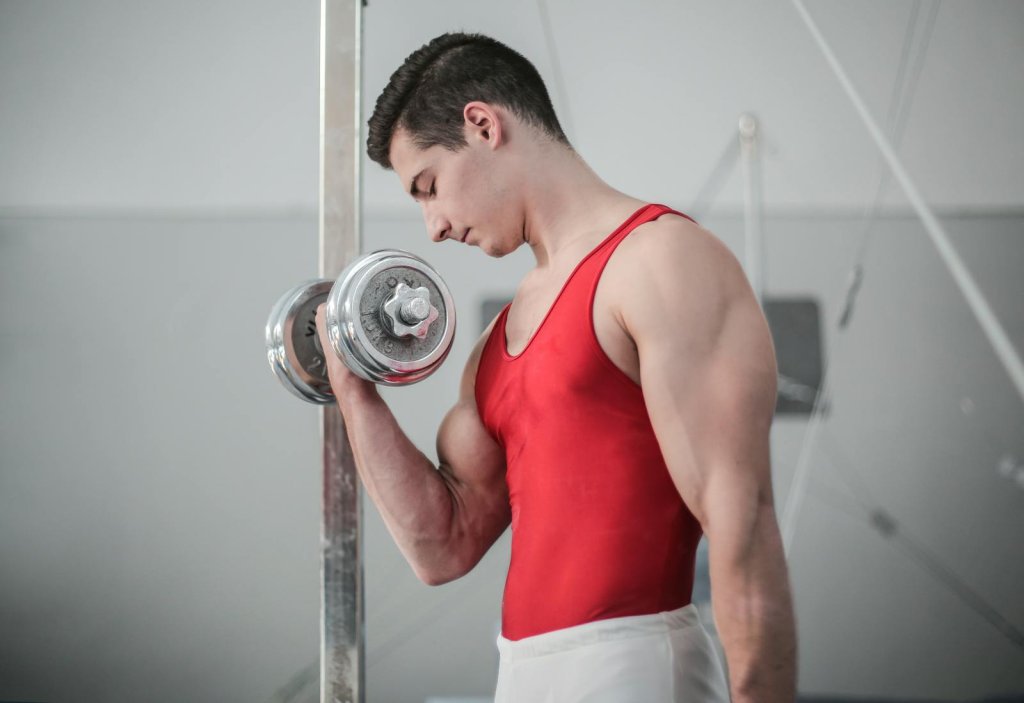
Understanding eccentric training matters because it places high mechanical tension on muscles with relatively lower metabolic cost, making it valuable for strength gains, athletic performance, and rehabilitation when programmed correctly.
In this guide, you’ll learn what eccentric exercise is, why it works, and how to perform the 10 best eccentric exercises safely and effectively.
What Is Eccentric Exercise?
Eccentric exercise refers to muscle action where the muscle lengthens while producing force. This typically happens during the lowering or braking phase of a movement.
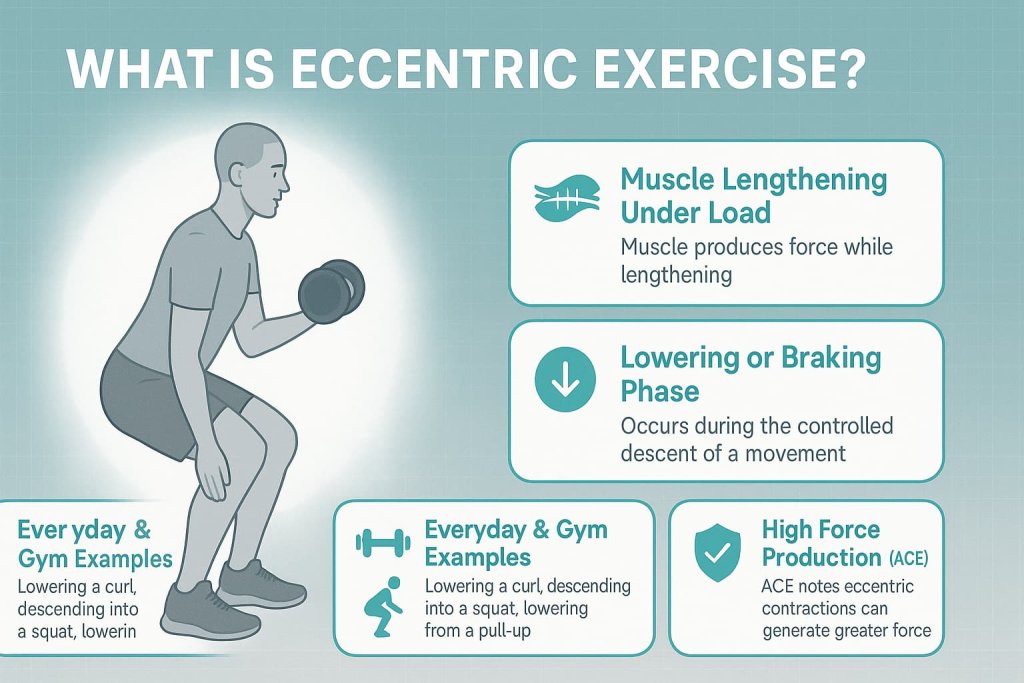
Examples include:
- Lowering a dumbbell in a biceps curl
- Descending into a squat
- Lowering your body during a pull-up
According to the American Council on Exercise (ACE), eccentric contractions can generate greater force than concentric (lifting) actions and are a key part of effective strength training and rehabilitation.
Why Eccentric Exercise Matters for Muscle and Strength
Eccentric training is often overlooked, but research shows it plays a major role in physical development.
Eccentric exercise may help support:
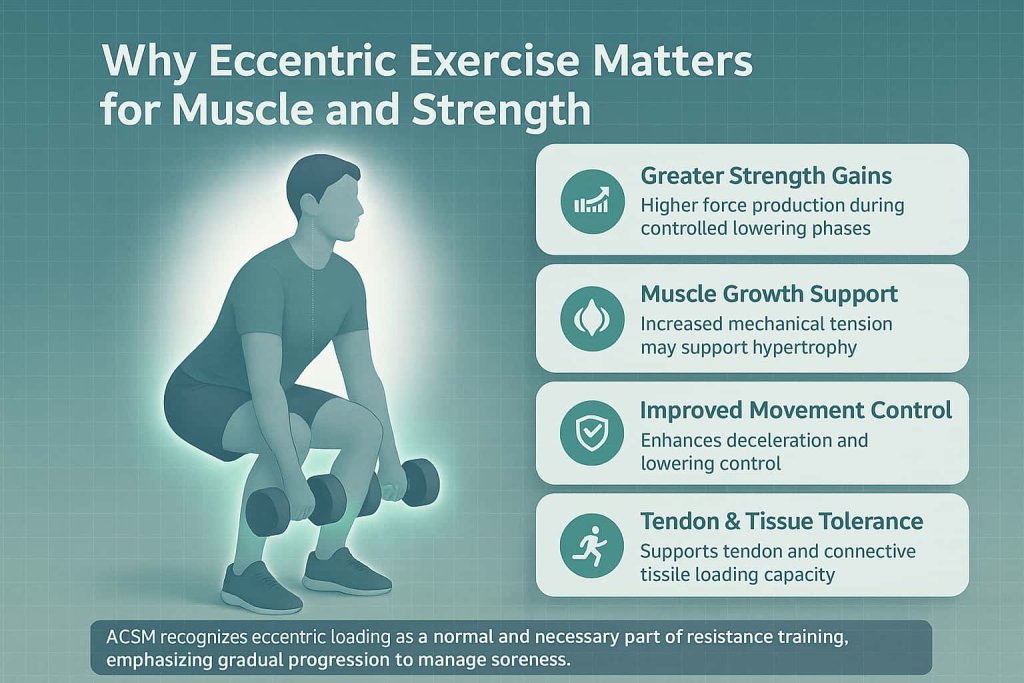
- Greater muscle strength gains due to higher force output
- Increased muscle hypertrophy through mechanical tension
- Improved control during deceleration and lowering movements
- Better tendon and connective tissue loading tolerance
- Enhanced movement efficiency in sports and daily activities
The American College of Sports Medicine (ACSM) highlights eccentric loading as a normal and necessary part of resistance training, while also emphasizing gradual progression to manage soreness.
10 Best Eccentric Exercises for Strength and Control
Below are 10 effective eccentric exercises that emphasize slow, controlled lowering to build strength, improve muscle control, and support joint stability. Each movement focuses on maximizing tension during the eccentric phase for safe, efficient strength development.
1. Eccentric Squat
Why it works:
The eccentric squat emphasizes the controlled lowering phase, which increases time under tension on the quadriceps and glutes. This phase places high mechanical load on the muscles while improving knee and hip control. Slower eccentrics also enhance motor control and joint stability, making squats safer and more effective for strength development.
Muscles worked:
- Quadriceps
- Gluteus maximus
- Adductors
- Hamstrings (stabilizing)
- Core stabilizers
How to do it:
- Stand with feet shoulder-width apart
- Brace your core and keep your chest tall
- Lower into a squat over 4–5 seconds
- Pause briefly at the bottom without relaxing
- Stand up at a normal, controlled speed
Trainer Tip:
Think “sit between your hips,” not straight down. If your knees cave in during the descent, slow the tempo further and reduce load.
2. Eccentric Push-Up
Why it works:
The slow lowering phase increases muscle activation in the chest, shoulders, and triceps while demanding greater shoulder and trunk stability. Eccentric push-ups are especially useful for building pressing strength when full push-ups are challenging.
Muscles worked:
- Pectoralis major
- Triceps brachii
- Anterior deltoids
- Core stabilizers
How to do it:
- Start in a strong plank position
- Keep your body in a straight line from head to heels
- Lower your chest toward the floor over 4 seconds
- Maintain elbow control close to the body
- Drop knees or reset to return to the top
Trainer Tip:
If your hips sag or elbows flare, regress to an incline push-up to maintain proper eccentric control.
3. Eccentric Pull-Up (Negative Pull-Up)
Why it works:
Muscles can tolerate greater loads eccentrically than concentrically. Negative pull-ups allow you to build back, arm, and grip strength even before you can perform full pull-ups.
Muscles worked:
- Latissimus dorsi
- Biceps brachii
- Forearms and grip muscles
- Upper back (rhomboids, mid-traps)
How to do it:
- Jump or step to the top pull-up position
- Start with chin over the bar
- Lower your body slowly over 5–6 seconds
- Keep shoulders controlled and engaged
- Step down and reset
Trainer Tip:
Stop the set when lowering speed becomes uncontrolled. Quality reps matter more than total volume.
4. Eccentric Romanian Deadlift
Why it works:
The hamstrings lengthen under load during the lowering phase, which strongly stimulates strength and tissue adaptation. This controlled hinge also reinforces proper hip mechanics and posterior-chain coordination.
Muscles worked:
- Hamstrings
- Gluteus maximus
- Erector spinae (stabilizing)
- Core stabilizers
How to do it:
- Hold weights in front of your thighs
- Brace your core and soften your knees
- Hinge at the hips and lower the weights slowly
- Keep the spine neutral and hips moving back
- Stop when you feel a strong hamstring stretch
Trainer Tip:
Do not force depth. The goal is tension, not touching the weights to the floor.
5. Eccentric Biceps Curl
Why it works:
Biceps are capable of handling higher loads during the eccentric phase. Slowing the lowering increases mechanical tension and helps improve tendon resilience around the elbow.
Muscles worked:
- Biceps brachii
- Brachialis
- Brachioradialis
How to do it:
- Curl the weight up using both arms or assistance
- Stabilize your elbows at your sides
- Lower the weight over 4–5 seconds
- Maintain control through the full range
Trainer Tip:
Avoid swinging the weight. If momentum appears, reduce load immediately.
6. Eccentric Nordic Hamstring (Assisted)
Why it works:
This exercise places high eccentric demand on the hamstrings, which is why it’s commonly used in athletic conditioning. Controlled exposure builds strength in the lengthened position.
Muscles worked:
- Hamstrings (especially biceps femoris)
- Gluteus maximus (stabilizing)
- Core stabilizers
How to do it:
- Kneel with ankles securely anchored
- Keep hips extended and torso upright
- Slowly lean forward while resisting gravity
- Use hands to catch yourself as needed
- Push back to the start position
Trainer Tip:
Beginners should limit the forward range. Even a few inches of controlled descent is effective.
7. Eccentric Step-Down
Why it works:
Step-downs train the quadriceps and hips to control knee flexion during single-leg loading, which is critical for stairs, running, and landing mechanics.
Muscles worked:
- Quadriceps
- Gluteus medius
- Gluteus maximus
- Calves (stabilizing)
How to do it:
- Stand on a box or step
- Shift weight onto one leg
- Slowly lower the opposite foot to the floor
- Keep hips level and knee aligned
- Return to the top and repeat
Trainer Tip:
If the knee collapses inward, reduce step height and slow the descent further.
8. Eccentric Overhead Press
Why it works:
Lowering a load from overhead challenges shoulder stabilizers and improves control through the full pressing range. The eccentric phase reinforces joint positioning and trunk stability.
Muscles worked:
- Deltoids
- Triceps
- Upper chest
- Core stabilizers
How to do it:
- Press the weight overhead normally
- Brace your core and ribs down
- Lower the weight slowly to shoulder level
- Maintain elbow and shoulder alignment
Trainer Tip:
Avoid flaring the ribs during the descent. If this happens, reduce weight.
9. Eccentric Calf Raise
Why it works:
Calf muscles and the Achilles tendon respond well to controlled eccentric loading, which improves strength and load tolerance when progressed gradually.
Muscles worked:
- Gastrocnemius
- Soleus
- Foot stabilizers
How to do it:
- Rise onto your toes using both feet
- Shift weight onto one foot
- Lower the heel slowly over 3–5 seconds
- Maintain balance and control
Trainer Tip:
Perform this near a wall or rail for balance so you can focus on tempo, not stability.
10. Eccentric Plank Shoulder Tap
Why it works:
This exercise challenges the core to resist rotation while the arms move slowly, increasing eccentric control through the shoulders and trunk.
Muscles worked:
- Transverse abdominis
- Obliques
- Deltoids
- Serratus anterior
How to do it:
- Start in a plank position
- Slowly lift one hand
- Tap the opposite shoulder
- Lower the hand with control
- Alternate sides
Trainer Tip:
If hips sway, widen your stance or elevate hands on a bench to maintain quality control.
How to Program Eccentric Exercises
For most people:
- 2–3 sets per exercise
- 6–10 slow reps
- 2–3 sessions per week
- Rest 48 hours between intense eccentric sessions
Beginners should start with bodyweight or light loads and increase gradually.
Common Mistakes with Eccentric Exercise
Avoiding these mistakes helps reduce injury risk and improve results:
- Using too much weight too soon
- Rushing the lowering phase
- Losing joint alignment during descent
- Skipping warm-ups before training
- Performing too much volume
- Training through pain instead of discomfort
Control, patience, and progression are the keys to safe and effective eccentric training.
Is Eccentric Exercise Safe? (What You Need to Know)
Yes—eccentric exercise is safe when performed with proper technique and gradual progression. Because the lowering phase produces higher muscle tension, it requires more control and recovery than regular lifting.
Key safety points:
- Expect mild muscle soreness, especially when new
- Start with light loads and fewer reps
- Use slow, controlled lowering (3–5 seconds)
- Maintain proper joint alignment and posture
- Allow extra recovery between hard sessions
- Stop if you feel sharp or worsening pain
How to Use Eccentric Exercise Safely
Before diving into the exercises, keep these principles in mind:
- Slow the lowering phase to about 3–5 seconds
- Maintain controlled movement and full-body tension
- Start with fewer reps and sets than usual
- Expect mild soreness when new, especially in the first 1–2 weeks
- Avoid pain, joint discomfort, or loss of form
If you’re recovering from injury or managing tendon pain, eccentric loading should be guided by a qualified professional.
Who Should Use Eccentric Training?
Eccentric exercise is useful for:
- Strength and hypertrophy training
- Athletes needing better deceleration control
- Rehabilitation and tendon-loading programs
- Older adults focusing on controlled strength
However, people with acute injuries or uncontrolled pain should consult a healthcare or fitness professional first.
Frequently Asked Questions About Eccentric Exercise
Is eccentric exercise better than regular training?
Eccentric training isn’t better—it’s complementary. Combining eccentric and concentric phases produces the best results.
Does eccentric exercise cause more soreness?
Yes, especially at first. This is normal and typically decreases with gradual exposure.
Can beginners do eccentric exercises?
Yes, when loads are light and movements are controlled.
How slow should eccentric reps be?
Most programs recommend 3–5 seconds for the lowering phase.
Is eccentric exercise good for tendons?
Clinical programs often use eccentric loading for tendons, but it should be individualized and progressed carefully.
Can eccentric training help build muscle?
Research suggests eccentric loading can strongly stimulate muscle growth due to high mechanical tension.
Conclusion
Eccentric exercise is one of the most effective—and most ignored—ways to build strength, control, and muscle. By slowing down the lowering phase, you challenge muscles in a unique way that supports long-term performance and resilience. Start conservatively, focus on control, and let eccentric training elevate your workouts.
If you want smarter strength gains, don’t rush the rep—own the lowering phase.
This content is for informational purposes only and not medical advice.
References
- ACSM (2022) — Eccentric Contractions Are Responsible for Muscle Damage and Neuromuscular Fatigue
- ACSM Position Stand (2009) — Progression Models in Resistance Training for Healthy Adults (PubMed)
- Suchomel et al. (2019) — Implementing Eccentric Resistance Training—Part 1: A Brief Review of Existing Methods (PMC)
- Harris-Love et al. (2021) — Eccentric Exercise: Adaptations and Applications for Health and Performance (PMC)
- Zhang et al. (2024) — The Impact of Eccentric Training on Athlete Movement Speed (Frontiers in Physiology)
- van Dyk et al. (2019) — Including the Nordic Hamstring Exercise in Injury Prevention Programmes Halves the Rate of Hamstring Injuries (BJSM)
- Alfredson et al. (1998) — Heavy-Load Eccentric Calf Muscle Training for Chronic Achilles Tendinosis (PubMed)
- Jayaseelan et al. (2019) — Eccentric Exercise for Achilles Tendinopathy: Narrative Review and Clinical Decision-Making Considerations (PMC)