
Rotator cuff tear exercises are controlled, pain-limited movements and strengthening drills that may help restore shoulder strength, stability, and day-to-day function over time—especially for non-surgical care and many partial-thickness tears. Understanding how to load the shoulder safely matters because the rotator cuff works with the shoulder blade muscles to keep the joint centered during reaching, lifting, and overhead movement.
What Are Rotator Cuff Tear Exercises?
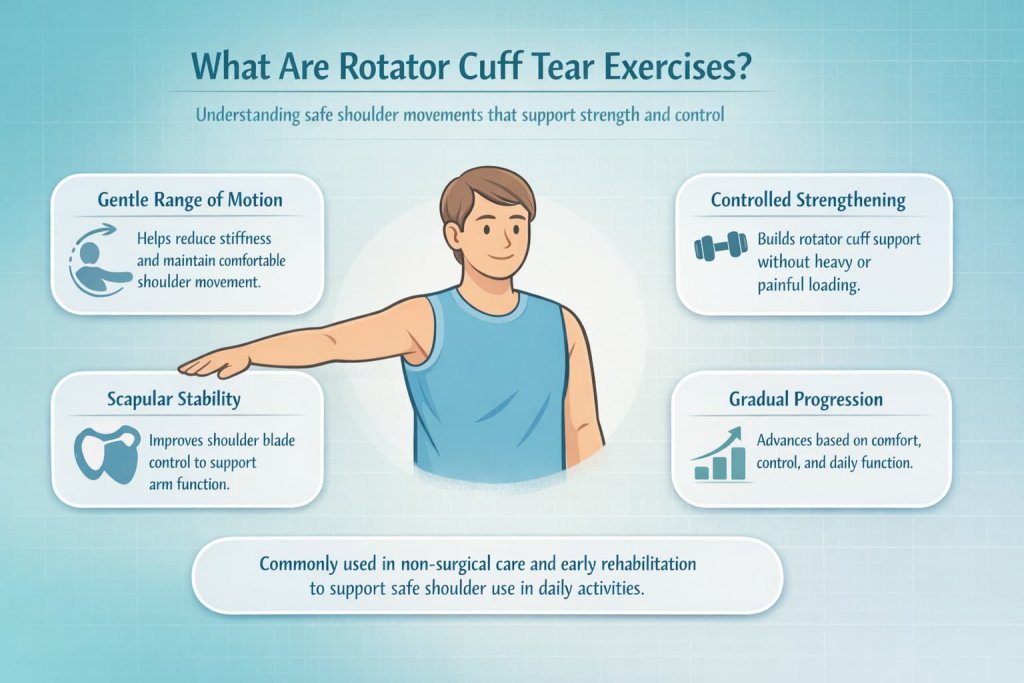
Rotator cuff tear exercises are structured, low-to-moderate load movements designed to support shoulder strength, control, and mobility after rotator cuff injury. These exercises focus on restoring how the shoulder moves and stabilizes rather than forcing painful range or heavy resistance.
They typically emphasize:
- Gentle range-of-motion to reduce stiffness
- Controlled strengthening of the rotator cuff muscles
- Shoulder blade (scapular) stability to support arm movement
- Gradual progression based on comfort and function
Rotator cuff tear exercises are commonly used in non-surgical care and early rehabilitation phases to help improve shoulder use during daily activities.
Who Can Benefit From Rotator Cuff Tear Exercises?
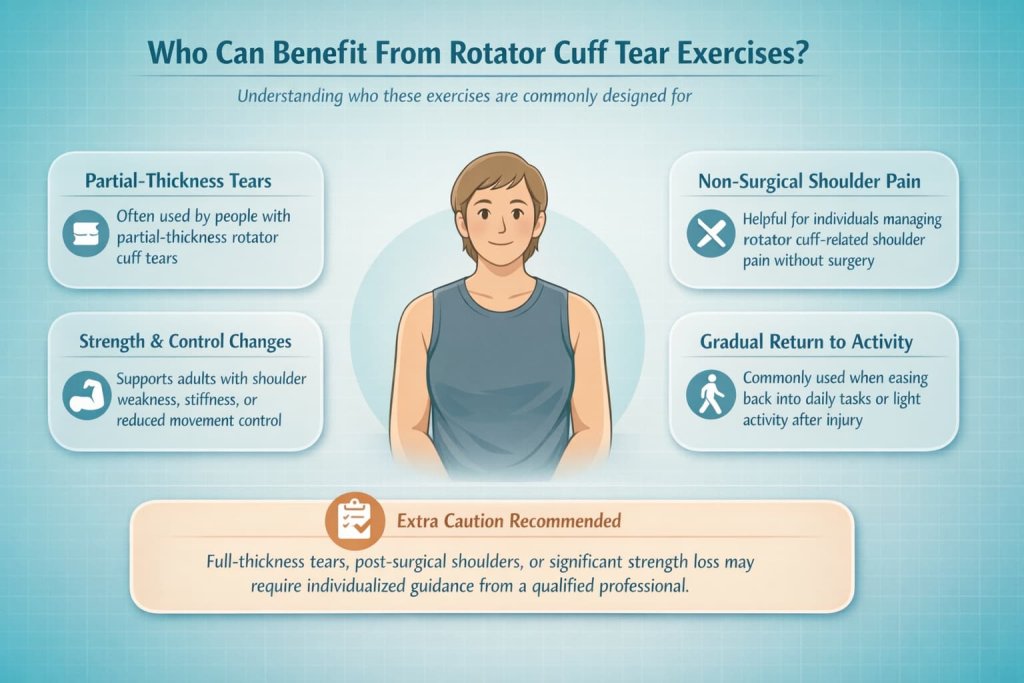
Rotator cuff tear exercises may be appropriate for individuals who need to rebuild shoulder strength and control while minimizing strain on injured tissues.
They are commonly used by:
- People with partial-thickness rotator cuff tears
- Individuals managing rotator cuff–related shoulder pain without surgery
- Adults experiencing shoulder weakness, stiffness, or reduced movement control
- People returning gradually to daily tasks or light activity after shoulder injury
Extra caution or professional guidance is recommended for those with full-thickness tears, significant loss of strength, or post-surgical shoulders, as exercise selection and progression may need to be individualized.
8 Best Rotator Cuff Tear Exercises
These exercises focus on restoring shoulder strength, control, and mobility while minimizing strain on healing tissues. They are designed to support safe, gradual progress for non-surgical and early-stage shoulder recovery.
1) Pendulum Swing
Why it works:
Pendulum swings allow the shoulder joint to move passively with minimal muscular effort, helping maintain joint nutrition and motion during early or irritable phases of a rotator cuff tear. This low-load movement may reduce stiffness and support comfort when active lifting is not yet tolerated. It is commonly included in early-stage shoulder rehabilitation programs recommended by the American Academy of Orthopaedic Surgeons.
How to do it:
- Lean forward and support your body with one hand on a table or chair
- Let the affected arm hang freely and relaxed
- Gently swing the arm forward and backward
- Progress to side-to-side swings, then small circular motions
- Keep all movements slow, smooth, and pain-free
Trainer Tip:
The arm should feel heavy and relaxed—movement should come from subtle body sway, not active shoulder lifting.
2) Supine Assisted Shoulder Flexion
Why it works:
Performing shoulder flexion while lying on your back reduces the effect of gravity, making it easier to regain comfortable overhead motion without excessive strain on the rotator cuff. Assisted range-of-motion exercises like this are commonly used in early rehab stages to restore movement confidence and joint mobility.
How to do it:
- Lie flat on your back with knees bent
- Support the affected arm with your opposite hand or forearm
- Slowly guide the arm overhead within a comfortable range
- Pause briefly, then lower the arm with control
- Maintain relaxed breathing throughout
Trainer Tip:
Only move through a range that feels smooth and controlled—avoid pushing into discomfort.
3) Scapular Setting (Shoulder Blade Control)
Why it works:
Proper shoulder blade positioning helps optimize how the rotator cuff stabilizes the shoulder during arm movement. Scapular setting improves postural awareness and supports more efficient shoulder mechanics, which is essential for long-term recovery.
How to do it:
- Stand or sit tall with ribs stacked over the pelvis
- Gently draw the shoulder blades slightly back and down
- Hold the position briefly
- Relax fully before repeating
- Keep the neck and jaw relaxed
Trainer Tip:
This is a subtle control exercise—avoid forceful squeezing or arching the lower back.
4) Isometric External Rotation
Why it works:
Isometric external rotation builds strength tolerance in the rotator cuff without joint movement, making it useful when full-range exercises are still uncomfortable. It helps maintain muscle activation and prepares the shoulder for later strengthening phases.
How to do it:
- Bend your elbow to about 90 degrees
- Keep the elbow tucked gently against your side
- Press the back of your hand outward into a wall or doorframe
- Hold the contraction steadily, then relax
Trainer Tip:
Use moderate effort rather than maximum force to keep the movement controlled and pain-free.
5) Isometric Internal Rotation
Why it works:
This exercise strengthens the internal rotators of the shoulder in a controlled, low-stress manner. Balanced internal and external rotator strength supports joint stability and smoother arm movement.
How to do it:
- Bend your elbow to 90 degrees and keep it close to your side
- Press your palm inward against a wall or doorframe
- Hold the pressure steadily
- Relax fully before the next repetition
Trainer Tip:
Maintain upright posture and avoid letting the shoulder roll forward during the hold.
6) Banded External Rotation
Why it works:
Banded external rotation introduces progressive resistance, helping rebuild functional rotator cuff strength and control. Rotational strengthening is a core component of many structured shoulder rehabilitation programs.
How to do it:
- Anchor a light resistance band at elbow height
- Hold the band with the affected arm and keep the elbow tucked at your side
- Rotate the forearm outward slowly
- Return to the starting position with control
Trainer Tip:
If the elbow drifts away from your side, reduce resistance or slow the movement.
7) Banded Internal Rotation
Why it works:
This exercise complements external rotation by restoring balanced strength across the rotator cuff. Controlled internal rotation supports daily activities such as pushing, reaching, and lifting.
How to do it:
- Anchor the resistance band at elbow height
- Start with the forearm slightly away from the body
- Pull the forearm inward toward your torso
- Slowly control the return
Trainer Tip:
Focus on keeping the shoulder blade steady and avoiding trunk rotation.
8) Wall Slide
Why it works:
Wall slides encourage coordinated shoulder blade motion during overhead movement, which is often limited after rotator cuff injury. This exercise supports smoother movement patterns and controlled elevation.
How to do it:
- Stand facing a wall with forearms resting against it
- Keep ribs down and neck relaxed
- Slowly slide the arms upward along the wall
- Lower back down with control
Trainer Tip:
Reduce the range of motion if shoulder pinching or discomfort appears.
Important note before you start
Many home programs apply best to rotator cuff–related shoulder pain, tendinopathy, and partial-thickness tears. Some clinical practice guidelines specifically exclude full-thickness tears from non-surgical tendinopathy recommendations, and post-surgical rehabilitation should always follow a clinician-directed timeline. This distinction is clearly outlined in guidance from the American Physical Therapy Association.
How to use these rotator cuff tear exercises safely
A simple way to self-monitor progress is the green-yellow-red rule:
- Green: Mild discomfort that settles quickly and does not worsen daily activities
- Yellow: Soreness that lingers into the next day or affects normal use
- Red: Sharp pain, catching, sudden weakness, or worsening night pain
Most evidence-based shoulder programs start with gentle mobility, then add isometric loading, and later progress to resistance and scapular control work—an approach consistent with shoulder conditioning recommendations from the American Academy of Orthopaedic Surgeons.
Sample weekly structure
- 4–6 days/week: Gentle mobility exercises
- 3–4 days/week: Scapular control and isometrics
- 2–3 days/week: Resistance band strengthening
Rehabilitation frameworks from the American Academy of Orthopaedic Surgeons emphasize consistency over several weeks rather than quick results.
Common mistakes that slow progress
- Advancing to heavy resistance too early
- Allowing shoulder shrugging or elbow flare
- Training through sharp pain
- Ignoring shoulder blade control
- Inconsistent practice
Who should be careful before doing rotator cuff tear exercises
Extra caution is advised if you have:
- A known full-thickness tear
- Rapid loss of shoulder strength
- Worsening night pain
- Recent shoulder surgery
Clinical scope limitations for non-surgical exercise programs are clearly outlined by the American Physical Therapy Association.
When to stop or seek professional guidance
Stop and seek evaluation if you experience:
- Sudden weakness or inability to lift the arm
- Persistent or worsening pain
- Loss of motion despite consistent exercise
Conclusion
Rotator cuff tear exercises work best when they are progressive, controlled, and tailored to symptoms. Starting with mobility, then adding isometrics and gradual strengthening, supports safer shoulder recovery. For complex cases, individualized care remains essential.
This content is for informational purposes only and not medical advice.
References
- American Academy of Orthopaedic Surgeons (AAOS) — Management of Rotator Cuff Injuries: Clinical Practice Guideline (2025) (PDF)
- AAOS OrthoInfo — Rotator Cuff and Shoulder Conditioning Program
- Journal of Orthopaedic & Sports Physical Therapy (JOSPT) — Rotator Cuff Tendinopathy Clinical Practice Guideline (2025)
- Oxford University Hospitals NHS — Rotator Cuff Tear Rehabilitation Programme (PDF)
- BMJ Open — Rotator cuff unloading vs loading exercise programs in shoulder pain with rotator cuff tears (2020)