
Shoulder taps are a plank variation that trains core stability by helping you resist hip sway and torso rotation while you shift weight from side to side. That matters because “real-life core strength” is less about doing endless ab reps and more about controlling your trunk during movement, lifting, walking, and sports.
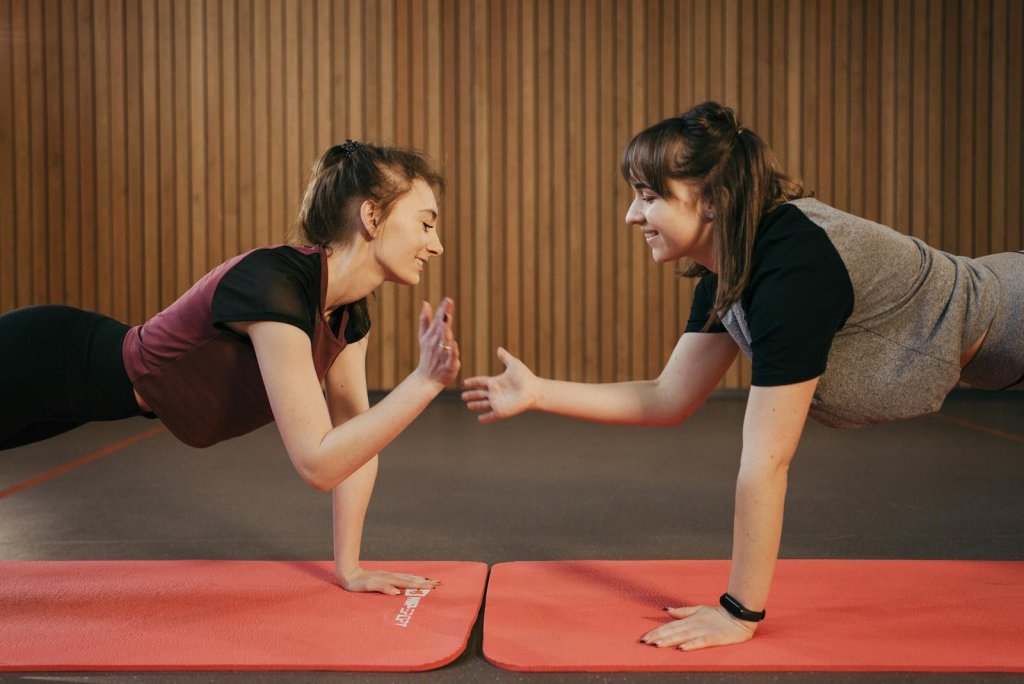
This guide shows you exactly how to do shoulder taps with clean form, how to scale them up or down, what muscles they work, and when to modify for safety, using evidence-based core training principles from the ACSM’s Health & Fitness Journal.
What Are Shoulder Taps
Shoulder taps are performed from a high plank (top of a push-up). You alternate tapping one shoulder with the opposite hand while keeping your body as still as possible. The “win” is not speed. The win is control.
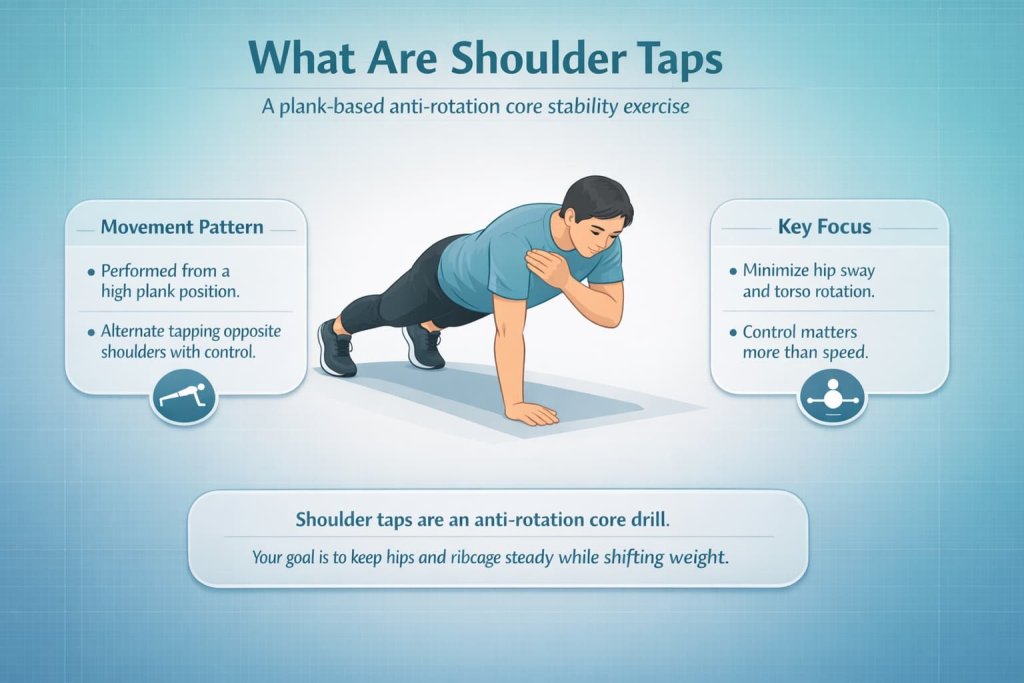
Done well, shoulder taps are an anti-rotation core drill: your body wants to twist as you lift a hand, and your job is to keep your hips and ribcage steady.
How to Do Shoulder Taps With Proper Form
How to do it:
- Start in a high plank with hands stacked under shoulders and feet about hip-width apart
- Squeeze glutes lightly and brace your core as if “zipping up” your midsection
- Shift your weight slightly into your left hand and feet (without letting hips twist)
- Tap your left shoulder with your right hand, then place the right hand back under your shoulder
- Repeat on the other side, moving slowly and quietly
- Keep your head in line with your spine and eyes down between your hands
- Stop the set if your hips start swaying or your lower back arches
Trainer Tip:
Widen your feet. A wider stance gives you a larger base and instantly reduces hip sway. Once you can stay steady, gradually bring your feet closer together.
Shoulder Taps Benefits for Core Strength and Stability
Shoulder taps are popular because they train the kind of core function you actually use: bracing and resisting unwanted movement. Core training guidance from the ACSM’s Health & Fitness Journal emphasizes that core work should be about stability and controlled force transfer, not just “burning abs.”
Shoulder taps may help you:
- Build anti-rotation strength (obliques and deep core control)
- Improve shoulder and scapular stability under bodyweight load
- Reinforce a strong plank position (useful for push-ups and many floor exercises)
- Train full-body tension (core + glutes + shoulders working together)
Plank-based variations also recruit shoulder and scapular muscles, and changing how much bodyweight is supported can influence muscle activation demands, as discussed in research indexed on PubMed.
Muscles Worked During Shoulder Taps
Shoulder taps train multiple muscle groups at once, with a strong focus on anti-rotation core control.
Primary muscles:
- Obliques (resist twisting)
- Transverse abdominis (deep core bracing)
- Rectus abdominis (supports trunk alignment)
Supporting muscles:
- Glutes (stabilize hips)
- Serratus anterior (supports shoulder blade stability)
- Deltoids and triceps (assist with arm support)
When done correctly, shoulder taps build coordinated core and shoulder stability rather than isolated abdominal strength.
Common Shoulder Tap Mistakes That Reduce Results
The most common reason shoulder taps “don’t work” is that they turn into a wobble drill. Watch for these:
Hips rocking side to side
If your hips visibly sway, you’re losing the anti-rotation challenge. Slow down, widen your stance, and shorten the set.
Hands not stacked under shoulders
Hands too far forward often makes you dump into shoulders and lose control. Keep hands under shoulders and press the floor away.
Lower back arching or ribs flaring
This usually means the brace is gone. Reset: exhale gently, tighten glutes, and aim for a straight line head-to-heels.
For additional guidance on plank alignment and safe technique, both the Cleveland Clinic and Harvard Health emphasize maintaining neutral spine position and steady trunk control.
Shoulder Taps Modifications and Progressions
Make shoulder taps easier
- Increase stability: widen feet and slow the tempo
- Use an incline: hands on a bench or sturdy counter to reduce load
- Reduce range: tap the opposite upper arm instead of the shoulder
- Shorten sets: do perfect 6–10 taps per side instead of pushing through form breakdown
Make shoulder taps harder
- Narrow your stance gradually (feet closer together)
- Add pauses: hold 1–2 seconds at the top of each tap without rotating
- Increase time under tension: slower taps with strict control
- Combine with a plank hold: 10–20 seconds plank + 6 taps per side
Research on plank variations indexed by PubMed suggests that changing bodyweight-bearing status alters shoulder and scapular muscle demands, which helps explain why progressions increase difficulty.
How Many Shoulder Taps Should You Do
For core stability, quality beats quantity.
Good starting targets:
- Beginners: 2–3 sets of 6–10 taps per side (slow and controlled)
- Intermediate: 2–4 sets of 10–16 taps per side
- Advanced: 3–5 sets with narrow stance and pauses, stopping before you lose alignment
General core exercise guidance from the Mayo Clinic reinforces keeping movements controlled and avoiding forcing positions that compromise form.
Who Should Modify or Avoid Shoulder Taps
Modify first (or choose a different core exercise) if you have:
- Wrist pain that worsens in a high-plank position
- Shoulder pain with weight-bearing or reaching
- Recent surgery or an injury where planks are not cleared yet
- Low back pain that increases during planks or tapping
A simple rule: if you can’t keep a stable plank without discomfort, switch to a lower-load core option (like dead bug or bird dog) and build back up.
When to Stop and Seek Professional Guidance
Stop shoulder taps and seek professional advice if you experience:
- Sharp or persistent wrist, shoulder, or lower back pain
- Numbness, tingling, or weakness in the arms
- Pain that worsens even after modifying the exercise
- Recent surgery or unresolved injury affecting the shoulders, spine, or wrists
If you cannot maintain proper form without discomfort, consult a qualified healthcare professional before continuing.
FAQ
Are shoulder taps good for abs?
Yes, when done with minimal hip sway. They train your abs to stabilize and resist rotation, which aligns with core stability principles described in the ACSM’s Health & Fitness Journal.
Do shoulder taps work obliques?
They can, especially when you keep hips level. The obliques help resist twisting as you lift one hand.
Should I do shoulder taps fast or slow?
Slow is better for stability. Speed usually increases rotation and reduces the core-control benefit.
Why do my hips sway during shoulder taps?
Usually your stance is too narrow, your set is too long, or your brace is fading. Widen feet, shorten the set, and slow down.
Can beginners do shoulder taps?
Yes. Start with a wider stance and/or an incline version so you can stay stable.
Are shoulder taps safe for wrists?
They can irritate wrists if your wrists are sensitive. Try an incline, take more breaks, or use a core alternative that doesn’t load the wrists.
Conclusion
Shoulder taps look simple, but they’re a high-value move for building core stability and full-body control when you focus on staying steady. Start with a wide stance, move slowly, and progress only when your hips stay quiet.
If you want, tell me your audience (beginners, seniors, athletes) and I’ll tailor a shoulder taps section set (warm-up + sets/reps + progressions) to match your post.