
The best hamstring exercises for runners are a mix of eccentric hamstring work (like Nordic variations) and hip-hinge strength (like RDL patterns) done 2–3 times per week. This combination supports stronger push-off, better stride control, and more resilient hamstrings during faster running.

Understanding this matters because hamstring strains often show up when the hamstrings are working hard while lengthening during faster running. Evidence shows programs that include the Nordic hamstring exercise can reduce hamstring injury rates “up to” about 51%, according to a large systematic review indexed on PubMed.
Why runners need hamstring strength
Your hamstrings do more than “bend the knee.” They help:
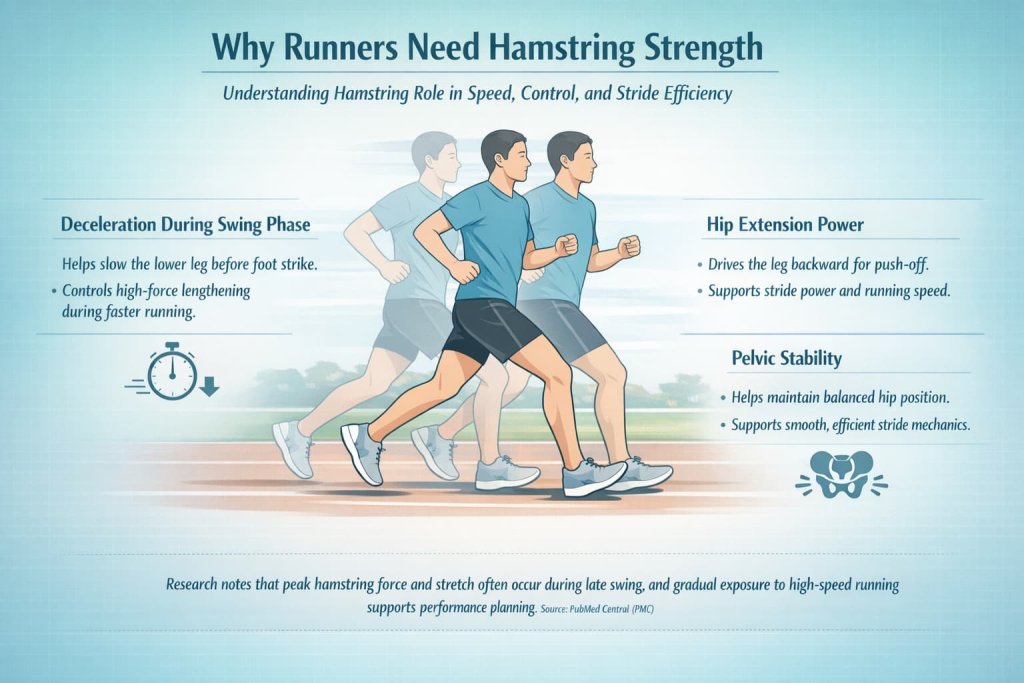
- Decelerate the lower leg during the swing phase of running (a high-demand, lengthening action)
- Extend the hip for push-off power
- Stabilize the pelvis to keep stride smooth and efficient
A major review on athletic hamstring injury explains that peak hamstring force and stretch often occur during late swing, and that progressive exposure to high-speed running is key in both rehab and performance planning, as outlined by research available through PubMed Central (PMC).
Why Hamstring Strength Matters for Runners
Hamstrings are heavily involved in both speed and control during running. They help slow the lower leg before foot strike and drive the hip backward for push-off power. Faster running increases the load placed on this muscle group.
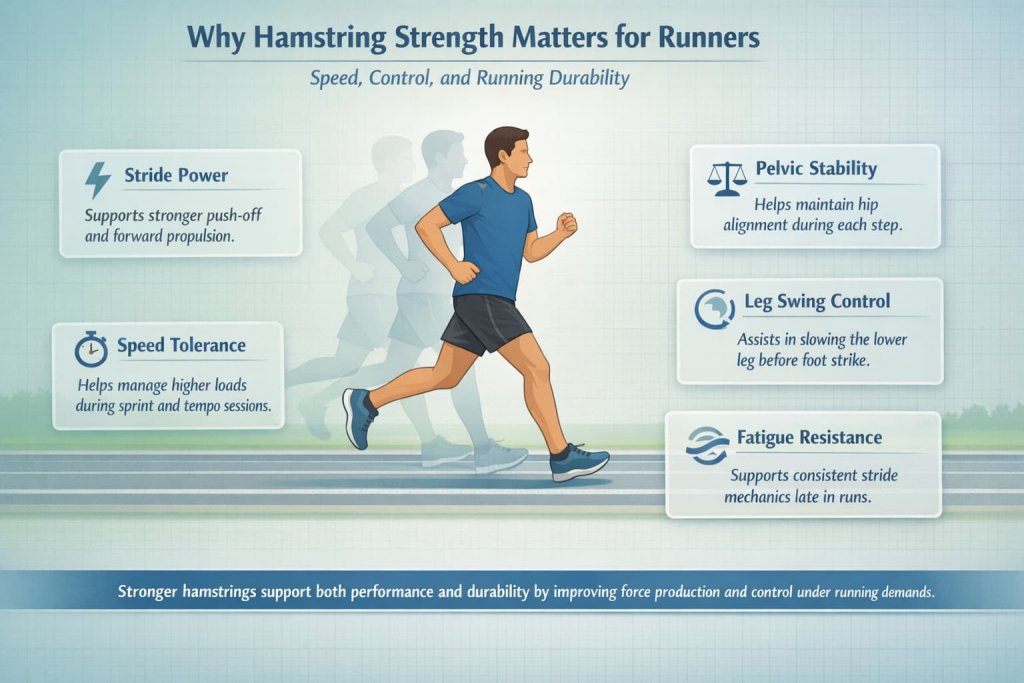
Strong hamstrings help runners:
- Improve stride power and push-off
- Maintain pelvic stability
- Support smoother leg swing
- Tolerate sprint and speed sessions
- Reduce overload during fatigue
In simple terms, stronger hamstrings support both performance and durability.
8 Best Hamstring Exercises for Runners
Strong hamstrings help runners generate more push-off power, control leg swing, and tolerate faster training sessions.
These 8 hamstring exercises target strength, stability, and endurance to help you run faster and stay resilient.
1) Assisted Nordic Hamstring Curl
How to do it:
- Kneel on a pad with ankles secured under a sturdy anchor or partner hold.
- Keep hips extended and ribs down.
- Slowly lean forward, resisting the fall as long as possible.
- Catch yourself with your hands, then lightly push back to start.
- Perform 2–4 reps per set, 2–3 sets.
Why it works: Nordic-style eccentrics train the hamstrings to handle high-force lengthening demands seen in sprinting. Large reviews summarized in PubMed report meaningful reductions in hamstring injury rates when this exercise is included in prevention programs.
Muscles worked: Hamstrings (especially biceps femoris), glutes (stabilizing), calves (assist).
Trainer Tip: If you cannot control the descent for at least 2 seconds, shorten the range and use your hands earlier.
2) Slider or Towel Hamstring Curl
How to do it:
- Lie on your back with heels on sliders or towels.
- Lift hips into a bridge position.
- Slide heels away slowly (3 seconds).
- Pull heels back in under control.
- Perform 6–10 reps, 2–3 sets.
Why it works: This movement strengthens knee flexion while emphasizing controlled eccentric return, making it highly practical for runners without heavy equipment.
Muscles worked: Hamstrings, glutes, calves (assist), core (stabilizing).
Trainer Tip: Keep hips lifted throughout; shorten the range if they drop.
3) Single-Leg Romanian Deadlift
How to do it:
- Stand tall and shift weight to one foot.
- Hinge at the hip while the opposite leg reaches back.
- Keep spine neutral and hips level.
- Pause, then return to standing.
- Perform 6–10 reps per side, 2–3 sets.
Why it works: Running is single-leg dominant. This builds hip-hinge strength and balance that directly supports stride stability.
Muscles worked: Hamstrings, glute max/med, spinal erectors (stabilizing), ankle stabilizers.
Trainer Tip: Focus on pushing the hips back rather than bending forward.
4) Romanian Deadlift (RDL)
How to do it:
- Stand with soft knees and weight close to legs.
- Hinge hips back with a neutral spine.
- Lower until you feel hamstring tension.
- Drive hips forward to stand.
- Perform 5–8 reps, 2–4 sets.
Why it works: Hip-hinge strength supports powerful hip extension and posterior chain durability for distance and speed work.
Muscles worked: Hamstrings, glutes, adductors (assist), erectors (stabilizing).
Trainer Tip: Keep the load close to your legs to maintain proper leverage.
5) Single-Leg Glute Bridge
How to do it:
- Lie on your back with one knee bent.
- Drive through the heel to lift hips.
- Pause briefly at the top.
- Lower slowly.
- Perform 8–12 reps per side, 2–3 sets.
Why it works: Bridges strengthen hip extension in a joint-friendly way and are useful during higher running mileage weeks.
Muscles worked: Glutes, hamstrings, core stabilizers.
Trainer Tip: Move heel slightly farther from your body to increase hamstring emphasis.
6) Hamstring Walkouts
How to do it:
- Begin in a bridge position.
- Slowly walk feet away while hips stay lifted.
- Walk back in and reset.
- Perform 4–8 walkouts, 2–3 sets.
Why it works: Walkouts challenge hamstring endurance through changing lever lengths, which mirrors repetitive running demands.
Muscles worked: Hamstrings, glutes, calves (assist), core.
Trainer Tip: Stop before hips sag to maintain proper tension.
7) Hinge Isometric Hold
How to do it:
- Hinge into mid-range RDL position.
- Hold 15–30 seconds while breathing steadily.
- Perform 2–4 holds.
Why it works: Isometrics build position-specific strength and can help runners increase tissue tolerance with lower soreness compared to heavy eccentrics.
Muscles worked: Hamstrings, glutes, erectors (stabilizing), core.
Trainer Tip: Keep tension in the back of the thighs, not the lower back.
8) Eccentric Hamstring Curl (Ball or Machine Alternative)
How to do it:
- Curl heels toward hips.
- Slowly extend out over 3–5 seconds.
- Keep hips elevated as long as possible.
- Perform 6–10 reps, 2–3 sets.
Why it works: Controlled eccentric work prepares hamstrings for the lengthening forces experienced during faster running, as discussed in sports medicine reviews available via PubMed Central (PMC).
Muscles worked: Hamstrings, glutes (assist), core.
Trainer Tip: Reduce reps if you cannot maintain hip position.
How often should runners do hamstring exercises?
Most runners do well with:
- 2 sessions per week in base training
- 2–3 sessions per week during speed-focused blocks (with lighter volume per session)
A simple structure:
- Day 1: Strength emphasis (hinge + curl)
- Day 2: Control emphasis (single-leg + bridge/isometric)
Keep high-soreness eccentric work away from your hardest sprint session when possible.
The best hamstring exercises for runners and what makes them work
A smart runner-focused plan usually includes:
- Eccentric knee-flexion strength (hamstrings control the “lengthening” phase)
- Hip-hinge strength (posterior chain power and pelvic control)
- Single-leg stability (because running is repeated single-leg loading)
For exercise selection principles and strain-risk considerations, the American College of Sports Medicine (ACSM) provides practical guidance on targeting relevant risk factors.
Quick safety checklist for runners
Stop and get medical guidance if you have sudden sharp pain, a “pop,” significant bruising, major weakness, or pain that changes your running form.
For training days, follow these guidelines:
- Mild effort discomfort is OK; sharp pain is not
- Start with controlled reps before adding speed or load
- Increase difficulty one variable at a time (range, load, reps, or tempo)
- Build sprint volume gradually if adding faster running
Sample 2-Day Hamstring Plan for Runners
Day A
- RDL: 3 × 5–8
- Slider Curl: 3 × 6–10
- Hinge Isometric Hold: 2 × 20–30 seconds
Day B
- Single-Leg RDL: 3 × 6–10 per side
- Single-Leg Bridge: 3 × 8–12 per side
- Hamstring Walkouts: 2–3 × 4–8
If including Nordics, begin with very low volume to manage soreness.
Common Mistakes Runners Make
- Training hamstrings only when they feel tight
- Starting Nordics with too much volume
- Ignoring hip-hinge strength
- Increasing sprint volume too quickly
Implementation consistency matters. Research published in BMJ Open Sport & Exercise Medicine highlights adherence challenges even when prevention programs are effective.
Frequently Asked Questions
Are hamstring exercises good for runners?
Yes. They support hip extension power, stride control, and resilience during faster running.
What are the best hamstring exercises for runners at home?
Slider curls, single-leg bridges, walkouts, and hinge holds are effective with minimal equipment.
Should runners do Nordic hamstring curls?
Many benefit when volume is introduced gradually. Reviews indexed on PubMed report substantial reductions in hamstring injury rates when Nordics are included in structured programs.
How many days per week should runners train hamstrings?
Typically 2 days per week, increasing cautiously during speed phases.
Can hamstring strengthening help improve speed?
It may support force production and stride efficiency. Some research reviews available through PubMed Central (PMC) also discuss performance-related improvements alongside strength gains.
What if exercises cause pain?
Mild muscular effort is acceptable. Sharp pain is not. Reduce intensity or seek professional evaluation if symptoms persist.
Conclusion
To run faster and stronger, build your hamstrings strategically. Combine eccentric strength, hip-hinge power, and single-leg control work 2–3 times per week. Progress gradually, stay consistent, and align strength training with your running schedule for the best results.