
You can build bigger, stronger shoulders at home by training all three parts of the deltoid (front, side, and rear) with simple presses, raises, and rear-delt moves 2–3 times per week. Learning the right deltoid exercises at home matters because shoulders are easy to irritate when you rush load, swing weights, or ignore balance between front and back muscles.

This guide gives you the 10 best deltoid exercises at home (dumbbells, bands, or bodyweight), plus form cues, sets and reps, and a shoulder-friendly progression approach.
What equipment you need for deltoid exercises at home
You can do these with:
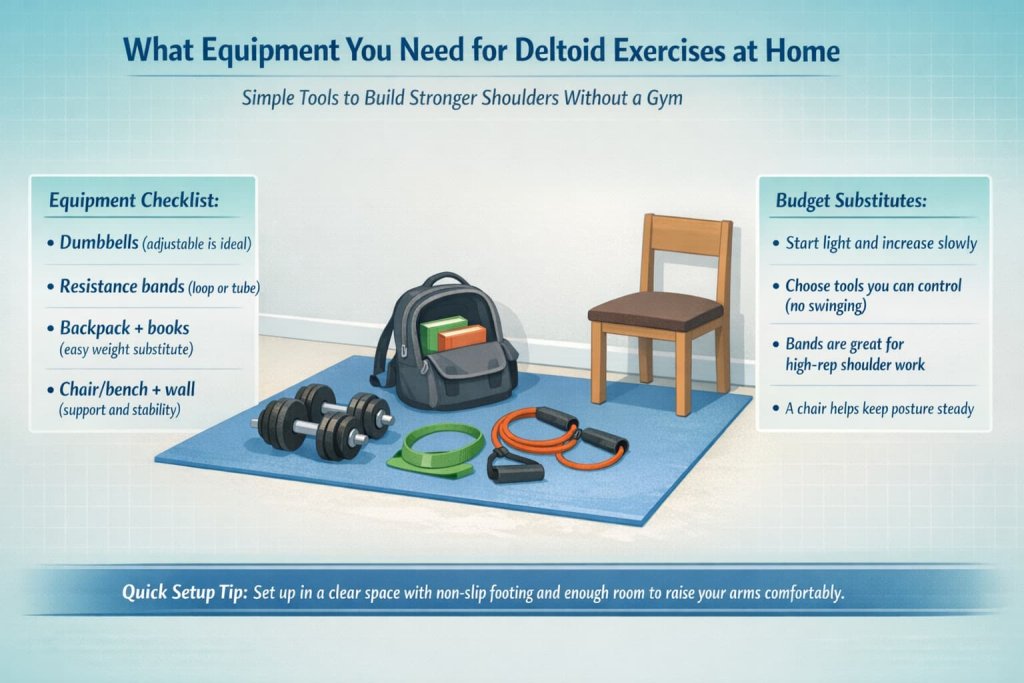
- Dumbbells (adjustable is ideal)
- Resistance bands (loop or tube)
- A backpack (loaded with books) as a dumbbell substitute
- A chair/bench and a wall
10 best deltoid exercises at home
Build bigger, stronger shoulders at home by training all three deltoid heads (front, side, and rear) with a mix of presses, raises, and rear-delt work. Use controlled reps, add weight or reps gradually, and follow the weekly plan below to keep progress steady and shoulders balanced.
1) Dumbbell overhead press (standing or seated)
Why it works
This is your main “strength builder” for the front and side delts. Done with control, it’s one of the most efficient ways to overload the shoulders at home.
How to do it
- Stand tall with ribs stacked over pelvis and glutes lightly tight
- Start dumbbells at shoulder height, elbows slightly in front of your body
- Press up until arms are overhead (no shrugging to “finish”)
- Lower slowly back to shoulder height and repeat
- Stop the set if your low back starts arching to get the weight up
Muscles worked
Front delts, side delts, triceps, upper chest (assist), core (stability)
Trainer Tip
If overhead bothers your shoulder, switch to a neutral grip (palms facing each other) and shorten the range slightly.
2) Dumbbell lateral raise
Why it works
Lateral raises are one of the best ways to target the side delts, which contribute most to “shoulder width.”
How to do it
- Stand with a slight bend in elbows and dumbbells at your sides
- Raise arms out to the sides until roughly shoulder height
- Keep shoulders down (avoid shrugging)
- Pause briefly, then lower slowly with control
- Use a weight you can lift without swinging
Muscles worked
Side delts (primary), upper traps (assist)
Trainer Tip
If you want a reliable form reference, the American Council on Exercise (ACE) exercise library reinforces a stable stance and controlled lifting.
3) Lean-away lateral raise (one arm)
Why it works
Leaning away increases challenge at the top range where side delts work hard, often with less weight.
How to do it
- Hold a doorway or pole with one hand and lean slightly away
- Hold one dumbbell in the free hand
- Raise to shoulder height with a slow tempo
- Lower under control and repeat, then switch sides
Muscles worked
Side delts (primary)
Trainer Tip
Go lighter than you think. This variation punishes momentum fast.
4) Front raise (dumbbell, band, or backpack)
Why it works
Front delts already get work from presses, but front raises can add direct volume if your front delts lag or you can’t press heavy.
How to do it
- Hold weight in front of thighs with palms down (or neutral grip)
- Raise to about shoulder height (not above)
- Keep ribs down and avoid leaning back
- Lower slowly and repeat
Muscles worked
Front delts (primary), upper chest (assist)
Trainer Tip
If your neck tightens, you’re probably shrugging or going too heavy.
5) Pike push-up (bodyweight overhead press)
Why it works
This is an equipment-free way to train a press pattern and load shoulders progressively.
How to do it
- Start in a push-up position, then hike hips up into a pike
- Hands shoulder-width, head moves toward the floor between hands
- Bend elbows to lower with control, then press back up
- Keep the movement smooth and avoid collapsing into your shoulders
Muscles worked
Front delts, side delts, triceps, upper chest (assist)
Trainer Tip
Want it harder? Elevate your feet on a chair.
6) Rear-delt dumbbell reverse fly (hinged)
Why it works
Rear delts are often undertrained, and building them helps shoulder balance and posture.
How to do it
- Hinge at hips (flat back), dumbbells hanging under shoulders
- With a slight elbow bend, raise arms out and back like “wings”
- Stop when upper arms are roughly in line with torso
- Lower slowly and repeat
Muscles worked
Rear delts (primary), mid traps/rhomboids (assist)
Trainer Tip
Think “wide” not “high.” If you feel it mostly in traps, go lighter and slow down.
7) Band pull-apart (rear delts + upper back)
Why it works
Simple, shoulder-friendly volume for rear delts and upper back—great as a warm-up or finisher.
How to do it
- Hold a band at chest height with arms straight
- Pull band apart by moving hands outward
- Keep shoulders down and chest tall
- Return slowly and repeat
Muscles worked
Rear delts, rhomboids, mid traps
Trainer Tip
Pause for one second when the band is fully stretched.
8) Face pull (band)
Why it works
Face pulls train rear delts and the muscles that help keep the shoulder joint centered during movement.
How to do it
- Anchor a band at upper-chest to face height
- Pull toward your face while spreading hands apart
- Elbows travel high and out (not tucked)
- Return slowly and repeat
Muscles worked
Rear delts, external rotators (assist), mid traps
Trainer Tip
Use lighter tension and perfect reps. The goal is control, not max resistance.
9) Y-raise (band or light dumbbells)
Why it works
This builds upward-rotation support and improves “overhead comfort” for many lifters when done lightly and strictly.
How to do it
- Hinge slightly forward or lie face down on an incline surface if available
- Raise arms into a “Y” shape (thumbs slightly up)
- Keep shoulders away from ears
- Lower slowly and repeat
Muscles worked
Rear delts (upper fibers), lower traps (assist), shoulder stabilizers
Trainer Tip
If you can’t keep it strict, the weight is too heavy.
10) Lateral raise mechanical drop set (partials + full reps)
Why it works
A home-friendly intensity technique: you extend the set without needing heavier dumbbells.
How to do it
- Do strict full-range lateral raises to near fatigue
- Immediately switch to slightly shorter-range reps (top half or mid-range)
- Keep shoulders down and movement smooth
- Stop before form breaks into swinging
Muscles worked
Side delts (primary)
Trainer Tip
This burns fast. Use it sparingly (1–2 sets at the end).
How to warm up before deltoid exercises at home
Do 3–5 minutes total:
- Arm circles (small to medium range)
- Wall slides or wall “Y” raises (slow)
- Band pull-aparts (light tension)
- 1 easy warm-up set of your first exercise (very light)
If you’ve had shoulder trouble before, keep loads lighter and reps higher. MedlinePlus notes rotator cuff–focused strengthening is typically done with smaller loads and higher repetitions, and that pain is a sign to adjust resistance or technique.
The best weekly plan for deltoid exercises at home
Train shoulders 2–3 days per week with at least one day between sessions (example: Mon/Thu or Mon/Wed/Fri).
Here are two simple options:
| Goal | Exercises | Sets x Reps |
|---|---|---|
| Strength + size | Overhead press, lateral raise, reverse fly, face pull | 3 x 6–10 (press), 3 x 10–15 (raises/fly/face pull) |
| Higher-rep shoulder pump | Pike push-up, lateral raise, front raise, band pull-apart | 3 x 8–12 (pike), 3–4 x 12–20 (others) |
How to progress safely for bigger, stronger shoulders
Progression doesn’t have to be complicated:
- Add reps first until you hit the top of your target range with clean form
- Then add a small amount of load (or band tension) and repeat
For a widely used progression model in resistance training (including guidance on when to increase load), see the American College of Sports Medicine (ACSM) position stand on resistance training progression.
Common mistakes with deltoid exercises at home
- Swinging lateral raises (turns it into momentum, not delts)
- Shrugging hard at the top (traps take over)
- Overdoing front delts while ignoring rear delts
- Pressing overhead with a big low-back arch
- Training shoulders hard every day (no recovery)
Quick safety checklist for deltoid exercises at home
- Keep reps controlled and stop sets before you lose posture
- Use pain as feedback: reduce range, load, or swap the exercise
- Balance pressing with rear-delt and upper-back work
- If you have ongoing shoulder pain, numbness/tingling, or pain that worsens week to week, get medical guidance
FAQ: deltoid exercises at home
How often should I train deltoids at home?
Most people do best with 2–3 shoulder sessions per week, leaving at least 48 hours between hard workouts.
Can I build bigger delts at home without dumbbells?
Yes. Pike push-ups, band raises, band pull-aparts, and face pulls can build delts if you train close to fatigue and progress reps or resistance.
Which deltoid head makes shoulders look wider?
The side (lateral) delts contribute most to a wider shoulder look, which is why lateral raise variations matter.
What’s the best deltoid exercise at home for strength?
A strict overhead press (dumbbells or bands) is usually the top strength builder, paired with lateral raises for side-delt size.
Should I train rear delts every workout?
You can train rear delts more often than heavy presses, but keep total volume reasonable. 2–4 rear-delt sets, 2–3 times per week works well for most.
Why do lateral raises hurt my shoulder?
Common causes are going too heavy, shrugging, poor control, or a range that irritates your shoulder. Go lighter, slow down, and stop around shoulder height.
Are deltoid exercises at home safe for beginners?
Usually, yes—when you use light loads, controlled reps, and balanced training. Start with bands or light dumbbells and build gradually.
Conclusion
Deltoid exercises at home work best when you train all three delt heads consistently: press for strength, raise for side-delt size, and include rear-delt work for balance. Start simple, progress slowly, and keep reps controlled.
References
- Cleveland Clinic. (2025, September 11). Shoulder impingement syndrome (rotator cuff tendinitis). Cleveland Clinic
- Mayo Clinic. (n.d.). Rotator cuff exercises (visual guide). Mayo Clinic
- Centers for Disease Control and Prevention. (2023, December 20). Physical activity guidelines for adults. CDC
- World Health Organization. (n.d.). Physical activity (recommendations and guidance). World Health Organization (WHO)