
Lateral lunges are a side-step lunge that builds stronger legs and hips by loading one side at a time while training balance and hip control.
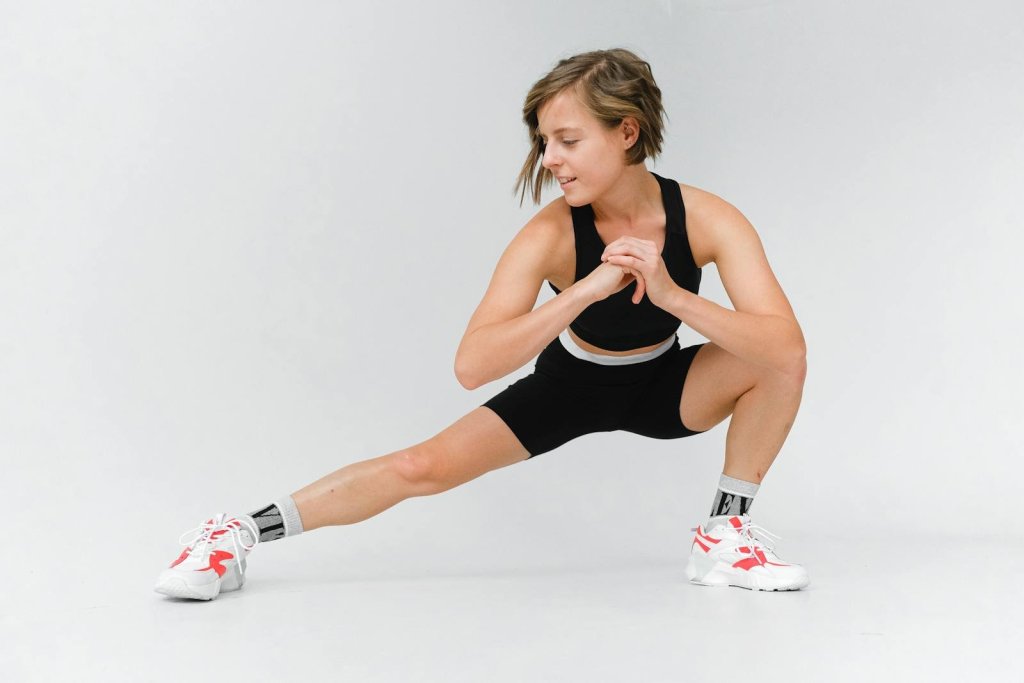
They’re especially useful because most workouts are “forward and backward” (squats, forward lunges), but real-life movement also happens side-to-side.
What are lateral lunges
A lateral lunge (often called a side lunge) is a lower-body exercise where you:
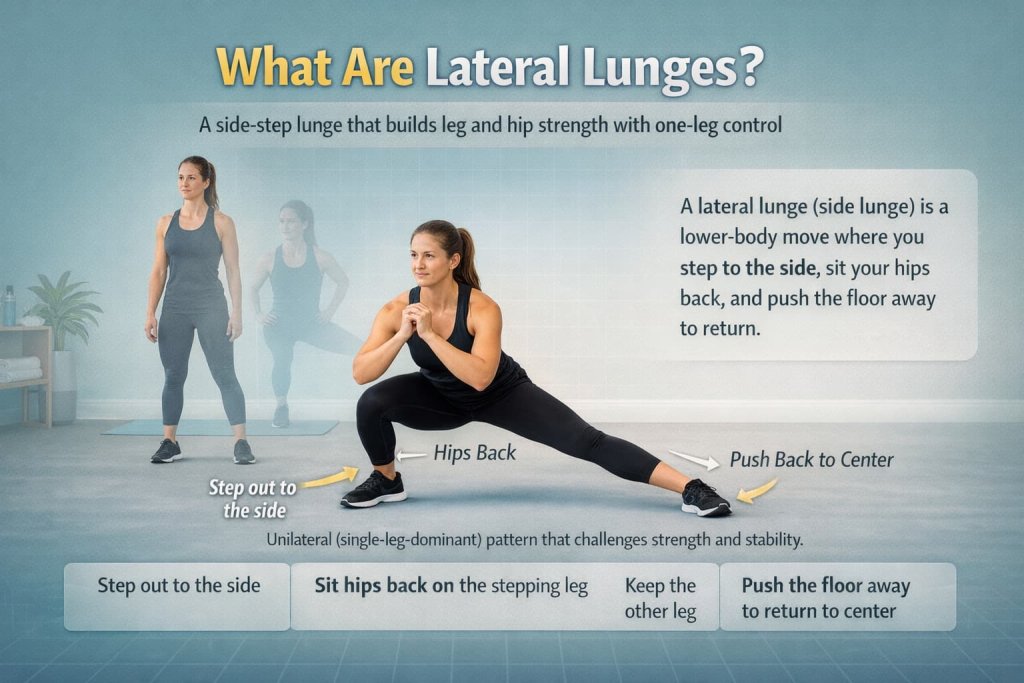
- Step out to the side
- Sit your hips back on the stepping leg
- Keep the other leg straighter
- Push the floor away to return to center
Because it’s a unilateral (single-leg-dominant) pattern, it challenges strength and stability at the same time.
How to do lateral lunges with proper form
How to do it:
- Stand tall with feet about hip-width, core braced.
- Step out to the side (not forward), keeping both feet mostly pointing forward.
- As your foot lands, push your hips back like a mini-squat on the stepping leg.
- Bend the stepping knee while keeping the other leg straighter.
- Keep your chest up and spine long.
- Aim for your knee to track in line with your toes (not caving inward).
- Push through the whole foot of the stepping leg to return to center.
- Repeat on the other side.
Why it works:
You load one side at a time while forcing the hips and thighs to control a side step, which builds strength and stability together.
Trainer Tip:
If you feel it mostly in your knee, shorten your step and sit your hips back more. If you feel your foot rolling in, slow down and focus on steady pressure through your heel and midfoot.
Lateral Lunge Variations
Bodyweight-to-loaded lateral lunge variations let you progress safely from mastering balance and hip control to building real leg and hip strength with added resistance. Start with bodyweight, then move to goblet, dumbbells at sides, and finally suitcase loading to challenge core stability and side-to-side control.
1. Bodyweight Lateral Lunge
Why it works:
This is the cleanest way to learn the side-step pattern. You build hip control, balance, and leg strength without extra load, so it’s easier to keep your knee tracking well and your torso braced. It also lets you gradually improve depth and mobility without forcing range.
How to do it:
- Stand tall with feet hip-width and brace your core.
- Step out to the side and plant your foot flat (avoid landing on the toes).
- Sit your hips back on the stepping leg and bend that knee.
- Keep the other leg straighter with the toes pointing mostly forward.
- Keep your chest up, spine long, and knee tracking over your toes.
- Push through your heel and midfoot to return to the start.
- Repeat for reps, then switch sides.
Trainer Tip:
Start with a “medium” step, not your widest step. If your knee caves inward, shorten the step and focus on pressing the floor away while keeping steady pressure through the whole foot.
2. Goblet Lateral Lunge (Hold One Dumbbell/Kettlebell at Chest)
Why it works:
The goblet hold acts like a built-in form guide. Keeping the weight close to your chest encourages a tall torso and better bracing, which helps many people stay balanced and avoid collapsing forward. It also adds a clear strength stimulus without being awkward to control.
How to do it:
- Hold a dumbbell or kettlebell at chest height (elbows slightly down).
- Stand tall, brace your core, and keep ribs stacked over hips.
- Step out to the side and plant your foot flat.
- Sit your hips back and bend the stepping knee while the other leg stays straighter.
- Keep the weight close, chest up, and knee tracking in line with the toes.
- Push through the stepping leg to return to center.
- Repeat, then switch sides.
Trainer Tip:
If the weight pulls you forward, lighten the load and slow the lowering phase. A 2–3 second descent builds control fast and keeps the movement smooth.
3. Dumbbell Lateral Lunge (Weights at Sides)
Why it works:
Holding weights at your sides increases total loading while keeping the movement natural. Because the weights hang lower, your hips and legs do more work, and your grip and core have to stabilize the load. This variation often feels more “strength-focused” than goblet style.
How to do it:
- Hold two dumbbells at your sides with shoulders relaxed (don’t shrug).
- Stand tall, brace your core, and keep feet hip-width.
- Step out to the side and plant the foot flat.
- Sit hips back and bend the stepping knee with control.
- Keep your torso long and your knee tracking over toes.
- Push through heel/midfoot to return to the start.
- Repeat for reps, then switch sides.
Trainer Tip:
Avoid rushing the return to center. Drive up smoothly and “stand tall” at the top—if you bounce off the bottom, your knee and foot alignment usually gets sloppy.
4. Suitcase-Loaded Lateral Lunge (One Weight on One Side)
Why it works:
Suitcase loading (one dumbbell or kettlebell held at one side) adds an anti-lean core challenge. Your trunk has to resist tipping toward the weight, which improves lateral core stability and hip control—two things that matter a lot in side-to-side movement.
How to do it:
- Hold one dumbbell or kettlebell at your side like a suitcase.
- Stand tall, brace your core, and keep shoulders level (don’t lean).
- Step out to the side and sit hips back on the stepping leg.
- Keep the knee tracking over toes and the other leg straighter.
- Push through heel/midfoot to return to center without tilting your torso.
- Do all reps on one side, then switch the weight to the other hand and repeat.
Trainer Tip:
Start lighter than you think. The goal is “no wobble, no lean.” If your torso tilts or your shoulder hikes up, reduce weight and slow the tempo until you can stay stacked.
Lateral lunge muscles worked
Lateral lunges train the “big movers” and the stabilizers:
- Glutes: drive hip extension to stand back up
- Quads and hamstrings: support the bending leg through the descent and push out of the bottom
- Adductors (inner thigh): help control the side step and stabilize the hips
- Core and lower back muscles: brace the torso so you don’t collapse forward
A practical lunge muscle breakdown from the Cleveland Clinic aligns with this by consistently highlighting the quads, hamstrings, glutes, and adductors as key contributors in lunge patterns.
Benefits of lateral lunges for stronger legs and hips
Builds side-to-side strength most people miss
Many routines are dominated by squats and forward lunges. Lateral lunges add a frontal-plane (side-to-side) strength stimulus that complements those patterns.
Improves balance and single-leg control
Since your weight shifts onto one leg, you’re practicing alignment and stability that carries over to sports and everyday movement.
Adds variety without fancy equipment
You can do them with just bodyweight, then progress to dumbbells, a goblet hold, or a suitcase carry-style load.
Common mistakes to avoid with lateral lunges
Stepping too wide
A huge step often forces your knee and foot to lose alignment, and it’s harder to sit your hips back.
Letting the knee cave inward
Think “knee over middle toes.” If it collapses inward, reduce depth and slow the rep down.
Rounding forward through the torso
A small forward lean is normal, but your back should stay long and braced (not rounded).
Turning the toes out too much
A slight toe turn can be okay for comfort, but too much can shift the exercise into a different pattern and reduce control.
Modifications and low-impact alternatives
If you’re a beginner
- Reduce range of motion: go only as low as you can with good control.
- Use support: lightly hold a chair or wall for balance.
- Shorten the step: smaller step = easier to keep alignment.
If your hips feel tight
- Start with a warm-up: gentle hip hinges, bodyweight squats, and easy side steps.
- Keep your depth shallow at first and progress slowly.
How often to do lateral lunges
For most people, lateral lunges fit best on lower-body or full-body strength days:
- 2–3 times per week, 2–4 sets total
- 6–12 reps per side (choose a rep range you can do with clean alignment)
If you want a simple weekly anchor, the strength-training frequency recommendations from the CDC are a helpful baseline for most adults.
Who should avoid or get guidance first
If you have ongoing knee pain, hip pain, a recent lower-body injury, or significant balance issues, it’s smart to scale the movement (shorter step, less depth, support) or get professional guidance.
Also, deeper knee-bend positions can raise joint demand for some people, so depth should be progressed thoughtfully. The National Strength and Conditioning Association (NSCA) discusses knee-movement considerations that can help you choose safer ranges based on your situation.
What makes lateral lunges different from forward lunges
A key reason lateral lunges “feel different” is that they change joint demands. A biomechanics comparison indexed in PubMed reports meaningful differences between forward and lateral lunge patterns, including how much the ankle and knee bend during each variation.
Lateral lunges are a smart way to diversify how you load the lower body—without simply repeating another forward lunge pattern.
FAQs about lateral lunges
Are lateral lunges good for inner thighs?
Yes. Lateral lunges strongly involve the adductors (inner thigh) because they help control the side step and stabilize the hip and knee.
Are lateral lunges bad for knees?
Not automatically. Knee comfort usually improves when you shorten the step, sit hips back, keep the knee tracking over the toes, and avoid forcing deep ranges too soon.
What’s the difference between a lateral lunge and a side lunge?
Most people use the terms interchangeably. “Lateral lunge” often implies a more controlled coaching cue set; “side lunge” is the common name. The movement pattern is essentially the same.
Should my toes point forward or outward?
Start with toes mostly forward. A slight toe turn is fine if it helps your hip sit back comfortably, but avoid excessive turnout that makes alignment harder.
How low should I go on lateral lunges?
Go only as low as you can while keeping a braced torso, stable foot pressure, and a knee that tracks in line with your toes. Depth can increase over time.
Can I do lateral lunges at home without weights?
Yes. Bodyweight lateral lunges work well at home. You can progress by slowing the lowering phase, adding a pause at a shallow depth, or holding a backpack/dumbbell.
What should I feel during lateral lunges?
Most people feel the stepping-side glute and quad working, plus a stretch and tension through the inner thigh of the straighter leg—without sharp joint pain.
Conclusion
Lateral lunges are one of the simplest ways to build stronger legs and hips while training the side-to-side control that many workouts skip. Start with a comfortable step, sit your hips back, keep your knee tracking cleanly, and progress load or depth slowly.
References
- PubMed Central (PMC). Flanagan SP, Salem GJ, Wang M-Y, et al. Biomechanical attributes of lunging activities for older adults. 2004. Accessed March 5, 2026.
- American College of Sports Medicine (ACSM). Physical Activity Guidelines (ACSM Resource Hub). Accessed March 5, 2026.
- PubMed. Boren K, Conrey C, Le Coguic J, Paprocki L, Voight M, Robinson TK. Electromyographic analysis of gluteus medius and gluteus maximus during rehabilitation exercises. 2011. Accessed March 5, 2026.