
The Cuban press is a light, controlled dumbbell movement that trains shoulder external rotation and overhead mechanics to support shoulder stability—especially for pressing and overhead work.
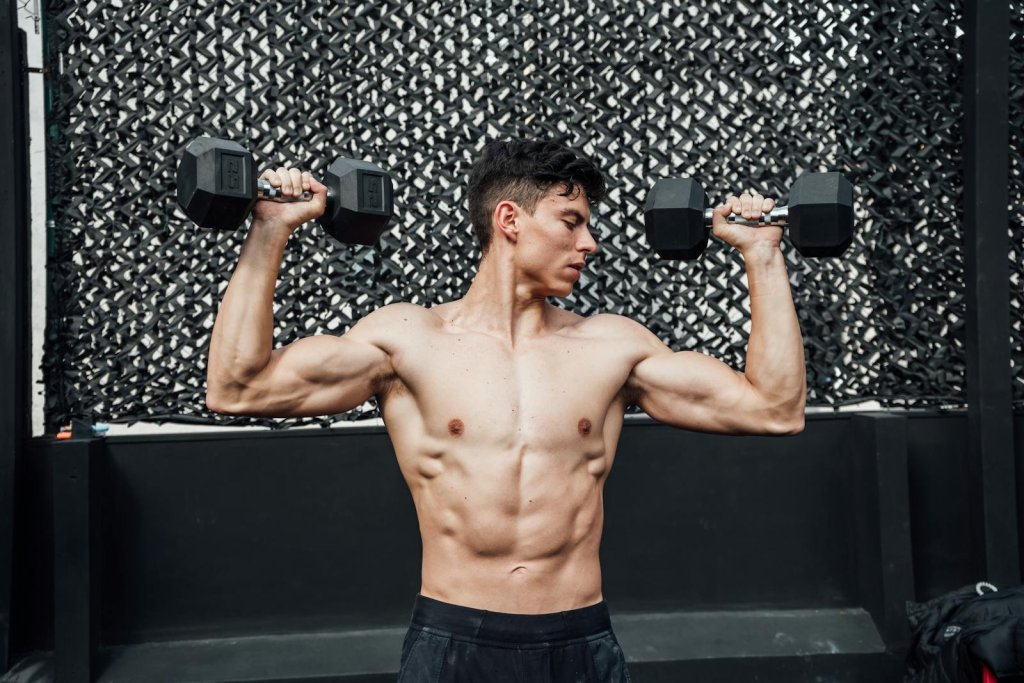
If you want healthier-feeling shoulders during lifts like overhead press, bench, or snatches, understanding the Cuban press matters because it reinforces the control muscles (rotator cuff and upper-back stabilizers) that help keep the shoulder joint centered and moving smoothly.
What Is the Cuban Press
The cuban press is a 3-part combo:
- A controlled upright row to about chest/shoulder height
- External rotation (turning the forearms up while elbows stay lifted)
- A smooth overhead press (only if pain-free and controlled)
Why the Cuban Press Improves Shoulder Stability
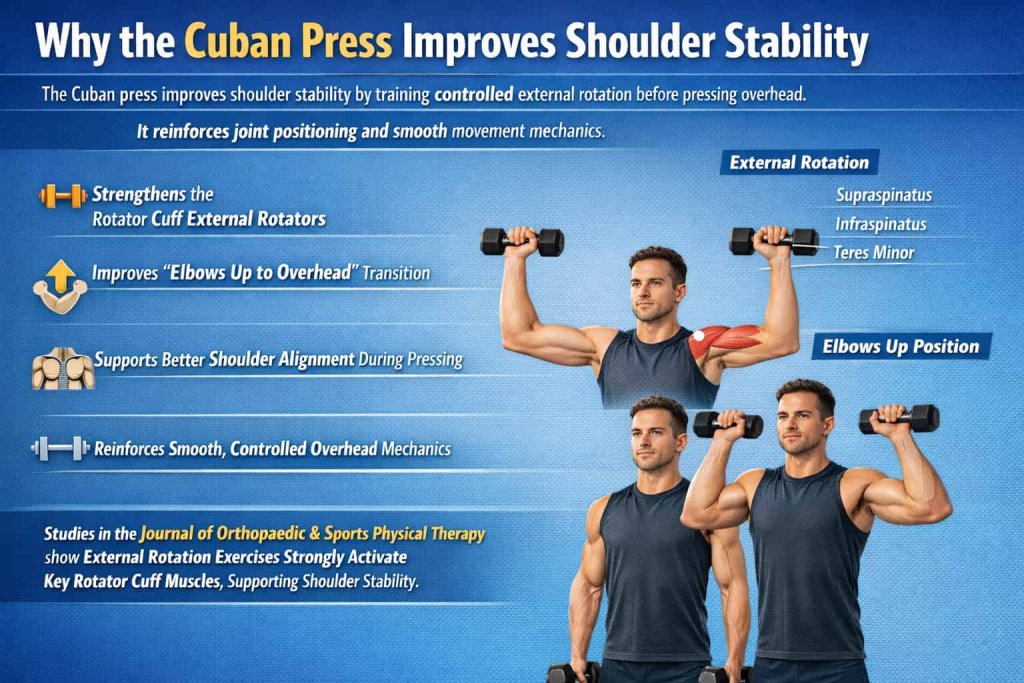
The cuban press improves shoulder stability by training controlled external rotation before pressing overhead. Instead of just building strength, it reinforces joint positioning and smooth movement mechanics.
The movement helps:
- Strengthen the rotator cuff external rotators
- Improve control in the “elbows up to overhead” transition
- Support better shoulder alignment during pressing
- Reinforce smooth, controlled overhead mechanics
Research published in the Journal of Orthopaedic & Sports Physical Therapy shows that external rotation exercises strongly activate key rotator cuff muscles, supporting their role in shoulder stability and control.
How to Do the Cuban Press With Proper Form
Use very light dumbbells so you can control the rotation phase smoothly and without shrugging.
1) Start position
- Stand tall with ribs stacked over hips
- Lightly brace your core
- Hold dumbbells with palms facing down
2) Upright row to elbows high
- Pull the dumbbells upward until elbows reach shoulder height
- Avoid aggressively shrugging or rolling shoulders forward
3) External rotation
- Keep elbows lifted at shoulder height
- Rotate forearms upward until palms face forward
- Move slowly and evenly
4) Press (optional)
- Press overhead only if it feels smooth and pain-free
- If pressing causes discomfort, stop at the rotated goalpost position and reverse the movement
Best Cuban Press Variations and Regressions
Master these Cuban press variations and regressions to improve shoulder control and rotator cuff strength safely.
Choose the right version based on your mobility, stability, and overhead comfort level.
1) No-Press Cuban Rotation
Why it works:
This variation removes the overhead press, allowing you to focus entirely on controlled external rotation and shoulder positioning. It reduces overhead stress while still training the transition from upright row to rotated “goalpost” position. This makes it ideal for beginners or anyone rebuilding shoulder control.
How to do it:
- Stand tall holding light dumbbells with palms facing down.
- Perform a controlled upright row until elbows reach shoulder height.
- Keep elbows lifted and rotate forearms upward into a goalpost position.
- Pause briefly, then reverse the rotation.
- Lower the weights back to the starting position slowly.
Trainer Tip:
Move slower during the rotation than the row. If your elbows drop or your shoulders shrug, the weight is too heavy.
2) Seated Cuban Press
Why it works:
Sitting limits lower-body momentum and body sway. This encourages stricter shoulder mechanics and better focus on controlled rotation and pressing. It’s useful if you tend to lean back or use hip drive during standing versions.
How to do it:
- Sit upright on a bench with feet flat and core lightly braced.
- Hold light dumbbells with palms facing down.
- Row elbows up to shoulder height.
- Rotate forearms upward while keeping elbows lifted.
- Press overhead if pain-free and controlled.
- Reverse each phase slowly back to the start.
Trainer Tip:
Keep ribs stacked over hips. Avoid arching your lower back to “help” the press. If pressing feels unstable, switch to the no-press version.
3) Band or Cable External Rotation Alternative
Why it works:
If your primary goal is isolated rotator cuff work, this regression simplifies the movement. It removes the upright row and overhead press so you can concentrate on pure external rotation under controlled resistance.
How to do it:
- Attach a band or cable at elbow height.
- Stand tall with elbow bent at 90 degrees and tucked near your side (or slightly lifted if preferred).
- Rotate your forearm outward while keeping the elbow stable.
- Pause briefly at end range.
- Return slowly to the starting position under control.
Trainer Tip:
Keep the elbow steady and avoid twisting your torso. The shoulder should rotate—not your whole body. Use light resistance and prioritize smooth tempo over heavier load.
Cuban Press Benefits
Better shoulder control for overhead lifting
The Cuban press trains the transition from “elbows up” to “rotate and press,” which is a common weak link for people who feel pinching, instability, or shakiness overhead—often due to poor control rather than lack of strength.
Stronger external rotation pattern
External rotation is a key function of the rotator cuff, especially the infraspinatus and teres minor. EMG research published in the Journal of Orthopaedic & Sports Physical Therapy shows that external-rotation-focused exercises can strongly recruit these muscles, supporting why the rotation phase is central to the Cuban press.
Smarter warm-up before pressing days
Most coaches recommend keeping the Cuban press light and controlled because quality matters more than load, a point.
Muscles Worked in the Cuban Press
Primary emphasis typically includes:
- Rotator cuff external rotators (infraspinatus and teres minor function)
- Rear delts and shoulder stabilizers
- Upper back and scapular stabilizers, depending on technique
Common Cuban Press Mistakes to Avoid
Going too heavy
The biggest mistake is loading the movement too much. Heavy weight often turns the Cuban press into a sloppy upright row followed by a forced press. Keeping it light allows the rotator cuff to stay engaged, a point.
Letting elbows drop during rotation
If elbows fall below shoulder height, the external rotation changes mechanically and reduces the intended shoulder-control benefit.
Rushing the rotation
The external rotation should be the slowest, most controlled portion of the movement.
Turning it into a shrug
If your traps dominate and shoulders hike upward, reduce the load and reset posture.
Who Should Modify or Skip the Cuban Press
You should modify or avoid the Cuban press—especially the overhead press portion—if you have:
- Sharp shoulder pain during rotation or pressing
- Symptoms that worsen with overhead movement
- A recent shoulder injury or post-surgical restrictions
If that applies, limit the movement to the upright row plus controlled rotation phase or use simpler external rotation drills under professional guidance.
How to Program the Cuban Press
Use it primarily as a shoulder primer rather than a max-strength lift.
Best use cases
- Warm-up before overhead press or bench sessions
- Accessory movement on upper-body days
- Control-focused training phases
Research published in Frontiers in Sports and Active Living highlights how load variations in shoulder external rotation exercises influence muscle torque and activation, supporting the recommendation to prioritize control over heavy loading.
Simple programming option
- 2–3 sets of 8–12 controlled reps
- Light load
- 45–75 seconds rest
- 2–3 times per week
People Also Ask About the Cuban Press
Is the Cuban press good for rotator cuff strength?
It can support rotator cuff engagement because of the external rotation phase. EMG findings in the Journal of Orthopaedic & Sports Physical Therapy show strong activation of key external rotators during similar rotation exercises.
Should you do the Cuban press heavy?
Most coaching guidance recommends keeping it light and strict rather than heavy and momentum-driven, as emphasized in instructional.
Is the Cuban press a warm-up or a main lift?
For most people, it works best as a warm-up or accessory movement rather than a primary strength builder.
When to Seek Professional Guidance
The Cuban press should always feel controlled and pain-free. Seek professional evaluation if you notice:
- Sharp or worsening shoulder pain
- Pain that lingers after workouts
- Weakness during overhead lifting
- Clicking, catching, or instability
- A recent shoulder injury or surgery
If symptoms persist, stop the movement and consult a qualified healthcare professional before continuing training.
FAQs About Cuban Press
1) What weight should I use for Cuban presses?
Start very light and only increase load if you can rotate and press without shrugging or rushing.
2) How many reps should I do?
Most people perform 8–12 controlled reps for 2–3 sets.
3) Can beginners do the Cuban press?
Yes, but beginners should start with the no-press version until they can control the rotation phase smoothly.
4) Does the Cuban press work rear delts?
It can involve the rear delts during the upright row phase, but its main value is shoulder control through external rotation and stable pressing mechanics.
5) What if I feel pinching in the shoulder?
Stop the overhead portion, reduce range, and keep the movement pain-free. Persistent symptoms should be evaluated by a qualified professional.
6) How often can I do Cuban presses?
Commonly 2–3 times per week as part of a structured warm-up.
7) What’s a good alternative if I can’t press overhead?
Use the upright row plus external rotation only, or perform a simpler external rotation exercise with bands or cables.
Conclusion
If your shoulders feel unstable or inconsistent during pressing, the cuban press can help you practice controlled external rotation and smoother overhead mechanics without heavy weight. Add it to your warm-up 2–3 times per week, stay light, and focus on perfect control rather than bigger dumbbells.
References
- Abstract record for Reinold et al. (2004) external rotation EMG study. PubMed
- Saeki Y, Kubota A, Kishimoto K, et al. “Effect of different load of shoulder external rotation exercises on changes in muscle activity and exerted torque.” Frontiers in Sports and Active Living (2025). Frontiers
- Full-text access to Saeki et al. (2025) external rotation load study. PubMed Central
- Clinical guidance on rotator cuff injury symptoms, causes, and when to seek care. Mayo Clinic
- Guidance on shoulder pain and when to see a doctor. Mayo Clinic
- Medical overview of shoulder impingement/rotator cuff tendinitis (risk and evaluation). American Academy of Orthopaedic Surgeons
- Rotator cuff and shoulder conditioning program (warm-up and rehab-style guidance). American Academy of Orthopaedic Surgeons