
The best teres major and minor exercises include pulldowns, rows, pull-ups, straight-arm pulldowns, face pulls, and external rotation drills because these movements train shoulder pulling strength, rotation control, and upper-back stability. The teres major helps with shoulder extension, adduction, and internal rotation, while the teres minor is part of the rotator cuff and supports external rotation and shoulder stability.
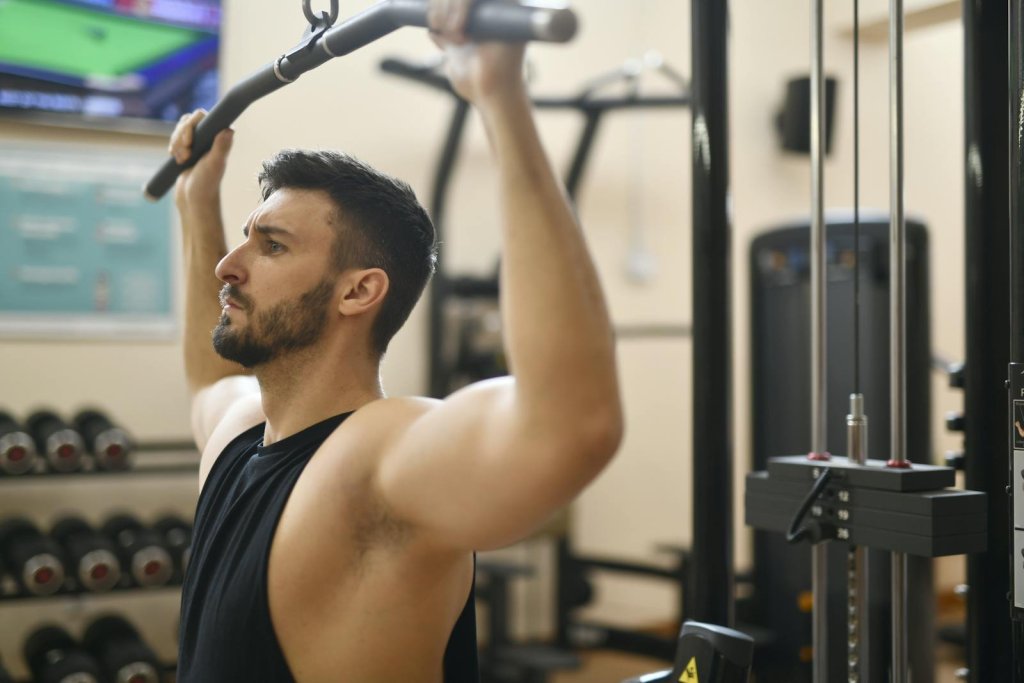
Understanding the difference matters because these two small shoulder muscles do different jobs. The teres major often works with the lats during pulling exercises, while the teres minor works with the rotator cuff to help control the shoulder joint. According to NCBI Bookshelf, the teres major works with the latissimus dorsi and helps stabilize the humeral head. NCBI Bookshelf also describes the teres minor as a rotator cuff muscle that externally rotates the arm and helps stabilize the shoulder joint.
This guide breaks down the best teres major and minor exercises, how to do them, which muscles they work, and how to train them safely.
What Are the Teres Major and Teres Minor?
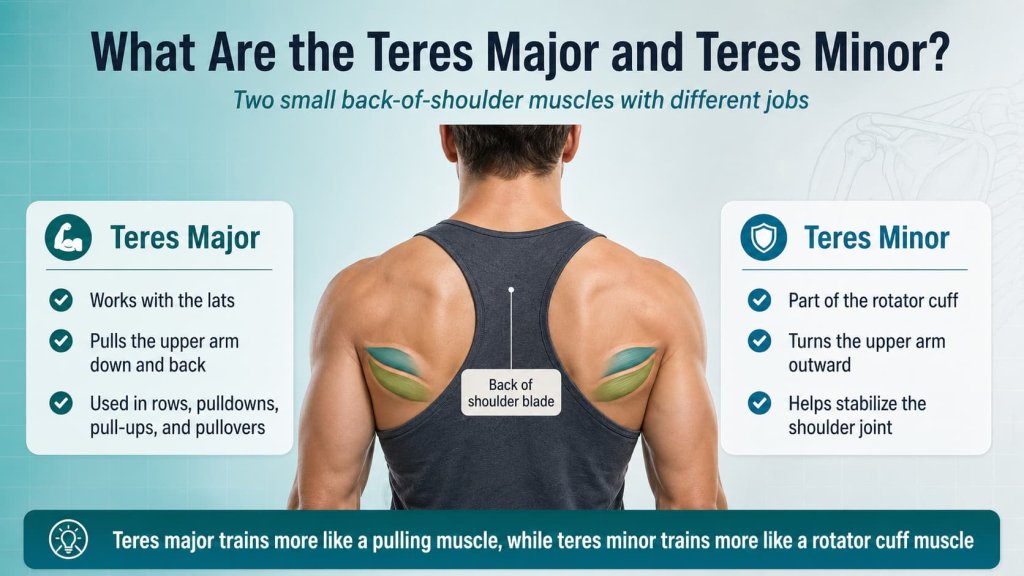
The teres major and teres minor are two small muscles located around the back of the shoulder blade. They sit close to each other, but they are not the same muscle and should not be trained in exactly the same way.
The teres major is sometimes called the “little lat” because it works closely with the latissimus dorsi. It helps pull the upper arm down and back, making it important during rows, pulldowns, pull-ups, and pullovers.
The teres minor is one of the four rotator cuff muscles. Its main job is external rotation, which means turning the upper arm outward. It also helps keep the shoulder joint stable during pressing, pulling, throwing, and overhead movements.
Teres Major vs Teres Minor: Key Difference
| Muscle | Main Role | Best Exercise Types |
|---|---|---|
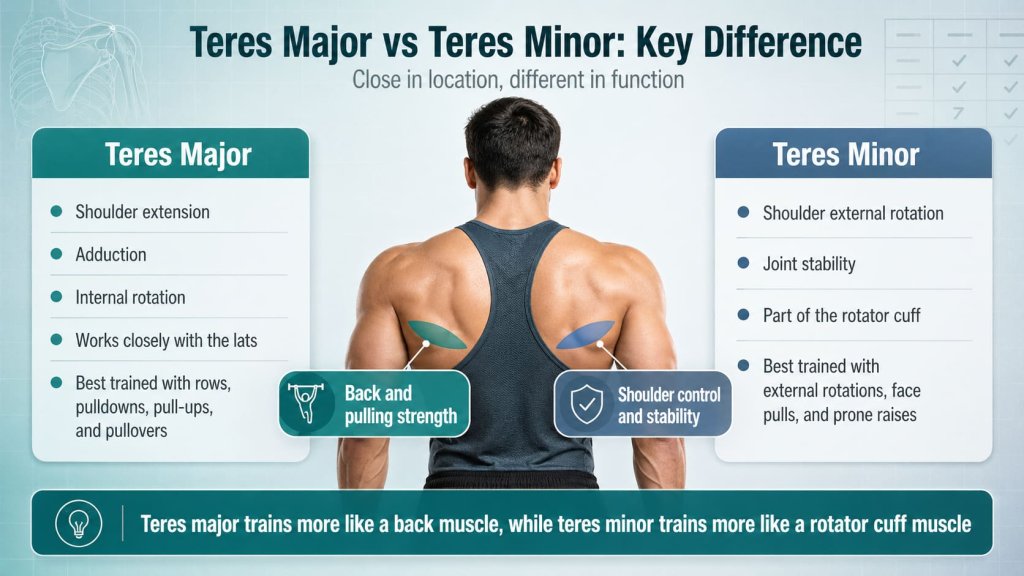
| Teres major | Shoulder extension, adduction, internal rotation | Rows, pulldowns, pull-ups, pullovers |
| Teres minor | Shoulder external rotation and joint stability | External rotations, face pulls, prone raises |
| Muscle group | Works closely with the lats | Part of the rotator cuff |
| Training focus | Back and pulling strength | Shoulder control and stability |
A simple way to remember it: teres major is trained more like a back muscle, while teres minor is trained more like a rotator cuff muscle.
Benefits of Teres Major and Minor Exercises
Training these muscles can support stronger shoulders, better pulling mechanics, and improved upper-back control.
Key benefits include:
- Stronger pulling strength during rows, pulldowns, and pull-ups
- Better shoulder control during upper-body workouts
- Improved external rotation strength
- Better support for the shoulder joint
- More balanced upper-back development
- Better posture support when paired with full back training
- Lower chance of overloading only the lats, traps, or rear delts
These exercises are not a cure for shoulder pain or injury. They may help support strength and stability when programmed correctly, but ongoing shoulder pain should be checked by a qualified healthcare professional.
Before You Start Teres Major and Minor Exercises
Warm up before training your shoulders and upper back. The shoulder joint has a large range of motion, so control matters more than heavy weight.
Before your workout:
- Do 5–10 minutes of light cardio or dynamic movement
- Start with light band pull-aparts or easy rows
- Use slow, controlled reps for rotator cuff work
- Keep your ribs down and shoulder blades controlled
- Avoid forcing painful ranges of motion
- Stop if pain feels sharp, worsening, or unusual
For rotator cuff-style work, lighter resistance is usually better. The AAOS OrthoInfo shoulder conditioning program includes external rotation exercises that target the infraspinatus, teres minor, and posterior deltoid, and it recommends progressing gradually with manageable resistance.
14 Best Teres Major and Minor Exercises
Below are the best exercises divided into two practical groups: teres major-focused pulling exercises and teres minor-focused shoulder-stability exercises.
Teres Major Exercises
These exercises mainly train the teres major through pulling, shoulder extension, and arm adduction. They also involve the lats, rear delts, traps, rhomboids, and biceps.
1. Neutral-Grip Lat Pulldown
The neutral-grip lat pulldown is one of the best teres major exercises because it trains the upper arm to pull down toward the body. This matches one of the teres major’s key roles.
How to do it:
- Sit at a lat pulldown machine with a neutral-grip handle attached.
- Hold the handles with your palms facing each other.
- Keep your chest tall and ribs controlled.
- Pull the handles down toward your upper chest.
- Drive your elbows down and slightly back.
- Pause briefly at the bottom.
- Slowly return to the starting position with control.
Why it works: The neutral-grip pulldown trains shoulder adduction and extension while keeping the grip comfortable for many lifters. NASM lists the teres major as an agonist during the lat pulldown, along with the latissimus dorsi.
Muscles worked: This exercise works the teres major, latissimus dorsi, biceps, rear delts, traps, rhomboids, and forearms.
Trainer Tip: Think about pulling your elbows toward your ribs instead of yanking the bar with your hands.
2. Wide-Grip Lat Pulldown
The wide-grip lat pulldown emphasizes the upper back and lats while still training the teres major.
How to do it:
- Sit at the lat pulldown machine.
- Hold the bar slightly wider than shoulder width.
- Keep your torso tall with a slight lean back.
- Pull the bar toward your upper chest.
- Keep your elbows moving down, not straight back.
- Pause briefly near the chest.
- Slowly return the bar overhead.
Why it works: This variation trains shoulder adduction, which is one of the actions supported by the teres major. It is useful for building pulling strength and upper-back width.
Muscles worked: The wide-grip pulldown works the teres major, lats, lower traps, rhomboids, rear delts, biceps, and forearms.
Trainer Tip: Avoid behind-the-neck pulldowns. Pulling to the front of the chest is usually a safer and more practical setup for most people.
3. Pull-Up or Assisted Pull-Up
Pull-ups are a strong bodyweight option for training the teres major, lats, and upper back.
How to do it:
- Hold a pull-up bar with your hands slightly wider than shoulder width.
- Start from a controlled hang.
- Brace your core and keep your ribs from flaring.
- Pull your chest toward the bar.
- Drive your elbows down toward your sides.
- Pause briefly at the top if you can.
- Lower slowly until your arms are extended again.
Why it works: Pull-ups challenge the teres major because the upper arm moves down and back as you lift your body. Assisted pull-ups are a good option if full pull-ups are too difficult.
Muscles worked: Pull-ups work the teres major, lats, biceps, brachialis, rear delts, traps, rhomboids, and core.
Trainer Tip: Use an assisted pull-up machine or resistance band if you cannot control the lowering phase yet.
4. One-Arm Dumbbell Row
The one-arm dumbbell row is a classic teres major and upper-back exercise. It allows each side to work independently, which can help reveal strength differences.
How to do it:
- Place one hand and one knee on a bench.
- Hold a dumbbell in the opposite hand.
- Keep your back flat and neck neutral.
- Let the dumbbell hang under your shoulder.
- Pull the dumbbell toward your hip.
- Squeeze your shoulder blade gently back.
- Lower the weight slowly.
Why it works: Pulling the elbow toward the hip trains shoulder extension, which strongly involves the teres major and lats.
Muscles worked: This exercise works the teres major, lats, rhomboids, traps, rear delts, biceps, and forearms.
Trainer Tip: Do not twist your torso to lift heavier weight. Keep the movement controlled and let the shoulder blade move naturally.
5. Seated Cable Row
The seated cable row trains the teres major while also building mid-back strength and posture control.
How to do it:
- Sit at a cable row machine with your feet supported.
- Hold a neutral-grip handle.
- Sit tall with your chest lifted.
- Pull the handle toward your lower ribs.
- Keep your elbows close to your sides.
- Pause briefly.
- Return slowly until your arms are extended.
Why it works: The seated cable row trains shoulder extension and scapular retraction. This makes it useful for developing the teres major, lats, and upper-back muscles together.
Muscles worked: This exercise works the teres major, lats, rhomboids, middle traps, rear delts, biceps, and forearms.
Trainer Tip: Do not turn the row into a lower-back swing. Your torso can move slightly, but the main action should come from your back and arms.
6. Straight-Arm Cable Pulldown
The straight-arm cable pulldown is one of the most direct teres major and lat-focused movements because the elbows stay mostly fixed.
How to do it:
- Attach a straight bar or rope to a high cable.
- Stand facing the cable machine.
- Hold the attachment with arms extended.
- Keep a slight bend in your elbows.
- Brace your core.
- Pull the bar down toward your thighs.
- Slowly return to shoulder height.
Why it works: Because your arms stay mostly straight, the movement focuses more on shoulder extension instead of elbow flexion. This helps target the teres major and lats without relying heavily on the biceps.
Muscles worked: This exercise works the teres major, lats, long head of the triceps, rear delts, and core stabilizers.
Trainer Tip: Keep the movement smooth. If you have to lean hard or swing, the weight is too heavy.
7. Dumbbell Pullover
The dumbbell pullover trains the teres major, lats, chest, and shoulder stabilizers through a long overhead range.
How to do it:
- Lie on a flat bench with a dumbbell held over your chest.
- Hold the dumbbell with both hands.
- Keep a slight bend in your elbows.
- Brace your core and keep your ribs from flaring.
- Lower the dumbbell slowly behind your head.
- Stop when you feel a comfortable stretch.
- Pull the dumbbell back over your chest.
Why it works: The pullover challenges shoulder extension from an overhead position. This can train the teres major and lats, but it requires good shoulder control.
Muscles worked: This exercise works the teres major, lats, chest, serratus anterior, triceps, and core.
Trainer Tip: Do not force the dumbbell too far behind your head. Use a comfortable range and keep your rib cage controlled.
Teres Minor Exercises
These exercises mainly train external rotation and shoulder stability. Use lighter weight and higher control. The goal is not to lift as heavy as possible.
8. Band External Rotation
Band external rotation is one of the simplest teres minor exercises and works well as a warm-up or accessory move.
How to do it:
- Attach a resistance band at about elbow height.
- Stand sideways to the anchor point.
- Hold the band with the outside hand.
- Keep your elbow bent at 90 degrees.
- Place your elbow close to your side.
- Rotate your hand outward.
- Slowly return to the start.
Why it works: The teres minor helps externally rotate the shoulder. This exercise trains that exact action in a controlled way.
Muscles worked: Band external rotation works the teres minor, infraspinatus, posterior deltoid, and shoulder stabilizers.
Trainer Tip: Keep your elbow close to your side. Place a small towel between your elbow and ribs if it helps you stay in position.
9. Side-Lying Dumbbell External Rotation
Side-lying external rotation is a popular rotator cuff exercise because it allows strict control with light weight.
How to do it:
- Lie on your side on a bench or mat.
- Hold a light dumbbell in your top hand.
- Bend your top elbow to 90 degrees.
- Keep your elbow resting near your side.
- Rotate the dumbbell upward.
- Pause briefly at the top.
- Lower slowly.
Why it works: This exercise trains external rotation without requiring a cable machine. It is especially useful for controlled teres minor and infraspinatus work.
Muscles worked: This exercise works the teres minor, infraspinatus, posterior deltoid, and small shoulder stabilizers.
Trainer Tip: Start lighter than you think. Many people only need 1–5 pounds for clean rotator cuff work.
10. Cable External Rotation
Cable external rotation gives smooth tension through the movement and is easy to adjust.
How to do it:
- Set a cable handle at elbow height.
- Stand sideways to the cable machine.
- Hold the handle with the outside hand.
- Keep your elbow bent at 90 degrees.
- Rotate your hand away from your body.
- Pause briefly.
- Return with control.
Why it works: The cable keeps tension on the external rotators, including the teres minor, throughout the rep. It is a good progression from band work.
Muscles worked: Cable external rotation works the teres minor, infraspinatus, posterior deltoid, and shoulder stabilizers.
Trainer Tip: Do not rotate your torso to move the handle. Keep your body still and let the shoulder do the work.
11. 90/90 External Rotation
The 90/90 external rotation trains the shoulder in a raised-arm position, which can be useful for athletes and lifters who need overhead control.
How to do it:
- Set a cable or band at about shoulder height.
- Raise your upper arm out to the side.
- Bend your elbow to 90 degrees.
- Keep your upper arm level with your shoulder.
- Rotate your hand upward.
- Pause briefly.
- Return slowly to the starting position.
Why it works: This exercise trains external rotation with the shoulder abducted. The AAOS OrthoInfo shoulder conditioning PDF includes external rotation with the arm abducted 90 degrees and lists the infraspinatus and teres minor as the main muscles worked.
Muscles worked: The 90/90 external rotation works the teres minor, infraspinatus, posterior deltoid, and shoulder stabilizers.
Trainer Tip: Use very light resistance. If your shoulder pinches or feels unstable, choose a lower-arm position first.
12. Face Pull
The face pull is a useful upper-back and shoulder-stability exercise that trains the rear delts, rotator cuff, and scapular muscles.
How to do it:
- Attach a rope to a cable machine at upper-chest or face height.
- Hold one end of the rope in each hand.
- Step back until the cable is tight.
- Pull the rope toward your face.
- Let your elbows move out to the sides.
- Finish with your hands near your ears.
- Return slowly with control.
Why it works: Face pulls combine upper-back pulling with external rotation. This makes them useful for training the teres minor, rear delts, and scapular stabilizers together.
Muscles worked: Face pulls work the teres minor, infraspinatus, rear delts, rhomboids, middle traps, lower traps, and external rotators.
Trainer Tip: Do not turn face pulls into a heavy row. Keep the weight light enough to finish with clean shoulder rotation.
13. Prone Horizontal Abduction
Prone horizontal abduction is a controlled shoulder exercise done lying face down. It is useful for training the rear shoulder and external rotators.
How to do it:
- Lie face down on a bench.
- Hold light dumbbells or use no weight.
- Let your arms hang toward the floor.
- Raise your arms out to the sides.
- Keep your thumbs slightly up.
- Pause briefly at shoulder height.
- Lower slowly.
Why it works: This exercise trains the posterior shoulder and upper back while requiring the rotator cuff to control the humeral head. It is best done with light resistance and strict form.
Muscles worked: Prone horizontal abduction works the teres minor, infraspinatus, rear delts, rhomboids, and middle traps.
Trainer Tip: Keep your neck relaxed. Do not shrug your shoulders toward your ears.
14. Quadruped Shoulder Horizontal Abduction
Quadruped shoulder horizontal abduction is done on hands and knees. It challenges the shoulder while the trunk stays stable.
How to do it:
- Start on your hands and knees.
- Hold a light dumbbell in one hand, or use no weight.
- Brace your core.
- Raise one arm out to the side.
- Keep your elbow slightly bent.
- Pause briefly near shoulder height.
- Lower slowly and repeat.
Why it works: This movement trains shoulder control while your core resists rotation. A 2021 study in PubMed Central looked at teres minor activity during quadruped horizontal abduction and supports the idea that shoulder position can affect teres minor involvement.
Muscles worked: This exercise works the teres minor, infraspinatus, rear delts, rhomboids, traps, and core stabilizers.
Trainer Tip: Use slow reps and avoid twisting your hips or lower back as your arm lifts.
Best Teres Major and Minor Workout
Here is a simple workout that trains both muscles without overloading the shoulder.
| Exercise | Sets | Reps |
|---|---|---|
| Neutral-grip lat pulldown | 3 | 8–12 |
| One-arm dumbbell row | 3 | 8–12 per side |
| Straight-arm cable pulldown | 2–3 | 10–15 |
| Face pull | 2–3 | 12–15 |
| Band external rotation | 2 | 12–20 per side |
| Side-lying dumbbell external rotation | 2 | 10–15 per side |
Do this workout 1–2 times per week as part of a balanced upper-body plan. If you already train back and shoulders often, start with fewer sets.
How Often Should You Train the Teres Major and Minor?
Most people can train the teres major through back exercises 1–3 times per week, depending on total workout volume. The teres minor can usually be trained with light external rotation work 2–3 times per week, especially when the goal is control and endurance rather than heavy strength.
A practical weekly plan:
- Back day: rows, pulldowns, pull-ups, straight-arm pulldowns
- Shoulder stability day: face pulls, external rotations, prone raises
- Warm-up work: light band external rotations before upper-body training
Avoid training the rotator cuff to failure. These muscles are small and respond best to clean, controlled reps.
Common Mistakes When Training Teres Major and Minor
Small shoulder muscles are easy to overload if you chase weight too quickly.
Common mistakes include:
- Using too much weight on external rotations
- Turning rotator cuff exercises into full-body swings
- Shrugging during rows and face pulls
- Pulling behind the neck on pulldowns
- Skipping warm-ups before upper-body training
- Training through sharp shoulder pain
- Doing only lat work and ignoring external rotation
The fix is simple: use lighter loads, slow down your reps, and focus on clean shoulder movement.
Who Should Be Careful With These Exercises?
Teres major and minor exercises are generally safe when performed with control, but some people should be more careful.
Get professional guidance first if you have:
- Current shoulder pain
- Recent shoulder surgery
- A history of shoulder dislocation
- Rotator cuff injury
- Numbness, tingling, or weakness down the arm
- Pain that gets worse during or after exercise
- Limited shoulder range of motion
If an exercise causes sharp pain, stop and choose a more comfortable variation. Mild muscle fatigue is normal. Sharp, pinching, or worsening pain is not something to push through.
FAQs About Teres Major and Minor Exercises
What is the best exercise for the teres major?
The neutral-grip lat pulldown is one of the best teres major exercises because it trains shoulder adduction and extension. Rows, pull-ups, straight-arm pulldowns, and dumbbell pullovers are also strong options.
What is the best exercise for the teres minor?
Band external rotation and side-lying dumbbell external rotation are two of the best teres minor exercises. They directly train shoulder external rotation with light, controlled resistance.
Are the teres major and teres minor part of the rotator cuff?
The teres minor is part of the rotator cuff. The teres major is not part of the rotator cuff. The teres major works more like a pulling muscle with the lats, while the teres minor helps stabilize and externally rotate the shoulder.
Can teres major and minor exercises help shoulder stability?
They may help support shoulder stability when used correctly. Teres minor exercises are especially important for rotator cuff control, while teres major exercises support pulling strength and upper-back function.
Should I train teres minor with heavy weight?
No. The teres minor is a small rotator cuff muscle, so light resistance and strict control are usually better than heavy loading. Use slow reps and stop if your form breaks down.
Can I train teres major and minor on the same day?
Yes. A good plan is to do larger pulling exercises first, such as pulldowns and rows, then finish with lighter teres minor exercises like external rotations and face pulls.
Why do I feel external rotations in the back of my shoulder?
That is common because the teres minor and infraspinatus sit at the back of the shoulder. You should feel controlled muscle work, not sharp pain or pinching.
Conclusion
Teres major and minor exercises can make your shoulders and upper back stronger, more balanced, and more controlled. Train the teres major with rows, pulldowns, pull-ups, and pullovers. Train the teres minor with external rotations, face pulls, and controlled shoulder-stability drills.
Start light, move slowly, and focus on clean form before adding resistance. For the best results, include both pulling strength and rotator cuff control in your weekly routine.
References
- NCBI Bookshelf: Anatomy, Shoulder and Upper Limb, Teres Major Muscle
- NCBI Bookshelf: Anatomy, Shoulder and Upper Limb, Arm Teres Minor Muscle
- NCBI Bookshelf: Anatomy, Rotator Cuff
- AAOS OrthoInfo: Rotator Cuff and Shoulder Conditioning Program
- AAOS OrthoInfo Shoulder Conditioning PDF
- NASM: The Biomechanics of the Lat Pulldown
- PubMed Central: Teres Minor Activity During Quadruped Horizontal Abduction
- NCBI Bookshelf: Rotator Cuff Injury