
The lat pulldown exercise is a cable machine movement that builds back width by training shoulder adduction and elbow flexion—mainly targeting the latissimus dorsi (lats) when you pull with control and keep your torso steady.

The reason form matters is simple: small technique errors (like leaning back and yanking) can shift the work away from your lats and increase stress on your shoulders or low back. A clean setup, the right pulling path, and smart grip choices are what keep it effective and joint-friendly.
What Is the Lat Pulldown Exercise
The lat pulldown is performed on a cable pulldown station using a bar or handle attachment. You sit with your thighs secured under pads, start with arms overhead, and pull the handle down toward your upper chest while driving your elbows down.
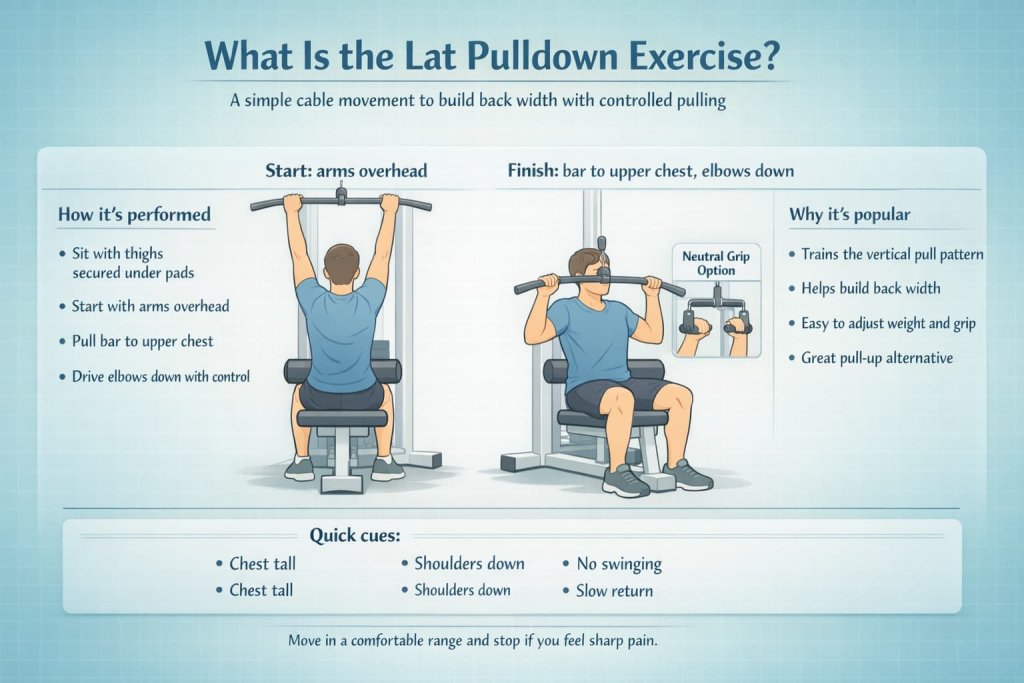
It’s popular because it lets you train the “vertical pull” pattern even if you can’t do pull-ups yet, and it’s easy to adjust load and grips.
How to Do the Lat Pulldown With Proper Form
Use this checklist to get the most lat work with the least wasted motion.
Setup
- Adjust the thigh pad so your legs are locked in (you shouldn’t lift off the seat when you pull).
- Set your grip about shoulder-width to slightly wider to start (you can adjust later based on comfort).
- Sit tall with ribs down and core braced.
- Lean back slightly (about 20–30°)—not a big recline.
Pull (the rep)
- Start by pulling your shoulder blades down and back (depress + retract) as your elbows begin to move.
- Drive your elbows down (think “elbows to pockets”).
- Pull the bar toward the upper chest area under control.
- Pause briefly, then return the bar up slowly without letting your shoulders shrug hard at the top.
Breathing
- Exhale as you pull down.
- Inhale as you return up.
Lat Pulldown Variations and When to Use Them
Build your back with the variation that matches your goal and joint comfort. Start with the option you can control best, then progress load or reps while keeping your shoulders down and torso steady.
1. Wide-grip pulldown (overhand)
Why it works:
A slightly wider overhand grip can make it easier to keep your elbows tracking down and out just enough to “find” the lats, especially if you naturally feel pulldowns more in your arms. It can also encourage a strong upper-back brace when you keep your chest tall and shoulders down.
How to do it:
- Grip the bar slightly wider than shoulder-width with palms facing away.
- Lock your thighs under the pads and sit tall with a small backward lean (don’t recline).
- Set your shoulders “down” before you pull (avoid shrugging).
- Drive elbows down and pull the bar to your upper chest with control.
- Pause briefly, then return slowly until your arms are overhead again without losing posture.
Trainer Tip:
If your shoulders feel pinchy or your elbows flare too far out, narrow the grip slightly and think “elbows down, not back.”
2. Close-grip neutral pulldown (V-handle)
Why it works:
A neutral grip (palms facing each other) often feels more joint-friendly and helps many people keep the shoulders packed down. The closer hand position can also make it easier to pull in a smooth path without swinging.
How to do it:
- Attach a V-handle (or neutral grip handle) and grip it firmly.
- Sit tall, brace your core, and keep your ribs stacked over your pelvis.
- Start the rep by pulling your shoulder blades down and back.
- Drive elbows down close to your sides and pull the handle toward your upper chest.
- Control the return all the way up—no bouncing at the top.
Trainer Tip:
Keep your wrists neutral and let your elbows lead. If you “curl” the handle down, your biceps will take over.
3. Single-arm lat pulldown (D-handle)
Why it works:
Unilateral pulldowns help you correct left-right strength or control differences and can improve your ability to keep the torso steady. Many people feel the working-side lat better because you can focus on the elbow path and scapular control.
How to do it:
- Attach a single D-handle and sit centered with your thigh secured.
- Grab the handle with one hand and keep the other hand lightly braced on the seat or pad.
- Set your shoulder down (avoid shrugging) and keep your torso square.
- Drive the elbow down toward your hip and pull to about upper-chest level.
- Pause briefly, then return slowly and repeat before switching sides.
Trainer Tip:
Don’t twist to “cheat” the weight down. If you rotate, the load is too heavy—reduce weight and own the path.
4. Straight-arm pulldown
Why it works:
This variation reduces elbow flexion, so it’s a strong option when you want more lat tension with less biceps dominance. It trains shoulder extension through a long range and works well as a lat “primer” before pulldowns or rows.
How to do it:
- Stand facing a cable stack with a straight bar or rope attached high.
- Step back slightly, hinge a little at the hips, and brace your core.
- Keep arms mostly straight with a soft bend in the elbows.
- Pull the bar/rope down toward your thighs by driving your arms down and back.
- Pause, then return slowly until you feel a controlled stretch overhead.
Trainer Tip:
If your elbows bend a lot, you’ve turned it into a triceps/biceps movement. Keep the elbow angle nearly the same and focus on “arms as levers.”
5. Tempo lat pulldown (3 seconds up)
Why it works:
Slowing the return (eccentric) reduces momentum, increases time under tension, and helps reinforce better shoulder positioning. It’s especially useful if you tend to bounce at the top or lose control as the weight rises.
How to do it:
- Perform a standard pulldown rep down with clean form.
- At the bottom, pause briefly to remove momentum.
- Return the bar up for a slow 3-count (1…2…3) without shrugging.
- Reset your shoulders at the top and repeat with the same tempo.
Trainer Tip:
Treat the slow return as the “skill work.” If you can’t keep your shoulders down during the 3-second rise, lower the weight and keep the tempo.
Lat Pulldown Muscles Worked
Primary muscle
- Latissimus dorsi (lats): the main back muscle responsible for pulling your upper arm down and in (shoulder adduction). Research comparing multiple pulldown setups shows the lats are consistently a primary contributor across variations, even when other muscles shift slightly.
Secondary muscles (common contributors)
- Biceps brachii (elbow flexion)
- Posterior deltoid
- Middle/lower trapezius (scapular control)
- Rotator cuff contributors (shoulder stability), depending on grip and technique
Practical takeaway: you’ll usually “feel” it most in your lats when you keep the chest tall, shoulders down, and elbows driving toward your sides (not behind you).
Lat Pulldown Mistakes to Avoid
Leaning back and turning it into a row
If your torso keeps leaning back more and more during the set, you’re using momentum and shifting the pattern toward a row. Keep the trunk stable and let the shoulders and elbows do the work.
Yanking the bar down or bouncing out of the bottom
Fast, jerky reps reduce lat tension and can irritate the shoulder. Control the down phase and especially the return (eccentric).
Shrugging your shoulders up
If your shoulders ride up toward your ears, you’re losing the “shoulders down” position that helps the lats do their job.
Pulling behind the neck
Behind-the-neck pulldowns are widely considered higher-risk for shoulder positioning, and front pulldowns can produce similar (or better) training effects with better alignment.
Best Grip for the Lat Pulldown Exercise
People ask this a lot, so here’s the evidence-based answer:
- A classic EMG study (2010) indexed on PubMed reported higher lat activity in pronated (overhand) grips than supinated (underhand) in their test conditions.
- A newer EMG study (2025) available on PubMed Central (PMC) tested seven pulldown variations and found no meaningful differences in lat activation across variations overall, though some setups changed activation in other muscles (like posterior deltoid).
What to do in real life
Choose the grip that lets you:
- Keep shoulders down
- Pull smoothly to the upper chest
- Feel your lats working
- Train pain-free and progress over time
If your elbows or shoulders feel cranky, a neutral grip (handles) is often the easiest on joints.
Sets, Reps, and Programming for Results
Your best rep range depends on your goal, but these simple guidelines work for most lifters:
For strength + muscle
- 3–4 sets of 6–12 reps
- 60–120 seconds rest
- Add weight when you can hit the top of your rep range with clean form
For muscle endurance
- 2–3 sets of 12–20 reps
- Shorter rests (about 60–90 seconds), staying controlled
For overall health, widely used guidelines recommend training major muscle groups with resistance work at least 2 days per week, which you can review on the American College of Sports Medicine (ACSM) resource page.
Who Should Do the Lat Pulldown Exercise
This is a strong option if you:
- Want a beginner-friendly alternative to pull-ups
- Want more back width and upper-back strength
- Need a controlled, adjustable vertical pull pattern
Who Should Avoid or Modify It
Consider modifying (or getting qualified guidance) if you have:
- Ongoing shoulder pain during overhead pulling
- Recent shoulder, neck, or upper-back injury
- Symptoms that worsen with pulldowns (pinching, sharp pain, numbness/tingling)
Safer modifications often include lighter loads, neutral grips, shorter ranges of motion, and slower tempos.
People Also Ask About the Lat Pulldown Exercise
Should you pull to the chest or behind the neck?
For most people, pulling to the upper chest is the better choice for posture and shoulder positioning.
Is the lat pulldown as good as pull-ups?
They’re both effective vertical pulls. Pull-ups add more bodyweight stability demand, while pulldowns allow easier load control and progression.
Do wide grips build wider lats?
Grip changes may not dramatically “isolate” the lats for everyone. What matters most is consistent progressive training with good mechanics.
FAQ
1) What should I feel during the lat pulldown exercise?
Mostly your lats (sides of your back) working, with some biceps. If you feel it mostly in the neck or shoulders, adjust posture and grip.
2) How wide should my grip be?
Start shoulder-width to slightly wider, then adjust to the most comfortable position that lets you pull smoothly to the upper chest.
3) Should I lean back on lat pulldowns?
A small lean (about 20–30°) is fine. Big leaning and swinging usually reduces lat focus and adds stress to the low back.
4) Are behind-the-neck pulldowns safe?
They can place the shoulder in a less favorable position. A front pulldown is usually the safer default for most people.
5) How often should I train lat pulldowns?
Most people do well training back/vertical pulls 1–2 times per week, depending on their overall program and recovery.
6) Why do my biceps take over?
Common reasons: pulling with the hands first, shrugging, or letting elbows drift too far forward. Focus on “elbows down” and keeping shoulders down.
7) What’s the best attachment for lats?
The one that lets you keep great form and progress. EMG research suggests lat activation can be similar across multiple variations for trained lifters.
Conclusion
The lat pulldown exercise is one of the simplest ways to build a stronger, wider back—if you keep your torso steady, shoulders down, and pull with your elbows (not momentum). Start with a comfortable grip, control the full range you can own, and progress gradually. If you want, tell me your equipment (bar only, neutral handles, single D-handle), and I’ll write a short “best 2-day back plan” using lat pulldowns plus the right accessories.
References
- Sperandei et al. (2009) – EMG Analysis of Three Types of Lat Pull-Down (Front vs Behind-the-Neck vs V-Bar) (PubMed)
- Andersen et al. (2014) – Effects of Grip Width on Strength and Muscle Activation in the Lat Pull-Down (PubMed)
- Centers for Disease Control and Prevention (CDC) – Adult Physical Activity Guidelines
- ACSM Position Stand (2009) – Progression Models in Resistance Training for Healthy Adults (PubMed)