
The dumbbell French press is an overhead triceps extension that builds stronger, thicker triceps by training elbow extension through a long range of motion. It’s especially popular because the overhead position can put the triceps (including the long head) under a deeper stretch than many pressing or pushdown variations.
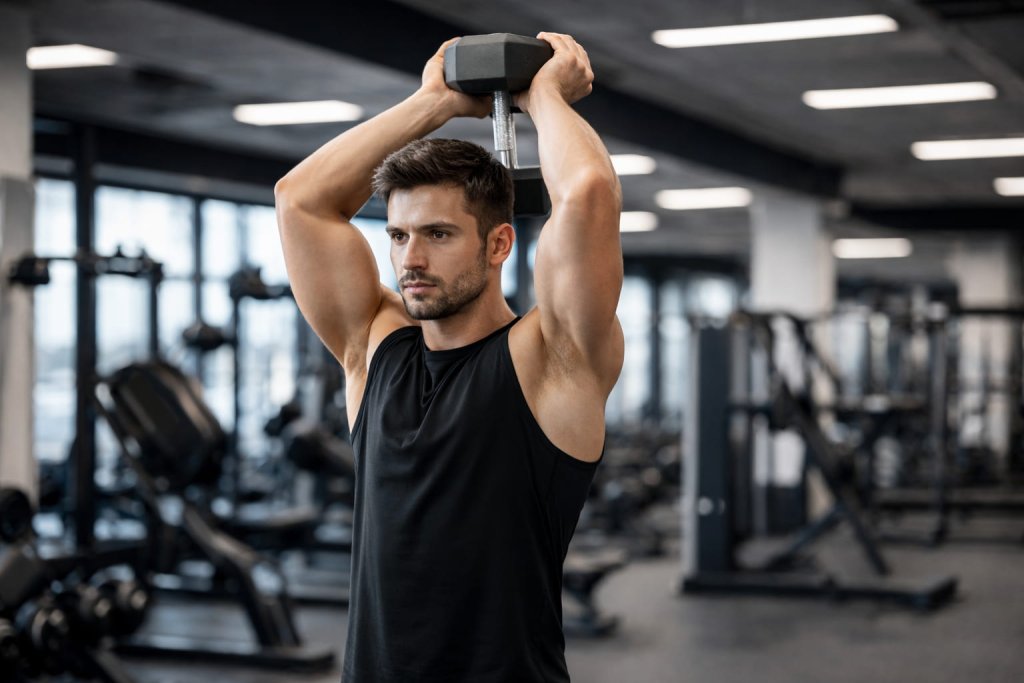
Doing it with clean form matters. When your elbows stay controlled and your ribs stay down, the triceps do the work. When form breaks, your shoulders and lower back often “take over,” and results (and comfort) can suffer.
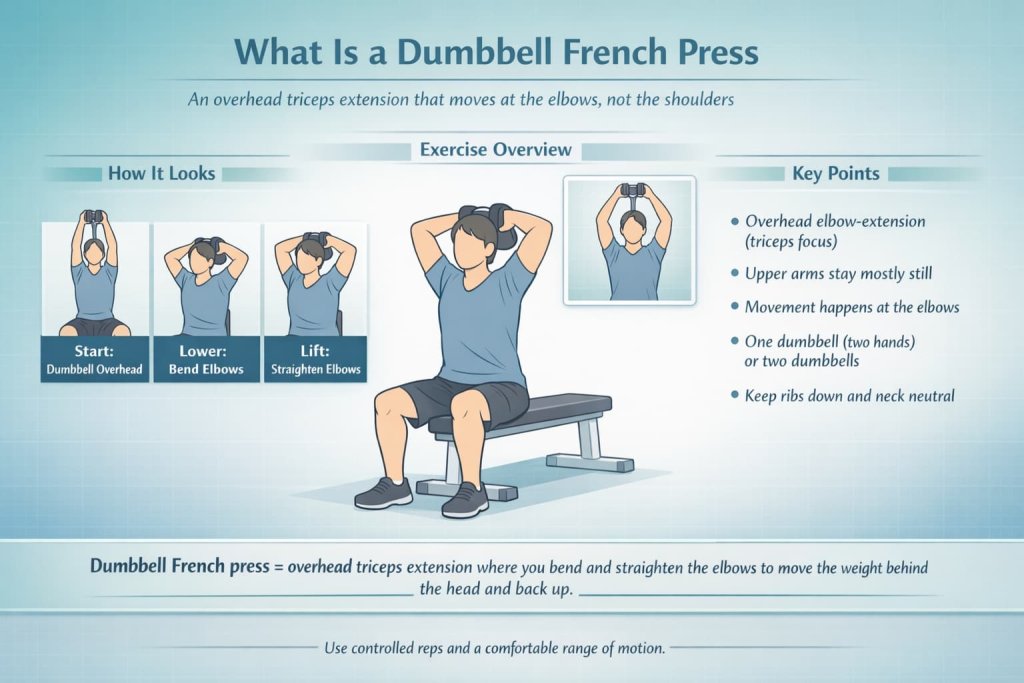
What Is a Dumbbell French Press
A dumbbell French press is simply an overhead dumbbell elbow-extension. You hold one dumbbell (two hands on one head) or two dumbbells (one in each hand), bend your elbows to lower the weight behind your head, then straighten the elbows to lift it back up.
How to Do the Dumbbell French Press With Perfect Form
Use this checklist for a strong, joint-friendly setup:
- Choose your position
- Seated is usually easier to keep strict form.
- Standing is fine if you can keep ribs stacked over hips.
- Set your posture
- Brace your midsection like you’re about to be lightly poked in the stomach.
- Keep ribs down and avoid leaning back.
- Lock in your upper arms
- Keep elbows pointed mostly forward/up (not flared wide).
- Upper arms stay relatively still; the elbow joint moves.
- Lower with control
- Bend elbows and lower the dumbbell behind your head until you feel a strong triceps stretch.
- Stop if you feel shoulder pinching or sharp elbow pain.
- Press back up
- Straighten your elbows to return to the top.
- Finish strong, but don’t “snap” into an aggressive lockout.
A simple safety rule that applies here: if an exercise causes pain, stop and reassess your form and load, as emphasized in strength-training technique guidance from the Mayo Clinic.
Best Dumbbell French Press Variations
1. Seated Dumbbell French Press
Why it works:
Sitting removes a lot of “cheat” options, so you can keep your ribs stacked and your torso quiet. That usually makes it easier to keep tension on the triceps instead of leaning back and turning the rep into more of a press.
How to do it:
- Sit tall on a bench with feet flat and core lightly braced
- Hold one dumbbell with both hands (palms supporting the inner plate) or use two dumbbells
- Start with arms overhead and elbows pointing mostly forward/up
- Lower the weight behind your head by bending the elbows under control
- Stop at a comfortable depth where you feel a strong triceps stretch
- Extend the elbows to return to the top without snapping the lockout
Trainer Tip:
If your elbows flare, reduce the weight and think “elbows up, biceps near ears.” Smooth reps beat heavy reps on this one.
2. Single-Dumbbell Two-Hand French Press
Why it works:
Using one dumbbell keeps the setup simple and often feels more stable for beginners. It also makes it easier to focus on a controlled lowering phase and a strong squeeze at the top.
How to do it:
- Hold one dumbbell overhead with both hands on the dumbbell head
- Stand tall or sit upright with ribs down and glutes lightly engaged
- Keep upper arms mostly still and elbows angled forward/up
- Lower the dumbbell behind your head slowly (2–3 seconds down)
- Pause briefly at the bottom if you can control it
- Press back up by extending the elbows, stopping just short of a harsh lockout
Trainer Tip:
A slightly slower lowering phase usually improves comfort and makes lighter weights feel harder (which is great for triceps growth).
3. Two-Dumbbell Overhead Extensions
Why it works:
Two dumbbells let each arm work independently, which can reduce side-to-side compensation. Many people also find it easier to keep the wrists in a comfortable position compared with gripping one heavier dumbbell.
How to do it:
- Hold a dumbbell in each hand and press them overhead
- Turn palms to face in (neutral grip) if that feels best
- Keep elbows pointing forward/up rather than wide
- Lower both dumbbells behind your head with control and matching depth
- Extend the elbows to return to the top, keeping reps smooth and even
Trainer Tip:
If one elbow drifts more than the other, practice in front of a mirror and use lighter weights until both sides move the same.
4. Incline Seated Overhead Extension
Why it works:
Incline support can make it easier to “lock in” your torso and feel a stronger triceps stretch. It often reduces the urge to lean back, which helps you keep tension where you want it.
How to do it:
- Set a bench to a moderate incline (not fully upright)
- Sit with your back supported and keep ribs down
- Hold one dumbbell with both hands or use two dumbbells
- Start overhead with elbows pointing mostly forward
- Lower behind your head slowly to a comfortable stretch
- Extend elbows to lift back up, keeping shoulders down and away from ears
Trainer Tip:
Don’t let your shoulders shrug as you fatigue. Think “shoulders down, elbows move” to keep stress off the neck.
5. Rope Overhead Cable Extension Alternative
Why it works:
If dumbbells feel awkward on wrists or elbows, a cable can feel smoother because tension stays consistent through the range. The rope also allows a natural hand position and a controlled “spread” at the top for a strong triceps contraction.
How to do it:
- Set a cable to a low position with a rope attachment
- Face away from the stack and bring the rope overhead
- Stagger your stance and brace your core (ribs down)
- Keep elbows tucked and angled forward
- Bend elbows to bring hands behind your head under control
- Extend elbows to press the rope up and slightly apart at the top
- Return smoothly—no jerking or leaning back
Trainer Tip:
If you feel low-back strain, shorten your stance, squeeze your glutes, and lower the weight. Your torso should feel “locked” while the elbows do the work.
Dumbbell French Press Benefits
- Targets the triceps through a big range of motion (great for hypertrophy-focused accessory work)
- Challenges the long head of the triceps because your arm is overhead (the long head crosses the shoulder)
- Easy to scale with lighter dumbbells and higher-rep sets
- Home-gym friendly (just a dumbbell and a bench or chair if you want seated support)
Muscles Worked
Primary muscle:
- Triceps brachii (all heads contribute)
Common supporting muscles:
- Upper back and shoulder stabilizers (to keep the shoulder joint steady)
- Core (to prevent rib flare and low-back arching)
Dumbbell French Press vs Overhead Triceps Extension
They’re essentially the same family of exercise. “French press” is often used as a common name for an overhead triceps extension done with:
- One dumbbell held with both hands (most common)
- Two dumbbells (one in each hand)
- A barbell or EZ bar (barbell French press)
Common Dumbbell French Press Mistakes
Flaring elbows too wide
This often reduces triceps tension and can feel rough on elbows or shoulders. Think “elbows up” rather than “elbows out.”
Over-arching your lower back
If your ribs pop up and your back arches, you’re borrowing motion from your spine. Go lighter, sit down, and brace.
Using momentum
Fast reps can turn this into a sloppy shoulder movement. Slow down and own the lowering phase.
Going too heavy too soon
This lift is usually best as an accessory movement. A slightly lighter load with controlled reps tends to build more consistent progress.
Sets, Reps, and Where It Fits in Your Workout
Most people get the best results using the dumbbell French press after compound pressing (bench, push-ups, overhead press) as a focused triceps finisher.
Good starting ranges:
- 3–4 sets of 8–15 reps
- Rest 60–90 seconds
- Aim for 1–3 reps left in the tank on most sets (good effort, clean form)
For progression, add reps first, then add a small amount of weight once you can hit the top of your rep range with control. If you want a research-backed reference point for resistance-training progression concepts, you can review a well-cited position stand indexed on PubMed.
How to Make It More Elbow-Friendly
- Warm up with very light extensions or pressdowns for 1–2 easy sets
- Use a controlled tempo (especially lowering)
- Don’t force depth if it creates a sharp sensation
- Consider the two-dumbbell version if one heavy dumbbell feels awkward on wrists
Who Should Avoid Dumbbell French Press or Talk to a Clinician First
Consider getting personalized guidance first if you have:
- Persistent elbow pain (especially tendon pain) that flares with extension work
- Shoulder pain or pinching with arms overhead
- A recent upper-body injury or surgery clearance requirement
If overhead work consistently doesn’t agree with your shoulders or elbows, it may be smarter to choose a different triceps variation and build back gradually using general resistance-training guidance from the American College of Sports Medicine (ACSM).
Frequently Asked Questions
Is the dumbbell French press good for triceps long head?
It can be, because the long head crosses the shoulder and is challenged when the arm is overhead. Many lifters also like it because it provides a strong stretch position.
Should I do it seated or standing?
Seated is usually easier to keep strict form. Standing is fine if you can keep ribs down and avoid leaning back.
What’s the difference between French press and skull crushers?
French press is typically overhead (or more “behind the head” angled), while skull crushers are usually lying and bring the weight toward the forehead area. Both train elbow extension but can feel different on elbows and shoulders.
Why do my elbows flare out?
Often it’s a load that’s too heavy or a grip that feels unstable. Reduce weight, slow down, and think “elbows up and in” rather than wide.
How heavy should I go?
Start lighter than you think, especially if you’re new to overhead extensions. Pick a weight you can control for 8–15 reps without arching your back.
Can I do dumbbell French press if overhead positions bother my shoulders?
If overhead positions consistently cause discomfort, consider swapping to a different triceps movement that feels better. Don’t push through sharp pain.
How often should I train this exercise?
Many programs use it 1–3 times per week depending on your total pressing and triceps volume. Keep recovery in mind if your elbows get irritated.
Conclusion
The dumbbell French press is a simple, effective way to build stronger triceps when you keep your ribs stacked, elbows controlled, and reps smooth. Start with a manageable load, earn clean range of motion, and progress gradually.
If you want, tell me your equipment (one dumbbell or two, bench or no bench) and your goal (size, strength, or elbow-friendly training), and I’ll build a short triceps routine that includes the dumbbell French press.
References
- Weight training do’s and don’ts of proper technique. Mayo Clinic Sports Medicine .
- Strength training: Get stronger, leaner, healthier. Mayo Clinic.
- Effect of shoulder position on triceps brachii heads activity in dumbbell elbow extension exercises. PubMed.
- 6 Exercises for Stronger Triceps. American Council on Exercise (ACE)