
Yes, the overhead triceps extension is one of the most effective exercises for building strong, defined arms.
This move specifically targets the long head of the triceps — the muscle that adds fullness and creates the signature “horseshoe” shape.

Unlike pushdowns or kickbacks, the overhead position places the triceps under a deep stretch, making it one of the best exercises for maximum growth. Why does this matter? Strong triceps not only improve arm aesthetics but also enhance pressing strength, elbow stability, and overall upper-body performance.
Best of all, the overhead triceps extension is highly versatile. With just a dumbbell, cable, kettlebell, or resistance band, you can perform it virtually anywhere.
What Is the Overhead Triceps Extension?
The overhead triceps extension is a resistance exercise where you extend your elbows while holding weight overhead. It is an isolation exercise, meaning the triceps do most of the work without much help from other muscles.
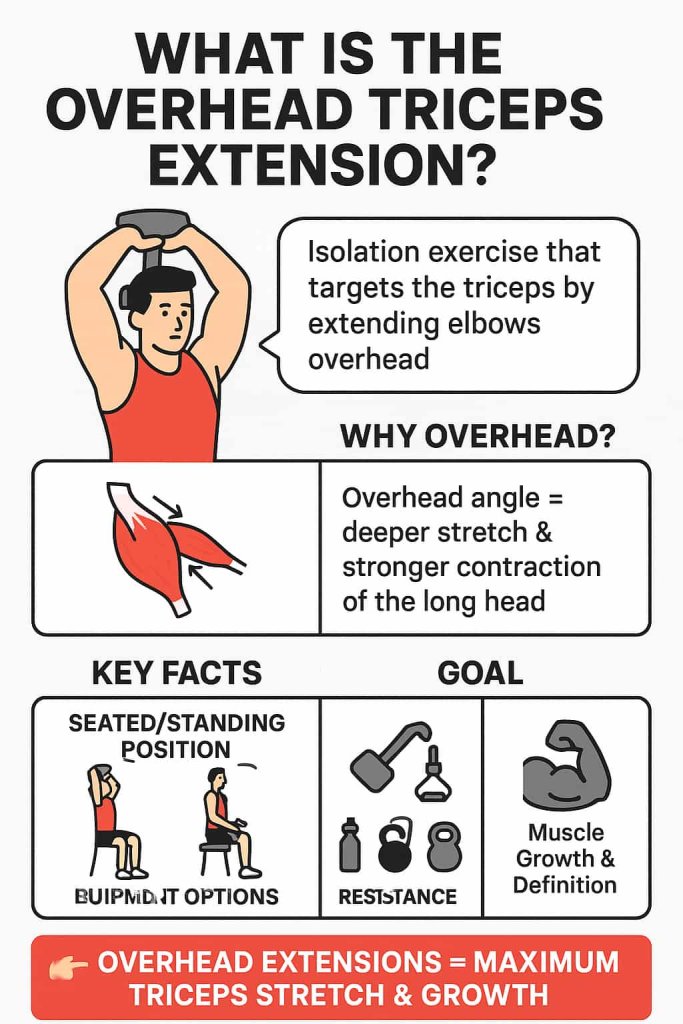
Because the long head of the triceps crosses the shoulder joint, the overhead angle provides a deeper stretch and stronger contraction compared to most other triceps moves.
Key Facts:
- Can be performed standing, seated, or with one arm at a time.
- Works with dumbbells, EZ bar, cables, kettlebells, or bands.
- Effective for muscle growth (hypertrophy) and arm definition.
How to Perform Overhead Triceps Extension (Step by Step)
Standing Overhead Triceps Extension
- Setup → Hold one dumbbell with both hands under the top plate. Stand tall, feet hip-width apart.
- Start Position → Raise the dumbbell overhead, arms fully extended, elbows close to ears.
- Lower Phase → Bend elbows slowly, lowering weight behind the head in a controlled arc.
- Extension Phase → Straighten elbows to lift the dumbbell back up, squeezing triceps at the top.
- Breathing → Inhale down, exhale up.
- Sets/Reps → 3–4 sets of 8–12 reps for muscle growth.
👉 Trainer Tips:
- Keep elbows tucked forward.
- Brace your core to avoid back arching.
- Use controlled movements, not momentum.
Muscles Worked
The overhead triceps extension mainly targets the triceps brachii, which has three heads:
- Long Head → Primary focus; adds arm thickness and shape.
- Lateral Head → Contributes to outer-arm width and definition.
- Medial Head → Provides stability and endurance in extension.
Supporting Muscles:
- Shoulders (Deltoids) → Keep arms steady overhead.
- Core (Abs & Obliques) → Maintain posture and prevent arching.
- Forearms & Grip → Secure the weight.
Variations of Overhead Triceps Extension
1. Seated Dumbbell Overhead Extension
How to do it:
- Sit upright on a bench or chair with your feet flat on the floor.
- Hold one dumbbell with both hands and raise it overhead.
- Keep your upper arms close to your head and your elbows pointing forward.
- Slowly lower the dumbbell behind your head by bending your elbows.
- Lower only as far as you can without losing control or arching your back.
- Press the dumbbell back up until your arms are straight.
- Repeat for the desired number of reps.
Trainer Tips:
- Keep your elbows close to your head—don’t let them flare too wide.
- Brace your core and keep your back pressed against the bench for protection.
- Ideal for beginners and intermediates building size and strength.
2. Single-Arm Dumbbell or Kettlebell Overhead Extension
How to do it:
- Stand or sit tall with your core braced.
- Hold one dumbbell or kettlebell overhead in one hand.
- Keep your elbow close to your head and your upper arm mostly still.
- Bend your elbow to lower the weight behind your head.
- Pause briefly at the bottom without letting your elbow flare too much.
- Extend your arm to bring the weight back overhead.
- Complete all reps on one side, then switch arms.
Trainer Tips:
- Perform in front of a mirror to check elbow alignment.
- Keep the unused hand on your core or ribcage for stability.
- Use moderate weights to prevent shoulder stress.
3. EZ Bar Overhead Extension
How to do it:
- Stand or sit tall while holding an EZ bar with both hands.
- Press the bar overhead with your hands in a comfortable angled grip.
- Keep your elbows pointed mostly forward and close to your head.
- Lower the bar behind your head by bending at the elbows.
- Control the lowering phase and avoid moving your shoulders too much.
- Extend your elbows to raise the bar back to the starting position.
- Repeat with steady, controlled reps.
Trainer Tips:
- Perform seated if you struggle with back stability.
- Keep the bar path steady—don’t let it drift too far back.
- Try slow eccentrics (lowering phase) for maximum hypertrophy.
4. Cable Rope Overhead Extension
How to do it:
- Attach a rope handle to a low cable pulley.
- Face away from the machine and bring the rope behind your head.
- Step forward into a split stance for balance.
- Keep your elbows bent and close to your head at the start.
- Extend your elbows to press the rope upward and slightly forward.
- At the top, separate the rope ends slightly for a full triceps squeeze.
- Return slowly to the starting position and repeat.
Trainer Tips:
- Step slightly forward to create a stretch at the bottom.
- Pull the rope ends apart at the top for maximum triceps activation.
- Use controlled tempo; avoid jerking the rope.
5. Resistance Band Overhead Extension
How to do it:
- Anchor the resistance band under your feet or to a low secure point.
- Hold the band handles or ends and bring your hands overhead.
- Stand tall with your core tight and elbows close to your head.
- Bend your elbows to lower your hands behind your head.
- Keep your upper arms steady as you move through the rep.
- Extend your elbows to press back to the top position.
- Repeat with smooth and controlled motion.
Trainer Tips:
- Use a band with appropriate resistance (too heavy can snap back).
- Keep elbows tucked and aligned with ears.
- Best for high-rep endurance or as a burnout finisher.
Benefits of Overhead Triceps Extension
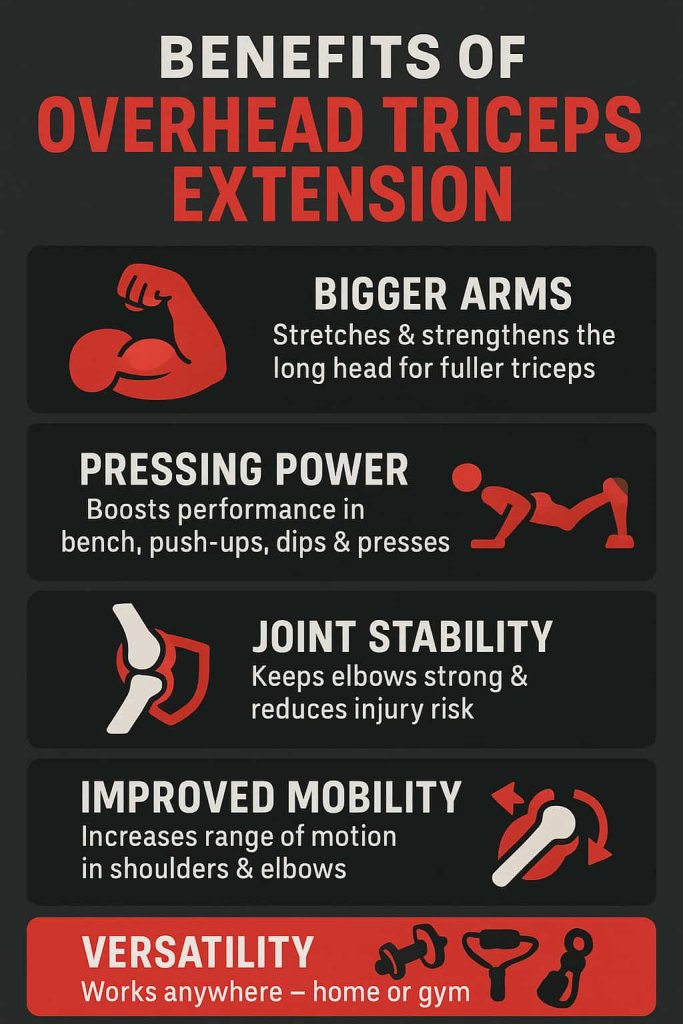
- Bigger Arms → Stretches and strengthens the long head for full, defined triceps.
- Pressing Power → Improves strength in bench press, push-ups, dips, and overhead presses.
- Joint Stability → Strengthens elbows, reducing risk of strain.
- Improved Mobility → Enhances shoulder and elbow flexibility.
- Versatility → Can be done at home or gym with multiple equipment options.
Who Should Do the Overhead Triceps Extension?
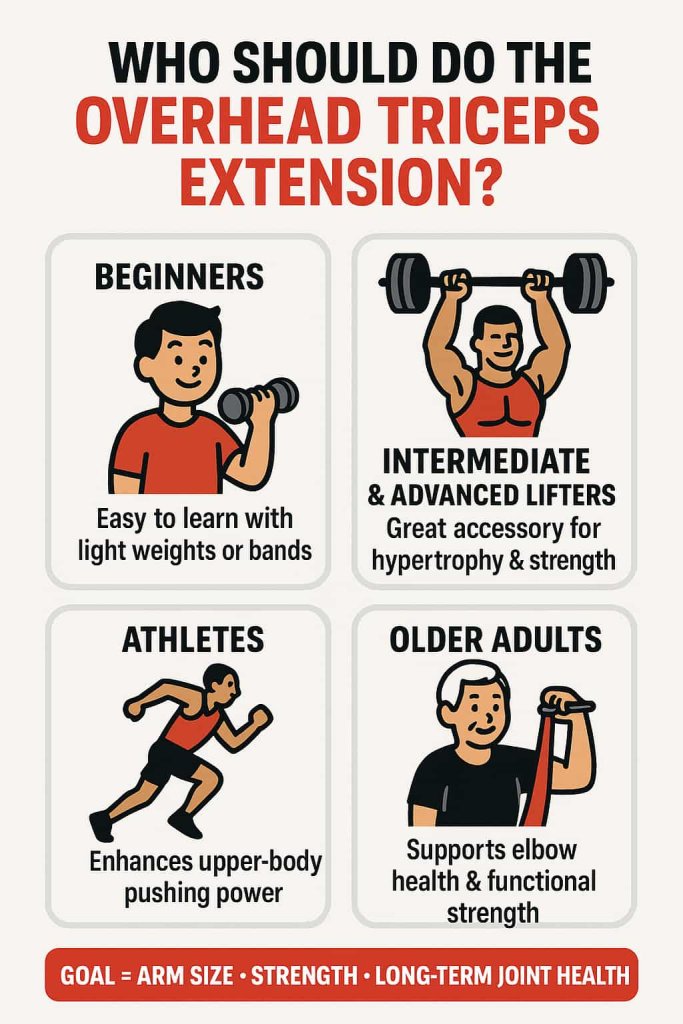
This exercise is useful for many groups:
- Beginners → Easy to learn with light weights or bands.
- Intermediate & Advanced Lifters → Excellent accessory for hypertrophy and strength.
- Athletes → Improves upper-body pushing strength for sports.
- Older Adults → Helps maintain elbow stability and arm function using light resistance.
👉 If your goal is arm size, strength, or long-term joint health, this exercise belongs in your routine.
Common Mistakes to Avoid
- Going Too Heavy → Sacrifices form and stresses elbows.
- Arching the Lower Back → Always engage the core.
- Partial Reps → Lower fully behind the head for maximum stretch.
- Elbows Flaring Out → Reduces triceps engagement and stresses shoulders.
Safety Tips & Injury Prevention
- Warm Up → Mobilize elbows and shoulders before lifting.
- Start Light → Master form before adding weight.
- Control the Motion → Avoid jerking the weight.
- Don’t Hyperextend → Stop at full extension without snapping elbows.
- Progress Gradually → Increase load slowly to prevent overuse injuries.
👉 Safety first — prioritize good form over heavy weights.
How to Program Overhead Triceps Extensions
The exercise works best as an accessory movement after compound presses.
Sample Push Day Routine:
- Bench Press → 4 sets of 6–8 reps
- Overhead Press → 3 sets of 8–10 reps
- Overhead Triceps Extension → 3 sets of 10–12 reps
- Lateral Raises → 3 sets of 15 reps
👉 Train triceps 2–3 times weekly, leaving at least 48 hours between sessions.
FAQs About Overhead Triceps Extension
1. Is this exercise beginner-friendly?
Yes, start with bands or light dumbbells.
2. Dumbbells vs. cables — which is better?
Dumbbells allow deeper stretch; cables give constant tension. Both are great.
3. Can I do it seated?
Yes. The seated version offers more stability.
4. Should I do it before or after compound lifts?
After compounds — to avoid pre-fatigue.
5. Does it hurt the elbows?
Not if performed correctly. Avoid jerky movements or excessive weight.
6. How many times per week should I train triceps?
2–3 times per week with progressive overload.
7. Can I grow big arms with only extensions?
No. Combine isolation with compound lifts for full development.
Conclusion
The overhead triceps extension is one of the best exercises to sculpt strong, defined arms. By emphasizing the triceps long head, it builds size, strength, and stability while boosting performance in pressing movements.
👉 Add it to your push or arm day routine, focus on proper form, and increase resistance gradually. With consistency, you’ll see noticeable improvements in both arm aesthetics and upper-body strength.