
Hand and wrist exercises help improve mobility, support grip strength, and may reduce stiffness or daily discomfort caused by typing, repetitive use, arthritis, or minor overuse. These movements keep your joints moving smoothly, enhance circulation, and support the muscles and tendons that power your daily activities.
Understanding the right exercises is important because the hands and wrists contain small but essential structures—tendons, nerves, ligaments, and tiny stabilizing muscles. A balanced routine of mobility, stretching, and strengthening can help you move more comfortably throughout the day.
What Are Hand and Wrist Exercises?
Hand and wrist exercises include mobility drills, stretching movements, and strength-based tasks that help your hands move and function more comfortably. These exercises support daily tasks such as gripping, typing, carrying, twisting, lifting, and maintaining fine motor control.
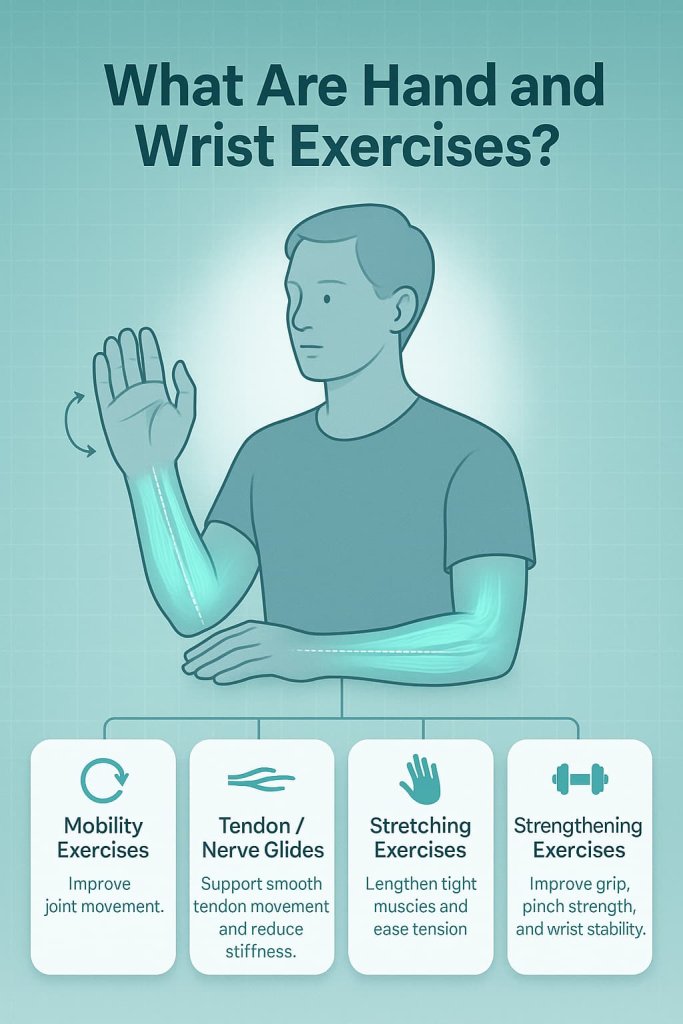
Most programs include:
- Mobility exercises — improve joint movement
- Tendon/nerve glides — support tendon movement and reduce stiffness
- Stretching exercises — lengthen tight muscles and reduce tension
- Strengthening exercises — improve grip, pinch, and wrist stability
12 Best Hand and Wrist Exercises to Improve Strength, Mobility & Comfort
Improve flexibility, reduce stiffness, and support healthier hand function with these simple, effective exercises. Perfect for typing strain, daily discomfort, mild overuse, and boosting overall grip strength.
Mobility & Tendon Glides
1. Wrist Flexion & Extension
Why it works:
This movement improves joint lubrication in the wrist and helps reduce stiffness caused by immobility, typing, or repetitive gripping. It gently mobilizes the wrist capsule and encourages smooth tendon movement.
Muscles worked:
Wrist flexors, wrist extensors, forearm stabilizers.
How to do it:
- Rest your forearm on a table with your hand hanging off the edge.
- Slowly lift your hand upward (wrist extension).
- Then slowly bend your wrist downward (wrist flexion).
- Keep the movement small and controlled.
- Repeat 10–12 times.
Trainer Tip:
Move only through a comfortable range. If the joint clicks, reduce the speed and move through a shorter arc.
2. Wrist Side-to-Side Movement (Radial/Ulnar Deviation)
Why it works:
This movement targets the side-to-side mechanics of the wrist, which improves joint mobility and reduces stiffness from writing, mouse use, and gripping tools.
Muscles worked:
Forearm radial deviators, ulnar deviators, wrist stabilizers.
How to do it:
- Support your forearm on a table.
- Move your hand gently side to side, like waving.
- Keep your fingers relaxed.
- Repeat 10–12 times.
Trainer Tip:
Do not let your forearm rotate—keep it flat so only the wrist moves.
3. Pronation–Supination (Palm Up / Palm Down)
Why it works:
This improves forearm rotation, essential for tasks like turning doorknobs, opening jars, and typing with proper wrist alignment.
Muscles worked:
Pronator teres, pronator quadratus, supinator, biceps (assists in supination).
How to do it:
- Bend your elbow at 90 degrees.
- Rotate your forearm so your palm faces up.
- Rotate back so your palm faces down.
- Perform 10–12 gentle rotations.
Trainer Tip:
Keep your elbow tucked into your side to ensure true forearm rotation rather than shoulder movement.
4. Full Tendon Glide Series
Why it works:
Tendon glides help the flexor tendons move smoothly through their sheaths—important for reducing stiffness from typing, texting, and overuse. They are commonly recommended for arthritis and early carpal tunnel symptoms.
Muscles worked:
Finger flexors, intrinsic hand muscles, forearm stabilizers.
How to do it:
Move through the following positions slowly:
- Straight hand
- Hook fist
- Tabletop
- Full fist
- Straight hand again
Perform 5–10 rounds.
Trainer Tip:
Move smoothly with no jerking. If a position is painful, skip it and stay within a comfortable range.
Stretching & Nerve-Friendly Movements
5. Wrist Flexor Stretch
Why it works:
Stretching the wrist flexors helps reduce tightness from prolonged gripping or typing. It also helps decrease tension in the forearm muscles that commonly contribute to wrist discomfort.
Muscles worked:
Wrist flexors, finger flexors, palm muscles.
How to do it:
- Extend your arm forward, palm facing up.
- Use your other hand to gently pull your fingers downward.
- Hold 15–20 seconds.
- Switch sides.
Trainer Tip:
Keep your elbow straight. A bent elbow reduces the effectiveness of the stretch.
6. Wrist Extensor Stretch
Why it works:
This movement reduces tension in the top of the forearm—an area often irritated by typing, lifting, or repetitive wrist movements.
Muscles worked:
Wrist extensors, finger extensors.
How to do it:
- Extend your arm, palm facing down.
- Use your other hand to gently bend your wrist downward.
- Hold 15–20 seconds.
- Switch sides.
Trainer Tip:
You can intensify the stretch by slightly turning your palm inward before pressing down.
7. Finger Flexor Stretch
Why it works:
Stretches the front of the fingers and hands, helping counteract tightness from gripping, writing, or holding devices for long periods.
Muscles worked:
Finger flexors, intrinsic hand muscles.
How to do it:
- Place your fingertips or full fingers on a table.
- Gently press downward until you feel a mild stretch.
- Hold 10–15 seconds.
Trainer Tip:
To stretch deeper, move your hand slightly forward so more of the fingers contact the table surface.
8. Median Nerve Glide (Beginner Variation)
Why it works:
This gentle sequence promotes movement of the median nerve through its pathway. It is commonly recommended for mild carpal tunnel symptoms but must remain gentle.
Muscles worked:
Forearm muscles that assist nerve movement; also improves nerve mobility.
How to do it:
- Start with a loose fist.
- Open your hand.
- Extend your fingers and wrist slightly back.
- Stop immediately if symptoms worsen.
- Perform 5–8 slow reps.
Trainer Tip:
Keep intensity low—nerve glides should feel smooth, never forceful. If you feel tingling, reduce range or stop.
Strengthening Exercises for Grip & Wrist Stability
9. Ball or Putty Squeezes
Why it works:
Improves grip strength and enhances the activation of small hand muscles used for carrying, typing, lifting, and daily tasks.
Muscles worked:
Finger flexors, intrinsic hand muscles, forearm flexors.
How to do it:
- Hold a soft ball or therapy putty.
- Squeeze gently for 3 seconds.
- Release slowly.
- Perform 10–12 repetitions.
Trainer Tip:
Do not over-squeeze. Moderate, controlled pressure builds strength without stressing joints.
10. Thumb Opposition Press
Why it works:
Enhances thumb strength and coordination, essential for gripping, pinching, writing, and using tools.
Muscles worked:
Thenar muscles, thumb flexors, intrinsic hand stabilizers.
How to do it:
- Touch your thumb to each fingertip.
- Apply light pressure and hold briefly.
- Repeat 2–3 rounds.
Trainer Tip:
Move slowly through each fingertip; the slower pace builds better neuromuscular control.
11. Wrist Curls (Light Dumbbell or Water Bottle)
Why it works:
Strengthens wrist flexors, which support grip strength and stabilize the wrist during lifting or gripping activities.
Muscles worked:
Wrist flexors, forearm flexors, small stabilizers.
How to do it:
- Rest your forearm on your thigh or a table.
- Hold a light dumbbell or water bottle.
- Curl your wrist upward.
- Lower slowly.
- Perform 12–15 reps.
Trainer Tip:
Keep your forearm still. All movement should occur at the wrist for maximum benefit.
12. Reverse Wrist Curls
Why it works:
Balances the wrist by strengthening the extensors—the muscles that counteract the flexors. Essential for injury prevention and overall wrist stability.
Muscles worked:
Wrist extensors, forearm extensors, stabilizers.
How to do it:
- Hold a light dumbbell/bottle with your palm facing down.
- Lift your hand upward slowly.
- Lower with control.
- Perform 12–15 reps.
Trainer Tip:
Use very light weight. Wrist extensors fatigue quickly, and using too much load can cause irritation.
How Often Should You Do Hand and Wrist Exercises?
Frequency guidelines based on NHS, ASSH, and research recommendations:
- Mobility exercises: 2–3 times per day
- Tendon glides: 1–3 times per day
- Stretching: 1–2 times per day
- Strengthening: 2–3 days per week
Begin with gentle, pain-free movements and increase slowly.
Safety Tips Before You Begin
- Warm up with warm water or a warm towel if your hands feel stiff.
- Move slowly—never force stiff joints.
- Mild stretching discomfort is normal; sharp pain isn’t.
- Stop if swelling, numbness, or worsening symptoms appear.
- Individuals with arthritis, carpal tunnel, or injury should progress cautiously.
- Consult a clinician for post-surgery, severe pain, or nerve symptoms.
Who Should Avoid These Exercises or Be Cautious?
Hand and wrist exercises are generally gentle, but some individuals should be cautious or avoid specific movements until medically cleared. This protects sensitive tissues and ensures your routine remains safe and appropriate.
You should use caution—or avoid these exercises—if you have:
- Recent injury, fracture, or ligament tear, especially if still healing.
- Recent hand, wrist, or forearm surgery, unless your surgeon or therapist has approved exercises.
- Severe arthritis flare-ups with intense pain, swelling, or heat around the joint.
- Moderate to severe carpal tunnel symptoms, such as ongoing numbness, night pain, or weakness.
- Unexplained swelling or bruising in the hand or wrist.
- Progressive numbness, tingling, or weakness, which may indicate nerve irritation.
- Sharp, electric, or radiating pain during movement, especially into fingers or the forearm.
- Joint instability, including the feeling that a joint may “give way.”
If any movement increases symptoms, stop immediately. For individuals with underlying medical conditions, it’s best to begin exercises under guidance from a hand therapist, physiotherapist, or orthopedic specialist.
When to See a Doctor or Hand Therapist
While most mild hand and wrist discomforts improve with rest, gentle mobility, and proper activity habits, certain symptoms require professional evaluation. Early guidance can help prevent worsening irritation and protect nerve and joint health.
You should seek medical advice if you experience:
- Persistent numbness, tingling, or burning, especially in the thumb, index, or middle finger.
- Symptoms of carpal tunnel that worsen over time, including night pain or dropping objects.
- Severe or sudden swelling, warmth, or redness in the hand or wrist.
- Sharp pain that does not improve with gentle movement or worsens during exercises.
- Loss of strength or noticeable weakness, especially when gripping or pinching.
- A visible deformity or significant change in hand shape after an injury.
- Inability to move the wrist or fingers fully after trauma.
- Pain lasting longer than 2–3 weeks, even with self-care and gentle exercise.
A hand therapist (OT or PT) or orthopedic/hand specialist can provide a tailored exercise plan, ergonomic recommendations, splinting if needed, and further medical assessment.
FAQ
1. Do hand and wrist exercises really help?
They support mobility, flexibility, and grip strength and may help reduce stiffness when done consistently.
2. Can these exercises help carpal tunnel?
Gentle tendon and nerve glides may help mild symptoms, but severe cases require medical guidance.
3. How long until I see improvements?
Many people notice changes in 2–4 weeks with consistent practice.
4. Are these exercises safe during arthritis flare-ups?
Do gentle mobility only—avoid heavy strengthening until symptoms settle.
5. Can I do these exercises daily?
Mobility and stretching are safe daily; strengthening should be spaced 48 hours apart.
6. Should I stop if my fingers tingle?
Yes. Tingling, numbness, or sharp pain is a sign to stop and consult a professional.
7. Do I need equipment?
Most exercises require no equipment; optional tools include a soft stress ball, putty, or light dumbbell.
Conclusion
Hand and wrist exercises are simple, effective movements that support mobility, grip strength, and everyday comfort. A balanced routine of mobility, stretching, and strengthening—supported by authoritative guidelines—can help your hands feel and perform better throughout your day. Start gently, stay consistent, and adjust based on what feels comfortable for you.
References
- American Society for Surgery of the Hand (ASSH) – Hand and Finger Exercises
Hand and Finger Exercises – American Society for Surgery of the Hand (ASSH) - ASSH – Common Hand and Finger Exercises (Patient PDF)
Common Hand and Finger Exercises – ASSH Patient Handout (PDF) - NHS Inform – Exercises for Wrist, Hand and Finger Problems
Exercises for Wrist, Hand and Finger Problems – NHS Inform - Swansea Bay University Health Board (NHS) – Hand & Wrist Exercises Leaflet
Hand & Wrist Exercises – Swansea Bay University Health Board (NHS) - Mayo Clinic – Hand Exercises for People with Arthritis
Hand exercises for people with arthritis – Mayo Clinic - Arthritis Foundation – 9 Exercises to Help Hand Arthritis
9 Exercises to Help Hand Arthritis – Arthritis Foundation - AAOS OrthoInfo – Carpal Tunnel Syndrome: Therapeutic Exercise Program
Carpal Tunnel Syndrome: Therapeutic Exercise Program – American Academy of Orthopaedic Surgeons (AAOS) - Huang L et al. (2024) – Exercise-Based Rehabilitation in Hand Osteoarthritis (JOSPT)
The Effectiveness of Exercise-Based Rehabilitation in People With Hand Osteoarthritis – Systematic Review and Meta-analysis (JOSPT, 2024)