
Back mobility exercises can help improve movement, reduce stiffness, and support everyday comfort when they are done gently and consistently. That matters because major guidance for low back pain and stiffness supports staying active, using exercise as part of self-management, and building up gradually rather than avoiding movement completely, as explained by the World Health Organization.

If your back feels tight from long sitting, reduced activity, or general non-specific stiffness, the right mobility routine may help you move more comfortably. The key is to choose simple movements, stay in a tolerable range, and avoid forcing painful positions. Guidance from the National Institute for Health and Care Excellence and the American Academy of Orthopaedic Surgeons also supports exercise-based care for many people with ongoing back symptoms.
Why back mobility exercises matter
Back stiffness can make ordinary tasks feel harder than they should. Bending, reaching, getting out of a chair, walking, and even turning in bed can feel restricted when your spine and the surrounding muscles are not moving well. The broader evidence on low back pain also supports exercise as a useful part of care.
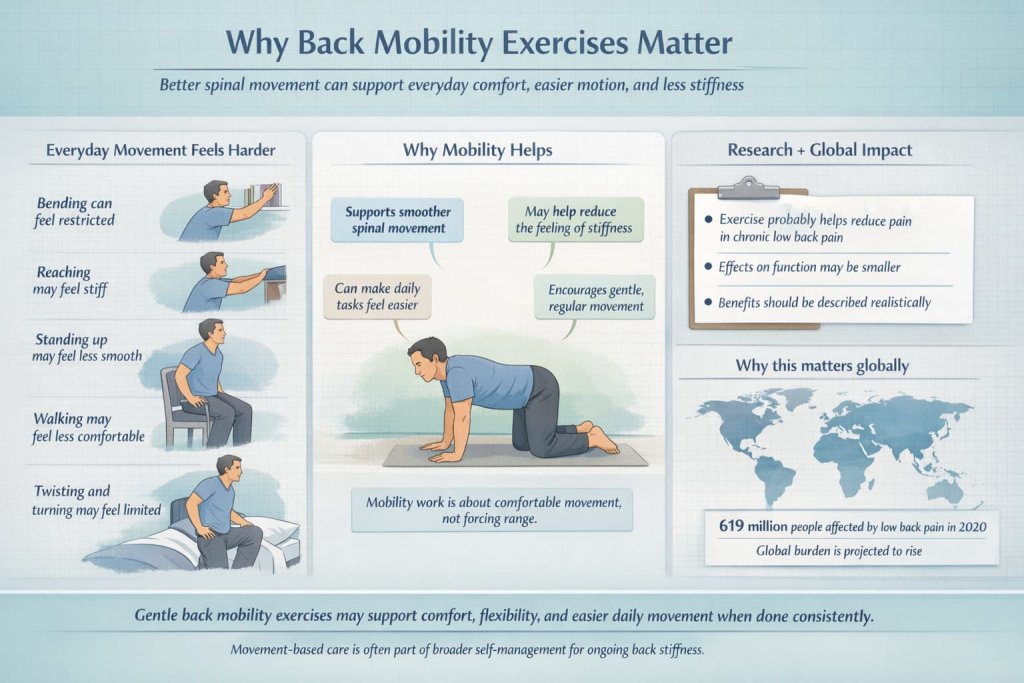
A major review indexed by PubMed found moderate-certainty evidence that exercise probably helps reduce pain in chronic low back pain, although the effect on function is smaller and should not be overstated.
This is also a very common issue. The World Health Organization reports that low back pain affected 619 million people in 2020, and that burden is projected to rise globally.
Who may benefit most from back mobility exercises
Back mobility exercises may be a good fit for people who have:
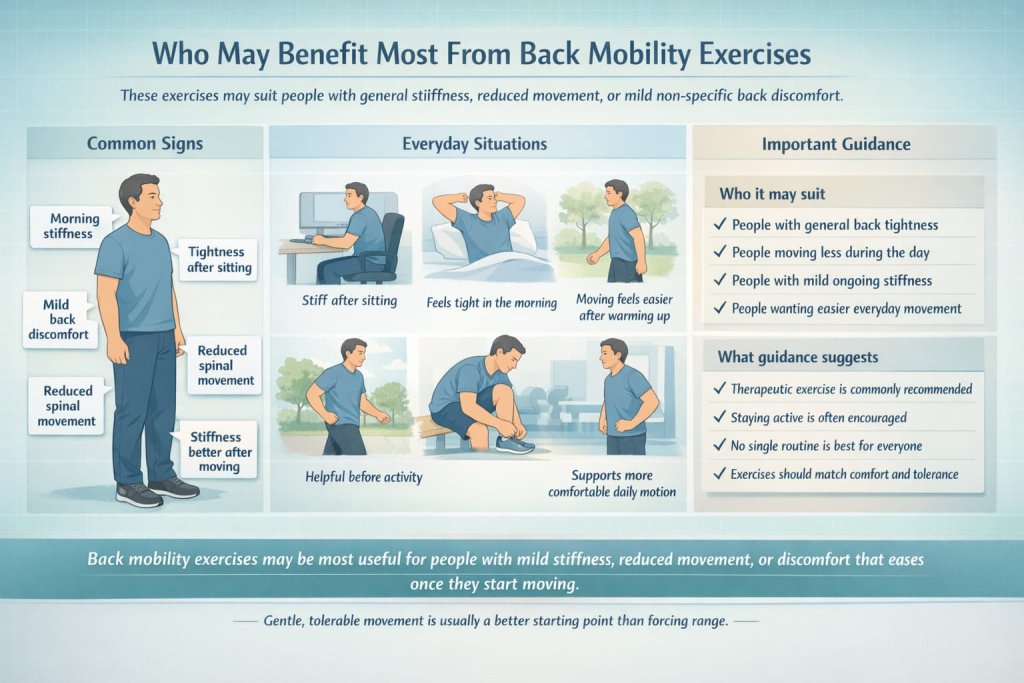
- morning stiffness or tightness after sitting
- mild, non-specific back discomfort
- reduced spinal movement from a more sedentary routine
- stiffness that improves once they start moving
- a goal of moving more comfortably before walking, strength work, or daily tasks
Clinical guidance generally supports therapeutic exercise and advice to stay active for many people with subacute or chronic low back pain, but it does not suggest that one exact routine is best for everyone, based on a recent guideline review available through PubMed.
7 best back mobility exercises
These exercises are chosen because they are simple, beginner-friendly, and cover several useful spinal motions, including flexion, extension, rotation, and gentle segmental control.
1. Cat-Cow
How to do it:
- Start on all fours with your hands under your shoulders and knees under your hips.
- Inhale and gently lift your chest and tailbone to create a comfortable arch.
- Exhale and slowly round your back, letting your head and pelvis tuck slightly.
- Move back and forth in a slow, controlled rhythm.
- Repeat for 5 to 8 reps.
Why it works:
Cat-Cow takes the spine through gentle flexion and extension. It can be useful when your back feels stiff from inactivity because it encourages movement without heavy loading.
Muscles worked:
Spinal stabilizers, abdominals, hip muscles, and the muscles along the back.
Trainer Tip:
Think “smooth and easy,” not “big and extreme.” The goal is motion quality, not the deepest possible range.
2. Pelvic Tilt
How to do it:
- Lie on your back with your knees bent and feet flat.
- Gently tighten your abdominal muscles.
- Flatten your lower back slightly toward the floor by tipping your pelvis.
- Hold briefly, then return to neutral.
- Repeat for 6 to 10 reps.
Why it works:
Pelvic tilts are one of the most commonly used beginner back movements because they help improve awareness and control of the lower back and pelvis with minimal strain.
Muscles worked:
Deep abdominals, pelvic stabilizers, and lower back support muscles.
Trainer Tip:
Do not jam your back hard into the floor. A small controlled motion is enough.
3. Knee Rolls
How to do it:
- Lie on your back with knees bent and feet together or hip-width apart.
- Keep your shoulders relaxed on the floor.
- Slowly let both knees roll to one side within a comfortable range.
- Bring them back to center and repeat on the other side.
- Perform 5 to 8 reps per side.
Why it works:
Knee rolls add gentle lumbar and trunk rotation, which can help ease stiffness and restore comfortable side-to-side movement.
Muscles worked:
Obliques, trunk stabilizers, lower back muscles, and hip muscles.
Trainer Tip:
Only go as far as you can without forcing the twist or lifting the shoulders aggressively.
4. Child’s Pose
How to do it:
- Start on all fours.
- Sit your hips back toward your heels as your arms reach forward.
- Rest in the position that feels comfortable for your back and hips.
- Hold for 15 to 30 seconds.
- Repeat 2 to 4 times.
Why it works:
Child’s Pose gives many people a gentle stretch through the back, lats, and hips. It can be useful when the back feels compressed from prolonged standing or sitting.
Muscles worked:
Lower back muscles, lats, shoulders, and hips.
Trainer Tip:
If deep bending feels uncomfortable, place a pillow between your hips and heels or reduce the range.
5. Knee-to-Chest Stretch
How to do it:
- Lie on your back with both knees bent.
- Bring one knee toward your chest and hold it lightly with your hands.
- Keep the other foot on the floor or leg bent, depending on comfort.
- Hold for 15 to 20 seconds, then switch sides.
- Repeat 2 to 3 rounds per side.
Why it works:
This movement can help reduce the feeling of tightness in the low back and hips, especially after sitting for long periods.
Muscles worked:
Hip flexors indirectly through positioning, glutes, lower back area, and trunk support muscles.
Trainer Tip:
Pull gently. You should feel mild stretch, not sharp pressure in the back or hip.
6. Prone Press-Up
How to do it:
- Lie on your stomach with your hands under your shoulders.
- Press through your hands to lift your chest while your hips stay down.
- Move only into a comfortable range.
- Pause briefly, then lower back down.
- Repeat 5 to 10 reps.
Why it works:
This gentle extension-based movement may feel helpful for some people whose backs get stiff from prolonged sitting or flexed postures. It will not suit everyone, but it is a common mobility option in back care programs.
Muscles worked:
Spinal extensors, shoulders, triceps, and trunk stabilizers.
Trainer Tip:
Keep your hips heavy and shoulders relaxed. If extension clearly aggravates symptoms, stop and choose a different movement.
7. Open Book Thoracic Rotation
How to do it:
- Lie on your side with hips and knees bent.
- Reach both arms straight out in front of you.
- Slowly open your top arm across your body, rotating through your upper back.
- Follow the hand with your eyes if that feels natural.
- Return slowly and repeat 5 to 8 reps, then switch sides.
Why it works:
Not all back stiffness comes from the low back. Many people also lack thoracic rotation, especially after long desk hours. Improving upper-back movement may help make twisting and reaching feel easier.
Muscles worked:
Upper-back rotators, chest muscles through stretch, shoulder stabilizers, and obliques.
Trainer Tip:
Try to rotate from your upper back instead of letting the knees roll far backward.
Before you start back mobility exercises
Start small. NHS Inform advises that when starting new exercises, it can help to do just 2 to 3 repetitions at a time, repeat them in small amounts through the day, and add more gradually as they feel easier.
Stop and get medical advice promptly instead of self-managing if back symptoms come with warning signs such as:
- new bladder or bowel problems
- numbness around the genitals, buttocks, or inner thighs
- major leg weakness
- fever with back pain
- severe pain after a serious fall or accident
- unexplained weight loss
- pain that is getting worse rather than settling
Those red-flag symptoms are highlighted in guidance from Homerton Healthcare NHS Foundation Trust because they can suggest something more serious.
How often should you do back mobility exercises?
For many people, a short daily routine works well for stiffness, especially in the morning or after long sitting. When you are just starting, use the NHS approach of a few repetitions at a time and build up gradually. The American Academy of Orthopaedic Surgeons also notes that a conditioning routine performed 2 to 3 days per week can help maintain back strength and range of motion over time.
A practical starting point is:
- 4 to 6 exercises per session
- 5 to 10 controlled reps each, or short holds
- 1 to 2 rounds
- stop before symptoms become clearly worse
What back mobility exercises can and cannot do
Back mobility work may help:
- reduce the feeling of stiffness
- improve comfort with everyday movement
- support posture variety during the day
- prepare the body for walking, lifting, or training
Back mobility work cannot guarantee that it will remove all pain or fix every back problem. That is important because current guidelines support exercise, but they also show that outcomes vary and specific exercise prescriptions are often not very detailed in the evidence base, as discussed in another evidence review indexed by PubMed.
Common mistakes to avoid with back mobility exercises
Going too hard too soon
Big ranges and aggressive stretching are not always better. Start small and let your body adapt.
Holding your breath
Steady breathing helps reduce tension and makes the movements easier to control.
Forcing painful positions
A mild stretch or mild effort can be fine. Sharp pain, spreading symptoms, or clear worsening is a sign to stop.
Expecting one exercise to work for everyone
Some people feel better with flexion-based movements. Others prefer extension or rotation. Choose the exercises that feel tolerable and useful for your body.
Back mobility exercises vs back stretches
They are related, but they are not exactly the same.
- Back stretches usually focus on lengthening tissues and holding a position for a period of time.
- Back mobility exercises usually emphasize active movement through a comfortable range.
Most good routines use both. For example, Child’s Pose is more stretch-focused, while Cat-Cow and knee rolls are more movement-focused.
When to progress from mobility to strengthening
Mobility is often the starting point, not the finish line. Once movement feels easier, it often makes sense to add simple strength work for the glutes, trunk, and back muscles. That lines up with the broader spine conditioning guidance from the American Academy of Orthopaedic Surgeons, which combines flexibility, range-of-motion work, and strengthening instead of relying on mobility alone.
Frequently asked questions about back mobility exercises
Are back mobility exercises good for lower back stiffness?
Yes, they can be helpful for general lower back stiffness, especially when the stiffness improves once you start moving. Current guidance supports exercise and staying active for many cases of non-specific low back symptoms.
Should I do back mobility exercises every day?
Many people tolerate a short daily routine well, especially for stiffness. Start with small doses and build up gradually rather than doing a long aggressive session right away.
What is the best back mobility exercise?
There is no single best exercise for everyone. Pelvic tilts, knee rolls, Cat-Cow, prone press-ups, and thoracic rotations are all common options. The best choice is usually the one that helps you move more comfortably without worsening symptoms.
Can back mobility exercises help with back pain?
They may help some people, especially as part of a broader plan that includes staying active and progressing exercise sensibly. Evidence is more supportive for chronic low back pain than for acute low back pain, and claims should stay realistic.
When should I stop doing back mobility exercises?
Stop and get medical advice if you develop new numbness, serious weakness, bladder or bowel changes, fever, or severe worsening symptoms. Those signs need proper assessment.
Is walking better than back mobility exercises?
Walking and mobility exercises can work well together. Walking adds general activity, while mobility drills target specific motions that may feel stiff. The American Academy of Orthopaedic Surgeons recommends combining regular activity with exercises that keep the back and abdominal muscles strong and flexible.
Can I do back mobility exercises if I sit all day?
Often yes. In fact, these exercises are commonly useful for people who feel stiff after long periods of sitting. Start gently and use short movement breaks through the day.
Conclusion
Back mobility exercises can be a simple, practical way to improve flexibility, ease stiffness, and help your spine move more comfortably through the day. The best approach is not to chase extreme range. It is to move often, stay consistent, and use exercises that feel controlled and tolerable.
If your back feels stiff, start with one or two of these exercises today and build a short routine you can actually keep doing.