
Plyometric exercises for runners can help improve running economy, lower-body power, and force production when they are programmed progressively and paired with good landing mechanics. That matters because runners do not just need endurance. They also need stiffness, reactivity, and single-leg control to push off efficiently, maintain form, and handle higher speeds.
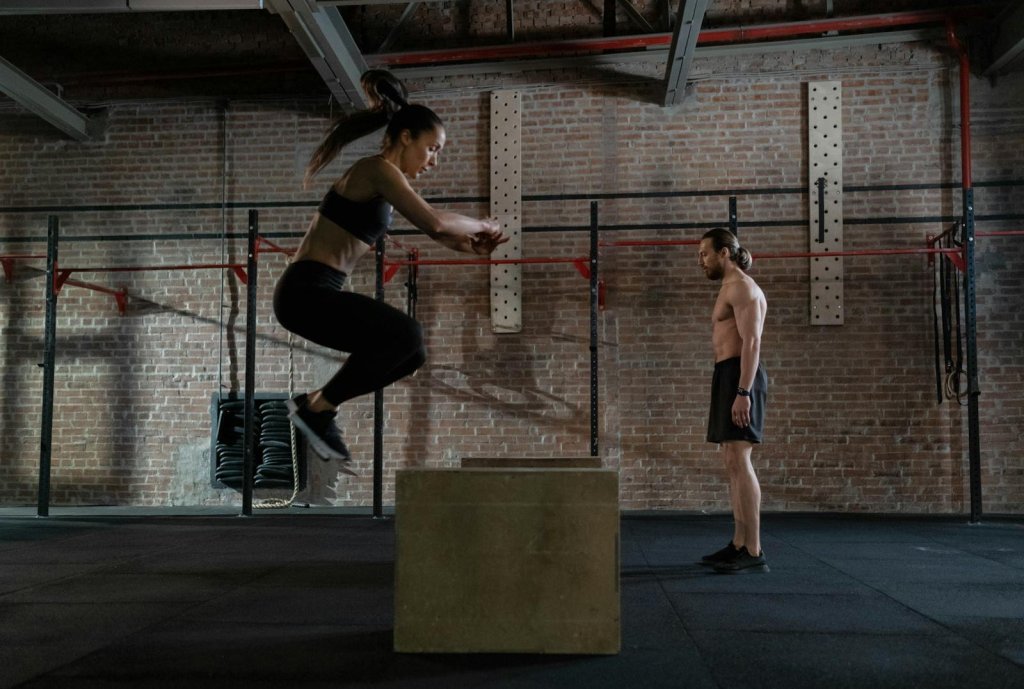
If you are building a smarter running program, the key is simple: choose runner-specific jumps, start with low volume, focus on soft controlled landings, and place plyometrics when you are fresh.
What are plyometric exercises for runners?
Plyometric exercises are explosive movements that train the body to produce force quickly. They rely on the stretch-shortening cycle, where a fast muscle-tendon loading phase is followed by a rapid push-off. For runners, that matters because every stride includes a brief ground contact, elastic loading, and propulsive push. Well-chosen plyometrics can help train that pattern more efficiently.
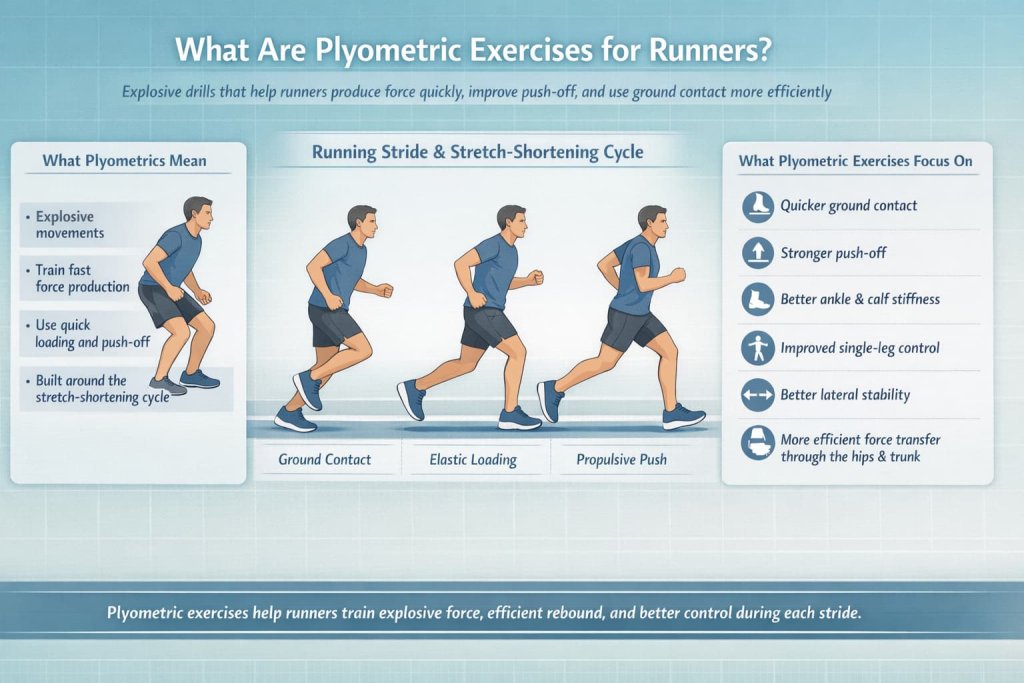
For runners, plyometrics usually focus on:
- quicker ground contact
- stronger push-off
- better ankle and calf stiffness
- improved single-leg control
- better lateral stability
- more efficient force transfer through the hips and trunk
Do plyometric exercises actually help runners?
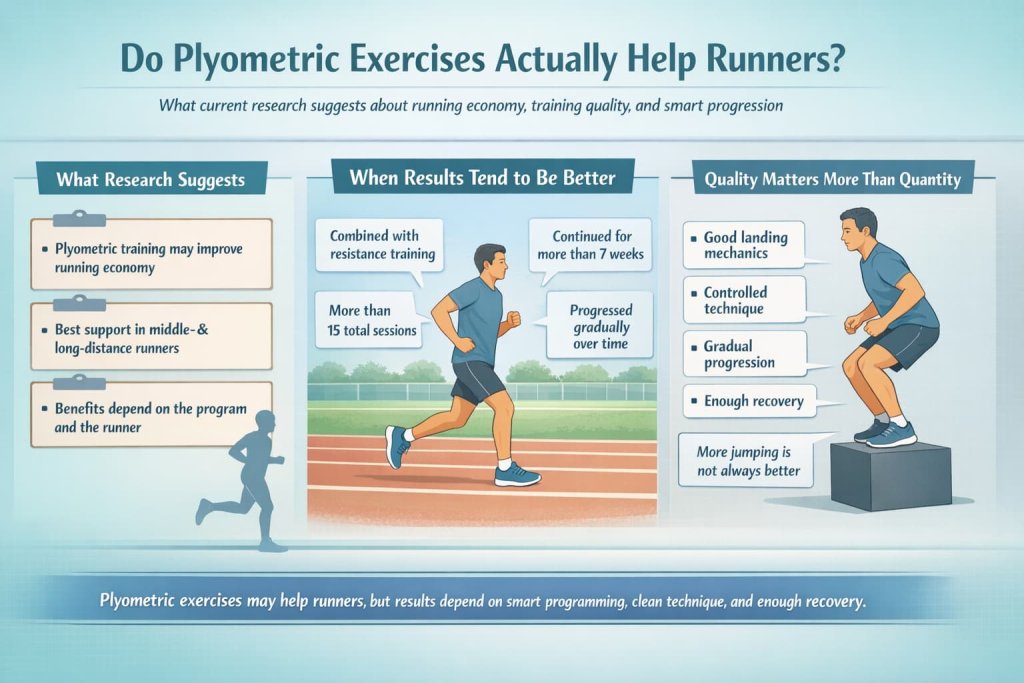
The evidence is promising, but the benefit depends on the program and the runner. Recent systematic reviews found that plyometric training may improve running economy in middle- and long-distance runners. Research focused on endurance runners also found a small overall effect on running economy, with better results when plyometrics were combined with resistance training, performed for more than 7 weeks, and included more than 15 total sessions.
That does not mean more jumping is always better. Quality matters more than quantity. Good technique, gradual progression, and enough recovery are what make plyometrics useful instead of just fatiguing.
10 best plyometric exercises for runners
Build speed, power, and better stride efficiency with these runner-focused plyometric exercises. This list includes 10 effective moves to improve explosiveness, control, and running performance.
1. Pogo jumps
How to do it:
- Stand tall with feet hip-width apart.
- Keep the knees slightly soft, but do not dip into a deep squat.
- Bounce quickly off the balls of the feet.
- Think of the ankles doing most of the work.
- Keep ground contact short and posture tall.
Why it works:
Pogo jumps are one of the best entry-level plyometric exercises for runners because they train ankle stiffness, reactive foot strike, and quick rebounding without a large jump height. They fit well early in a runner’s plyometric progression.
Muscles worked:
Calves, Achilles tendon complex, intrinsic foot muscles, and core stabilizers.
Trainer Tip:
Keep the jumps quiet and springy. If you are bending deeply at the knees, you are turning it into a different drill.
2. Squat jumps
How to do it:
- Stand with feet about shoulder-width apart.
- Lower into a controlled quarter squat.
- Drive through the floor and jump straight up.
- Land softly with bent hips and knees.
- Reset before the next rep.
Why it works:
Squat jumps build vertical power and teach you to produce force from a loaded lower-body position. They are useful for runners who need a stronger push-off and better leg drive.
Muscles worked:
Glutes, quadriceps, calves, hamstrings, and core.
Trainer Tip:
Focus on a clean landing first. Height matters less than control.
3. Box jumps
How to do it:
- Stand facing a sturdy box or platform.
- Dip into a quarter squat and swing the arms.
- Jump onto the box with both feet.
- Land softly and stand tall.
- Step down instead of jumping down.
Why it works:
Box jumps let you train explosive intent while usually reducing landing impact compared with repeated ground landings. They can be a smart option for runners who want power work with a bit less eccentric stress.
Muscles worked:
Glutes, quadriceps, calves, hamstrings, and core.
Trainer Tip:
Use a low box you can land on cleanly. Do not chase box height.
4. Lateral bounds
How to do it:
- Start on one leg with the knee and hip slightly bent.
- Push sideways and jump to the other leg.
- Land softly and hold briefly.
- Repeat side to side with control.
Why it works:
Running is mostly forward, but controlling side-to-side motion still matters. Lateral bounds can help improve frontal-plane stability, hip control, and balance, all of which support better mechanics and may help with durability.
Muscles worked:
Glute medius, glute max, adductors, calves, quadriceps, and core.
Trainer Tip:
Stick the landing before adding speed.
5. Skater jumps
How to do it:
- Start on one leg.
- Jump laterally and slightly forward onto the other leg.
- Let the back leg trail behind naturally.
- Land with the chest tall and hip stable.
- Repeat rhythmically from side to side.
Why it works:
Skater jumps add a more athletic, flowing lateral pattern. They help runners train balance, force absorption, and hip stability in a way that feels more dynamic than simple side hops.
Muscles worked:
Glutes, calves, adductors, quadriceps, hamstrings, and trunk stabilizers.
Trainer Tip:
Do not rush. A stable landing is more valuable than a bigger jump.
6. Split squat jumps
How to do it:
- Start in a split stance lunge position.
- Lower slightly, then explode upward.
- Switch legs in the air if appropriate for your level, or land back in the same stance.
- Absorb the landing softly.
- Reset posture before the next rep.
Why it works:
This drill builds unilateral power and can match the split-leg demands of running. It also challenges hip stability, coordination, and force production in a stride-like pattern.
Muscles worked:
Glutes, quadriceps, calves, hamstrings, and core.
Trainer Tip:
Start with low reps. This exercise gets intense quickly.
7. Single-leg hops
How to do it:
- Stand on one leg with a slight bend in the knee.
- Hop forward or in place with a small controlled motion.
- Land softly on the same leg.
- Keep the pelvis level and knee aligned.
- Repeat, then switch sides.
Why it works:
Single-leg hops are highly specific for running because each stride is effectively a single-leg support and push-off. They help train stiffness, balance, landing control, and leg-to-leg asymmetry awareness.
Muscles worked:
Calves, glutes, quadriceps, hamstrings, foot stabilizers, and core.
Trainer Tip:
Only use this once you can control double-leg jumps well.
8. Forward bounds
How to do it:
- Begin in an athletic stance.
- Push forcefully off one leg and travel forward.
- Land on the opposite leg with control.
- Continue in a smooth bounding rhythm.
- Keep the torso tall and arms active.
Why it works:
Bounding trains horizontal force production and stride power. It is especially relevant for runners because it resembles an exaggerated running push-off and flight phase.
Muscles worked:
Glutes, hamstrings, calves, hip flexors, and core.
Trainer Tip:
Think “power forward, not collapse downward.”
9. Tuck jumps
How to do it:
- Stand tall with feet hip-width apart.
- Jump upward and bring the knees up under control.
- Land softly with bent hips and knees.
- Reset between reps.
Why it works:
Tuck jumps train explosiveness and coordination, but they are more demanding than basic jump drills. They are best for runners who already tolerate lower-level plyometrics well.
Muscles worked:
Hip flexors, quadriceps, glutes, calves, and core.
Trainer Tip:
Do not use fatigue reps here. Form drops fast.
10. Step-up jumps
How to do it:
- Stand facing a low step or box.
- Place one foot on the platform.
- Drive through that leg and jump upward.
- Land softly and reset.
- Complete all reps before switching sides.
Why it works:
Step-up jumps blend unilateral strength and explosive drive. They are useful for runners because they reinforce push-off through one leg while keeping the pattern relatively simple.
Muscles worked:
Glutes, quadriceps, calves, hamstrings, and core.
Trainer Tip:
Use a low platform and focus on a clean drive from the front leg.
How often should runners do plyometric exercises?
For many runners, 1 to 2 sessions per week is a practical starting point, especially during a regular running block. Guidance from Hospital for Special Surgery recommends limiting plyometrics to one to two times weekly and performing them at the beginning of a workout while fresh. Research reviews also suggest better outcomes when plyometric programs are done consistently over several weeks, often with more than 15 total sessions and longer than 7 weeks.
A simple starting structure looks like this:
- 1 to 2 sessions per week
- 2 to 4 exercises per session
- 2 to 4 sets per exercise
- low reps with full recovery
- quality over fatigue
When should runners do plyometrics?
The best time is usually after your warm-up and before the main strength session or before a short quality run, not at the end when you are already tired. Hospital for Special Surgery specifically notes that plyometrics should be done at the beginning of a workout because they are explosive and fatiguing.
Good options include:
- before a gym-based strength workout
- before short sprint work
- on a lower-mileage day
- after an easy jog warm-up and dynamic drills
Less ideal times include:
- after a long run
- after a hard interval session when your form is already fading
- on days when you have tendon pain or joint soreness
Who may benefit most from plyometric exercises for runners?
Plyometric exercises may be especially useful for runners who:
- want better running economy
- need more speed or finishing kick
- want stronger push-off and better ground contact
- are already tolerating regular strength training
- have enough baseline control to land well
They often make the most sense for runners who already have a basic strength base and can manage landing mechanics well. Progressive programs matter because explosive loading places meaningful stress on the feet, ankles, calves, knees, and hips.
Who should avoid or modify plyometric exercises for runners?
You should be cautious or get professional guidance first if you have:
- a recent lower-body injury
- active Achilles, patellar tendon, or plantar fascia pain
- significant knee pain with jumping
- poor balance or poor landing control
- marked swelling after running
- a recent surgery or rehab situation without clearance
Common mistakes runners make with plyometric exercises
Doing too much too soon
The biggest mistake is jumping into high-volume or high-impact drills without building tolerance first. A little well-done plyometric work is usually more productive than a large amount of sloppy work.
Chasing fatigue instead of quality
Plyometrics are not meant to feel like endless cardio. When rep quality drops, the session has usually gone too far. This is another reason they should be placed early in the workout.
Ignoring landing mechanics
Soft landings, brief balance holds, and avoiding inward knee collapse matter just as much as the jump itself.
Using advanced single-leg drills too early
Single-leg hops and reactive bounds are valuable, but they should usually come after simpler double-leg drills and lower-impact options. Progression matters more than trying the hardest drill too early.
Quick safety checklist for plyometric exercises for runners
Before starting a session, check these boxes:
- you are warmed up
- you are not carrying sharp tendon or joint pain
- you are training on a stable surface
- you can land quietly and under control
- your knees do not cave inward
- you are fresh enough to move explosively
- you have enough recovery before your next hard run
A brief warm-up and gentle dynamic preparation also make more sense than jumping in cold.
Sample beginner-friendly plyometric routine for runners
A simple starter session could look like this:
Session A
- pogo jumps: 3 sets of 12 to 20 contacts
- squat jumps: 3 sets of 4 to 6 reps
- lateral bounds: 2 to 3 sets of 4 to 6 per side
Session B
- box jumps: 3 sets of 4 to 5 reps
- step-up jumps: 2 to 3 sets of 4 to 6 per side
- forward bounds: 2 to 3 sets of 10 to 20 meters
Keep rest long enough that each set stays sharp. Stop the session if landings get heavy, noisy, or unstable.
FAQ about plyometric exercises for runners
Are plyometric exercises good for long-distance runners?
Yes, they can be. Recent reviews suggest plyometric training may improve running economy in middle- and long-distance runners, especially when done progressively and often alongside strength training.
How many times a week should runners do plyometrics?
For many runners, 1 to 2 times per week is a practical starting point.
Should runners do plyometrics before or after running?
Usually before the main workout while fresh, not after a fatiguing session.
Do plyometric exercises help speed?
They can support speed by improving explosive force production, stiffness, and push-off ability. That does not guarantee faster race times on its own, but it can improve qualities that matter for speed.
Are plyometrics safe for beginner runners?
They can be safe when the program starts with low-impact basics, low volume, and good landing mechanics. Beginner runners should usually start with pogo jumps, low squat jumps, and simple box jumps before moving to harder single-leg drills.
Can plyometric exercises replace strength training for runners?
Usually no. Research suggests runners often do best when plyometrics are combined with resistance training rather than used alone.
What is the best plyometric exercise for runners?
There is no single best choice for everyone, but pogo jumps, bounds, lateral bounds, and single-leg hops are especially useful because they match common running demands like ankle stiffness, stride power, and single-leg control.
Conclusion
Plyometric exercises for runners can be a smart way to build speed, power, and better stride efficiency, but only when they are chosen well and progressed carefully. Start with simple drills, keep the volume manageable, and prioritize clean landings over bigger jumps. For most runners, adding one or two brief sessions per week alongside a solid strength plan is the most practical approach. If you are dealing with pain, swelling, or a recent injury, get guidance before adding explosive work.
References
- Llanos-Lagos, C., et al. (2024). Effect of Strength Training Programs in Middle- and Long-Distance Runners: A Systematic Review with Meta-Analysis. Sports Medicine.
- Llanos-Lagos, C., et al. (2024). The Effect of Strength Training Methods on Middle-Distance and Long-Distance Running Performance: A Systematic Review with Meta-Analysis. Sports Medicine.
- Balsalobre-Fernández, C., Santos-Concejero, J., & Grivas, G. V. (2016). Effects of Strength Training on Running Economy in Highly Trained Runners: A Systematic Review with Meta-Analysis of Controlled Trials. Journal of Strength and Conditioning Research.
- Blagrove, R. C., Howatson, G., & Hayes, P. R. (2018). Effects of Strength Training on the Physiological Determinants of Middle- and Long-Distance Running Performance: A Systematic Review. Sports Medicine.
- de Villarreal, E. S., Requena, B., & Newton, R. U. (2012). The Effects of Plyometric Training on Sprint Performance: A Meta-Analysis. Journal of Strength and Conditioning Research.
- National Strength and Conditioning Association. Plyometric Training.
- Massachusetts General Brigham Sports Medicine. Jump and Plyometric Training Progression Goals.
- Hospital for Special Surgery. A Beginner’s Guide to Plyometrics Workouts.