
The long arc quad exercise is a simple seated knee-extension move that strengthens the quadriceps, the muscles on the front of your thigh. It is commonly used in physical therapy and knee-rehab programs because it helps train active knee extension in a controlled, low-skill position.
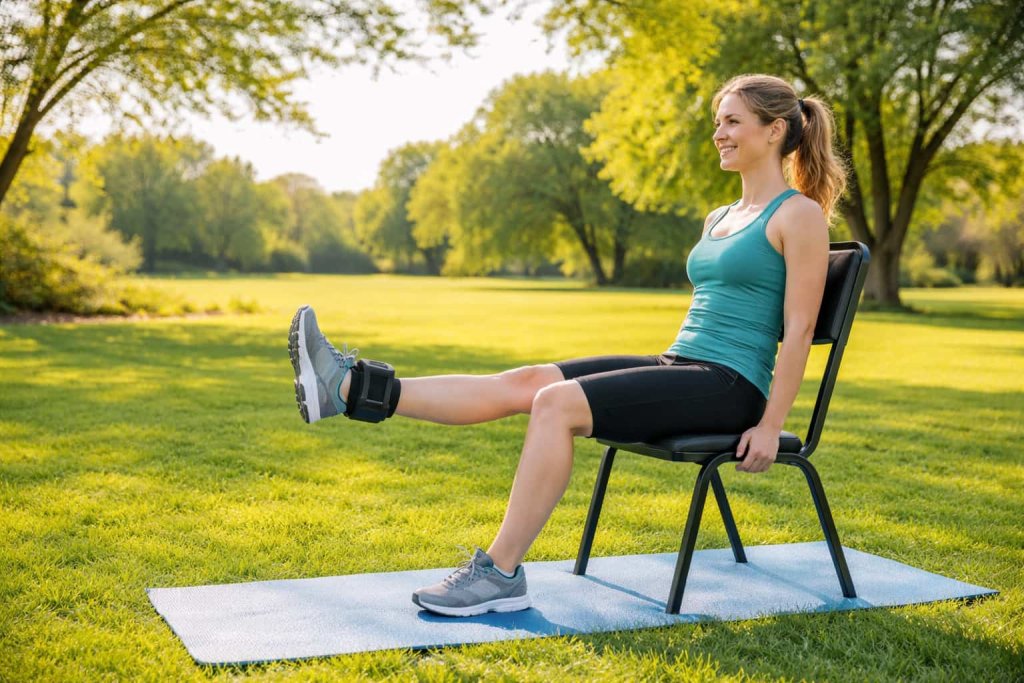
Understanding how to do it correctly matters because good quad strength supports walking, standing up, stair use, and knee control in daily life. Official rehab resources from Massachusetts General Brigham, AAOS, and University of Washington Medicine all support seated knee-extension style work as part of quad strengthening and knee recovery.
What Is the Long Arc Quad Exercise?
The long arc quad exercise, often shortened to LAQ, is a seated exercise where you begin with your knee bent and then slowly straighten the leg as far as comfortable before lowering it back down under control. That is the same basic movement described in patient exercise guides from Concord Orthopaedics and AAOS knee-conditioning material.
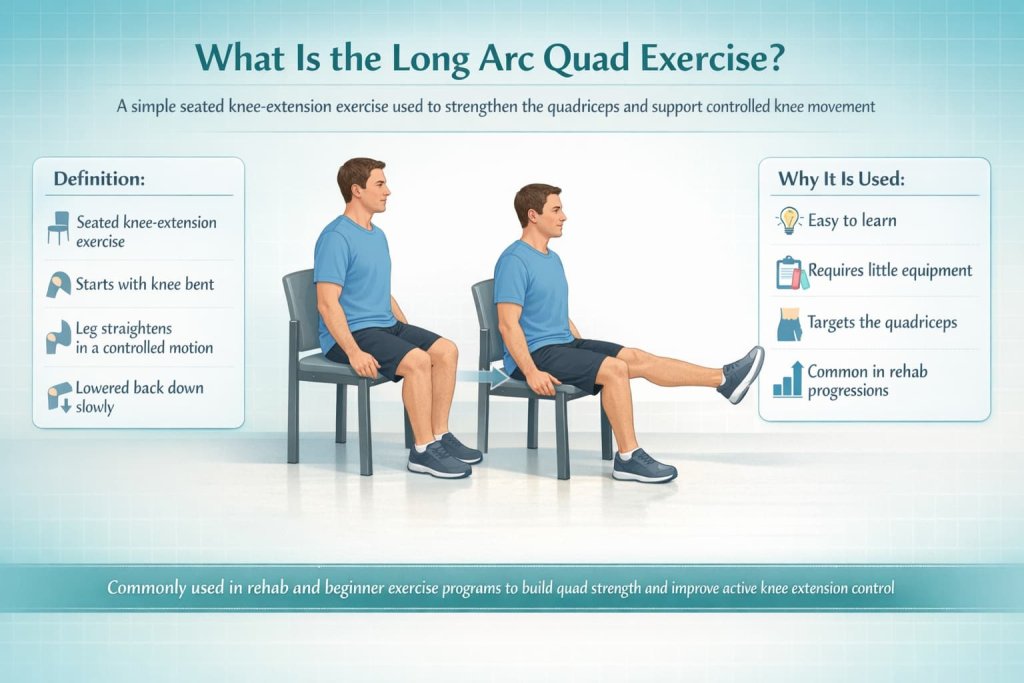
In rehab settings, LAQ is often chosen because it is easy to learn, does not require much equipment, and lets you focus directly on the quadriceps. A current total knee arthroplasty rehab protocol from Massachusetts General Brigham specifically lists long arc quad (LAQ) during strength progression.
How to Do the Long Arc Quad Exercise
How to do it:
- Sit upright on a sturdy chair or bench with your feet flat on the floor.
- Keep your back straight and your thigh supported.
- Tighten the muscles on the front of one thigh.
- Slowly straighten your knee until your leg is out in front of you, or as far as feels comfortable.
- Pause briefly at the top.
- Lower your foot back down slowly and under control.
- Repeat for the prescribed reps, then switch sides if needed.
This matches the general technique shown in exercise guidance from AAOS, Concord Orthopaedics, and University of Washington Medicine: sit upright, straighten the knee slowly, avoid swinging, and lower with control.
Why the Long Arc Quad Exercise Matters
The main reason people use the long arc quad exercise is simple: it targets knee extension strength. Your quadriceps help straighten the knee, and that action is important for everyday tasks such as getting up from a chair, climbing stairs, and controlling the leg while walking. AAOS notes that strengthening the muscles that support the knee can help reduce stress on the joint, and it also highlights the quadriceps as one of the key muscle groups in knee conditioning.
This exercise also fits well into structured rehab. Along with Mass General’s protocol, Brigham and Women’s Hospital includes seated long arc quad work in knee replacement rehabilitation, showing that this is still a standard clinical exercise rather than an outdated one.
Muscles Worked in the Long Arc Quad Exercise
The main muscle group worked is the quadriceps, especially because the movement is based on actively straightening the knee. AAOS lists leg extensions as a quadriceps exercise and notes that you should feel the movement at the front of the thigh.
Supporting muscles may also help stabilize your leg and posture during the exercise, but the long arc quad is mainly used as a quad-focused movement.
Benefits of the Long Arc Quad Exercise
It directly trains the quadriceps
This is the clearest benefit. The movement pattern is knee extension, which is the job of the quadriceps. That makes LAQ useful when the goal is to rebuild or maintain front-of-thigh strength.
It is beginner-friendly
You can do the exercise while sitting in a chair, which makes it approachable for many beginners, older adults, and people following a rehab plan. University of Washington Medicine includes long arc quad in seated lower-body exercise guidance, which supports its accessibility.
It works well in rehab progressions
Massachusetts General Brigham includes LAQ as part of strengthening progression, which shows that clinicians still use it when building knee function over time.
It can be scaled easily
You can start with body weight only, slow the tempo down, add a pause at the top, or later use a light ankle weight if your clinician or program allows it. AAOS leg extension guidance also notes gradual resistance progressions with ankle weights when appropriate.
Long Arc Quad Exercise Sets and Reps
There is no single universal prescription because exercise dosage depends on the person, the reason for training, and whether the movement is being used for rehab or general strengthening. Still, many hospital and rehab handouts use practical ranges such as 10 repetitions, sometimes 2 to 3 times per day in early recovery, while AAOS uses 3 sets of 10 for leg extensions in a general knee-conditioning program.
A sensible general starting point is:
- 1 to 3 sets
- 8 to 12 reps per side
- Slow, controlled tempo
- Stop if it causes sharp pain
If you are recovering from surgery or injury, follow your surgeon’s or physical therapist’s plan instead of general internet advice.
Common Mistakes to Avoid
Swinging the leg up
Momentum makes the exercise easier for the wrong reason. AAOS specifically advises not to swing the leg or use forceful momentum during leg extensions.
Sitting slouched
A more upright position usually makes it easier to keep the movement controlled and focused on the working leg.
Rushing the lowering phase
Lowering too fast can reduce control. Rehab instructions commonly emphasize slow return to the starting position.
Pushing into painful range
AAOS says you should not feel pain during an exercise and should speak with your doctor or physical therapist if you do.
Who Should Use the Long Arc Quad Exercise?
The long arc quad exercise may fit well for:
- Beginners who need a simple quad exercise
- People doing chair-based lower-body training
- Adults working on basic knee-extension strength
- People in a rehab plan when a clinician has included it
It is often seen in post-op knee protocols and general knee-conditioning resources, so it has a strong place in both rehab and basic strengthening.
Who Should Be Careful With It?
Use extra caution, and get professional guidance first, if you have:
- Recent knee surgery without clearance
- Significant swelling after exercise
- Sharp knee pain during extension
- A current diagnosis where your clinician has told you to limit certain knee movements
That caution matters because rehab protocols are phase-based and depend on healing status, individual findings, and clinical judgment. Massachusetts General Brigham states that exercise progression should be based on the patient’s needs, exam findings, and clinician decision-making.
Long Arc Quad Exercise vs Short Arc Quad
People often confuse these two exercises.
- Long arc quad is done seated with the leg starting from a more bent position and then straightening through a larger range.
- Short arc quad is usually done lying down with the knee supported on a rolled towel or bolster, so the knee moves through a smaller arc near the end range.
Both train the quadriceps, but the setup and movement range differ. Concord Orthopaedics describes both short arc and long arc knee extension variations in its exercise handout.
Safety Tips for Better Results
- Move slowly and stay in control.
- Keep the effort focused on the thigh muscles.
- Use a chair that feels stable.
- Avoid jerking the leg upward.
- Start with body weight before adding resistance.
- Stop and get guidance if the movement causes sharp pain, unusual swelling, or feels wrong for your current rehab stage.
Those tips line up with AAOS guidance about avoiding pain during exercise and using gradual resistance progressions when appropriate.
Frequently Asked Questions
Is the long arc quad exercise good for knee rehab?
It is commonly used in knee rehab programs. Current hospital protocols from Massachusetts General Brigham and Brigham and Women’s include LAQ in knee-recovery exercise progressions.
What muscles does the long arc quad exercise work?
It mainly works the quadriceps, the muscles at the front of the thigh that straighten the knee. AAOS classifies leg extensions as a quadriceps exercise.
Can beginners do the long arc quad exercise?
Yes, many beginners can do it because it is a seated, low-complexity exercise. University of Washington Medicine includes long arc quad in seated lower-body routines.
How many reps of long arc quad should I do?
A common starting range is 8 to 12 reps per leg for 1 to 3 sets, but rehab handouts vary. Some use 10 reps and repeat the session multiple times per day, while AAOS uses 3 sets of 10 for general leg extensions. Your best dosage depends on your goal and condition.
Should I add ankle weights?
Possibly, but not right away for everyone. AAOS notes that leg extensions can be progressed with ankle weights as the exercise becomes easier. Add resistance only if your form is solid and your program allows it.
Does the long arc quad exercise hurt the knees?
It should not be painful when it is appropriate for you and performed correctly. AAOS says you should not feel pain during an exercise. If you do, speak with your doctor or physical therapist.
What is the difference between long arc quad and leg extension?
In many rehab and exercise guides, they are essentially the same basic seated knee-extension pattern. AAOS uses the term leg extensions, while many rehab settings call the same movement long arc quad or LAQ.
Conclusion
The long arc quad exercise is one of the simplest ways to work on seated knee extension and build quadriceps strength. It is easy to learn, commonly used in rehab, and practical for many beginners when done with control and within a pain-free range. For the best results, use smooth reps, avoid momentum, and match the exercise to your current ability or rehab stage. If your goal is stronger quads and better knee control, this is a smart exercise to include.
References
- Brigham and Women’s Hospital – Total Knee Arthroplasty Protocol
- Concord Orthopaedics – Total Hip and Knee Exercise Handout
- PubMed – Quadriceps Weakness and Osteoarthritis of the Knee
- PMC – Quadriceps Strengthening Exercises Are Effective in Improving Pain, Function and Quality of Life in Patients With Osteoarthritis of the Knee
- ChoosePT – Physical Therapy Guide to Knee Osteoarthritis