
The quad set exercise is an easy, no-equipment move that activates your quadriceps by tightening the front thigh muscle to improve knee control and support rehab strength. If your knee feels weak, “sleepy,” or hard to fully straighten after injury or surgery, quad sets are often one of the first exercises used to re-train the muscle and rebuild confidence.

You’ll see quad sets listed in many clinical rehab programs, including the knee replacement exercise guide from the American Academy of Orthopaedic Surgeons (AAOS). Below is a detailed, practical guide so you can do them correctly, understand what they help with, and avoid the mistakes that slow progress.
What Is a Quad Set Exercise?
A quad set (also called a quadriceps set) is an isometric contraction. That means you tighten the quadriceps without a big visible joint movement.
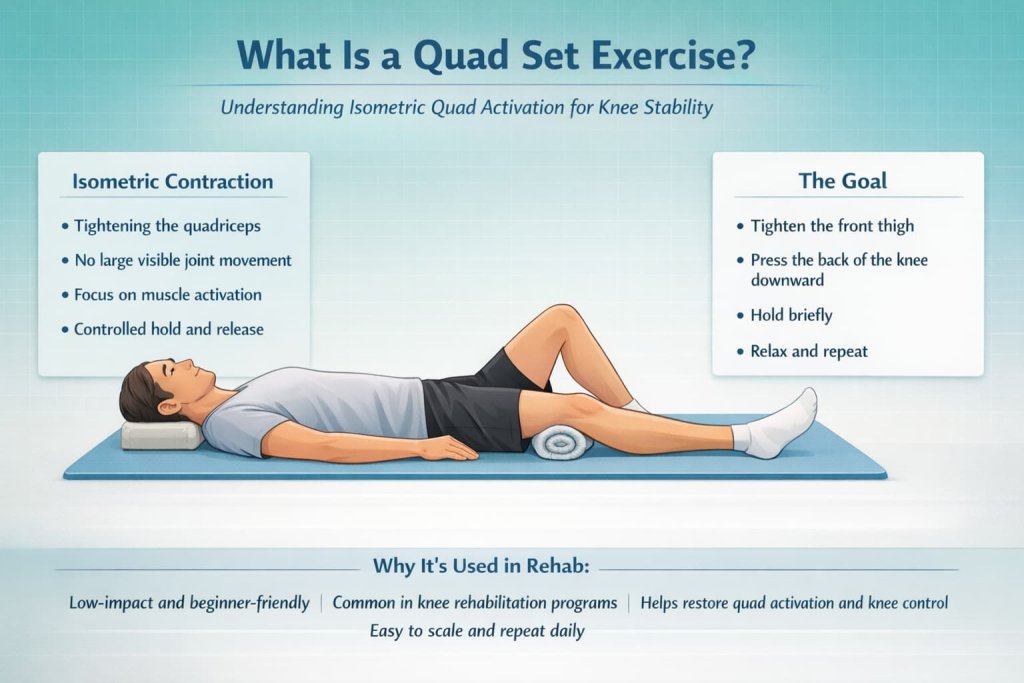
The goal is simple:
- Tighten the front thigh
- Press the back of the knee downward (often into the floor/bed or a towel roll)
- Hold briefly
- Relax and repeat
This is a foundational drill in many rehab plans because it’s low impact, easy to scale, and teaches your body to “find” the quad muscle again.
How to Do the Quad Set Exercise Correctly
Use this technique as the “standard” version most rehab programs teach.
Setup (best for beginners)
- Lie on your back on a firm bed or floor.
- Keep the working leg straight.
- Optional but helpful: place a small rolled towel under your knee (many rehab programs use this to give you something to press into).
Quad Set Steps
- Tighten the muscle on the top/front of your thigh.
- Think: “Press the back of my knee down.”
- Try to fully straighten the knee while keeping the heel on the surface.
- Hold your contraction for about 5–10 seconds, then relax.
Clinical-style patient education from Kaiser Permanente describes tightening the thigh and holding for several seconds per repetition, while instructional materials from the American Academy of Orthopaedic Surgeons commonly recommend 5–10 second holds in rehab settings.
Quad Set Exercise Variations and Progressions
1) Towel-Roll Quad Set
Why it works:
Placing a towel under the knee gives you tactile feedback. It makes it easier to feel the quad contract and helps you focus on pressing the knee downward, which can improve activation in early rehab stages.
Muscles worked:
Primarily the quadriceps, with light stabilization from the hip flexors and core.
How to do it:
- Lie on your back with your leg straight.
- Place a small rolled towel under your knee.
- Tighten the front of your thigh.
- Press the back of your knee firmly into the towel.
- Hold for 5–10 seconds.
- Relax completely before the next rep.
Trainer Tip:
Put your hand on your quad while pressing down. If you can feel the muscle tighten and the kneecap subtly lift, you’re doing it correctly.
2) Seated Quad Set
Why it works:
The seated position changes the angle of the hip and can make quad activation easier for some people, especially if lying flat is uncomfortable.
Muscles worked:
Quadriceps (primary), with light involvement of hip flexors and postural stabilizers.
How to do it:
- Sit upright on a chair or bench with one leg extended straight.
- Keep your heel resting on the floor or surface.
- Tighten your thigh muscle.
- Press the back of your knee downward toward the surface.
- Hold for 5–10 seconds.
- Relax and repeat.
Trainer Tip:
Avoid leaning backward or arching your lower back to “help” the movement. Keep your torso tall and let the quad do the work.
3) Quad Set Into Terminal Knee Extension
Why it works:
This progression adds light resistance to the final part of knee straightening, helping build strength in the end range of extension, which is important for walking and stair control.
Muscles worked:
Quadriceps (especially the vastus medialis), with added stabilization from the glutes and calf muscles.
How to do it:
- Stand with a light resistance band anchored behind your knee.
- Slightly bend the knee to create tension in the band.
- Tighten your quad and straighten your knee fully against resistance.
- Hold briefly at full extension.
- Slowly return to the starting position.
Trainer Tip:
Focus on squeezing the quad at the fully straight position instead of snapping the knee back quickly. Control matters more than speed.
4) Straight-Leg Raise Progression
Why it works:
Once you can hold a strong quad contraction, adding leg lift increases demand while maintaining knee stability. It challenges both strength and control.
Muscles worked:
Quadriceps (primary), hip flexors, and core stabilizers.
How to do it:
- Lie on your back with one knee bent and the other leg straight.
- Perform a quad set on the straight leg.
- Keeping the knee locked straight, slowly lift the leg about 12 inches off the floor.
- Pause briefly at the top.
- Lower slowly with control.
Trainer Tip:
If your knee bends during the lift, your quad may not be strong enough yet. Go back to standard quad sets until you can keep the leg fully straight throughout the movement.
Quad Set Exercise Benefits
Quad sets are not a magic fix, but they can be a strong starting point for rebuilding knee function.
May improve quad activation and knee control
If your quad isn’t firing well, everyday tasks like walking, stairs, or standing up can feel unstable. Quad sets train clean contraction without extra load.
May support knee extension (straightening) mechanics
Many rehab guides emphasize pressing the knee down and trying to fully straighten it as part of regaining comfortable extension, which is why quad sets are commonly included in recovery protocols from the American Academy of Orthopaedic Surgeons.
Low-impact strengthening when movement is limited
Because it’s isometric, it’s often tolerated earlier than exercises that require bending and straightening under resistance.
Helpful “bridge” to bigger strengthening exercises
Done consistently, quad sets can prepare you for progressions like straight-leg raises, terminal knee extensions, step-ups, and squats (when appropriate for you).
Muscles Worked in the Quad Set Exercise
Primary muscle group:
- Quadriceps (front of the thigh)
Secondary/support:
- Hip flexors (light involvement depending on position)
- Core stabilizers (especially if you brace and avoid arching)
Quad Set Sets, Reps, and Frequency
Exact programming depends on your condition and clinician advice, but authoritative rehab sources commonly suggest ranges like these:
- Hold: 5–10 seconds
- Reps: about 8–12 or 10–15 reps
- Sets: 1–3 sets, depending on fatigue and plan
- Frequency: often daily, depending on your recovery stage
For example, Kaiser Permanente patient guidance commonly suggests holding about 6 seconds for multiple repetitions, while Intermountain Health patient education materials often list 5–10 second holds for 10–15 reps in home programs.
A safe, general starting template (if you’ve been cleared to exercise):
- 1–2 sets of 10 reps
- 5–10 second holds
- Stop with mild-to-moderate fatigue, not sharp pain
Common Quad Set Exercise Mistakes to Avoid
1) Holding Your Breath
Breath-holding can increase unnecessary tension. Instructional demonstrations from the MSD Manuals emphasize breathing normally during the contraction.
2) Pushing Through Sharp or Worsening Pain
A mild “working” sensation in the thigh is normal. Sharp knee pain, sudden swelling, locking, or worsening symptoms are not.
3) Using the Hip Instead of the Quad
If your heel lifts or your whole leg pops up, you may be turning it into a different exercise. Focus on pressing the knee down and tightening the thigh.
4) Rushing the Hold
Quad sets work best when you build a steady contraction, hold, then fully relax. Don’t turn it into fast pulses.
5) Letting the Knee Rotate Out of Neutral
Keep the leg straight and aligned so the quadriceps do the work evenly.
How to Tell If Your Quad Set Form Is Working
Use these quick checks:
- You can feel the front thigh tighten under your hand.
- The kneecap may move slightly upward (subtle is normal).
- The back of the knee presses downward more firmly.
- You can hold the contraction without cramping or breath-holding.
If you can’t feel the quad at all, try:
- A towel roll under the knee for better feedback
- Lightly tapping the quad before you tighten
- Shorter holds (3–5 seconds) to start, then build up
Who Should Be Careful With Quad Sets?
Quad sets are generally low risk, but get medical guidance first if you have:
- A recent injury with significant swelling or instability
- A new or worsening knee symptom pattern
- A recent surgery with specific restrictions
- Signs of infection or severe calf pain after surgery
Always follow your surgeon’s or physical therapist’s protocol.
When to Stop and Seek Medical Advice
Stop the exercise and seek medical advice if you notice:
- Sharp pain that doesn’t ease when you stop
- Rapid swelling increase
- New numbness or tingling
- Knee giving-way episodes
- Redness, warmth, fever, or unusual symptoms
FAQs About the Quad Set Exercise
1) How long should I hold a quad set?
Many rehab programs use about 5–10 seconds per hold, depending on tolerance and stage of recovery.
2) How many quad sets should I do per day?
It depends on your rehab plan. Some programs use a few sets daily, while post-op plans may use short, frequent sessions.
3) Should I feel quad sets in my knee or my thigh?
Mostly in your front thigh (quadriceps). Mild pressure at the knee is normal, but sharp knee pain is not.
4) Can I do quad sets with a towel under my knee?
Yes. A towel roll often improves feedback and helps you press the knee downward more clearly.
5) Why can’t I feel my quad working?
After pain, swelling, or surgery, quad activation can be reduced. Use tactile cues, shorter holds, and controlled contractions. If it persists, a physical therapist can help.
6) Are quad sets good after knee surgery?
They’re commonly included in post-op rehab programs from organizations like the American Academy of Orthopaedic Surgeons, but timing and volume should follow your clinician’s protocol.
7) Can quad sets help knee pain?
They may support knee function by improving quad activation and control, which can reduce strain during daily movement for some people. They are not a diagnosis or guaranteed solution for every knee condition.
Conclusion
The quad set exercise is one of the simplest ways to retrain your quadriceps and build a foundation for stronger, steadier knees. Keep the squeeze controlled, hold for a few seconds, breathe normally, and progress only when your form is consistent. If you’re recovering from an injury or surgery, follow your clinician’s protocol and use quad sets as a stepping stone to more advanced strengthening.