
The renegade row is a plank-based dumbbell row that trains your back while forcing your core to resist twisting. That mix of rowing strength, shoulder control, and anti-rotation stability is what makes the renegade row different from a regular dumbbell row. The move can be very effective, but it also demands more control than many people expect, so clean form matters from the first rep.

Understanding the renegade row matters because it can help you train several major muscle groups at once, which fits well with public-health guidance from the CDC to include muscle-strengthening work for all major muscle groups at least two days per week. For most people, the safest approach is to start light, widen the feet for balance, and focus on staying square to the floor before worrying about heavy dumbbells or extra reps.
What Is the Renegade Row?
The renegade row is a closed-chain, plank-based rowing exercise done with two dumbbells on the floor. You hold a high plank with one hand on each dumbbell, then row one dumbbell toward your rib cage while the rest of the body stays braced and as still as possible. The American Council on Exercise describes the setup with the hands under the shoulders, legs extended behind, and the body kept straight and flat as you row one side at a time. NASM also emphasizes shoulders over wrists, a straight-line plank, and keeping the hips level during the pull.
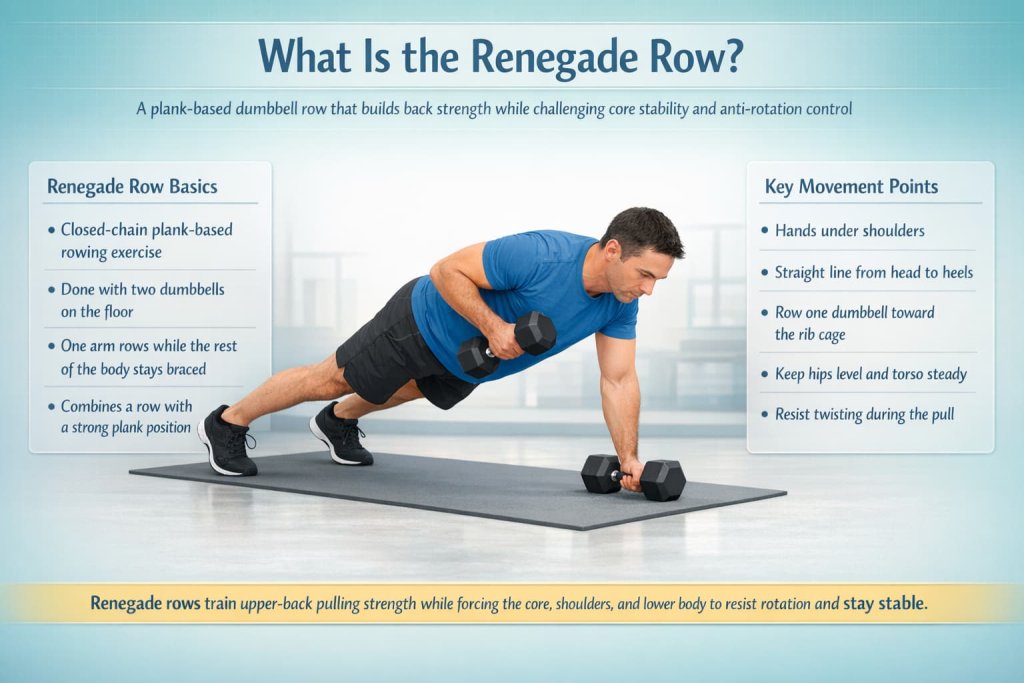
In practical terms, the renegade row is part row, part plank. The rowing side works through upper-back and arm strength, while the non-rowing side and lower body help stabilize you against rotation. That is why this exercise often feels harder on the trunk than people expect, even when the dumbbells are not very heavy. Material from the NSCA helps explain this training demand: the goal is to resist unwanted movement while maintaining a controlled spine and torso position.
How to Do the Renegade Row Correctly
Start with two stable hex dumbbells if possible, because round dumbbells can roll and make the setup less secure. Set the dumbbells on the floor about shoulder-width apart and get into a high plank with one hand gripping each handle. Your shoulders should stack over your wrists or hands, your legs should extend behind you, and your body should form a straight line from head to heels. Guidance from the American Council on Exercise, HSS, and the Mayo Clinic all align with these core setup ideas: hands under shoulders, core engaged, and no sagging through the hips.
Step-by-step instructions
- Place two dumbbells on the floor and grip them firmly.
- Step back into a high plank.
- Set your feet wider than hip-width if you need more balance.
- Brace your abs and glutes before starting the row.
- Pull one elbow back toward your rib cage without shrugging the shoulder.
- Keep your hips and chest as square to the floor as possible.
- Lower the dumbbell with control.
- Repeat on the other side.
The American Council on Exercise specifically notes pressing the feet into the floor and keeping the body straight and flat during the movement, while NASM stresses keeping the elbow close and the hips level.
Best form cues
- Think “wide feet, quiet hips.”
- Keep the neck neutral instead of looking forward.
- Pull with the back, not just the hand.
- Move slowly enough that the body does not rock side to side.
- Stop the set if you can only finish reps by twisting.
Muscles Worked in the Renegade Row
The primary moving muscles in the renegade row are the upper-back pulling muscles and elbow flexors. That usually includes the latissimus dorsi, rhomboids, middle trapezius, rear deltoid, and biceps during the rowing action. The American Council on Exercise and NASM both support this general pulling pattern, especially the cue to row the elbow back close to the rib cage.
At the same time, the exercise heavily involves the trunk and support system. The abdominals and obliques help resist rotation, while the glutes and quads help keep the lower body rigid enough to maintain plank position. The non-rowing shoulder, chest, and triceps also work to support bodyweight through the floor. That is why many people feel the renegade row in the core and shoulders almost as much as in the back.
Renegade Row Variations and Modifications
1. Wide-Stance Renegade Row
Why it works:
The wide-stance renegade row is often the most practical starting variation because it increases your base of support. With the feet set wider apart, it becomes easier to control side-to-side shifting and reduce unwanted torso rotation. That added stability lets you focus on the main goal of the exercise: rowing with control while keeping the hips as level as possible. It is a smart option for people who are learning the movement pattern or struggling to stay square to the floor.
Muscles worked:
This variation still trains the upper back, especially the lats, rhomboids, and middle traps, along with the biceps during the rowing phase. The core, especially the obliques and deep abdominal muscles, works hard to resist twisting. The glutes, quads, shoulders, and chest also help stabilize the body in the plank position.
How to do it:
- Place two stable dumbbells on the floor about shoulder-width apart.
- Step into a high plank with your hands gripping the dumbbells.
- Set your feet wider than usual for a stronger base.
- Brace your abs and squeeze your glutes.
- Row one dumbbell toward your rib cage without letting the hips twist.
- Lower it with control.
- Repeat on the other side.
Trainer Tip:
Think “wide feet, quiet hips.” If your torso still rocks too much, reduce the weight and slow the tempo before trying to make the exercise harder.
2. Knee-Supported Renegade Row
Why it works:
The knee-supported renegade row lowers the total demand on the core, shoulders, and lower body by shortening the lever and reducing the intensity of the plank position. This makes it easier to practice anti-rotation control without having to manage full-body plank tension at the same time. It is one of the best beginner-friendly regressions for learning the renegade row pattern safely.
Muscles worked:
This version still works the back muscles, including the lats, rhomboids, and middle traps, plus the biceps during the row. The core remains active, especially the obliques and abdominals, but the overall stabilization demand is lower than in the full plank version. The shoulders and chest still provide support through the floor.
How to do it:
- Place two dumbbells on the floor and grip them firmly.
- Come into a modified plank with your knees on the floor and your body in a straight line from head to knees.
- Keep your hands under your shoulders.
- Brace your core and avoid letting your hips sway.
- Row one dumbbell toward your side.
- Lower it slowly.
- Repeat on the other side.
Trainer Tip:
Do not treat this like an “easy” version you rush through. Use it to build control, clean alignment, and steady rowing mechanics before progressing to the full plank variation.
3. Elevated Renegade Row
Why it works:
The elevated renegade row reduces the amount of bodyweight supported by the upper body by changing the angle of the exercise. When your hands are placed on a bench or sturdy box, the plank position becomes less demanding, which can make it easier to maintain spinal alignment and reduce pressure on the shoulders and wrists. This variation is useful for beginners, taller lifters who struggle with floor setup, or anyone working back toward the standard version.
Muscles worked:
The upper back, rear shoulders, and biceps still perform the rowing action, while the core and obliques work to limit rotation. The chest, shoulders, and triceps also help support the body against the bench or elevated surface. Compared with the floor version, the same muscles are involved, but the stability challenge is more manageable.
How to do it:
- Set two dumbbells on a sturdy bench, box, or other secure elevated surface.
- Grip the dumbbells and step back into a high plank position with your body straight.
- Keep your shoulders stacked over your hands.
- Brace your abs and glutes.
- Row one dumbbell toward your rib cage while keeping the hips steady.
- Lower it slowly to the start.
- Repeat on the other side.
Trainer Tip:
The surface must be stable. Do not use anything wobbly or too narrow. A secure setup matters more than range of motion in this variation.
4. Single-Dumbbell Bird-Dog Row or Bench-Supported Row
Why it works:
This option is a useful modification for people who want the rowing benefit without the full plank demand of a standard renegade row. A bird-dog row or bench-supported row reduces stress on the wrists, shoulders, and low back while letting you focus more directly on upper-back strength and controlled pulling mechanics. It is often the better choice when someone is not yet ready for the anti-rotation demands of the floor version.
Muscles worked:
These variations mainly target the lats, rhomboids, traps, rear delts, and biceps. The core still contributes, especially in the bird-dog row, where trunk stability helps prevent shifting. In the bench-supported version, the back muscles take on more of the workload because the body has extra support.
How to do it:
- For a bird-dog row, place one hand and the opposite knee on a bench.
- Extend the free leg behind you and hold a dumbbell in the free hand.
- Brace your core and keep your torso steady.
- Row the dumbbell toward your side.
- Lower it with control and repeat for reps before switching sides.
- For a bench-supported row, place one knee and hand on a bench and row with the free arm in the same controlled way.
Trainer Tip:
Do not think of these as lesser options. They are often the best stepping stones for building the back strength and control you need before moving into a true renegade row.
Renegade Row Benefits
One of the biggest renegade row benefits is efficiency. Instead of training only the back, this exercise also challenges the core, shoulders, hips, and glutes to keep the body stable while one arm moves. That makes it a useful choice when you want more full-body demand from a single dumbbell exercise. Another major benefit is anti-rotation core training. As one dumbbell leaves the floor, your body naturally wants to twist, so your abs and obliques have to work hard to resist that movement. The renegade row may also support better shoulder and trunk control because the plank position creates a strong stability demand while the rowing arm moves through the pull.
- Fits well into strength-and-stability focused workouts
- Builds upper-back and rowing strength
- Trains anti-rotation core stability
- Challenges shoulder control and support
- Increases full-body tension and coordination
- Works the core, glutes, and hips along with the back
- Makes one exercise do the job of both a row and a plank
Common Renegade Row Mistakes
Twisting the hips too much
This is the most common problem. A little natural weight shift can happen, but large torso rotation usually means the load is too heavy or the base is too narrow. The training goal is not to spin open. The goal is to row while resisting rotation. The American Council on Exercise and NASM both highlight keeping the hips square and body flat.
Using dumbbells that are too heavy
Heavy weights often turn the exercise into a body-twist challenge instead of a controlled row. If the dumbbell only moves because the torso jerks upward, the exercise has drifted away from its main purpose. Lighter dumbbells with slower reps are usually more productive for this movement. The American Council on Exercise includes using lighter weights or taking the knees down to reduce difficulty in its renegade-row workout example.
Letting the hips sag
A sagging plank changes the trunk position and can make the set feel rough on the low back. Guidance from the Mayo Clinic and HSS reinforces keeping a neutral body line and not letting the hips drop.
Shrugging the rowing shoulder
Pulling the shoulder up toward the ear can reduce upper-back quality and make the movement look rushed. Think about drawing the elbow back while keeping the shoulder packed and the chest broad. The American Council on Exercise supports a controlled pull toward the chest or rib area rather than a loose yank.
Who Should Modify or Avoid the Renegade Row?
You may need to modify or skip the renegade row for now if you have active wrist pain, shoulder pain, poor plank control, or back symptoms that worsen in a loaded plank position. Guidance from the AAOS is very clear on a broader point that applies here: you should not ignore pain during exercise. ChoosePT also distinguishes normal muscle soreness from pain that is sharp or occurs during exercise.
You should also be cautious if you cannot keep the torso from twisting even with light weights. In that case, a supported dumbbell row, chest-supported row, or separate plank variation may be a better stepping stone. That is not a downgrade. It is often the faster route to better long-term form.
How to Program the Renegade Row
For general strength and control, the renegade row usually works well for low to moderate reps with clean technique. A practical starting point is 2 to 4 sets of 5 to 8 reps per side, using a load you can control without twisting. The exact rep scheme is a coaching recommendation rather than a fixed official rule, but it fits the exercise’s high stability demand and the CDC recommendation to include muscle-strengthening work at least two days per week.
You can place the renegade row:
- in an upper-body workout after a primary press or pull
- in a full-body workout as a secondary compound exercise
- in a circuit when you want core and back work together
Because it is more technical than a regular row, it often works better earlier in the session, before fatigue makes torso control sloppy. That is a practical training inference based on the movement’s stability demand.
Quick Safety Checklist for Renegade Rows
- Use stable dumbbells that will not roll easily.
- Start lighter than you think you need.
- Widen your feet to improve control.
- Keep the hips level and the body long.
- Stop if you feel sharp pain, not normal muscle effort.
- Regress to knees-down or elevated versions if needed.
This checklist reflects technique guidance from the American Council on Exercise, NASM, AAOS, and ChoosePT.
Renegade Row vs Dumbbell Row
A standard dumbbell row is usually better if your goal is to load the back more heavily and with less balance challenge. A renegade row is usually better if you specifically want a combined back-and-core drill that emphasizes anti-rotation control. In other words, the regular dumbbell row is often easier to progress for pure pulling strength, while the renegade row asks more from your trunk, shoulders, and overall stability. That comparison is a coaching interpretation built from technique descriptions from the American Council on Exercise and NASM.
Frequently Asked Questions
Is the renegade row good for abs?
Yes, the renegade row can be very challenging for the abs and obliques because the trunk has to resist rotation while one arm rows. That core demand is one of the main reasons the exercise is popular.
Is the renegade row a back exercise or a core exercise?
It is both, but many people feel it as a core-and-stability exercise first and a row second. The back still works hard, but the plank position adds a major anti-rotation demand.
Are renegade rows good for beginners?
Usually not as a first rowing exercise. Many beginners do better with a supported dumbbell row, cable row, or knee-supported version first. NASM supports that approach by describing the exercise as advanced.
How heavy should I go on renegade rows?
Use the heaviest weight you can control without twisting, shrugging, or sagging. For many people, that is lighter than their normal one-arm row weight. The quality of the plank matters more than chasing load on this exercise.
Do renegade rows help posture?
They can support the muscles involved in upper-back strength and trunk control, which may be helpful in a balanced strength program. But no single exercise can fix posture on its own.
What if renegade rows hurt my wrists?
Try a different setup, such as stable hex dumbbells, an elevated position, or another rowing variation that reduces wrist extension and plank load. If pain continues, stop and get advice from a qualified clinician. The AAOS advises not to ignore pain during exercise.
Conclusion
The renegade row is a smart exercise when you want to train your back and challenge your core stability at the same time. Its real value is not just the row itself, but the ability to row without letting the body twist out of position.
Start lighter, use strict form, and treat the exercise as a stability-focused progression rather than a basic row. For many people, that approach makes the renegade row safer, more effective, and much easier to fit into a strong long-term training plan.