
Bodyweight exercises for runners can help build stronger legs, hips, calves, and core without equipment, and that matters because strength work is linked with better running economy and overall durability. For most adults, official U.S. guidance from the U.S. Department of Health and Human Services recommends muscle-strengthening work for all major muscle groups on at least 2 days per week, which fits well alongside a running plan from easy miles to speed sessions.

For runners, the goal is not just stronger muscles. It is better force production, better single-leg control, and better movement quality over thousands of steps. Recent peer-reviewed reviews in PubMed report that strength training, especially high-load, plyometric, or mixed approaches, may improve running economy in middle- and long-distance runners. Even when you do not have weights, bodyweight training is still a practical way to build the movement patterns runners need most.
Why bodyweight exercises matter for runners
Running is a single-leg sport. Every stride asks your foot, ankle, calf, knee, hip, and trunk to absorb force, stay aligned, and push you forward again. That is why a good runner-strength routine should not focus only on quads. It should also train glutes, calves, hip stabilizers, and core control.
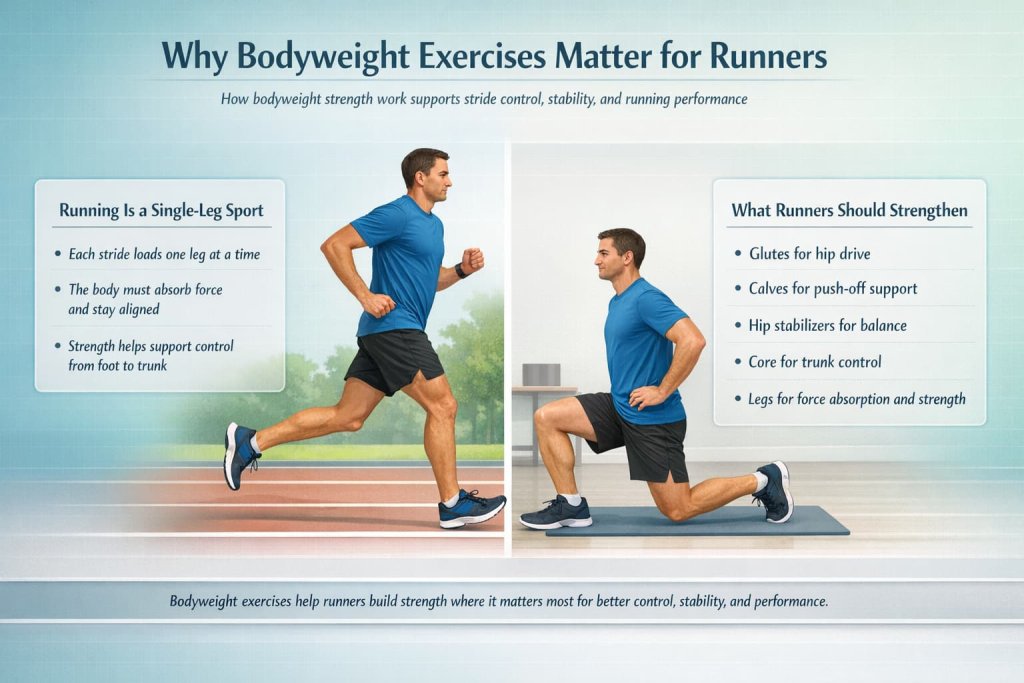
This approach also matches runner-specific guidance from World Athletics, which highlights glute work, calf raises, planks, squats, lunges, and bridges as useful strength options for runners.
Benefits of bodyweight exercises for runners
Bodyweight strength work may help runners:
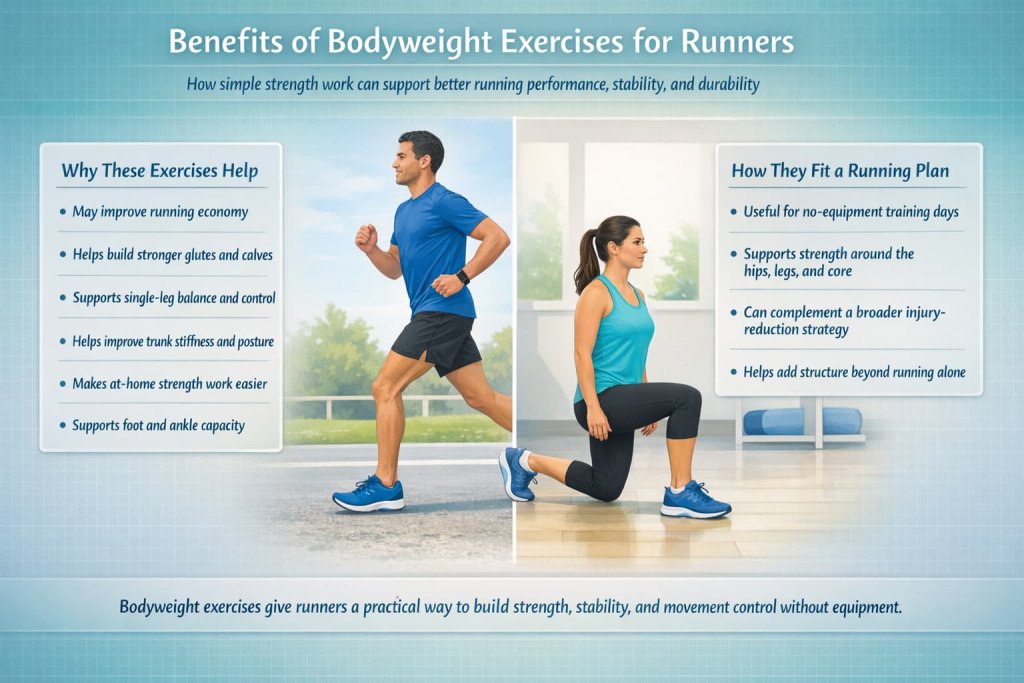
- Improve running economy
- Build stronger glutes and calves
- Support single-leg balance and control
- Improve trunk stiffness and posture during running
- Add useful strength sessions at home with no equipment
- Support foot and ankle capacity as part of a broader injury-reduction plan
A 2025 scoping review in PMC found that strengthening, including plyometric, isometric, foot, and ankle work, is commonly used to support performance and reduce injury risk as part of a broader strategy.
How often should runners do bodyweight strength training?
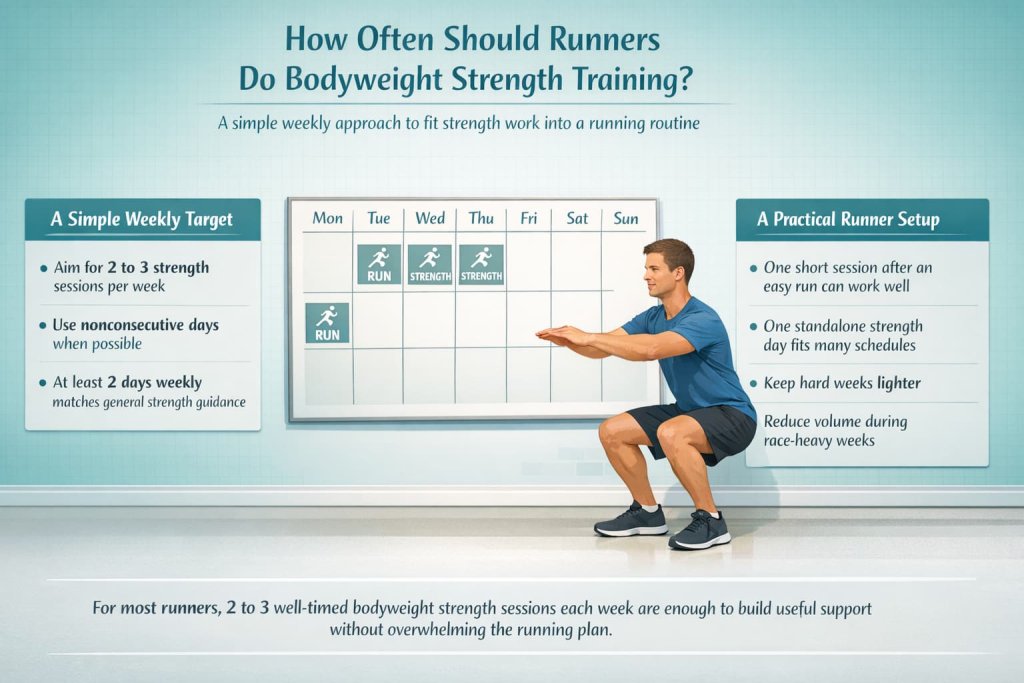
A simple target is 2 to 3 sessions per week on nonconsecutive days. That lines up with the broader physical activity guidance in the HHS Physical Activity Guidelines recommending muscle-strengthening work at least 2 days weekly.
For most runners, one short session after an easy run and one standalone session later in the week works well. During heavy race weeks, reduce volume instead of trying to set strength records.
12 Best Bodyweight Exercises for Runners
Build stronger legs, hips, calves, and core with these runner-friendly bodyweight exercises that need no equipment. These 12 moves can help support better speed, stability, running form, and overall durability.
1. Bodyweight Squat
How to do it:
- Stand with feet about hip- to shoulder-width apart.
- Brace your core and keep your chest tall.
- Sit your hips back and bend your knees.
- Lower until comfortable while keeping your heels down.
- Stand back up with control.
Why it works:
The squat builds foundational lower-body strength and teaches coordinated hip, knee, and ankle movement. It is a simple way to train force production for runners who need better general strength.
Muscles worked:
Quads, glutes, adductors, calves, and core.
Trainer Tip:
Do not chase depth if your heels lift or your back rounds. Smooth, controlled reps are more useful than forcing range.
2. Reverse Lunge
How to do it:
- Stand tall with feet under your hips.
- Step one leg back.
- Lower until both knees bend comfortably.
- Keep most of your weight through the front foot.
- Push through the front leg to return to standing.
- Repeat, then switch sides.
Why it works:
Reverse lunges train single-leg control with less forward knee stress than some forward-stepping variations. They also help runners build hip stability and reduce side-to-side wobble.
Muscles worked:
Glutes, quads, hamstrings, calves, and core.
Trainer Tip:
Think “drop straight down,” not “lean forward.” That keeps the move cleaner and more balanced.
3. Walking Lunge
How to do it:
- Stand tall and step forward into a lunge.
- Lower with control until both legs bend comfortably.
- Push through the front foot and bring the back leg through.
- Continue moving forward one step at a time.
- Keep your torso upright throughout.
Why it works:
Walking lunges add dynamic control and challenge balance as you move from stride to stride. That makes them very runner-friendly.
Muscles worked:
Glutes, quads, hamstrings, calves, and core.
Trainer Tip:
Use shorter steps at first. Long, sloppy lunges usually turn into a balance drill instead of a strength drill.
4. Split Squat
How to do it:
- Set up in a staggered stance.
- Keep your front foot flat and torso tall.
- Lower straight down by bending both knees.
- Pause briefly near the bottom.
- Drive through the front leg to rise.
- Complete all reps, then switch sides.
Why it works:
The split squat builds strength in a stable single-leg pattern without requiring forward movement. It is easier to control than a walking lunge and great for learning alignment.
Muscles worked:
Glutes, quads, hamstrings, and core.
Trainer Tip:
Keep your front knee tracking over your mid-foot, not collapsing inward.
5. Step-Up
How to do it:
- Use a stable stair or low box.
- Place one full foot on the step.
- Lean slightly forward from the hips.
- Push through the working leg to stand up.
- Lower back down slowly.
- Finish all reps, then switch sides.
Why it works:
Step-ups train the kind of single-leg force production runners use on hills, stairs, and strong toe-off phases. They also build control in a very functional pattern.
Muscles worked:
Glutes, quads, calves, hamstrings, and core.
Trainer Tip:
Avoid pushing hard off the bottom leg. Let the leg on the step do most of the work.
6. Glute Bridge
How to do it:
- Lie on your back with knees bent and feet flat.
- Brace your core lightly.
- Squeeze your glutes and lift your hips.
- Stop when your body forms a straight line from shoulders to knees.
- Lower with control and repeat.
Why it works:
Glute bridges train hip extension, which is a key part of efficient running mechanics. World Athletics specifically lists glute bridges, squats, and lunges among useful glute exercises for runners.
Muscles worked:
Glutes, hamstrings, and core.
Trainer Tip:
Do not overarch your lower back. Think about lifting from the hips, not the spine.
7. Single-Leg Glute Bridge
How to do it:
- Set up as for a regular glute bridge.
- Lift one foot off the floor.
- Keep your thighs aligned.
- Press through the grounded foot and lift your hips.
- Lower slowly and repeat.
- Switch sides after each set.
Why it works:
This variation increases the single-leg demand and exposes left-right differences that can matter for runners.
Muscles worked:
Glutes, hamstrings, and core.
Trainer Tip:
If your pelvis twists, go back to the two-leg version and build control first.
8. Single-Leg Calf Raise
How to do it:
- Stand near a wall or chair for balance.
- Shift your weight onto one foot.
- Rise onto the ball of that foot as high as you can.
- Pause briefly at the top.
- Lower slowly all the way down.
- Repeat, then switch sides.
Why it works:
The calf complex is heavily involved in running propulsion and stiffness. World Athletics specifically recommends calf raises, including single-leg versions, for runners.
Muscles worked:
Gastrocnemius, soleus, and foot stabilizers.
Trainer Tip:
The lowering phase matters. Control the descent instead of dropping fast.
9. Side-Lying Leg Raise
How to do it:
- Lie on one side with legs straight.
- Keep your top leg long and your foot neutral.
- Lift the top leg without rolling your hips back.
- Lower slowly.
- Complete all reps, then switch sides.
Why it works:
This move targets the lateral hip muscles that help control pelvic drop and knee position during running.
Muscles worked:
Gluteus medius, gluteus minimus, and tensor fasciae latae.
Trainer Tip:
Lift only as high as you can without twisting. Smaller and cleaner is better here.
10. Lateral Lunge
How to do it:
- Stand tall with feet together.
- Step one leg out to the side.
- Sit your hips back into the stepping leg.
- Keep the other leg straighter.
- Push back to the start position.
- Repeat, then switch sides.
Why it works:
Runners mostly move forward, so lateral work fills an important gap. It helps build hip strength and frontal-plane control.
Muscles worked:
Glutes, quads, adductors, and hamstrings.
Trainer Tip:
Keep the stepping foot flat. Do not let the knee cave inward.
11. Front Plank
How to do it:
- Set up on your forearms and toes.
- Keep your body in a straight line.
- Brace your abs and squeeze your glutes.
- Hold without letting your hips sag.
- Breathe steadily.
Why it works:
A front plank trains trunk stiffness and anti-extension control. For runners, that can help you hold posture when fatigue rises.
Muscles worked:
Rectus abdominis, transverse abdominis, obliques, glutes, and shoulders.
Trainer Tip:
A shorter perfect hold beats a long sloppy one. Stop before your low back takes over.
12. Bird-Dog
How to do it:
- Start on hands and knees.
- Brace your core.
- Reach one arm forward and the opposite leg back.
- Pause without twisting your trunk.
- Return to the start.
- Alternate sides.
Why it works:
Bird-dogs train cross-body coordination, trunk control, and balance. That fits the contralateral pattern of running very well.
Muscles worked:
Core, glutes, spinal stabilizers, and shoulders.
Trainer Tip:
Do not reach for maximum height. Reach long and stay steady.
Best Bodyweight Exercises for Runners by Goal
If you want more leg strength
Focus on:
- Bodyweight squat
- Split squat
- Reverse lunge
- Step-up
If you want more speed and power
Focus on:
- Walking lunge
- Step-up
- Single-leg calf raise
- Squat performed with faster intent on the way up
If you want better stability and control
Focus on:
- Single-leg glute bridge
- Side-lying leg raise
- Front plank
- Bird-dog
Sample Bodyweight Runner Workout
Here is a simple full-body routine you can use 2 times per week:
Workout A
- Bodyweight squat: 3 sets of 10 to 15
- Reverse lunge: 3 sets of 8 to 10 per side
- Glute bridge: 3 sets of 12 to 15
- Front plank: 3 holds of 20 to 40 seconds
- Single-leg calf raise: 2 to 3 sets of 10 to 15 per side
Workout B
- Split squat: 3 sets of 8 to 10 per side
- Step-up: 3 sets of 8 to 12 per side
- Side-lying leg raise: 2 to 3 sets of 12 to 15 per side
- Bird-dog: 2 to 3 sets of 6 to 10 per side
- Lateral lunge: 2 to 3 sets of 8 to 10 per side
Common Mistakes Runners Make With Bodyweight Strength Work
Doing only squats and skipping single-leg work
Running is mostly one leg at a time. Bilateral strength matters, but runners usually need split-stance and single-leg drills too.
Ignoring calves and feet
Foot and ankle capacity matters more than many runners think. A randomized controlled trial in PMC found lower running-related injury occurrence in the intervention group during foot-core training follow-up, and newer follow-up work continues to support the value of foot-core training in runners.
Adding too much volume during hard run weeks
Strength should support your running, not bury it. Reduce reps or sets when you are already carrying fatigue from races, long runs, or speed work.
Rushing reps
Fast, sloppy reps usually shift work away from the muscles you want to train. Controlled reps are more useful for most runners.
Are Bodyweight Exercises Enough for Runners?
They are often enough for beginners, general fitness runners, and runners training at home. They can also be enough during maintenance phases. But advanced runners may eventually need heavier loading, plyometrics, or more progressed strength work to keep improving.
That said, bodyweight training is still a smart entry point. It builds the patterns that make later strength work safer and more effective, and it is easy to fit into a busy week.
Who Should Be Careful With These Exercises?
Use extra caution or get professional guidance first if you have:
- Current pain that worsens during exercise
- A recent lower-limb injury
- Balance problems
- Recent surgery
- A medical condition that changes exercise safety
Stop and get medical advice if an exercise causes sharp pain, major swelling, or symptoms that clearly worsen afterward.
Frequently Asked Questions
What are the best bodyweight exercises for runners?
The best options usually include squats, lunges, step-ups, glute bridges, calf raises, planks, and hip-stability drills because they target the muscles runners rely on most.
How many times per week should runners do bodyweight exercises?
Most runners do well with 2 to 3 strength sessions per week. Official guidance supports muscle-strengthening work on at least 2 days per week according to HHS.
Can bodyweight exercises make you faster?
They can help support speed by improving strength, coordination, and running economy. The biggest performance gains may come when strength work is done consistently and progressed over time, as noted in PubMed.
Are bodyweight exercises good for preventing running injuries?
They may help as part of a broader plan, especially when they improve strength, control, and foot-ankle capacity. No single exercise guarantees injury prevention, but strength work is commonly recommended in runner-support strategies discussed in PMC.
Should runners do strength work before or after running?
Most runners place strength work after easy runs or on separate days. Doing hard strength work before a key speed session can reduce running quality.
Do runners need calf raises?
Usually yes. Calf raises are one of the simplest ways to build lower-leg strength for running mechanics, stiffness, and push-off.
What is the best core exercise for runners?
There is no single best one, but planks and bird-dogs are strong choices because they train trunk control without a lot of equipment or setup.
Conclusion
The best bodyweight exercises for runners are the ones that build useful strength where runners need it most: hips, glutes, calves, feet, and core. Start with simple, well-controlled movements, train them consistently, and keep the plan realistic enough to fit your running week.
If you are building a runner-strength routine for your site, this topic works best when the exercises stay practical, progression stays clear, and the advice stays grounded in evidence rather than hype.