
The split squat exercise is a unilateral lower-body movement that builds leg strength, improves balance, and supports joint stability by training one side at a time.
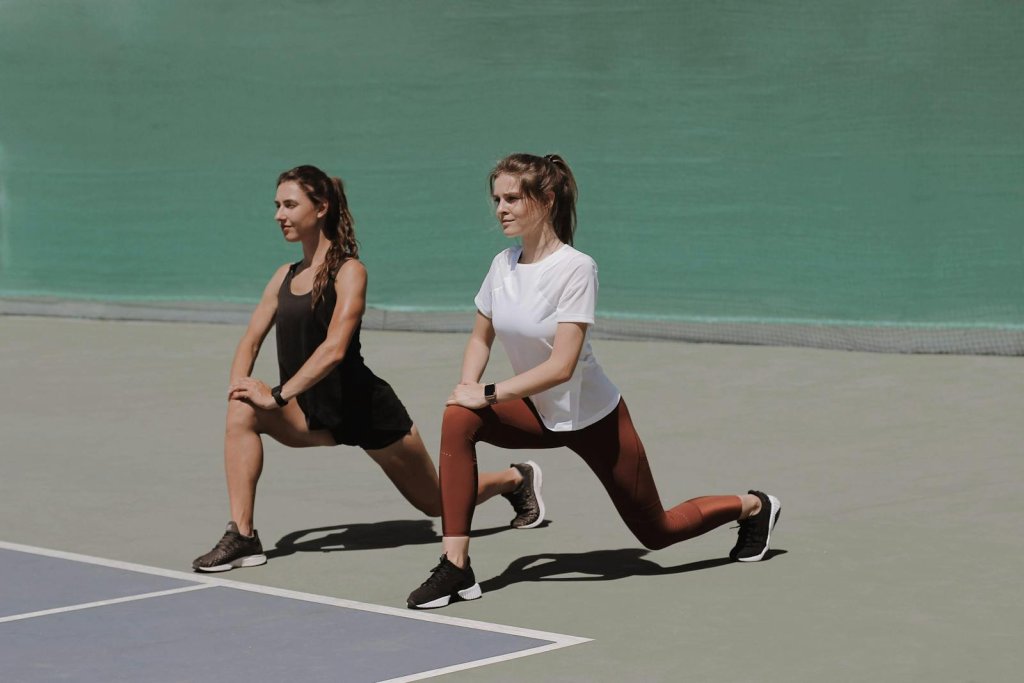
Understanding how to perform it correctly matters because unilateral exercises are widely used to address strength imbalances, enhance coordination, and improve functional movement in daily life and sports. This guide covers proper form, muscles worked, benefits, variations, programming tips, safety considerations, and common questions—so you can use split squats confidently and effectively.
What Is the Split Squat Exercise?
The split squat is a static lunge pattern where your feet remain planted throughout the movement. Unlike walking lunges, there’s no step between reps, which allows for better control and consistent loading.
Key characteristics:
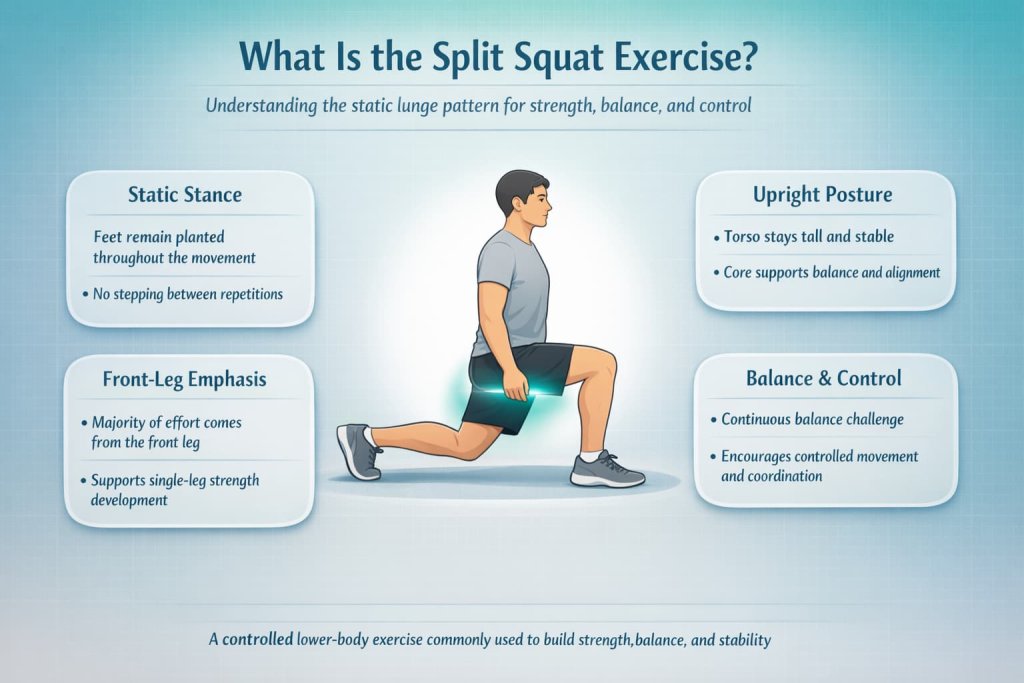
- One foot stays forward, the other behind
- The torso remains upright and stable
- Most of the work is done by the front leg
- Balance and core control are continuously challenged
How to Do the Split Squat Exercise (Proper Form)
How to do it
- Stand in a staggered stance with one foot forward and one foot back
- Keep your torso upright and core engaged
- Bend both knees and lower your body straight down
- Allow the front knee to bend naturally while keeping the heel down
- Lower until both knees are comfortably bent
- Press through the front heel to return to standing
- Complete reps on one side, then switch
Trainer Tip
Start with bodyweight only. Once balance and control feel solid, add dumbbells gradually.
Split Squat Exercise Variations
Once you master the basic split squat, progressing to variations helps increase strength, control, and training stimulus without changing the core movement pattern. Below are the most effective split squat exercise variations, explained in a consistent, training-focused format.
1. Dumbbell Split Squat
Why it works
Adding dumbbells increases external load while keeping the movement stable and controlled. This allows progressive overload, which is essential for building lower-body strength and muscle over time.
How to do it
- Hold a dumbbell in each hand with arms at your sides
- Step into a split stance with feet planted
- Keep your torso upright and core braced
- Lower straight down by bending both knees
- Press through the front heel to return to standing
- Complete all reps on one side before switching
Trainer Tip
Start with lighter weights than you think you need. Maintaining balance and knee alignment is more important than lifting heavy early.
2. Rear-Foot-Elevated Split Squat (Bulgarian Split Squat)
Why it works
Elevating the rear foot increases the load on the front leg, significantly raising demands on hip and knee extensors. This variation is commonly used to build single-leg strength and address strength asymmetries.
How to do it
- Place the top of your rear foot on a bench or low platform
- Step the front foot far enough forward for balance
- Keep your torso tall and hips square
- Lower under control until the front knee bends deeply
- Push through the front heel to stand back up
- Switch sides after completing the set
Trainer Tip
If balance is challenging, lower the rear foot height or start with bodyweight before adding resistance.
3. Goblet Split Squat
Why it works
Holding a single weight in front of the chest helps counterbalance the body, making it easier to maintain an upright torso and consistent depth. This makes it a useful variation for technique refinement.
How to do it
- Hold a dumbbell or kettlebell close to your chest
- Step into a split stance
- Brace your core and keep elbows tucked
- Lower straight down with control
- Drive through the front foot to stand
- Complete reps evenly on both sides
Trainer Tip
Use this variation if you struggle with forward leaning or want to reinforce proper posture during split squats.
4. Paused Split Squat
Why it works
Adding a pause at the bottom increases time under tension and improves control, stability, and positional awareness. It also helps expose and correct weak points.
How to do it
- Set up in a normal split squat stance
- Lower slowly until you reach the bottom position
- Hold the bottom position for 2–3 seconds
- Maintain balance and tension throughout the pause
- Press through the front heel to return to standing
- Repeat for controlled repetitions
Trainer Tip
Reduce the load when first adding pauses. Quality control and stability matter more than resistance in this variation.
Muscles Worked in the Split Squat Exercise
The split squat targets multiple lower-body muscles while also engaging stabilizers.
Primary muscles:
- Quadriceps (front thigh)
- Gluteus maximus (hips and buttocks)
Secondary and stabilizing muscles:
- Gluteus medius (hip stability)
- Hamstrings
- Adductors (inner thigh)
- Calves
- Core stabilizers
Because the movement is unilateral, these muscles work harder to maintain alignment and balance.
Benefits of the Split Squat Exercise
Split squats are a staple in strength and conditioning programs for several reasons:
- Builds single-leg strength and control
- Helps reduce side-to-side strength imbalances
- Improves balance and coordination
- Supports knee and hip stability when performed with proper form
- Transfers well to sports, walking, climbing stairs, and daily tasks
Public-health and fitness organizations such as American College of Sports Medicine and World Health Organization emphasize the importance of lower-body strength for long-term mobility and functional independence.
Split Squat vs Lunge: What’s the Difference?
While similar, these exercises serve slightly different purposes.
| Split Squat | Lunge |
|---|---|
| Feet stay planted | Stepping movement |
| Easier to control balance | Higher coordination demand |
| Ideal for beginners | More dynamic |
| Easier to load safely | Often used for conditioning |
Both are valuable, but split squats are often preferred for learning technique and building foundational strength.
How Often Should You Do the Split Squat Exercise?
General guidelines for strength training recommend:
- 2–3 sessions per week
- 2–4 sets per leg
- 6–12 controlled reps per set
According to Centers for Disease Control and Prevention and World Health Organization, adults should include muscle-strengthening activities at least two days per week.
Common Mistakes to Avoid
Avoid these errors to get the most from split squats:
- Front heel lifting off the floor
- Knee collapsing inward
- Leaning excessively forward
- Taking too narrow or too wide a stance
- Rushing through reps without control
How to Progress the Split Squat Safely
Safe progression focuses on control before intensity. Build a solid foundation first, then increase difficulty gradually.
- Start with bodyweight and master balance
- Add load only after consistent form is achieved
- Change one variable at a time (weight, depth, tempo)
- Stop if balance or alignment breaks down
How to Modify the Split Squat for Beginners
Beginner modifications make the movement more accessible and comfortable.
- Use a shorter stance
- Limit depth to a pain-free range
- Hold a wall or chair for balance
- Begin with low reps and controlled tempo
Who Should Be Cautious or Seek Guidance
Split squats are generally safe, but extra care is advised if you:
- Have knee, hip, or lower-back pain
- Recently had surgery or injury
- Struggle significantly with balance
Reputable health resources such as Mayo Clinic suggest prioritizing pain-free range of motion and professional guidance when starting new exercises with joint concerns.
FAQs About the Split Squat Exercise
Is the split squat good for beginners?
Yes. The fixed stance makes it easier to control than walking lunges.
Does the split squat build muscle?
When progressively loaded, it supports muscle strength and hypertrophy.
Are split squats bad for the knees?
When done with proper alignment and pain-free range, they are generally well tolerated.
Can I do split squats at home?
Absolutely. Bodyweight split squats require no equipment.
How is a split squat different from a Bulgarian split squat?
The Bulgarian version elevates the rear foot, increasing difficulty and muscle demand.
Should my knee go past my toes?
A small forward knee movement is normal; comfort and control matter more than exact position.
Conclusion
The split squat exercise is a simple yet powerful tool for building stronger legs, improving balance, and supporting long-term mobility. By focusing on controlled form, gradual progression, and consistency, you can safely integrate split squats into almost any strength routine. Start with bodyweight, move with intention, and progress as your confidence grows.
References
- NSCA Strength and Conditioning Journal: Dumbbell Split Squat Technique Article
- Journal of Strength and Conditioning Research: Squat vs Split Squat vs Step-Up Muscle Forces Across Loads (PubMed)
- BMC Sports Science, Medicine and Rehabilitation: Muscle Activation in Bulgarian Split Squat Variations
- Mayo Clinic: Strength Training Basics (Safe, Practical Guidance)