
Upper body pull exercises are movements that train you to pull weight toward your body or pull your body toward a bar, and they are some of the best exercises for building a stronger back, biceps, rear shoulders, and better posture. They matter because a solid pull program helps balance all the pressing most people do, supports shoulder function, and fits directly into major exercise guidelines that recommend muscle-strengthening work at least 2 days per week. Both the CDC and the NSCA support this bigger-picture approach to strength training.
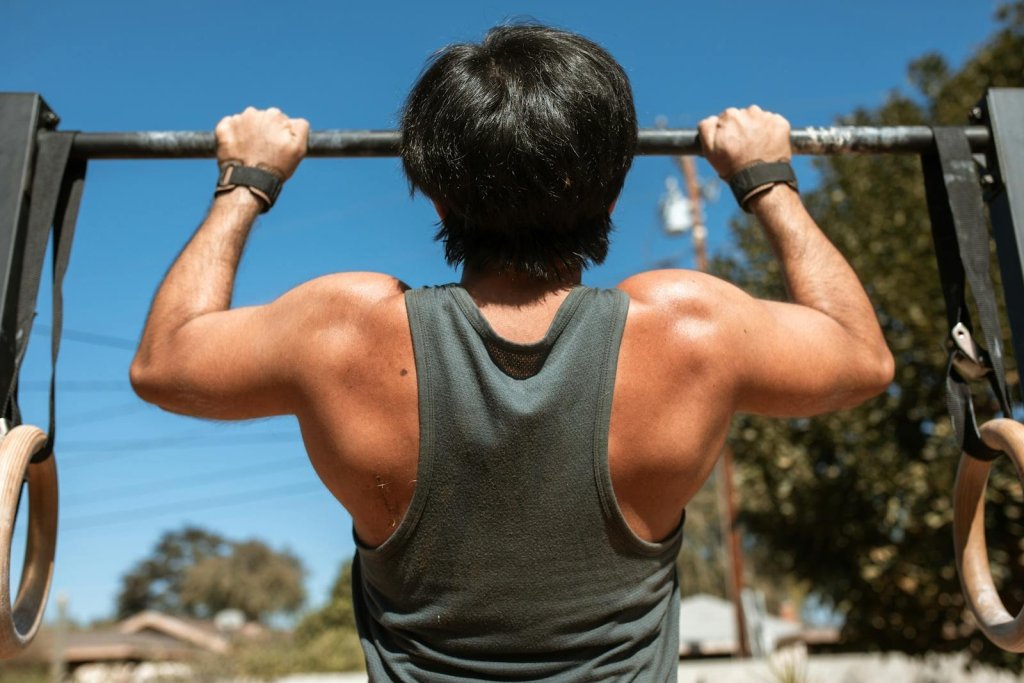
A good upper body pull workout does not need to be complicated. Most people do best with a mix of vertical pulls like pull-ups and pulldowns, plus horizontal pulls like rows and face pulls. Research also suggests that heavier loading tends to improve maximal strength more, while a broad range of loads can still help with muscle growth, which aligns well with evidence summarized in PubMed.
What Are Upper Body Pull Exercises?
Upper body pull exercises are strength movements where the main action is pulling. In practical terms, that means either pulling a handle, band, cable, or dumbbell toward your torso, or pulling your body upward toward a fixed bar. The NSCA groups these movements into two main patterns: horizontal pulls such as rows and vertical pulls such as pull-ups and pulldowns. That is the simplest and most useful way to organize this topic.
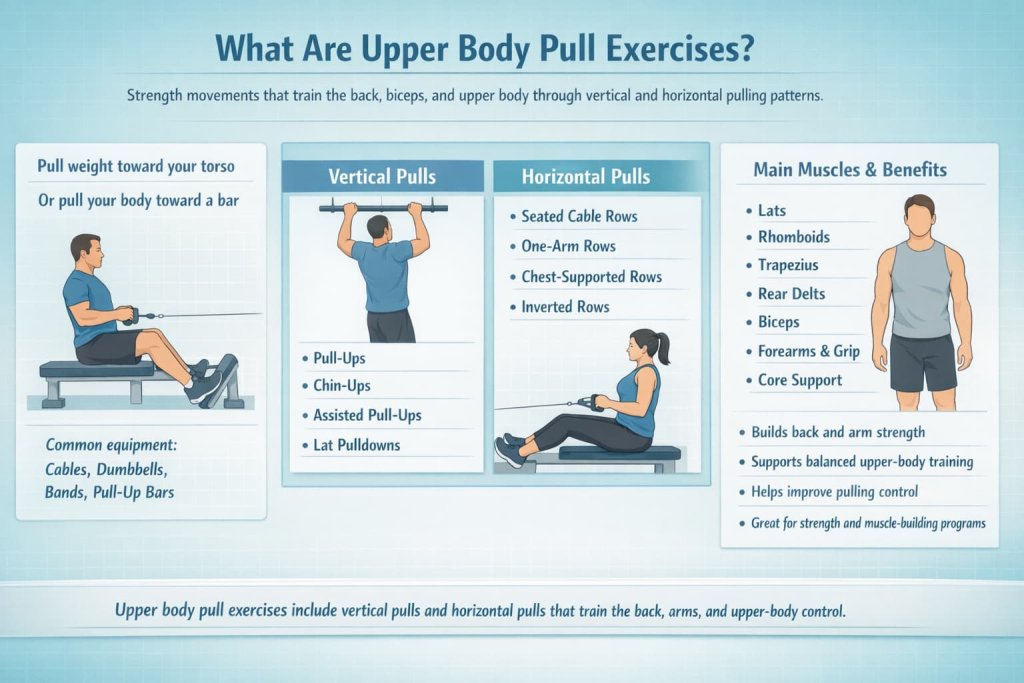
These exercises mainly train the latissimus dorsi, rhomboids, trapezius, posterior deltoids, and elbow flexors such as the biceps. Depending on the variation, they also challenge the forearms, grip, and core. The American Council on Exercise reflects that mix of back and arm involvement in its exercise guidance for movements like the single-arm row, lat pulldown, and pull-up.
Why Upper Body Pull Exercises Matter
Upper body pull exercises do more than build muscle. They help create a more balanced upper-body program, especially for people who already do bench presses, push-ups, shoulder presses, or a lot of desk work. The American Council on Exercise also supports the value of well-coached pulling patterns for shoulder-blade control and cleaner upper-body mechanics.
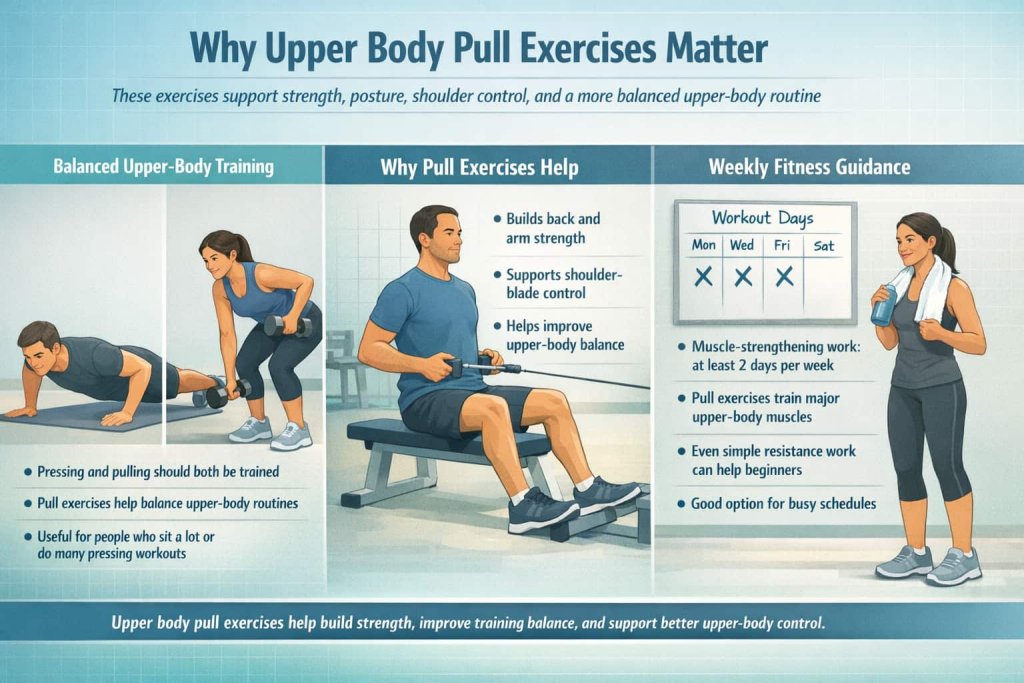
They also fit well with public-health guidance. The CDC recommends that adults do muscle-strengthening activity at least 2 days each week, and pull exercises are an easy way to train major upper-body muscle groups during those sessions. Even lower-volume resistance training can still improve strength compared with doing nothing, which is useful for beginners or busy adults.
12 Best Upper Body Pull Exercises
Build a stronger back, biceps, and upper body with these effective pulling movements. This list covers 12 upper body pull exercises to improve strength, posture, and muscle balance.
1. Pull-Up
How to do it:
- Grab the bar with an overhand grip.
- Start from a controlled hang.
- Pull your chest upward by driving your elbows down.
- Pause near the top without craning your neck.
- Lower slowly to the start.
Why it works:
The pull-up is one of the best upper body pull exercises for total pulling strength. It trains the back and arms at the same time and gives you a clear long-term strength goal. Because you are moving your own body through space, pull-ups create a high overall strength demand. They are a vertical pull, so they fit directly into the movement model explained by the NSCA. The American Council on Exercise also classifies pull-ups as a back-and-arms exercise.
Muscles worked:
Lats, upper back, biceps, forearms, and core.
Trainer Tip:
If full pull-ups are too hard right now, start with assisted reps, band assistance, or eccentric-only lowers.
2. Chin-Up
How to do it:
- Use a shoulder-width underhand grip.
- Hang with your body steady.
- Pull until your chin clears the bar.
- Lower with control.
- Repeat without swinging.
Why it works:
The chin-up is similar to the pull-up but uses an underhand grip. Many people find it slightly easier and more biceps-friendly. The underhand grip often allows a smoother path for beginners while still building strong vertical pulling strength. It is a great bridge to harder pull-up work.
Muscles worked:
Lats, biceps, upper back, forearms, and core.
Trainer Tip:
Keep your ribs down and avoid kicking your legs to finish the rep.
3. Assisted Pull-Up
How to do it:
- Use an assisted machine or a resistance band.
- Set your body in a stable hang.
- Pull up with a smooth motion.
- Pause briefly near the top.
- Lower under control.
Why it works:
The assisted pull-up is one of the best upper body pull exercises for beginners who want to build real pull-up strength. It keeps the same basic vertical-pull pattern while reducing load. That lets you practice form, range of motion, and control.
Muscles worked:
Lats, biceps, upper back, forearms, and core.
Trainer Tip:
Use only as much assistance as needed. Over time, reduce the help and make the movement more your own.
4. Lat Pulldown
How to do it:
- Sit down and secure your thighs under the pad.
- Take a controlled overhead grip.
- Pull the bar toward your upper chest by driving your elbows down.
- Pause briefly.
- Return the bar upward slowly.
Why it works:
The lat pulldown is a gym staple and a very practical alternative when pull-ups are not yet strong enough. It trains the vertical-pull pattern with adjustable load, which makes progression easier for most people. The American Council on Exercise also emphasizes torso control and avoiding excessive low-back arching during the setup.
Muscles worked:
Lats, upper back, biceps, rear shoulders, and forearms.
Trainer Tip:
Do not yank the bar or lean way back. Think “elbows down” rather than “hands down.”
5. Seated Cable Row
How to do it:
- Sit tall with your feet braced.
- Grab the handle and straighten your arms.
- Pull the handle toward your lower ribs or upper stomach.
- Squeeze your back briefly.
- Return to the start without rounding hard.
Why it works:
The seated cable row is one of the most useful horizontal upper body pull exercises because it is stable, scalable, and easy to feel in the back. It trains horizontal pulling with steady tension and usually makes it easier to focus on posture, shoulder-blade movement, and mid-back control.
Muscles worked:
Mid-back, lats, rhomboids, biceps, rear delts, and forearms.
Trainer Tip:
Avoid turning it into a low-back swing. The torso should stay mostly steady.
6. One-Arm Dumbbell Row
How to do it:
- Place one hand and the same-side knee on a bench.
- Hold a dumbbell in the other hand.
- Keep your back flat and core braced.
- Pull the dumbbell toward your hip.
- Lower slowly and repeat.
Why it works:
The one-arm dumbbell row is a classic upper body pull exercise for building back strength one side at a time. It allows a long pulling range, helps address side-to-side differences, and is easy to load progressively. The American Council on Exercise also highlights a braced torso and flat-back position, which makes it a strong teaching exercise.
Muscles worked:
Lats, rhomboids, middle traps, rear delts, biceps, and grip.
Trainer Tip:
Think about pulling with your elbow, not shrugging with your shoulder.
7. Chest-Supported Row
How to do it:
- Lie chest-down on an incline bench.
- Let the weights hang with straight arms.
- Pull your elbows back toward your torso.
- Pause briefly at the top.
- Lower under control.
Why it works:
The chest-supported row removes a lot of lower-back strain and lets you focus more on the upper back. Because your chest is supported, there is less need to stabilize your torso. That often makes the movement easier to learn and cleaner to load.
Muscles worked:
Mid-back, rear delts, lats, rhomboids, traps, and biceps.
Trainer Tip:
This is a smart choice when fatigue, low-back discomfort, or sloppy form limits your regular rows.
8. Inverted Row
How to do it:
- Set a bar around waist height.
- Lie under it and grab it with an overhand grip.
- Keep your body straight from head to heels.
- Pull your chest toward the bar.
- Lower back down slowly.
Why it works:
The inverted row is a bodyweight horizontal pull that works well for home gyms, racks, and beginner-to-intermediate programs. It teaches you to move your body as one piece while building upper-back strength. It also gives you an easier entry point than many pull-ups.
Muscles worked:
Upper back, lats, biceps, rear delts, forearms, and core.
Trainer Tip:
To make it easier, bend your knees. To make it harder, elevate your feet.
9. Machine Row
How to do it:
- Adjust the seat and chest pad if needed.
- Grip the handles and sit tall.
- Pull the handles toward your body.
- Pause briefly with your shoulder blades drawn back.
- Return with control.
Why it works:
The machine row is one of the best upper body pull exercises for people who want consistent setup and controlled progression. Machine rows usually make stability easier, so you can focus more on effort and full reps. That is useful for beginners and for higher-effort accessory work.
Muscles worked:
Mid-back, lats, biceps, rear delts, and forearms.
Trainer Tip:
Do not shorten the rep just to use more weight. Full, clean reps usually work better.
10. Resistance Band Row
How to do it:
- Anchor the band at about chest height.
- Step back to create tension.
- Hold the handles with straight arms.
- Pull toward your ribs.
- Return slowly.
Why it works:
The resistance band row is simple, low-cost, and effective for home workouts. It trains the horizontal-pull pattern with portable equipment. For many beginners, it is an accessible way to build pulling volume and learn better shoulder-blade control.
Muscles worked:
Mid-back, rhomboids, rear delts, biceps, and forearms.
Trainer Tip:
Bands get harder as they stretch, so do not rush the last half of the rep.
11. Face Pull
How to do it:
- Set a rope or band around face height.
- Pull toward your face with elbows out.
- Finish with your hands near ear level.
- Pause briefly.
- Return slowly.
Why it works:
The face pull is a lighter accessory movement, but it is still an excellent upper body pull exercise for balanced shoulder training. It combines pulling with shoulder external rotation, which helps train the upper back and rear shoulder area in a way many basic rows do not. The American Council on Exercise supports the value of this type of controlled upper-back work.
Muscles worked:
Rear delts, upper traps, mid traps, rhomboids, and rotator cuff support muscles.
Trainer Tip:
Use less weight than you think. This movement works best when you can control the finish position.
12. Straight-Arm Pulldown
How to do it:
- Stand facing a cable or anchored band.
- Hold the bar or band with straight or slightly bent arms.
- Pull down in an arc toward your thighs.
- Pause briefly.
- Return to the start with control.
Why it works:
The straight-arm pulldown is a useful accessory for learning lat engagement without a lot of elbow flexion. It gives you another vertical-pull pattern, but with a different feel than pull-ups or pulldowns. Many lifters use it to improve mind-muscle connection with the lats.
Muscles worked:
Lats, teres major, long head of the triceps, and core stabilizers.
Trainer Tip:
Keep your ribs down and avoid turning it into a crunch.
Would you like me to format the rest of the article sections in this same style too?
Which Upper Body Pull Exercises Are Best for Beginners?
If you are new, start with movements that are stable, easy to control, and simple to progress. Good starting options include:
- Lat pulldowns
- Seated cable rows
- Resistance band rows
- Machine rows
- Assisted pull-ups
- Chest-supported rows
These exercises let you learn the movement pattern without needing elite bodyweight strength right away.
How to Program Upper Body Pull Exercises
A simple plan works well for most people. Research reviews in PubMed suggest that resistance training across a range of set and rep structures can improve results, while heavier loading tends to be better for maximal strength. Minimal-dose evidence from PubMed Central also shows that even modest amounts of resistance training can help, especially in beginners.
A practical starting point is:
- Train upper body pull exercises 2 times per week
- Use 2 to 4 exercises per session
- Do 2 to 4 sets per exercise
- Aim for about 6 to 12 reps on bigger lifts
- Use 10 to 20 reps on lighter accessory moves like face pulls
For strength, focus more on pull-ups, chin-ups, rows, and pulldowns with challenging but controlled loads. For muscle growth, use a mix of moderate and heavier loading with enough total weekly volume.
Common Mistakes With Upper Body Pull Exercises
Using Too Much Momentum
Swinging, jerking, or leaning too far back usually shifts tension away from the target muscles.
Shrugging Every Rep
This often makes the neck and upper traps dominate the movement too early.
Cutting the Range of Motion Short
Half reps can have a place, but most people build better general strength with controlled full reps.
Forgetting Horizontal Pulls
A routine with only pull-ups and pulldowns can miss useful mid-back and rear-delt work.
Going Too Heavy Too Soon
Stronger is good, but form still matters. Evidence summarized in PubMed supports heavier loading for maximal strength, not sloppy loading.
Upper Body Pull Exercises for Strength vs. Muscle Growth
For strength, center your program on harder compounds like pull-ups, chin-ups, heavy rows, and pulldowns. Use lower-to-moderate rep ranges and focus on gradual overload. Evidence from systematic reviews in PubMed shows that higher-load resistance training generally produces better maximal strength gains.
For muscle growth, you can use many of the same exercises, but you have more flexibility with reps and loading. The research suggests hypertrophy can improve across a broader range of loads, as long as the training is hard enough and repeated consistently.
Vertical vs. Horizontal Upper Body Pull Exercises
Vertical pulls move mostly up and down. These include pull-ups, chin-ups, assisted pull-ups, and lat pulldowns. They are especially useful for training the lats and building the ability to pull overhead or pull your body upward, which matches the movement-pattern model explained by the NSCA.
Horizontal pulls move mostly toward your torso. These include seated cable rows, chest-supported rows, one-arm dumbbell rows, inverted rows, and face pulls. They often make it easier to focus on the mid-back, rear shoulders, and shoulder-blade control.
For most people, the best plan is not choosing one over the other. It is using both.
Quick Upper Body Pull Workout Example
Here is a simple example:
Workout A
- Pull-up or assisted pull-up: 3 sets
- Seated cable row: 3 sets
- One-arm dumbbell row: 2 to 3 sets
- Face pull: 2 sets
Workout B
- Lat pulldown: 3 sets
- Chest-supported row: 3 sets
- Machine row or band row: 2 to 3 sets
- Straight-arm pulldown: 2 sets
This kind of split gives you both vertical and horizontal pulling each week.
FAQ About Upper Body Pull Exercises
What Muscles Do Upper Body Pull Exercises Work?
They mainly train the lats, rhomboids, trapezius, rear delts, biceps, forearms, and grip. Some variations also challenge the core and shoulder stabilizers, which is consistent with exercise guidance from the American Council on Exercise.
Are Pull-Ups Better Than Rows?
Not always. Pull-ups are excellent vertical pulls, while rows are excellent horizontal pulls. Most people benefit from doing both.
How Often Should I Train Upper Body Pull Exercises?
For general fitness, 2 sessions per week is a strong starting point and fits the muscle-strengthening guidance from the CDC.
Can Beginners Do Upper Body Pull Exercises?
Yes. Band rows, machine rows, lat pulldowns, and assisted pull-ups are all beginner-friendly starting options.
Are Upper Body Pull Exercises Good for Posture?
They can support better upper-back strength and shoulder-blade control, especially when paired with good technique and balanced training. Guidance from the American Council on Exercise supports the role of these patterns in sound upper-body mechanics.
Should I Train Pull Exercises Heavier for Strength?
Usually yes. Higher loads tend to be more effective for maximal strength, while a wider range of loads can still support hypertrophy, which is in line with current evidence summarized in PubMed.
Do I Need a Gym for Upper Body Pull Exercises?
No. You can do useful pull training with a pull-up bar, resistance bands, a suspension trainer, or dumbbells at home.
Conclusion
The best upper body pull exercises combine vertical pulls, horizontal pulls, and a few lighter accessory movements. That is the smartest way to build back and arm strength, improve balance in your training, and create a routine you can keep progressing for months. Start with a few basics, focus on clean reps, and add load or reps over time.
If you are building a stronger program, make sure your weekly plan includes both rows and pulldowns or pull-ups, not just one category.