
The best hamstring exercises for beginners are simple, controlled moves like glute bridges, heel-dig bridges, standing hamstring curls, and light hip-hinge patterns that build strength without forcing speed or heavy load. Learning hamstring exercises for beginners matters because stronger hamstrings support walking, stairs, lifting, posture, and lower-body balance, and they can also help round out your weekly strength routine when progressed gradually.
Guidance from the Physical Activity Guidelines for Americans supports doing muscle-strengthening work at least 2 days per week, while Mayo Clinic emphasizes starting with manageable resistance and correct form.
What Are Hamstring Exercises for Beginners?
Hamstring exercises for beginners are entry-level strength movements that train the muscles at the back of the thigh with low to moderate difficulty. The goal is to build basic strength, control, and movement confidence before moving on to harder options like aggressive slider curls or Nordic hamstring work. Research and clinical summaries in the Journal of Orthopaedic & Sports Physical Therapy continue to support progressive loading, with easier bridge, curl, and hip-hinge patterns often used before higher-strain eccentric work.
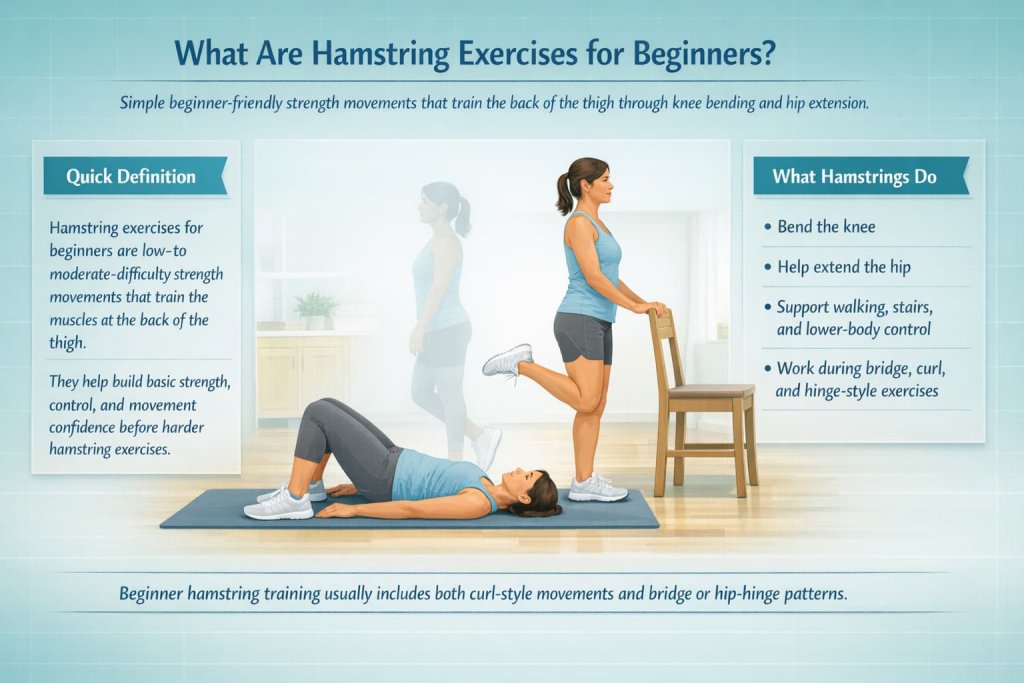
Your hamstrings help with two big actions:
- bending the knee
- extending the hip
That is why beginner hamstring training usually includes both curl-style exercises and hinge or bridge-style exercises.
Who Should Be Careful Before Starting Hamstring Exercises for Beginners?
Most healthy adults can start with gentle hamstring strengthening, but some people should use extra caution. The American Academy of Orthopaedic Surgeons advises warming up first and avoiding painful movement, and its conditioning materials state that you should not feel pain during an exercise.
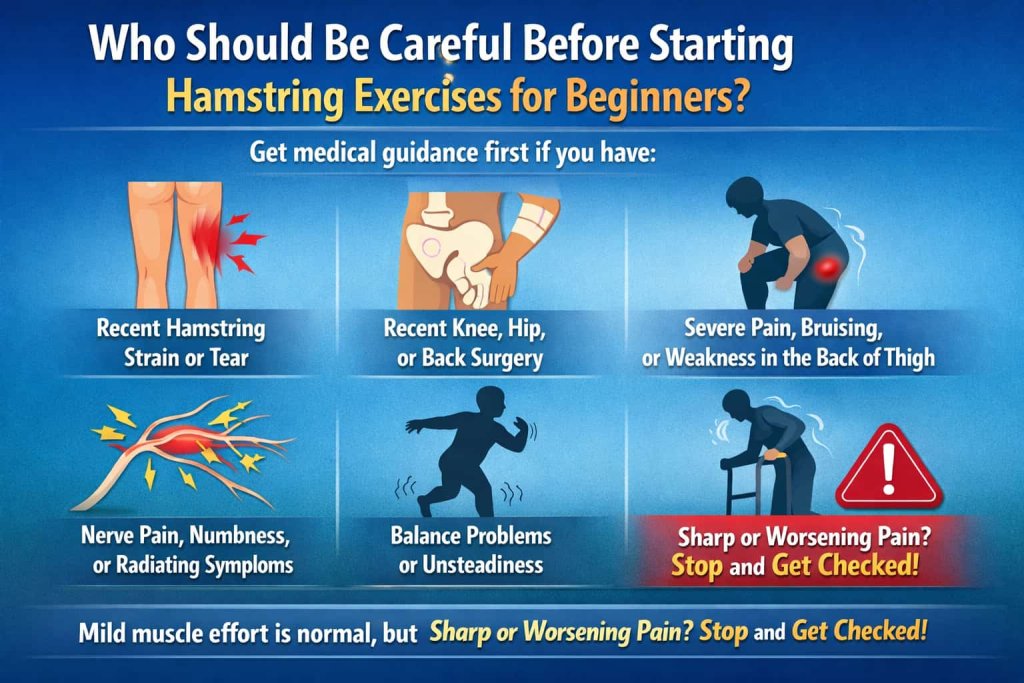
Get medical guidance first if you have:
- a recent hamstring strain or tear
- recent knee, hip, or back surgery
- sharp pain, bruising, or major weakness in the back of the thigh
- nerve-like pain, numbness, or radiating symptoms
- balance problems that make standing exercises unsafe
A good rule for beginners is simple: mild muscle effort is normal, but sharp, worsening, or radiating pain is a sign to stop and get checked.
Before You Start Hamstring Exercises for Beginners
A short warm-up can make these exercises safer and feel better. The American Academy of Orthopaedic Surgeons recommends warming up before flexibility work, and Mayo Clinic recommends 5 to 10 minutes of light activity before stretching.
Before you begin:
- walk in place for 5 minutes
- do a few easy sit-to-stands
- keep the first set lighter than you think you need
- move slowly enough to stay in control
- stop if the exercise causes pain instead of normal muscle effort
10 Best Hamstring Exercises for Beginners
Build stronger hamstrings with these 10 beginner-friendly exercises designed to improve stability, control, and lower-body strength safely. From simple bridges to easy curl and hinge variations, these moves help you start with confidence and progress at a comfortable pace.
1. Glute Bridge
How to do it:
- Lie on your back with knees bent and feet flat on the floor, about hip-width apart.
- Keep your arms by your sides.
- Tighten your abs gently.
- Press through your heels and lift your hips until your body forms a straight line from shoulders to knees.
- Pause briefly at the top.
- Lower with control and repeat.
Why it works:
The glute bridge is one of the best starting points because it trains hip extension with a stable body position. ACE uses this pattern to build the glutes, core, and posterior chain without making beginners balance on one leg right away.
Muscles worked:
This move mainly works the glutes and hamstrings, with support from the core and lower back stabilizers.
Trainer Tip:
Keep the movement smooth. Do not arch your lower back to force your hips higher.
2. Heel-Dig Bridge
How to do it:
- Lie on your back with knees bent.
- Place your heels slightly farther away from your hips than in a regular bridge.
- Pull your toes up toward your shins.
- Press your heels into the floor and lift your hips.
- Pause, then lower slowly.
Why it works:
Moving the feet slightly farther out and driving through the heels usually increases hamstring involvement compared with a standard bridge. It is a useful beginner step before curls with sliders or a ball.
Muscles worked:
This variation targets the hamstrings more directly while still training the glutes and trunk stabilizers.
Trainer Tip:
Think about dragging your heels back without actually moving them. That cue often helps you feel the back of the thighs more.
3. Standing Hamstring Curl
How to do it:
- Stand tall and hold a wall, chair, or countertop for balance.
- Shift your weight onto one leg.
- Bend the other knee and bring your heel up toward your glutes.
- Pause briefly at the top.
- Lower slowly and repeat, then switch sides.
Why it works:
This is a simple knee-flexion exercise that lets beginners train the hamstrings with very little setup. ACE notes that balance support can be used when needed.
Muscles worked:
This move mainly targets the hamstrings, with the standing leg and core helping you stay steady.
Trainer Tip:
Do not swing the leg. Lift and lower with control so the hamstrings do the work.
4. Prone Hamstring Curl
How to do it:
- Lie face down on a mat.
- Rest your forehead on your hands.
- Bend one knee and slowly bring your heel toward your glutes.
- Lower under control.
- Complete all reps, then switch sides.
Why it works:
The prone hamstring curl is beginner-friendly because it isolates knee flexion and removes most balance demands. It can be especially useful if standing work feels shaky at first.
Muscles worked:
The hamstrings do most of the work here, with minimal help from other muscles.
Trainer Tip:
Keep your hips pressed into the floor. Avoid lifting the thigh off the mat.
5. Marching Bridge
How to do it:
- Set up in a normal glute bridge.
- Lift your hips to the top position.
- Without letting your pelvis drop, lift one foot a few inches off the floor.
- Place it back down.
- Repeat on the other side in an alternating pattern.
Why it works:
This exercise builds on the regular bridge by adding light single-leg control. It challenges the hamstrings and glutes while teaching you to keep the pelvis stable.
Muscles worked:
The hamstrings and glutes stay active, while the core works harder to resist twisting or dropping.
Trainer Tip:
Keep the steps small. The goal is pelvic control, not big marching height.
6. Seated Band Hamstring Curl
How to do it:
- Sit upright on a chair or bench.
- Anchor a resistance band in front of you and loop it around one ankle.
- Start with the knee more extended.
- Pull your heel back under the chair against the band.
- Return slowly.
- Switch sides after your reps.
Why it works:
A light band adds resistance without needing a machine. It is a practical home option for beginners who want more challenge than bodyweight curls.
Muscles worked:
This variation mainly trains the hamstrings through knee flexion and also asks the core to keep your posture upright.
Trainer Tip:
Use a light band first. Your last reps should feel challenging, but your form should still look clean.
7. Romanian Deadlift With Light Weight
How to do it:
- Stand tall holding a light dumbbell, kettlebell, or even no weight at all.
- Keep a soft bend in the knees.
- Push your hips back as your torso leans forward.
- Keep your back neutral and the weight close to your legs.
- Lower until you feel a stretch in the hamstrings.
- Stand back up by driving the hips forward.
Why it works:
The Romanian deadlift teaches the hip hinge, which is one of the most useful movement patterns for hamstring strength. ACE notes that the Romanian deadlift is especially effective for targeting the hamstrings and teaching proper hip movement mechanics.
Muscles worked:
This exercise trains the hamstrings, glutes, and spinal stabilizers.
Trainer Tip:
Do not think “bend forward.” Think “push the hips back.”
8. Supported Single-Leg Romanian Deadlift
How to do it:
- Stand next to a wall or sturdy chair for support.
- Shift your weight onto one leg.
- Keep a slight bend in that knee.
- Hinge at the hips while the other leg moves slightly behind you.
- Lower only as far as you can stay steady.
- Return to standing and repeat, then switch sides.
Why it works:
The ACE single-leg Romanian deadlift pattern is effective for hamstrings, balance, and hip control, but beginners often do better when they keep one hand on support at first.
Muscles worked:
This move trains the hamstrings and glutes of the standing leg while adding more balance demand than a regular Romanian deadlift.
Trainer Tip:
Keep your hips square to the floor. Do not let the pelvis twist open.
9. Single-Leg Glute Bridge
How to do it:
- Lie on your back with knees bent.
- Lift one foot off the floor.
- Press through the planted heel and lift your hips.
- Pause briefly at the top.
- Lower with control.
- Finish your reps, then switch sides.
Why it works:
This is a strong progression from the regular bridge because one leg has to do far more of the work. ACE includes a single-leg glute bridge progression as a way to build unilateral strength and core stability.
Muscles worked:
The planted leg’s hamstrings and glutes work hard here, with extra help from the core.
Trainer Tip:
If your hips twist or cramp badly, go back to the marching bridge first.
10. Towel or Slider Hamstring Curl Progression
How to do it:
- Lie on your back with heels on towels or sliders on a smooth floor.
- Lift your hips slightly into a bridge.
- Slowly slide your heels away from your body.
- Pause when you can still control the position.
- Pull the heels back in.
- Lower and reset if needed.
Why it works:
Slider-style hamstring curls introduce more direct hamstring loading, especially during the lowering phase. ACE notes that hamstring curls can be performed with sliders, a ball, or similar tools when you want to progress the movement.
Muscles worked:
This exercise strongly challenges the hamstrings, with support from the glutes and core.
Trainer Tip:
Beginners do not need full range right away. Start with small slides and build from there.
Why Hamstring Exercises for Beginners Are Worth Doing
Hamstring training is not only for athletes. Stronger hamstrings can help support daily movement, improve lower-body strength balance, and make other exercises feel more stable. ACE exercise resources highlight glute bridges, Romanian deadlifts, and hamstring curl patterns as practical ways to train this area, and current reviews still show that eccentric hamstring training has an important role in long-term hamstring resilience, even if the hardest eccentric drills are not the best starting point for true beginners.
What Order Should Beginners Use?
A smart sequence is to move from the most stable patterns to the more demanding ones.
A practical order looks like this:
- Glute Bridge
- Heel-Dig Bridge
- Standing Hamstring Curl
- Prone Hamstring Curl
- Marching Bridge
- Seated Band Hamstring Curl
- Romanian Deadlift With Light Weight
- Supported Single-Leg Romanian Deadlift
- Single-Leg Glute Bridge
- Towel or Slider Hamstring Curl Progression
This order matches the usual beginner progression from basic activation and simple strength work toward greater unilateral control and eccentric challenge. That progression is also consistent with broader hamstring rehab and performance literature in the Journal of Orthopaedic & Sports Physical Therapy, which favors gradual loading instead of jumping straight into the hardest eccentric drills.
How Often Should Beginners Train Hamstrings?
For most beginners, 2 to 3 sessions per week is a practical starting point. The Physical Activity Guidelines for Americans recommend muscle-strengthening work involving major muscle groups on 2 or more days each week, and Mayo Clinic notes that many people can build strength effectively with controlled sets in a moderate rep range while focusing on proper technique.
A simple beginner plan:
- pick 3 to 5 hamstring exercises per session
- do 1 to 3 sets each
- aim for 8 to 15 reps on most moves
- rest about 45 to 90 seconds between sets
- leave 1 to 2 days between harder hamstring sessions if you are sore
Common Mistakes to Avoid With Hamstring Exercises for Beginners
Starting too hard
Advanced eccentric drills can be excellent, but they are not the right first move for many beginners. Reviews published in the International Journal of Environmental Research and Public Health support eccentric training, yet that does not mean every beginner should start with maximal Nordic hamstring work.
Rushing through the reps
Fast reps often shift the work away from the target muscles and make technique harder to control.
Overarching the lower back
This usually happens in bridges and hinges. Keep your ribs down and pelvis controlled.
Training through pain
The American Academy of Orthopaedic Surgeons is clear that you should not feel pain during an exercise.
Skipping progression
Doing only the easiest variation for months can stall progress. Once a move feels smooth and controlled, increase the challenge slightly.
When Should You Progress to Harder Hamstring Exercises?
You are usually ready to progress when:
- you can finish all reps with clean form
- the last few reps feel challenging but controlled
- you recover well by the next session
- you do not feel sharp pain during or after training
Harder progressions may include:
- heavier Romanian deadlifts
- fuller slider hamstring curls
- stronger band resistance
- more single-leg work
- eventually, carefully introduced eccentric options like Nordic hamstring drills
Current literature in the International Journal of Environmental Research and Public Health continues to show strong value in eccentric hamstring training for injury prevention and strength development, but it works best when matched to the person’s ability and compliance.
Do Hamstring Exercises for Beginners Actually Work?
Yes, when they are done consistently and progressed gradually. Beginner-friendly strength work improves the hamstrings’ ability to handle load, and both clinical and performance-focused literature support progressive strengthening as part of better hamstring function and resilience. Even practical bridge-based tests and training patterns continue to be used in recent research from PubMed Central because they reflect hamstring endurance and fatigue in a simple, useful way.
FAQs About Hamstring Exercises for Beginners
What is the easiest hamstring exercise for beginners?
The glute bridge is usually the easiest place to start because it is stable, simple, and easy to scale up or down.
Are hamstring exercises safe for beginners at home?
Yes, many are. Bodyweight bridges, standing curls, and light hinge drills are good home options as long as you move in control and stop if you feel pain.
How sore should my hamstrings feel after a workout?
Mild muscle soreness can be normal, especially when you start. Sharp pain, limping, bruising, or worsening pain is not normal and deserves attention.
Should beginners stretch or strengthen first?
For most people, strength should be the priority, with gentle stretching added as needed. Warm up first before stretching or training. The American Academy of Orthopaedic Surgeons and Mayo Clinic both emphasize warming up before stretching.
Are Romanian deadlifts too advanced for beginners?
Not if you start light and learn the hip hinge first. A bodyweight or very light Romanian deadlift can be beginner-friendly when form comes first.
How long does it take to get stronger hamstrings?
Many beginners notice better control and tolerance within a few weeks, but visible strength improvement usually depends on training consistency, recovery, and progression over time.
Do I need equipment for hamstring exercises for beginners?
No. Several effective options use only bodyweight. A light resistance band, towel, or pair of dumbbells can expand your choices later.
Conclusion
Hamstring exercises for beginners work best when you start simple, focus on control, and progress gradually. Begin with stable moves like bridges and curls, add hinge patterns once your form improves, and save harder eccentric progressions for later. Done consistently, these exercises can help you build stronger, more capable legs without overcomplicating your routine.